Top 10 AI Tools for Telecom Network Operations in 2026
The best AI tools for telecom network operations, from RAN optimization and autonomous fault management to enterprise-wide operational agents. Ranked by scope, production readiness, and what they deliver beyond the network layer.
A modern 5G network generates roughly 10 times more monitoring data than its 4G predecessor — yet most network operations centers still run on alert-driven workflows built for a simpler era. AI tools for telecom network operations now span two distinct layers: the network infrastructure itself (RAN optimization, fault prediction, autonomous configuration) and the operations teams who support it (NOC workflows, compliance monitoring, cross-system processes).
What is AI for telecom network operations?
AI for telecom network operations covers any technology that uses machine learning, predictive analytics, or autonomous agents to improve how telecom networks are monitored, maintained, and managed. In practice, this breaks into two categories that are often confused.
For network vendors and infrastructure teams, it means AI that optimizes the network itself: anomaly detection, fault prediction, capacity planning, RAN optimization, autonomous network functions, and self-healing configurations. For telecom operators, it increasingly means AI that runs the operations on top of the network: NOC workflow automation, customer onboarding, support, compliance monitoring, billing exceptions, and cross-departmental processes.
Both categories are valid. But the tools that serve them are fundamentally different — built by different companies, for different users, with different architectures. A RAN optimization model and an autonomous customer onboarding agent share almost nothing except the word "AI."
This list covers both, starting with tools that address the broadest operational scope and narrowing to those focused specifically on the network infrastructure layer.
What's the difference between network automation and network AI?
Network automation executes predefined rules: if fault X occurs, run remediation Y. Network AI learns from data, predicts failures before they occur, and adapts its behavior over time without being explicitly reprogrammed.
The GSMA's autonomous network maturity model defines six levels, from Level 0 (fully manual) to Level 5 (fully autonomous). As of 2025, more than two-thirds of operators have not progressed beyond Level 2 — partial automation within specific domains, still largely reactive and incident-driven. A small group demonstrated Level 4 autonomy in proof-of-concept environments in 2025, but most operators expect to reach Level 4 at scale around 2030 (GSMA).
The gap between automation and true AI autonomy is where most of the investment and competitive differentiation sits today.
Quick comparison
| Tool | Primary focus | Network domain | Business operations? | Time to value |
|---|---|---|---|---|
| Nexus | Enterprise-wide telecom operations | Operations layer above network | Yes, end-to-end | Days to weeks |
| Ericsson AI | Network optimization + configuration | RAN, core, transport | No | Infrastructure timelines |
| Nokia AI | Network automation + monitoring | RAN, core, fixed, cloud | No | Infrastructure timelines |
| Amdocs | BSS/OSS optimization | OSS/BSS | Partial (BSS/OSS) | 6–18 months |
| Huawei ADN | Autonomous driving networks | Network + cloud | No | Infrastructure timelines |
| Netcracker | BSS/OSS + service orchestration | BSS/OSS, lifecycle mgmt | Partial (BSS/OSS) | 6–18 months |
| Rakuten Symphony | Network orchestration | Open RAN, lifecycle | No | Platform deployment |
| Samsung Networks AI | RAN optimization | vRAN, Open RAN | No | RAN deployment tied |
| NVIDIA Aerial | AI compute for telecoms | AI-RAN, GPU-accelerated | No | Hardware dependent |
| Custom build | Whatever you scope | Custom | Depends on investment | 6+ months |
Which AI tools are purpose-built for telecom network operations?
The tools on this list split into three distinct layers:
Network infrastructure layer (Ericsson, Nokia, Huawei, Samsung, Rakuten, NVIDIA): purpose-built for RAN, core, transport, and cloud network functions. These tools are built by network vendors with decades of domain data and are deployed through infrastructure contracts. They make the network run better — but they stop at the network boundary.
BSS/OSS layer (Amdocs, Netcracker): AI embedded in billing, order management, and customer management platforms. Closer to business workflows, but scoped to specific vendor ecosystems with multi-year implementation cycles.
Operations layer (Nexus, custom build): AI that completes end-to-end business workflows across any department and system — NOC process automation, customer-facing operations, compliance, HR, reporting. This is where workforce hours actually concentrate, and where most network AI doesn't reach.
The NVIDIA/Nokia 2026 State of AI in Telecom survey found that 50% of operators cited autonomous networks as the top use case for AI ROI — while 41% of CSPs identified network management as the area where agentic AI will have the greatest impact (Omdia, November 2025). The investment is real. But network AI and operational AI are not the same investment.
The tools, ranked
1. Nexus
What it is: An autonomous agent platform that completes telecom operations end-to-end. Nexus agents handle full workflows across any department: customer onboarding, sales intelligence, compliance monitoring, support automation, HR processes, billing exceptions, reporting, and escalation routing. Business teams build and own the agents. Forward Deployed Engineers embed with your team from day one.
Why it ranks in a network operations article:
Network operations teams are not just the engineers running the RAN. They include the operations staff who manage NOC workflows, handle compliance and regulatory reporting, onboard enterprise customers, process billing exceptions tied to network SLAs, and coordinate across sales, support, and technical teams. These workflows are where the operational burden concentrates — and where network-layer AI doesn't reach.
The pattern that emerges from telecom deployments: network AI improved infrastructure metrics. It didn't reduce the operational headcount burden. Ericsson and Nokia have solved the RAN problem. The manual process problem on the operations side of the business remains largely unsolved.
Production results:
- Orange Group: 50% conversion improvement, ~$6M+ yearly revenue, 90% autonomous resolution, +10 CSAT. First agent live in 4 hours. Multi-market in 4 weeks. Business team built it — no engineering dependency.
- European telecom (13,000+ employees): Dozen production agents across support, compliance, registration, and data harmonization. 40% support capacity freed. 12-week deployment.
Key capabilities: 4,000+ integrations. 95+ languages. SOC 2 Type II, ISO 27001, ISO 42001, GDPR. EU AI Act ready. 100% POC-to-contract rate.
Best for: Telecom operators whose network AI is running well and who need AI to handle the operations layer — the workflows that sit above the network infrastructure.
See how Nexus works for telecom -->
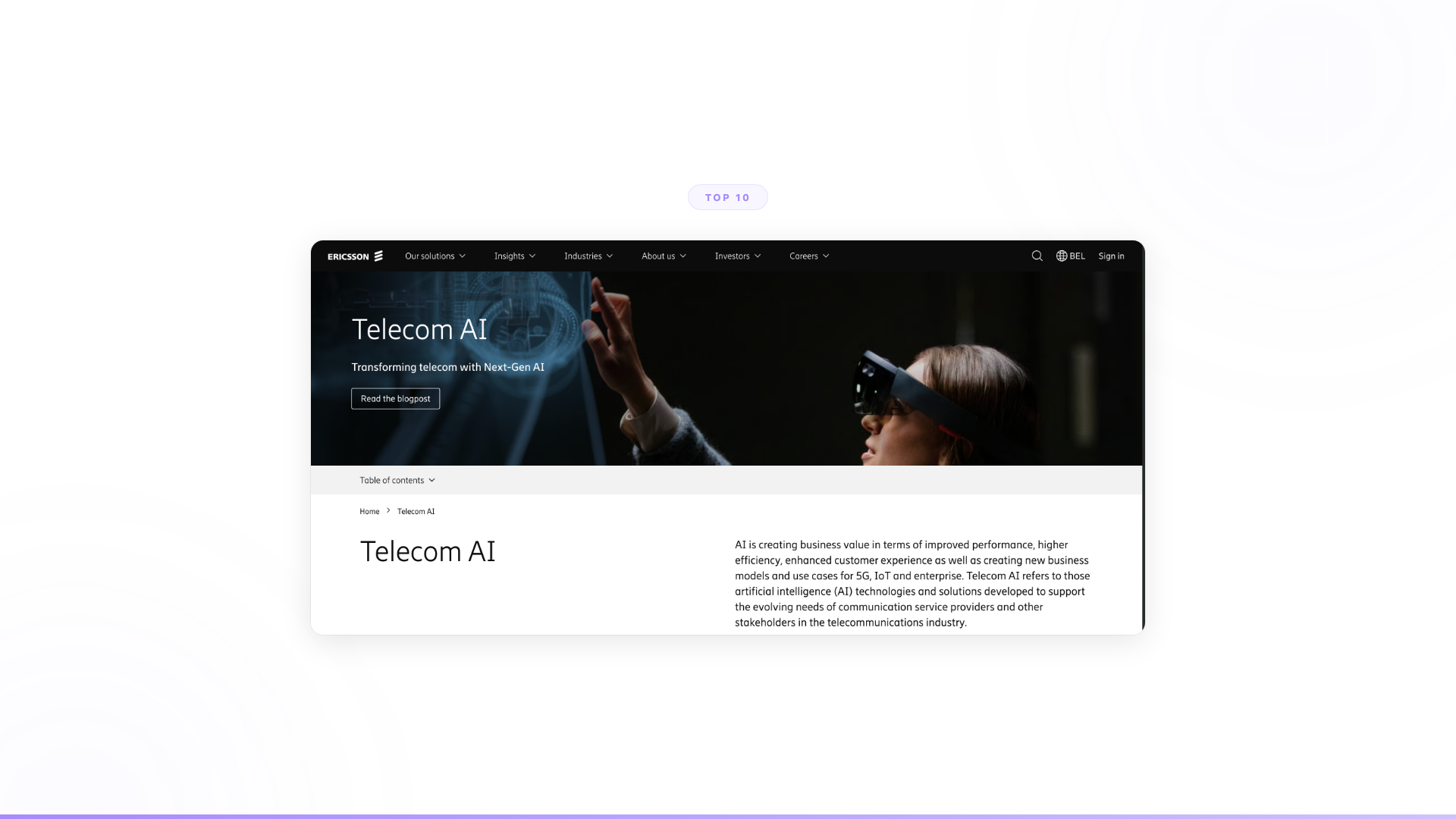
2. Ericsson AI
What it is: AI capabilities embedded across Ericsson's network infrastructure portfolio. Includes network optimization, AI-powered troubleshooting, multi-agent product configuration (released June 2025), the Mistral AI partnership for network agents (announced February 2026), and NetCloud agentic AI for enterprise 5G. Ericsson has decades of network data and deep domain expertise in radio access, core, and transport networks.
Strengths: The Mistral AI partnership brings frontier language model capabilities to network troubleshooting workflows — an approach that addresses the real complexity of interpreting vendor-specific network events at scale. Multi-agent configuration tools handle genuine complexity in network product setup across large deployments. T-Mobile AI-RAN trials signal serious production-grade investment.
NVIDIA's 2026 State of AI in Telecom report found that machine learning models predict network congestion with 95% accuracy in 5G trials, and AI optimizes RAN energy use by 30% in live deployments (NVIDIA Blog). Ericsson's AI capabilities are designed to capture exactly these gains.
Limitations for operations: Scope stays at the network layer. No customer-facing workflow automation. No sales, compliance, HR, or general business process AI. Deployment is engineering-dependent. Business teams have no access or ownership.
Best for: Network optimization, autonomous fault management, and the long-term autonomous networks roadmap.
Full Nexus vs Ericsson comparison -->
3. Nokia AI
What it is: Nokia's AI spans network automation, anomaly detection, real-time monitoring, and telco-trained AI models across RAN, fixed, core, and cloud network domains. Nokia Bell Labs' Autonomous Network Operations project focuses on neural networks and algorithms that interpret data generated by telecom equipment — giving operators proactive, business-relevant insights for diagnosing, resolving, and optimizing networks. The NVIDIA partnership targets AI compute for next-generation network functions. AI-RAN trials with T-Mobile are underway.
Strengths: Nokia Bell Labs' telco-trained models understand network behavior at a level general-purpose AI cannot match. LLM-based agents trained on network tickets and alarms can spot anomalous behavior and assign tickets predictively to forestall outages — reducing the reactive incident-driven cycle that consumes NOC capacity (Nokia Bell Labs). The NVIDIA partnership gives Nokia access to GPU-accelerated AI compute for network functions. Nokia's January 2026 reorganization around AI and data centers signals strategic commitment.
Limitations for operations: The same scope boundary as Ericsson. Nokia's "customer experience" strategy works indirectly through better network quality, not through AI agents handling customer interactions. The new Chief Customer Officer role (January 2026) suggests Nokia recognizes this gap but hasn't filled it with tooling yet.
Best for: Operators investing in autonomous network capabilities, AI-native network infrastructure, and predictive NOC operations.
Full Nexus vs Nokia comparison -->
4. Amdocs
What it is: The largest BSS/OSS vendor for telecoms, with AI capabilities across billing optimization, revenue management, order management, and customer experience analytics. The amAIz generative AI platform targets BSS/OSS workflow automation within the Amdocs ecosystem.
Strengths: Closer to business operations than pure network vendors. Billing, order management, and customer management are genuine business workflows with direct operational impact. Deep telecom domain expertise in BSS/OSS processes.
Limitations for operations: AI stays within the BSS/OSS boundary. Doesn't reach sales intelligence, compliance monitoring, HR operations, general support automation, or cross-departmental processes that sit outside the Amdocs platform. Multi-year contracts and long implementation cycles. Significant vendor lock-in.
Best for: Operators whose primary AI need is BSS/OSS optimization within an existing Amdocs environment.
Full Nexus vs Amdocs comparison -->
5. Huawei ADN
What it is: Huawei's Autonomous Driving Network (ADN) initiative combines intent-driven networking, predictive maintenance, network digital twins, and AI-powered energy efficiency across network and cloud infrastructure. Bundled with Huawei Cloud services for operators building integrated network and cloud AI capabilities.
Strengths: Substantial R&D investment. Strong deployment record in Asia and emerging markets. The network digital twin approach enables sophisticated simulation and optimization. Cloud bundling creates a more integrated offering than pure-play network vendors.
Limitations for operations: Network and cloud infrastructure AI only. Geopolitical restrictions limit availability in North America and much of Europe.
Best for: Operators in Huawei-accessible markets wanting network AI bundled with cloud infrastructure.
6. Netcracker (NEC)
What it is: BSS/OSS platform with AI capabilities for service orchestration, billing, customer management, and network lifecycle automation. Serves major telecoms globally.
Strengths: Similar to Amdocs in being closer to business operations than network vendors. Service orchestration and lifecycle management capabilities bridge some of the gap between network and business operations.
Limitations for operations: BSS/OSS scope. Doesn't handle enterprise-wide operational workflows outside the Netcracker platform. Implementation timelines measured in months to years.
Best for: Operators on NEC/Netcracker platforms who need BSS/OSS AI without switching vendors.
7. Rakuten Symphony
What it is: Network orchestration and automation platform built from Rakuten's experience running Japan's first fully cloud-native mobile network. The Symworld platform handles automated network deployment, optimization, and lifecycle management across Open RAN architectures.
Strengths: Built by an operator, for operators. Practical experience running an actual cloud-native network gives their AI a different perspective than traditional vendor approaches. Strong in Open RAN orchestration where the architectural openness creates unique opportunities for AI-driven optimization.
Limitations for operations: Network orchestration scope. Effective at automating the deployment and management of network functions. Doesn't touch business operations, customer workflows, or enterprise processes.
Best for: Operators building Open RAN architectures who want orchestration AI from an organization that has operated a real cloud-native network at scale.
8. Samsung Networks AI
What it is: AI capabilities focused on RAN optimization, particularly for vRAN and Open RAN deployments. Covers radio resource management, network energy efficiency, and automated RAN operations. Growing deployment footprint with major US operators.
Strengths: Focused and capable in RAN optimization. Strong execution in Open RAN and vRAN environments where newer approaches to radio management benefit significantly from AI-driven resource allocation.
Limitations for operations: Narrower than Ericsson or Nokia. RAN-specific AI doesn't extend into core network, transport, BSS/OSS, or business operations.
Best for: Operators investing in Open RAN or vRAN who want AI specifically for radio access optimization.
9. NVIDIA Aerial
What it is: NVIDIA's platform for accelerating telecom network functions with GPUs. Includes AI-RAN capabilities that run AI workloads and RAN processing on shared GPU infrastructure. Partners with Nokia, Ericsson, and others across the industry.
Strengths: NVIDIA's GPU compute is the engine behind much of the AI on this list. Aerial enables running AI workloads and network functions on shared infrastructure, which reduces costs and enables new real-time capabilities at the network edge. The 2026 NVIDIA State of AI in Telecom report found 90% of operators said AI has had a positive impact on revenue and costs — much of that is underpinned by GPU-accelerated compute (NVIDIA).
Limitations for operations: Infrastructure layer, not operations layer. NVIDIA provides the compute fabric. It doesn't provide agents that handle business workflows, customer interactions, or enterprise operations.
Best for: Operators building AI-native network infrastructure and wanting to run AI workloads at the network edge.
10. Custom build
What it is: Building telecom operations AI internally using frameworks like LangChain, LangGraph, or custom architectures tailored to specific operational requirements.
Strengths: Full control over scope, architecture, and integration. No vendor lock-in. Can be tailored to exact operational requirements.
Limitations for operations: Telecom operators rarely have surplus AI engineering capacity. Custom builds require solving governance, security, compliance, monitoring, and thousands of integrations independently. The economics are unfavorable for most operators compared to deploying a purpose-built platform with embedded expertise.
Best for: Operators with dedicated AI engineering teams, genuinely unique requirements that no platform addresses, and 6+ month development timelines.
The real question: which layer are you optimizing?
The tools on this list divide cleanly into three categories:
Network layer (Ericsson, Nokia, Huawei, Samsung, Rakuten, NVIDIA): AI that makes the network run better. Well-funded, mature in large deployments, and the focus of most telecom AI investment today.
BSS/OSS layer (Amdocs, Netcracker): AI that optimizes billing, order management, and customer management within BSS/OSS platforms. Closer to business operations but scoped to specific vendor ecosystems.
Operations layer (Nexus, custom build): AI that completes business workflows across any system and department. NOC process management, customer support, compliance, HR, onboarding, reporting. Where most workforce hours actually go.
Omdia's November 2025 survey found that 41% of CSPs see agentic AI driving autonomous network operations — but also that 47% expect agentic AI to become "very important" for troubleshooting, live network optimization, and on-demand reporting (Omdia). Most vendor investment remains at the network layer. The gap between what operators want — operational transformation across the business — and what vendors build — network infrastructure optimization — is where the unmet opportunity concentrates.
FAQ
What is AI-powered telecom network operations?
AI-powered telecom network operations uses machine learning, predictive analytics, and autonomous agents to monitor, manage, and optimize both network infrastructure and the business workflows that support it. At the network layer, this means fault prediction, anomaly detection, RAN optimization, and autonomous configuration. At the operations layer, it means automating NOC workflows, compliance processes, customer-facing operations, and cross-departmental business tasks.
What's the difference between network automation and autonomous network management?
Network automation executes predefined rules — scripts, runbooks, and conditional logic that trigger when specific conditions are met. Autonomous network management uses AI to learn from data, predict failures before they occur, and adapt behavior without being reprogrammed. The GSMA's autonomous network maturity model places most operators at Level 2 today (partial automation, largely reactive). Level 4 (cross-domain autonomous management with human supervision) is the near-term target, with most operators projecting that milestone around 2030.
Which AI tools are used for telecom NOC operations?
NOC operations span two distinct tooling categories. For network-layer NOC tasks — alarm correlation, fault isolation, incident prediction — tools like Nokia AI (Bell Labs Autonomous Network Operations), Ericsson AI, and Huawei ADN are purpose-built. For the workflow layer of NOC operations — ticket routing, escalation, compliance reporting, cross-system coordination — operational AI platforms like Nexus handle these processes across systems the network vendors don't touch.
Can AI replace human network operations center (NOC) staff?
Not in the near term at most operators. NVIDIA's 2026 survey found that while 42% of CSPs have deployed agentic AI for autonomous network resource management, the dominant pattern is AI augmenting NOC staff rather than replacing them — handling first-level triage, predictive alerts, and routine remediation while human engineers focus on complex fault analysis and architectural decisions. The GSMA's own guidance positions Level 5 (fully autonomous, no human intervention) as a long-horizon goal rather than a near-term operational reality.
What network AI tools work alongside business operations AI?
Network infrastructure AI (Ericsson, Nokia, Huawei) and business operations AI (Nexus) operate in parallel and do not overlap. Network AI optimizes the RAN, core, and transport layers. Business operations AI handles the workflows that run on top: customer onboarding tied to network provisioning, compliance monitoring, NOC process management, billing exceptions, and cross-departmental coordination. The two categories are complementary — an operator running Ericsson for network optimization and Nexus for operations is covering both layers without redundancy.
Worth exploring?
If your network AI is running well and you need AI that handles the rest — NOC workflow management, customer-facing operations, compliance, onboarding, HR, reporting — Nexus fills that operational gap. Forward Deployed Engineers embedded from day one. 3-month POC tied to measurable outcomes. You can exit anytime.
100% of clients who started a POC converted to an annual contract.
See how Nexus works for telecom -->
Related reading
- Nexus vs Ericsson: full comparison
- Nexus vs Nokia: network automation vs operational agents
- Nexus vs Amdocs: BSS/OSS AI vs autonomous agents
- Top 10 Ericsson AI alternatives for telecom
- Ericsson AI vs Nokia AI: telecom network AI compared
- How to deploy AI across all telecom operations
- How Nexus works for telecom