How to Deploy AI Across All Telecom Operations (2026 Guide)
Most telecom AI stops at the network. Here's how to extend AI into sales, support, compliance, HR, onboarding, and reporting. A practical 6-step guide for operators ready to move beyond network-only AI.
To deploy AI across telecom operations beyond the network layer, follow 6 steps: (1) map where workforce hours actually go — typically 75–85% outside network operations, (2) identify agent-ready workflows by volume, multi-system complexity, and measurable outcomes, (3) start with one high-impact workflow, (4) assign agent ownership to business teams rather than IT, (5) measure business outcomes not activity, (6) expand department by department.
Here's the pattern most operators recognize: the CTO's team has invested in network AI from Ericsson, Nokia, or Huawei. Fault detection is faster. Capacity planning is smarter. That's real, valuable progress on the infrastructure layer. But the COO, the CCO, the VP of Sales, the Head of Compliance, and the CHRO are still running their operations the same way they did five years ago. Customer onboarding is manual. Support is a labor-intensive cost center. Compliance monitoring lives in spreadsheets. Sales intelligence is fragmented across tools.
The network got AI. The business didn't.
According to GSMA Intelligence's Telco AI: State of the Market 2025 report, 74% of operators have deployed or are testing commercial GenAI solutions — yet operator transformation strategies prioritize revenue generation and customer experience over opex and capex savings by a four-to-one margin. The opportunity gap between what operators have deployed and where the business impact actually lives is large and largely unaddressed.
This guide is about closing that gap.
Why network AI (Ericsson, Nokia) doesn't cover telecom business operations
This isn't a criticism of network vendors. It's a structural reality.
Different data. Network AI is trained on traffic patterns, fault signals, radio parameters, and performance metrics. Business operations use CRM records, customer interactions, compliance rules, HR databases, billing data, and communication logs. The models, pipelines, and data architectures are fundamentally different.
Different users. Network AI serves engineers. Business operations AI serves sales teams, support agents, compliance officers, HR managers, and executives. These groups have different skills, different workflows, and different definitions of success.
Different timelines. Network AI evolves on infrastructure cycles — multi-year. Business operations need to improve this quarter. Customer churn, compliance deadlines, and sales targets don't wait for the next infrastructure release.
Different architectures. Network AI operates within the network stack (RAN, core, transport). Business operations span dozens of enterprise systems: CRMs, ERPs, communication platforms, compliance databases, HR systems, and reporting tools. The integration requirements are completely different.
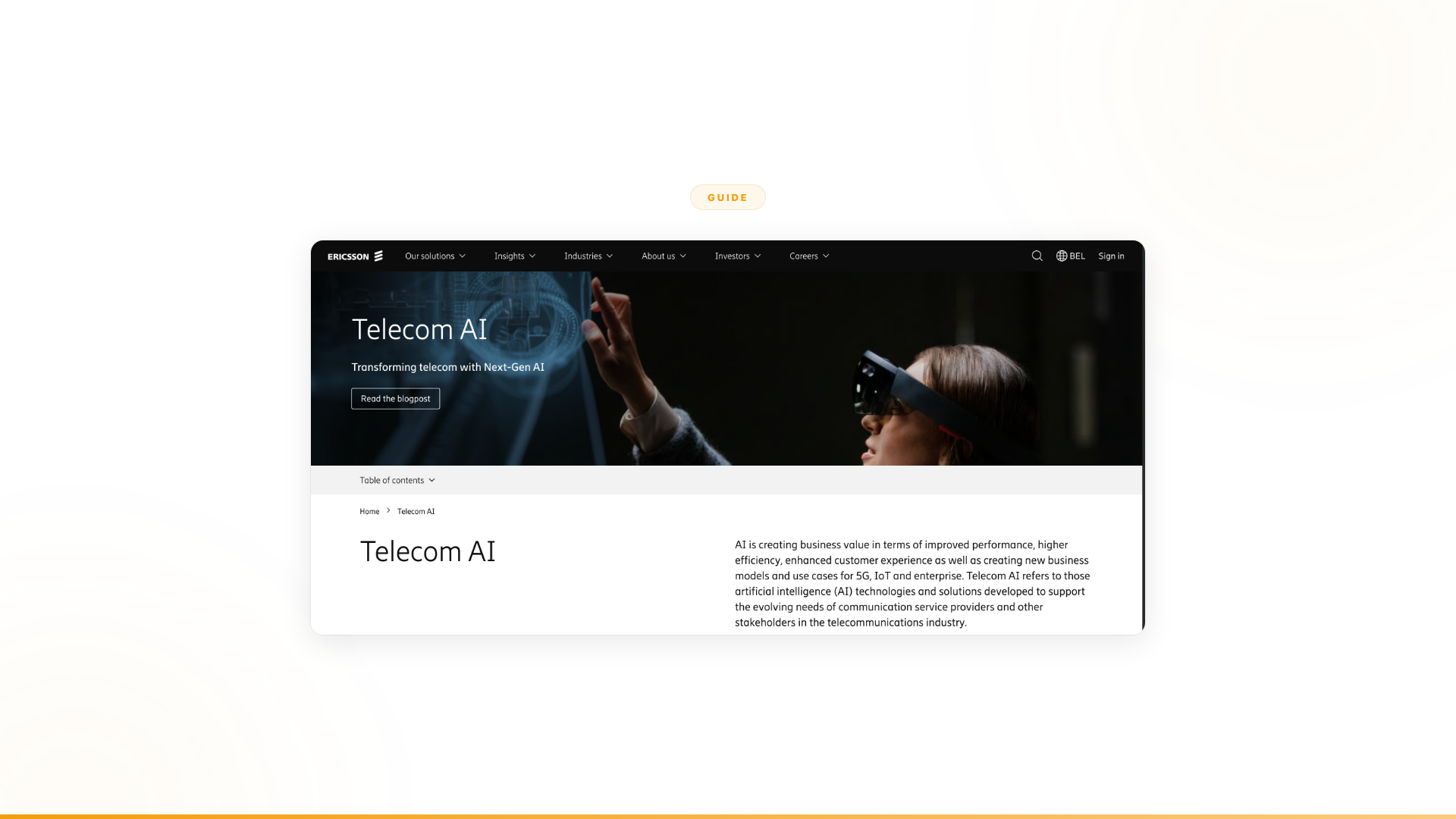
Ericsson's Mistral AI partnership, Nokia's telco-trained models, Huawei's autonomous driving networks — these are strong investments in network-layer AI. They aren't designed to complete a customer onboarding workflow, monitor regulatory compliance, or generate sales intelligence. They shouldn't be.
The TM Forum's AI Transformation Blueprint identifies five pillars for telecom AI: responsible AI, strategy, data infrastructure, AI-driven products and services, and workforce evolution. Network AI addresses one pillar. Operational AI addresses the other four.
Where telecom operators need AI: the operational gaps beyond the network
Telecom operators run complex, multi-department organizations. Here's where AI can transform operations, grouped by function.
Customer operations AI: onboarding, support, and retention automation
Onboarding. Customer sign-up involves data collection across multiple channels, identity verification, eligibility checks against backend systems, plan selection, billing setup, and confirmation. Most operators still run this as a semi-manual process with high drop-out rates. Orange's previous chatbot had a 27% abandonment rate (Nexus client data). Their operational agents now complete the full workflow autonomously with 90% autonomous resolution and a 50% conversion improvement.
Support. Tier 1 support consumes enormous workforce capacity. Most inquiries follow recognizable patterns: billing questions, plan changes, technical troubleshooting, service activation. AI agents can resolve these end-to-end, escalating only genuinely complex cases with full context. A major European telecom freed 40% of support capacity with agents deployed across millions of interactions (Nexus client data).
Retention and upsell. Identifying churn risk, triggering proactive outreach, personalizing offers, and completing the interaction. Today this is usually a combination of analytics dashboards and manual outreach. Agents can handle the full loop — from signal detection through offer delivery through customer response. This is one of the highest-ROI applications in telecom: the cost of retaining a customer is an order of magnitude lower than acquiring a new one, and AI agents can work at a scale no human team can match.
Sales and commercial AI: intelligence, partner management, and proposals
Sales intelligence. Monitoring enterprise accounts, tracking buying signals, synthesizing research from multiple sources, and surfacing opportunities. The people best positioned to act on this intelligence — account managers, commercial leads — are usually the ones wasting hours assembling it manually.
Partner and channel management. Coordinating with resellers, tracking partner performance, automating commission calculations, and routing escalations. Multi-system workflows that are almost always manual today.
Proposal and RFP generation. Pulling relevant data from past deals, compliance requirements, pricing frameworks, and technical specifications. Time-consuming work that agents can complete in minutes — including 5G B2B proposals where product complexity and customization requirements make manual assembly particularly costly.
5G monetization. Enterprise 5G sales involve complex fulfillment workflows: custom SLA configuration, network slicing coordination, provisioning across BSS and OSS systems, and ongoing account management. These workflows are exactly where operational AI delivers: multi-system, rule-based, measurable, and high-volume across a growing enterprise customer base.
Compliance AI: regulatory monitoring, audit trails, and GDPR automation
Regulatory monitoring. Telecom is one of the most regulated industries globally. Monitoring changes in regulations across multiple markets, assessing impact, updating internal policies, and documenting compliance. Most operators do this with legal teams and spreadsheets. Agents can monitor regulatory changes continuously across jurisdictions and surface relevant changes before they become compliance events.
Audit trails and documentation. Every customer interaction, every decision, every escalation needs to be traceable. AI agents can maintain complete audit trails by default — not as an afterthought. This matters especially in the EU AI Act context, where explainability and logging requirements are becoming operational requirements.
Data privacy and GDPR. Data subject requests, consent management, data retention policies. High-volume operational work that's structurally suited for autonomous agents — predictable, rule-based, and compliance-critical.
BSS/OSS integration. Operational AI doesn't replace BSS and OSS systems — it extends them. Agents connect to existing BSS/OSS infrastructure through standard integrations, execute workflows that span those systems, and surface outputs in the formats teams actually use. Operators don't need to replace their BSS stack to deploy operational AI; they need a platform with the right connectors.
Internal operations AI: HR, reporting, and data harmonization
HR and workforce management. Employee onboarding, benefits administration, policy inquiries, leave management, training coordination. Process-heavy workflows where agents handle routine requests and escalate complex cases.
Reporting and analytics. Executives want dashboards. Analysts spend hours pulling data from multiple systems, reconciling formats, and building reports. Agents can automate the data collection, reconciliation, and initial report generation.
Data harmonization. Telecom operators run dozens of systems that don't talk to each other naturally. Customer data in the CRM doesn't match billing data. Network performance data is separate from customer experience data. Agents can continuously harmonize data across systems — making the organization's own data actually useful.
6-step framework: deploying AI beyond network operations into telecom business workflows
Step 1: Map workforce time distribution across all operations
Before choosing tools, understand where the operational burden sits. Most telecom operators find that network operations — the part with AI — consume 15–25% of total workforce hours. Customer operations, support, compliance, sales, HR, and reporting consume the other 75–85%.
This isn't an argument against network AI. It's an argument for extending AI into the rest of the organization. The GSMA's Blueprint for AI Transformation in Telcos emphasizes workforce evolution as a core pillar of telecom AI strategy — not just network optimization.
Practical approach: Ask each department head to list their top 5 most time-consuming repetitive processes. Rank by total hours consumed per month. The list almost always includes: customer onboarding, Tier 1 support, compliance documentation, sales research, and report generation.
Step 2: Identify agent-ready workflows
Not every process benefits equally from AI. The highest-impact workflows share these characteristics:
- High volume: Thousands of interactions per month, not dozens.
- Multi-system: Requires data from 3+ systems. Manual because someone has to alt-tab between tools.
- Rule-based with exceptions: Clear business rules for 80% of cases, judgment needed for 20%.
- Measurable outcomes: You can track conversion, resolution time, compliance rate, or cost per interaction.
- Cross-departmental: Spans multiple teams. No single team owns the full process.
Customer onboarding, support resolution, and compliance monitoring almost always qualify. That's why they're the most common first deployments.
Step 3: Start with one high-impact workflow
Don't try to deploy AI across every department simultaneously. Pick the workflow with the clearest ROI, the most measurable outcomes, and the strongest internal champion.
Orange started with customer onboarding. First agent in hours. Clear metrics: conversion rate, drop-out rate, CSAT. Multi-market deployment in 4 weeks. That success created momentum for everything that followed.
A major European telecom started with support automation. Clear metrics: ticket resolution rate, capacity freed, compliance maintained. 40% of support capacity freed. That funded expansion into compliance, registration, and data harmonization.
Step 4: Assign agent ownership to business teams, not IT or engineering
This is the part most telecom operators get wrong. They assign operational AI to the IT team or the engineering team that manages network AI. The result: agents designed by people who understand technology but not the business workflow. Long development cycles. Misaligned priorities.
The better approach: business teams build and own the agents, with technical support from the platform provider. The people who understand the workflow should design the solution.
This requires a platform that doesn't demand engineering skills. If deploying an agent requires Python, APIs, and infrastructure management, it becomes an IT project. If business teams can build agents with guidance from experienced engineers, it becomes an operational improvement.
Step 5: Measure business outcomes, not activity
Network AI is measured in infrastructure metrics: latency, throughput, fault detection time. Operational AI should be measured in business metrics: revenue generated, costs reduced, compliance maintained, time saved, customer satisfaction improved.
Define success criteria before deploying. Tie the proof of concept to specific, measurable outcomes. Not "how many times did the AI respond?" but "how much revenue did it generate?" and "how many support hours did it free?"
This distinction matters for organizational buy-in as much as performance evaluation. Activity metrics don't fund expansion. Outcome metrics do.
Step 6: Expand department by department
Once the first workflow is in production and delivering measurable results, expand to the next department. The pattern at a major European telecom: started with support agents, then compliance, then registration, then data harmonization, then escalation routing. A dozen production agents in 12 weeks.
Each new agent is faster to deploy than the last because the platform is already integrated, the team understands the approach, and organizational trust in AI agents has been established.
Week-by-week deployment timeline for telecom operational AI
Operational AI can move on a different timeline than network AI. Here's what a structured deployment looks like.
Week 1–2: Engineers embed with your team. They assess the highest-impact workflows, understand your systems landscape, and identify the first agent to build.
Week 2–4: First agent built and deployed. Business team involved in design. Integration with relevant systems (CRM, BSS/OSS, communication platforms, compliance tools) through standard connectors.
Month 1–3: Proof of concept running with measurable outcomes. Agents completing workflows in production. Data on resolution rates, revenue impact, capacity freed, and compliance maintained.
Month 3+: If outcomes meet expectations, expand to additional departments and workflows.
For comparison: Ericsson's troubleshooting orchestrator was planned for Q4 2025, with configuration agents rolling out through 2026. Nokia's AI-RAN trials are expected in 2026. Network AI operates on infrastructure timelines. Operational AI can deliver results in weeks.
5 common mistakes when deploying operational AI in telecom
Mistake 1: Waiting for the network vendor to extend into operations. Operators assume Ericsson, Nokia, or their BSS vendor will eventually build AI for customer operations, compliance, and sales. They won't — it's not their domain, their data, or their expertise. Meanwhile, the operational gap stays open.
Mistake 2: Making operational AI an IT project. When operational AI is owned by IT, it becomes a technology implementation rather than a business transformation. Development cycles extend. Business requirements get filtered through technical teams. The result is technically sound but operationally misaligned.
Mistake 3: Starting with the hardest workflow. Complex, cross-departmental processes with regulatory implications are the eventual goal. They shouldn't be the first deployment. Start with something high-volume and measurable. Build confidence. Then tackle complex workflows.
Mistake 4: Measuring usage instead of outcomes. "The AI handled 10,000 interactions" is an activity metric. "The AI generated $6M in revenue" is an outcome metric. Tie everything to business outcomes from day one.
Mistake 5: Building custom when platform economics favor buying. The opportunity cost of diverting internal engineering from core business is high. For operators with AI engineering capacity below hyperscaler scale, the math almost always favors a purpose-built platform over custom development.
Frequently asked questions
What is the difference between network AI and operational AI in telecom?
Network AI — from vendors like Ericsson, Nokia, and Huawei — optimizes infrastructure: fault detection, capacity planning, RAN optimization, and network performance. Operational AI handles business workflows: customer onboarding, support resolution, compliance monitoring, sales intelligence, HR processes, and reporting. They use different data, serve different users, and operate on different timelines. Network AI operates on multi-year infrastructure cycles; operational AI can deliver results in weeks. GSMA Intelligence notes that the biggest impact from generative AI in telecom is expected to come from internally focused, operational use cases — not network optimization alone.
Which telecom operations are best suited for AI agents as a first deployment?
The highest-impact first deployments share five characteristics: high volume (thousands of interactions per month), multi-system complexity (data from 3+ systems), rule-based logic with exception handling (80% clear rules, 20% judgment), measurable outcomes (conversion rate, resolution time, compliance rate), and cross-departmental scope. Customer onboarding and Tier 1 support meet all five criteria — which is why they're the most common starting points across operators who have successfully deployed operational AI.
How does a European telecom maintain regulatory compliance when deploying AI agents?
Compliance is a platform feature, not a project phase. Look for SOC 2 Type II, ISO 27001, ISO 42001, GDPR compliance, and EU AI Act readiness built into the platform architecture. Every AI decision should generate a complete audit trail by default. Human oversight and escalation logic should be configurable per workflow. Operators deploying across multiple European markets need localization and regulatory variance handled at the platform level — not custom-engineered per market.
How long does it take to deploy AI agents for telecom operations?
Operational AI can deploy in weeks, not years. Orange deployed customer onboarding agents across multiple European markets in 4 weeks (Nexus client data). A major European telecom deployed a dozen agents across support, compliance, registration, and data harmonization in 12 weeks (Nexus client data). The first agent for a new operator typically runs within the first 1–4 weeks. Each subsequent deployment is faster as the platform integrates and the team builds confidence.
Why can't Ericsson or Nokia provide operational AI for telecom business workflows?
Network vendors are architected for infrastructure optimization, not business operations. Their models are trained on traffic patterns, fault signals, and radio parameters — not CRM records, customer interactions, compliance rules, or billing data. Network AI serves engineers; operational AI serves sales teams, support agents, compliance officers, and HR managers. The data, user profiles, integration requirements, and timelines are completely different domains. This isn't a gap that network vendors will close — it requires a platform purpose-built for business operations.
Worth exploring?
If your network AI is running well and you need AI that handles the rest — sales, support, compliance, onboarding, HR, reporting — the approach is different from deploying network AI. You need a platform built for business operations, not infrastructure optimization.
Every Nexus engagement starts with a 3-month proof of concept. Forward Deployed Engineers embed with your team from day one. You see results before committing.
Orange: ~$6M+ yearly revenue impact. 4-week multi-market deployment. 90% autonomous resolution (Nexus client data). European telecom: 40% support capacity freed. Dozen agents. 12 weeks (Nexus client data).
See how Nexus works for telecom -->
Related reading
- Nexus vs Ericsson: network AI vs operational agents
- Nexus vs Nokia: network automation vs operational agents
- Nexus vs Amdocs: BSS/OSS AI vs autonomous agents
- Top 10 AI tools for telecom network operations
- Top 10 Ericsson AI alternatives for telecom
- Top 10 Nokia AI alternatives for telecom
- How Nexus works for telecom
External sources: