How to Scale Enterprise Content with AI (2026 Guide)
Most enterprises adopted AI content tools and still can't scale. The problem isn't generation. It's the 90% of the workflow that stays manual: approvals, compliance, distribution, measurement. Here's how to fix it.
Scaling enterprise content with AI requires automating all seven workflow stages — research, briefing, generation, approval, localization, distribution, and measurement. Most enterprises adopt AI only at Stage 3 (generation), while Stages 4–7 remain manual. Content generation represents 10–15% of total cycle time; the remaining 85–90% sits in approval queues, compliance, and distribution. Full automation requires an agentic layer connected to CRM, PIM, compliance systems, and distribution platforms.
Why AI content tools don't scale enterprise content operations
Every enterprise content team has a version of the same story. They adopted an AI content tool. Generation got faster. Content volume went up. But the overall content operations cycle barely improved because everything around generation stayed manual.
Drafts still sit in approval queues for days. Compliance review is still a person reading every piece. Localization is still a spreadsheet exercise. Distribution is still someone uploading the same asset to four platforms. Performance tracking is still logging into five dashboards and copying numbers into a slide deck.
AI made the 10–15% of the process that was already fast even faster. The other 85–90% didn't change.
This is consistent with what enterprise teams report in practice. When one multinational manufacturing organization reduced content drafting time by 55% with AI, review cycle time actually increased by 18% — because SMEs were being asked to review more content more frequently (Aprimo, 2024). More volume, same bottleneck. And according to Content Marketing Institute's 2025 enterprise research, 73% of enterprise marketing teams say content workloads have grown beyond stable levels, while budgets and headcount have not kept pace (CMI Enterprise Research, 2026).
The core issue: content AI tools dramatically improve Stage 3. They don't touch the six other stages that determine how long content actually takes to reach the market.
This guide covers how to actually scale enterprise content with AI — not just generate more content, but transform the entire operation: from data collection through distribution through measurement.
What does the enterprise content workflow actually look like?
Before discussing solutions, it's worth mapping the full workflow. Most teams think about content in terms of creation. The actual process has seven stages, and generation is only one of them.
Stage 1: Research and data collection
Before anyone writes anything, someone needs to understand what to write, for whom, and why.
This means pulling customer data from the CRM, product specifications from the PIM, competitive positioning from market research, regulatory requirements from the compliance team, and campaign objectives from the marketing plan. In large enterprises, this data lives in 5–10 systems, none of which talk to each other natively.
Time: 2–8 hours per content piece. Longer for regulated industries. AI tools that handle this: Almost none. Content AI tools start at Stage 3.
Stage 2: Brief and strategy
The research gets synthesized into a content brief: target audience, key messages, constraints, tone, channels, and success metrics. Someone makes judgment calls about positioning, prioritization, and what not to say.
Time: 1–3 hours. AI tools that handle this: Some tools can generate brief templates, but the strategic decisions are still human.
Stage 3: Content generation
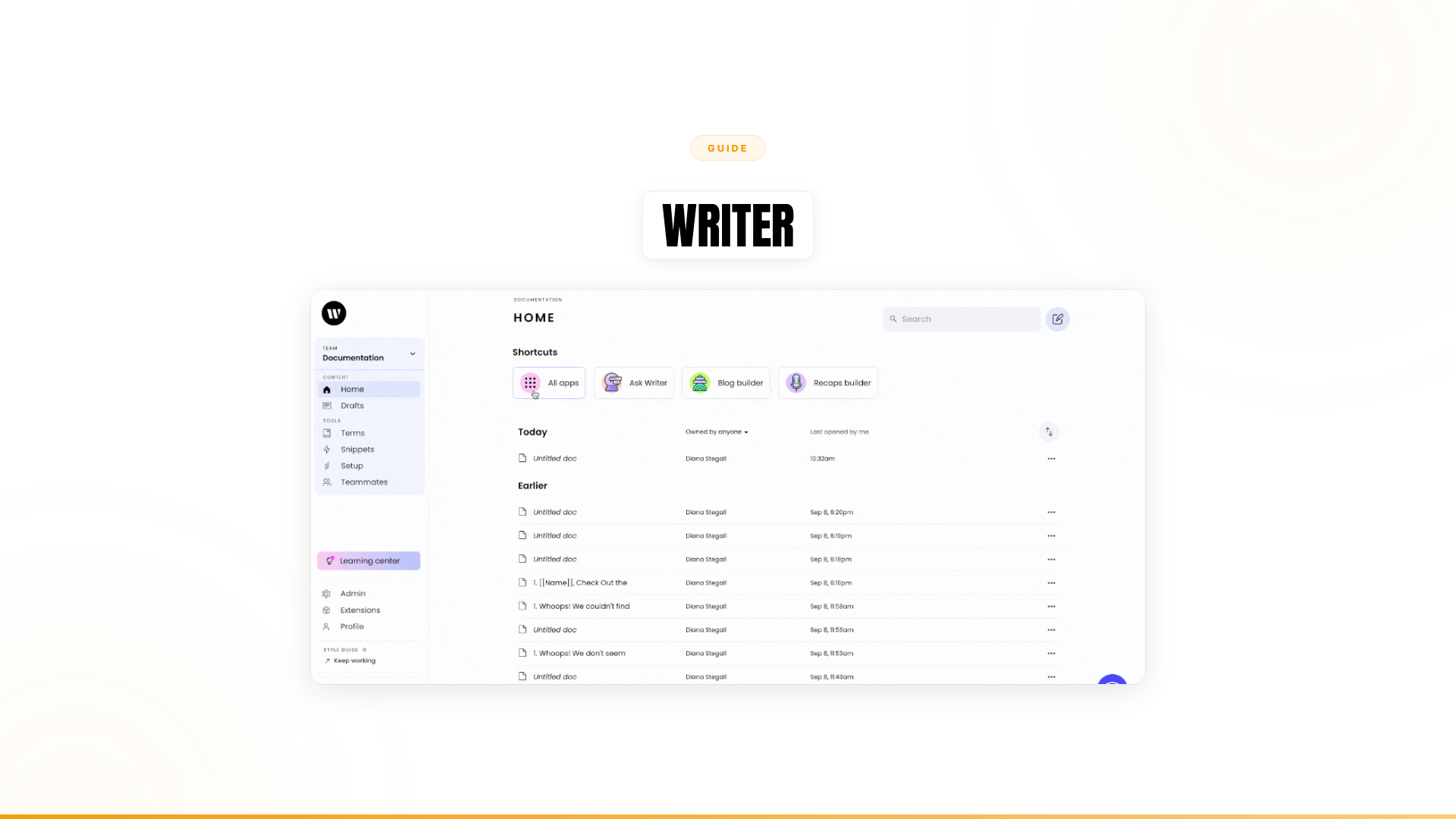
This is where Writer, Jasper, Claude, and every other content AI tool lives. Give the tool a prompt (or a brief), and it generates a draft. With brand voice training and the right context, the output is usable with light editing.
According to a 2025 marketing productivity benchmark, marketers using AI complete tasks 25.1% faster and save an average of 3 hours per piece of content at the generation stage (Synthesia AI Statistics, 2025).
Time: 15–60 minutes (with AI), down from 2–6 hours (manual). AI tools that handle this: All of them. This is the step every content AI tool optimizes.
Stage 4: Review, feedback, and approval
The draft goes to stakeholders: brand team, legal, compliance, product marketing, and the business owner. Feedback arrives in email threads, Slack messages, Google Doc comments, and meeting notes. Multiple revision cycles follow. In regulated industries, compliance review can take longer than every other step combined.
Enterprises without structured approval workflows experience approval cycles 40% longer than those with defined routing systems. In some industries, routine content runs 4–6 weeks from brief to publication (Screendragon, 2025).
Time: 2–14 days. Not hours. Days. AI tools that handle this: Almost none. Some tools offer collaboration features, but the routing, tracking, and exception handling are manual.
Stage 5: Localization and adaptation
Approved content needs to be adapted for different markets (translation, cultural adjustment, regulatory variation), different channels (long-form for blog, short-form for social, email for nurture, ad copy for paid), and different audiences (enterprise vs. SMB, technical vs. business). In regulated industries — pharma, finance, legal — each market may require separate compliance sign-off.
Time: 1–5 days per market and channel combination. AI tools that handle this: Some translation tools. But localization is more than translation. It's cultural adaptation, regulatory compliance per market, and format adjustment.
Stage 6: Distribution
Final content gets uploaded to the CMS, email marketing platform, social media scheduler, ad platform, partner portal, and internal knowledge base. Each platform has its own format requirements, metadata fields, and publishing workflows.
Time: 1–4 hours per piece across channels. AI tools that handle this: None of the content AI tools. Distribution happens in separate systems.
Stage 7: Measurement and optimization
Someone logs into Google Analytics, the email platform, the social media tool, the ad platform, and the CRM to figure out what worked. Data gets copied into spreadsheets and presentation decks. Insights — when they happen — inform the next content cycle, but there's usually no systematic feedback loop.
Time: 2–8 hours per reporting cycle. AI tools that handle this: BI tools handle visualization. No content AI tool closes the loop from measurement back to content strategy.
Where content AI tools actually help (and where they don't)
Here's an honest breakdown of where the time goes and where AI currently helps:
| Stage | Time (manual) | Time (with content AI) | Time saved |
|---|---|---|---|
| 1. Research and data collection | 2–8 hours | 2–8 hours | ~0% |
| 2. Brief and strategy | 1–3 hours | 1–2 hours | ~25% |
| 3. Content generation | 2–6 hours | 15–60 min | 75–85% |
| 4. Review and approval | 2–14 days | 2–14 days | ~0% |
| 5. Localization | 1–5 days | 0.5–3 days | ~30% |
| 6. Distribution | 1–4 hours | 1–4 hours | ~0% |
| 7. Measurement | 2–8 hours | 2–8 hours | ~0% |
Time estimates based on Nexus analysis of enterprise content operations engagements. Stage 3 savings consistent with 2025 AI productivity benchmarks (Synthesia, Fullview, Marketing AI Institute).
Content AI tools dramatically improve Stage 3. They provide some help with Stages 2 and 5. They don't touch Stages 1, 4, 6, or 7.
The total workflow is roughly 4–30 days depending on complexity. Content AI saves hours on Stage 3. The multi-day bottlenecks — approval, localization, distribution — remain unchanged.
That's why enterprises that adopt Writer, Jasper, or similar tools report faster content creation but not faster content operations. The overall cycle time barely moves because the bottleneck was never the writing itself.
What are the three approaches to scaling enterprise content with AI?
Approach 1: Content generation tools (point solutions)
What this looks like: Adopt Writer, Jasper, Typeface, or a similar platform. Train brand voice. Build templates. Roll out to content teams.
What it solves: Stage 3 bottleneck. Content teams produce more drafts in less time. Brand consistency improves across outputs. Content volume scales. For the 61% of high-performing content teams already using AI extensively, this is already in place (CMI Enterprise Research, 2025).
What it doesn't solve: Everything around generation. Approval cycles don't shorten. Compliance review doesn't get faster. Distribution doesn't automate. Measurement doesn't improve. You get more content moving through the same slow pipeline.
The result: Content volume increases, but content velocity (time from idea to published, measured impact) barely changes. Teams feel busier without being faster. The approval queue grows because more drafts are waiting for the same manual review process.
When this is the right approach: When content generation is genuinely the bottleneck. This is true for some teams — usually smaller marketing teams with minimal compliance requirements and straightforward distribution. For those teams, a content AI tool genuinely scales operations.
Approach 2: Content tools + workflow automation
What this looks like: Use Writer or Jasper for generation, then connect it to workflow automation tools (Zapier, Make, custom integrations) to handle routing, approvals, and distribution.
What it solves: Some of the workflow gap. Simple routing and distribution get automated. Notifications reduce waiting time. Basic approval tracking replaces email threads.
What it doesn't solve: The hard parts. Workflow automation tools follow rules. They can route a draft to the legal team. They can't review it for compliance. They can notify stakeholders that content needs approval. They can't handle the exception when the CFO is out and the VP needs to approve instead. They can push content to a CMS. They can't adapt the format, metadata, and messaging for each channel.
Enterprise content workflows are full of judgment calls, exceptions, and decisions that rule-based automation can't handle. What happens when the compliance team rejects the draft? When the data in the brief is outdated? When a new regulation changes what you can say in one market? When the campaign objective shifts mid-cycle? Rules break. Humans take over.
When this is the right approach: When workflows are simple and predictable. If your content goes through the same three reviewers every time, gets published to the same two channels, and doesn't involve compliance, localization, or cross-departmental coordination, stitching together content tools and workflow automation works. That describes some teams. It doesn't describe most enterprises.
Approach 3: Agent-based content operations
What this looks like: Instead of separate tools for generation, workflow, and distribution, autonomous agents handle the entire content lifecycle end-to-end. Agents pull data from source systems, generate content based on business context, route for approval, handle exceptions, manage compliance, adapt for channels and markets, distribute, and measure.
What it solves: The full pipeline. Not just generation. Not just routing. The entire process from trigger to measured outcome — including the judgment calls, exceptions, and edge cases that rule-based automation can't handle.
How it's different from workflow automation: Agents make decisions. When the compliance team rejects a draft, the agent analyzes the feedback, revises the content, and resubmits — instead of sending a notification and waiting for a human. When data in the CRM is outdated, the agent flags it, checks alternative sources, and proceeds with the best available information instead of stopping. When a new market requires different regulatory language, the agent applies the correct rules instead of routing to a human who applies them manually.
According to BCG analysis, agentic AI is transforming enterprise platforms specifically because agents extend beyond generation to directly execute multi-step workflows with minimal human intervention — a capability that conventional automation and generation tools cannot replicate (BCG, 2025).
When this is the right approach: When content operations are complex, high-volume, and cross-system. When the bottleneck isn't content generation but the 85–90% of the workflow around it. When you need content to flow through compliance, localization, approval, distribution, and measurement without manual intervention at every step.
How long does it take to scale enterprise content operations with AI?
The timeline depends on which approach and what's already in place:
- Content generation tools (Approach 1): 2–4 weeks to deploy and train on brand voice. Productivity gains visible within the first month. Pipeline bottlenecks remain unchanged.
- Content tools + workflow automation (Approach 2): 4–12 weeks depending on the number of systems being integrated and complexity of approval chains. Simple workflows can be live in weeks; multi-system integrations take longer. Gains are meaningful but incomplete.
- Agent-based operations (Approach 3): 3–6 months for a production-grade deployment covering the full lifecycle. A proof of concept covering one high-value workflow (e.g., compliance-heavy campaign content, multi-market localization) can typically be live in 4–6 weeks.
The critical variable in Approach 3 is organizational change, not technology. Content teams have established processes, tools, and relationships with reviewers, legal, and stakeholders. That change requires management. Most organizations underestimate this.
What agent-based content operations look like in practice
This isn't hypothetical. Here's what enterprises have deployed with Nexus, an autonomous agent platform paired with Forward Deployed Engineers.
Complete workflow, not just content generation
Nexus agents don't generate content in isolation. They handle the business process content is part of:
- Data collection: Agents connect to 4,000+ enterprise systems (CRMs, ERPs, data warehouses, communication tools, custom APIs) and pull the data needed to inform content. No manual data gathering.
- Content generation: Agents produce content based on business context, compliance requirements, and audience data. Content generation is one step, not the whole job.
- Compliance and validation: Agents check outputs against business rules, regulatory requirements, and brand guidelines — not just brand voice, but actual compliance logic.
- Routing and approval: Agents route to the right stakeholders, track status, handle exceptions (approver unavailable, conflicting feedback, escalation needed), and manage revision cycles.
- Distribution: Agents push content to the right channels in the right formats — multi-channel, multi-market.
- Measurement: Agents track outcomes and feed results back into the next cycle. Closed-loop, not disconnected.
Enterprise deployments
Orange Group (multi-billion euro telecom, 120,000+ employees): Deployed autonomous customer onboarding agents in 4 weeks. Every customer interaction involves personalized content generated as part of the onboarding workflow. The agents handle data collection, validation, content generation, routing, escalation, and resolution — delivering a 50% conversion improvement, approximately $6M in additional yearly revenue, and 90% autonomous resolution with full team adoption.
Lambda (a leading AI infrastructure company): Agents monitor 12,000+ accounts, synthesize data from dozens of sources, and produce intelligence reports and opportunity briefs. The content isn't generated from a template — it's generated from real-time data synthesis. Over $4B in pipeline was identified, and 24,000+ hours of research capacity added annually. The system was built by a non-engineer.
European telecom (13,000+ employees): A dozen Nexus agents handle customer support across millions of interactions. Each interaction involves generating contextual responses, checking policies, pulling data from multiple systems, and escalating with detailed written summaries when needed. Result: 40% of support volume freed.
Forward Deployed Engineers
Nexus isn't just a platform. It's a solution. Every enterprise engagement includes a Forward Deployed Engineer who embeds with your team. The FDE identifies the highest-impact use cases, designs agents for your specific business logic, handles integration with your existing systems, and manages the organizational change that comes with deploying AI at scale.
This matters because deploying AI that completes full content workflows is 10% technology and 90% organizational change. Content teams have established processes, tools, and habits. Changing those requires someone who understands both the technology and the organization. That's what FDEs do.
Which AI content approach is right for your enterprise?
You need a content generation tool if:
- Content generation is genuinely your bottleneck (not approval, not compliance, not distribution)
- Your content workflow involves fewer than 5 steps
- Approval is fast (one or two reviewers, same-day turnaround)
- You publish to one or two channels
- Compliance requirements are minimal
- You don't need localization across markets
In this case, Writer, Jasper, or a similar tool will genuinely scale your operations. Pick the one that matches your use case (Writer for enterprise governance, Jasper for marketing campaigns) and you'll see real improvement.
You need content tools + workflow automation if:
- Content generation is one bottleneck among several
- Your workflow is predictable with few exceptions
- You have 3–5 reviewers in a consistent approval chain
- You publish to 2–4 channels with standard formats
- Compliance is straightforward (checklist-based, not judgment-based)
- You have technical resources to build and maintain integrations
This approach works for moderately complex operations. It's more effort to set up and maintain, but it addresses more of the pipeline.
You need autonomous agents if:
- Content generation isn't the bottleneck. The workflow around it is.
- Your processes involve 7+ steps across multiple systems
- Approval chains vary by content type, market, and stakeholder
- Compliance requires judgment, not just checklists
- You distribute to 5+ channels across 3+ markets
- Exceptions are frequent and each one requires human judgment today
- Content operations span multiple departments
- You've already tried content tools and the overall cycle time barely improved
This is where agent-based operations deliver the biggest impact — not by generating content faster, but by automating the 85–90% of the workflow that content tools don't touch.
Common mistakes enterprises make when scaling content with AI
Mistake 1: Treating generation as the bottleneck when it isn't
The most common mistake. Leadership sees "AI content tools" and assumes faster content generation means faster content operations. It doesn't, unless generation is actually the constraining step. Before buying any tool, map your content workflow end-to-end and time each stage. If approval takes 10 days and generation takes 2 hours, making generation take 30 minutes doesn't change your cycle time.
Mistake 2: Adding volume without fixing the pipeline
Faster generation produces more drafts. If the approval, compliance, and distribution pipeline can't absorb more volume, you get a backlog — more content waiting for the same manual review, more assets in a queue. The team feels busier without being faster. Research shows that when AI accelerated content production at one enterprise, review cycle time increased by 18% because the downstream review process wasn't scaled in parallel.
Mistake 3: Stitching together point solutions
Using Writer for generation, Zapier for routing, a separate tool for compliance, another for distribution, and a BI tool for measurement creates an integration maintenance burden that grows with every new workflow. Each connection is a potential failure point. Each update to one system can break another. And nobody owns the end-to-end process because it spans five vendors.
Mistake 4: Underestimating organizational change
New tools change how people work. Content teams have habits, processes, and relationships with reviewers, legal, and stakeholders. Deploying AI that changes the workflow requires managing that change. Technology is 10% of the problem. Getting people to trust and use it is 90%.
Mistake 5: Measuring the wrong thing
Content volume is easy to measure. Content velocity (time from idea to published, measured impact) is harder. Content ROI (what did this content actually produce?) is hardest. If you're measuring how many drafts AI generates, you're measuring the input to a pipeline, not the output. Measure cycle time, approval turnaround, time-to-publish, and content-attributed outcomes.
How to get started scaling content operations with AI
Step 1: Map your full content workflow. List every step from data collection to performance measurement. Time each step. Identify where work waits (queue time) versus where work happens (process time). Queue time is typically 80%+ of total cycle time.
Step 2: Identify the actual bottleneck. If generation is the bottleneck, buy a content tool. If approval, compliance, distribution, or measurement is the bottleneck, a content tool won't help. You need workflow automation or autonomous agents.
Step 3: Quantify the cost of the bottleneck. How much revenue is delayed by slow content cycles? How many hours do team members spend on manual routing, formatting, and reporting? What's the opportunity cost of content that's late to market? These numbers determine what level of investment makes sense.
Step 4: Evaluate solutions by how much of the workflow they cover. Not by how well they generate content. Generation is largely solved. The workflow around it is the unsolved problem.
Frequently asked questions
What are the seven stages of enterprise content workflow?
The seven stages are: (1) Research and data collection (2–8 hours per piece, pulling from CRM, PIM, compliance, and market research systems); (2) Brief and strategy (1–3 hours, synthesizing research into a content brief); (3) Content generation (15–60 minutes with AI, down from 2–6 hours manually); (4) Review, feedback, and approval (2–14 days in most enterprises); (5) Localization and adaptation (1–5 days per market and channel combination); (6) Distribution (1–4 hours across platforms); and (7) Measurement and optimization (2–8 hours per reporting cycle). Most content AI tools only address Stage 3.
Why does AI content generation alone not scale enterprise content operations?
Content generation is Stage 3 of a seven-stage workflow. AI reduces Stage 3 from hours to minutes — a real improvement. But if Stages 4–7 (approval queues, compliance review, localization, distribution, measurement) remain manual, overall production volume increases while the downstream bottleneck stays constant. You produce more content faster into the same manual approval and distribution queue. One enterprise study found that after AI halved drafting time, review cycle time increased 18% because more content was entering the same review process at higher frequency.
What is the difference between AI content point solutions, AI content platforms, and agent-based content operations?
Point solutions (Writer, Jasper, Claude) automate Stage 3 — content generation. AI content platforms extend to Stages 3–4 with some workflow features. Agent-based operations connect all seven stages: agents pull data from CRM and PIM, generate content, route for approval through integrated workflows, check compliance against automated rules, localize across markets, distribute to connected platforms, and pull performance data back into the system — with decision-making capability at each step rather than rule-following.
What AI tools are used at enterprise scale for content operations?
By stage: generation — Writer, Jasper, Claude, GPT-4; brand voice governance — Writer Enterprise, Persado, Phrasee; SEO content — Surfer SEO, Clearscope; distribution management — Sprinklr, Contentful, Sitecore. For full workflow automation across all seven stages — including compliance, approval routing, localization, multi-channel distribution, and closed-loop measurement — enterprise agentic platforms that connect to CRM, PIM, DAM, and distribution systems are required.
How do you measure ROI from enterprise content AI?
Baseline metrics (before implementation): time per content piece across all seven stages, content volume per team per month, approval cycle time, localization turnaround, and error rate. Success metrics: end-to-end cycle time reduction, volume increase without headcount increase, compliance error reduction, and time-to-market improvement. Avoid measuring only content volume — that measures the input to the pipeline, not the output. The relevant metric is content velocity: time from idea to published, measured impact.
Worth exploring?
If your content operations bottleneck is the 85–90% that happens around generation — and you need AI that handles the full workflow (data collection, generation, compliance, approval, distribution, measurement) as part of a complete business process — it might be worth seeing what Nexus looks like in practice.
Every engagement starts with a 3-month proof of concept tied to measurable outcomes. A Forward Deployed Engineer embeds with your team from day one. You see the results before committing. You can exit anytime.
See how Nexus compares to Writer -->