Top 10 Writer AI Alternatives for Enterprise Content in 2026
Writer is strong at content generation, but enterprises need more than copy. Here are 10 alternatives ranked by whether they handle the full workflow content is part of.
Most enterprises searching for Writer AI alternatives are not dissatisfied with Writer's content quality. They are dissatisfied with the gap between generating content and completing the business process that content belongs to — the data collection before, and the approval, compliance, distribution, and measurement that follow. That gap is the problem this article addresses.
Writer does what content platforms do well. It generates on-brand copy. It enforces style guides. It retrieves knowledge from enterprise data. For marketing teams that need to produce more content faster, it works. Palmyra, Writer's proprietary model family, is cost-efficient and enterprise-tuned — the latest Palmyra X5 model delivers near-GPT-4.1 performance at 75% lower cost, with a 1 million token context window built for agent-scale tasks. The product is real.
But content generation is one task in a much larger business process. Before the content, someone has to collect data, identify the audience, check compliance requirements, and pull context from multiple systems. After the content, someone has to route it for approval, handle feedback, ensure regulatory compliance, distribute it across channels, and measure what happened. Writer handles the middle step. Everything before and after stays manual.
If that gap is what's driving your search, here are 10 alternatives worth evaluating. They range from tools that do what Writer does but differently, to platforms that handle the entire workflow content is part of.
What is Writer AI?
Writer is an enterprise AI platform for content generation and brand governance. It uses Palmyra, Writer's proprietary family of large language models, to generate on-brand content, enforce style guides, and retrieve knowledge from enterprise data sources. It integrates with tools including Salesforce, HubSpot, Figma, and Contentful. Writer is used primarily by marketing, communications, and legal teams in large enterprises, including Accenture, Marriott, Uber, and Vanguard.
Writer's compliance features — built-in legal review workflows, content approval routing, and regulatory guardrails — make it a meaningful option for enterprises in pharmaceutical, financial services, and healthcare, where content accuracy and traceability carry regulatory weight.
Quick comparison
| Tool | Category | Best for | Handles full workflow? | Pricing model |
|---|---|---|---|---|
| Nexus | Autonomous agent platform | Full business workflow automation, content generation included | Yes, end-to-end | Per-agent |
| Jasper | AI content platform | Marketing content at scale | No (content only) | Per-seat ($49–125/mo) |
| Copy.ai | AI content + GTM workflows | Sales and marketing copy, GTM automation | Partial (GTM focus) | Per-seat (free–$49/mo) |
| Grammarly Business | Writing assistant | Editing, tone, and grammar across teams | No (editing only) | Per-seat ($25/mo) |
| Microsoft Copilot | AI assistant | Individual productivity in Microsoft 365 | No | Per-user ($30/mo) |
| Claude for Enterprise | AI assistant | Complex reasoning and long-form content | No | Per-seat |
| Notion AI | Workspace AI | Writing and knowledge retrieval inside Notion | No (Notion only) | Per-member ($10/mo add-on) |
| Typeface | Brand content AI | Visual + text content with brand controls | No (content only) | Enterprise pricing |
| Writesonic | AI writing tool | SEO content and blog generation | No (content only) | Per-seat ($16–33/mo) |
| Custom build | Developer framework | Engineering teams building from scratch | Depends on team | Engineering cost |
The alternatives, ranked
1. Nexus
What it is: An autonomous agent platform paired with Forward Deployed Engineers who embed with your team. Nexus agents complete entire business workflows end-to-end: collecting data from multiple systems, validating against business rules, making decisions within guardrails, handling exceptions, and executing actions. Content generation is one capability agents can invoke as part of completing a workflow. Any department. Any process.
Why enterprises switch from Writer to Nexus:
The question isn't whether Writer generates good content. It does. The question is what happens to that content afterward, and what had to happen before it was generated.
A marketing campaign doesn't start with writing copy. It starts with identifying target segments from CRM data, pulling engagement history, checking compliance constraints, aligning with product messaging. Then someone writes the copy. Then it goes through legal review, brand approval, localization, channel adaptation, scheduling, and performance tracking. Writer handles the copy. Nexus agents handle the campaign.
For enterprises in regulated industries, this distinction is especially significant. When compliance review, approval routing, and audit trails are mandatory steps — not optional ones — a content generation platform that stops at the copy is structurally incomplete.
What it looks like in production:
- Orange Group (multi-billion euro telecom, 120,000+ employees): Business team built autonomous customer onboarding agents. Deployed in 4 weeks. 50% conversion improvement. ~$6M+ yearly revenue. 90% autonomous resolution. The agents handle the entire workflow: collecting information, validating against systems, checking compatibility, routing, and escalating with context when uncertain. Content generation — messages to customers, internal summaries, compliance documents — happens as part of the process, not as a separate step.
- European telecom (13,000+ employees): Spent 6 months trying to deliver production AI use cases with other tools. Deployed a dozen Nexus agents in the same timeframe. 40% support volume freed across millions of interactions.
All figures are Nexus client data.
Pricing: Per-agent, tied to value delivered. Not per-seat. An agent serving millions of customers costs the same whether you have 500 or 50,000 employees.
Best for: Enterprises that need AI to complete the business processes content is part of, not just generate the content itself. Marketing campaigns, compliance workflows, customer communications, support, onboarding, operations, reporting.
Full Nexus vs Writer comparison →
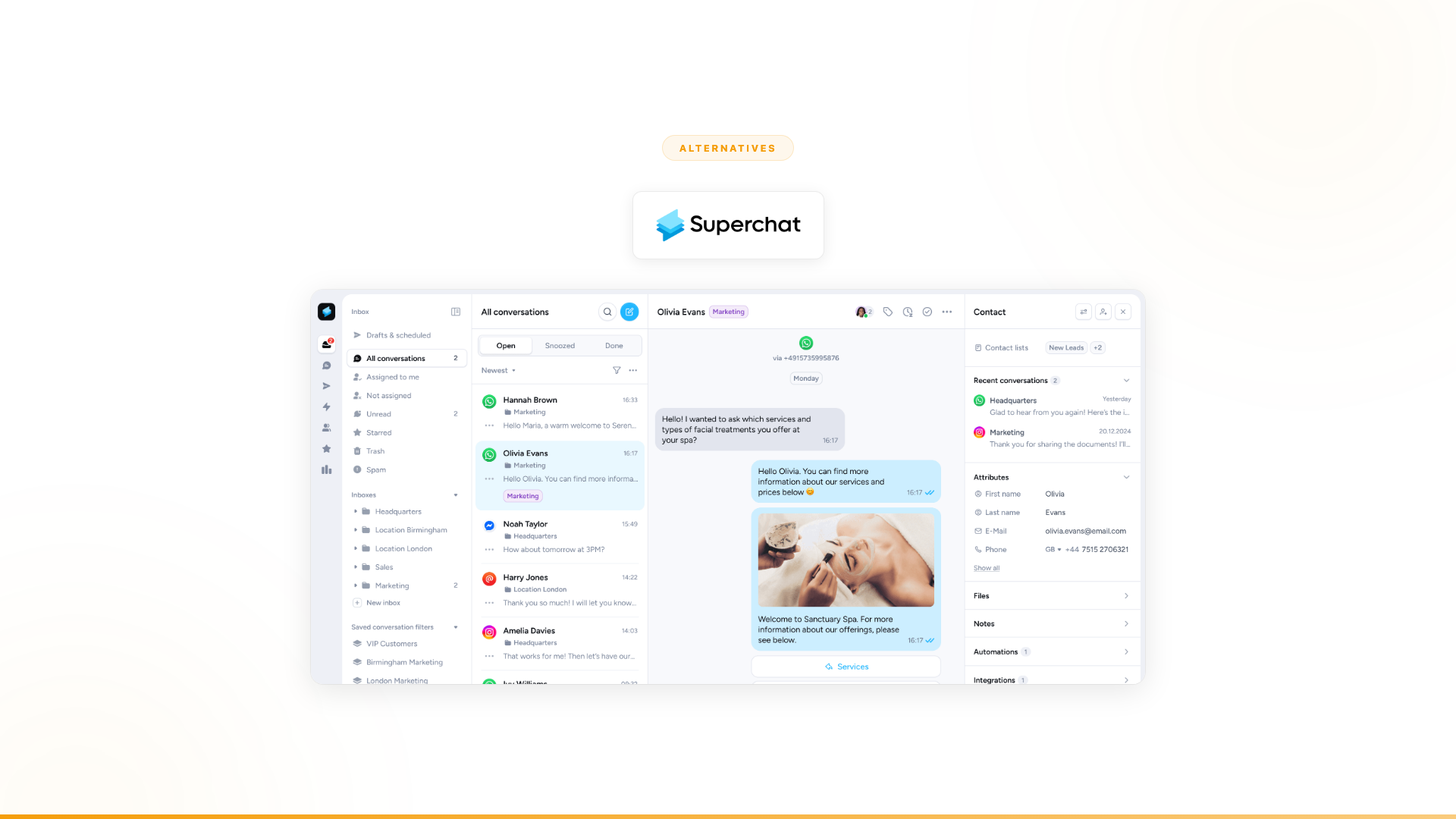
2. Jasper
What it is: AI content platform for marketing teams. Generates blog posts, social media copy, ad copy, email campaigns, and product descriptions. Known for its marketing-specific templates and brand voice training. One of the earliest AI content tools to reach enterprise scale.
How it compares to Writer: Jasper and Writer are the closest competitors in the content AI space. Both generate marketing content with brand controls. Jasper leans more toward creative marketing content — ads, social, campaigns. Writer leans more toward enterprise governance, knowledge retrieval, and compliance workflows. For pure content generation volume, the two are roughly comparable. Writer has the edge in regulated-industry content governance; Jasper has the edge in creative marketing templates and campaign tooling.
Why it might not solve the problem: Same structural limitation as Writer. Jasper generates content. It doesn't handle the approval chain, compliance review, multi-channel distribution, performance measurement, or the data collection that should inform the content in the first place. If you're leaving Writer because generating content isn't the bottleneck, switching to Jasper gives you the same category of tool with a different interface.
Pricing: Starts at $49/month (Creator), $125/month (Pro), custom enterprise pricing.
Best for: Marketing teams that want AI-generated content with brand controls and templates, and whose workflow beyond content generation is already handled.
3. Copy.ai
What it is: AI content and GTM workflow platform. Started as a copywriting tool and has expanded into go-to-market workflows: prospecting, outbound email sequences, competitive analysis, and sales enablement. Offers workflow automation for sales and marketing tasks beyond pure content generation.
How it compares to Writer: Copy.ai has moved beyond pure content generation into GTM workflow automation, which puts it a step ahead of Writer for sales-adjacent use cases. The workflow layer handles sequences like "research a prospect, draft an email, personalize it, schedule follow-ups." Writer is stronger on enterprise content governance and brand consistency.
Why it might not solve the problem: Copy.ai's workflows are primarily sales and marketing focused. They don't extend to customer onboarding, compliance monitoring, HR operations, or cross-departmental processes. And the workflows themselves are templated sequences, not autonomous agents that handle exceptions, make decisions, and adapt to unexpected inputs.
Pricing: Free tier available. Pro at $49/month. Custom enterprise pricing.
Best for: Sales and marketing teams that want AI-generated copy plus basic GTM workflow automation.
4. Grammarly Business
What it is: AI writing assistant for teams. Checks grammar, tone, clarity, and brand voice across everything employees write: emails, documents, Slack messages, presentations. Grammarly Business adds team-level style guides, tone detection, and analytics. Used by over 30 million daily users, with integrations across 500,000+ apps and websites.
How it compares to Writer: Different approach to the same problem. Writer generates content from scratch. Grammarly improves content people have already written. For organizations that want to elevate existing writing rather than generate new content, Grammarly is often a better fit. It works wherever people write — browsers, desktop apps, mobile — rather than requiring a separate application.
Why it might not solve the problem: Grammarly is purely a writing quality layer. It doesn't generate content, and it doesn't handle the business process around content. If the bottleneck is what happens before and after writing, Grammarly doesn't reach there.
Pricing: $25/member/month (Business), custom enterprise pricing.
Best for: Organizations where writing quality and consistency across teams is the primary need, and content generation is handled separately.
5. Microsoft Copilot
What it is: Microsoft's AI assistant for the Microsoft 365 ecosystem. Drafts emails in Outlook, summarizes documents in Word, creates presentations in PowerPoint, analyzes data in Excel, takes notes in Teams meetings. Embedded across the Microsoft productivity suite.
How it compares to Writer: Different category entirely. Copilot is a general-purpose productivity assistant. Writer is a specialized content generation platform. For pure content quality and brand governance, Writer is significantly better. Copilot's drafting capabilities are generic. But Copilot works across the entire Microsoft ecosystem, not just content workflows.
Why it might not solve the problem: Same structural limitation as every AI assistant. It helps individuals with surface-level tasks inside Microsoft 365. According to Gartner research on Microsoft 365 Copilot adoption, only around 6% of organizations that ran Copilot pilots moved to larger-scale deployment. The issue isn't the product. It's the category. Assistants draft and summarize. They don't complete multi-step business processes.
Pricing: $30/user/month (Microsoft 365 Copilot).
Best for: Microsoft 365 organizations that want individual productivity assistance across the suite, not specialized content generation.
Full Nexus vs Copilot comparison →
6. Claude for Enterprise
What it is: Anthropic's AI assistant for enterprises. Strong at complex reasoning, long-form content, code generation, and nuanced analysis. Enterprise version adds SSO, admin controls, longer context windows, and the guarantee that your data isn't used for training.
How it compares to Writer: Claude is arguably better at generating thoughtful, nuanced content than most other models. For long-form writing, analysis, and content that requires genuine reasoning, Claude outperforms Writer's Palmyra models. But Claude is a general-purpose AI assistant, not a content platform. No brand voice training, no style guides, no content templates, no knowledge retrieval from enterprise systems.
Why it might not solve the problem: Claude is a powerful thinking tool. It doesn't integrate with your enterprise systems, enforce brand guidelines, or handle any of the workflow around content. It's a better writer in a conversation window. The operational workflow stays entirely manual.
Pricing: Per-seat enterprise pricing. Custom.
Best for: Teams that need high-quality reasoning and content generation in a conversation interface, and don't need brand governance or workflow integration.
7. Notion AI
What it is: AI capabilities built into the Notion workspace. Generates content, summarizes pages, answers questions from your Notion workspace, fills databases, and assists with writing. Deeply integrated into the Notion experience.
How it compares to Writer: Notion AI works only inside Notion. Writer works across enterprise systems. For teams that live in Notion, Notion AI is convenient because it generates content where you're already working. But it has no brand voice training, no enterprise content governance, and no integration with external systems.
Why it might not solve the problem: Locked to Notion. Doesn't connect to CRMs, ERPs, marketing tools, or any system outside the Notion workspace. If content needs to flow through approval chains, compliance reviews, or multi-channel distribution, Notion AI doesn't handle any of that.
Pricing: $10/member/month add-on to any Notion plan.
Best for: Teams already using Notion as their primary workspace who want AI writing assistance without switching tools.
8. Typeface
What it is: Enterprise AI content platform focused on visual and text content with strong brand controls. Generates images, social posts, ads, and marketing copy while enforcing brand guidelines across every asset. Founded by the former CTO of Adobe.
How it compares to Writer: Typeface is stronger on the visual side. Where Writer focuses on text content with knowledge retrieval and compliance workflows, Typeface generates both visual and text assets with brand-consistent styling. For marketing teams that need images and copy produced together at volume, Typeface offers a more integrated creative experience. The brand governance depth — visual and textual — is the genuine differentiator.
Why it might not solve the problem: Same content-layer limitation. Typeface generates assets. It doesn't handle the campaign planning, data analysis, compliance review, approval routing, channel distribution, or performance measurement that surrounds those assets. Different execution of the same category.
Pricing: Custom enterprise pricing.
Best for: Marketing teams that need both visual and text content generation with strong brand controls.
9. Writesonic
What it is: AI writing tool focused on SEO content, blog posts, and digital marketing copy. Includes an AI article writer, chatbot builder, and SEO optimization features. More affordable than enterprise-focused alternatives.
How it compares to Writer: Writesonic is a simpler, more affordable option for SEO content. It lacks Writer's enterprise governance, brand voice depth, knowledge retrieval, and compliance features. For small teams that need blog posts and SEO-optimized content without enterprise overhead, Writesonic gets the job done at a lower price.
Why it might not solve the problem: If you're searching for Writer alternatives because you need more than content generation, moving to a simpler content tool won't help. Writesonic is a lighter version of the same category.
Pricing: Starts at $16/month (Individual), $33/month (Teams), custom enterprise pricing.
Best for: Small to mid-size teams that need affordable AI-generated SEO content without enterprise complexity.
10. Custom build
What it is: Build your own content and workflow system using open-source frameworks (LangChain, LangGraph, CrewAI) and LLM APIs. Your engineering team designs the architecture, writes the code, handles deployment, security, and maintenance.
How it compares to Writer: Maximum flexibility. You can build exactly the content workflow you need, including the parts Writer doesn't handle: data collection, approval routing, compliance checks, multi-channel distribution. If you have the engineering team and the timeline, you can build something that matches your exact requirements.
Why it might not solve the problem: Most enterprises don't have surplus AI engineering capacity. The engineers you do have are working on your core product, not internal content tooling. Custom builds also require you to solve governance, security, monitoring, and maintenance yourself. The opportunity cost of pulling engineering capacity from revenue-generating work typically exceeds the cost of buying a purpose-built platform.
Pricing: Engineering salaries + infrastructure. Typically 3–6 months for a first production system, with ongoing maintenance costs.
Best for: Organizations with dedicated AI engineering teams and unique requirements that justify the development investment.
So which alternative should you actually choose?
The answer depends on what's actually broken.
If the problem is content quality or brand consistency, and Writer just isn't the right content tool for you, look at Jasper (marketing-focused), Typeface (visual + text), Copy.ai (GTM workflows), or Grammarly Business (editing). These are different versions of the same category. They'll generate or improve content. The workflow around content stays the same.
If the problem is regulated-industry compliance, and you need tighter content approval workflows, audit trails, or legal review capabilities, Writer's compliance features deserve a closer look before switching. Alternatives like Jasper and Writesonic don't match Writer's governance depth for pharmaceutical, financial services, or healthcare use cases.
If the problem is that content generation is fine but everything around it is manual, that's a different category of problem. No content tool solves it because the bottleneck isn't content. It's the data collection, validation, approval, compliance, distribution, and measurement surrounding content. That's workflow, not copywriting.
If the problem is that AI hasn't delivered the business process transformation leadership expected, and you need AI that completes the entire workflow content is part of — not just the generation step — that's what Nexus was built for.
Orange didn't need a better content generator. They needed agents that complete customer onboarding autonomously. ~$6M+ yearly revenue. 4-week deployment. 100% team adoption.
A major European telecom didn't need another writing tool. They deployed a dozen Nexus agents that freed 40% of support volume across millions of interactions.
Content generation is a task. The business process content belongs to is the real work. The gap between a content tool and an agent platform isn't a feature gap. It's a category gap.
Frequently asked questions
What is Writer AI? Writer is an enterprise AI platform for content generation and brand governance. It uses Palmyra, Writer's proprietary family of large language models, to generate on-brand content, enforce style guides, and retrieve knowledge from enterprise data sources. Writer integrates with Salesforce, HubSpot, Figma, and other enterprise tools, and is used primarily by marketing, communications, and legal teams in large organizations.
What is the Palmyra model? Palmyra is Writer's proprietary family of large language models, trained for enterprise content use cases. The latest version, Palmyra X5, features a 1 million token context window, adaptive reasoning, and is benchmarked at near-GPT-4.1 performance at 75% lower cost. Palmyra models are optimized for enterprise deployment, including domain specialization, brand voice consistency, and data privacy requirements. Source: Writer, April 2025
Writer AI vs Jasper: which is better for enterprise content? Writer and Jasper are the two leading enterprise AI content platforms. Writer is stronger on enterprise knowledge retrieval, style guide enforcement, and compliance workflows — particularly relevant for pharmaceutical, financial services, and healthcare companies with strict content governance requirements. Jasper is stronger on creative marketing content generation and templates for campaigns, social media, and advertising. For enterprise governance, Writer has the edge. For creative marketing volume, Jasper is competitive.
Does Writer handle the full content workflow? Writer handles the content generation and brand governance step. The data collection that should inform content — audience research, CRM data, compliance requirements — and the workflow that follows it — approval routing, legal review, distribution, performance tracking — are not natively handled within Writer and require additional tooling or manual work.
How much does Writer cost? Writer pricing starts at $18/user/month for the Team plan. Enterprise pricing is custom. Writer positions at the higher end of enterprise AI content tools, reflecting its governance, compliance, and knowledge retrieval capabilities relative to more basic content generators.
Worth exploring?
Every Nexus engagement starts with a 3-month proof of concept tied to measurable outcomes. Forward Deployed Engineers embed with your team from day one. You see the results before committing. You can exit anytime.
100% of clients who started a POC converted to an annual contract. Every one.
See the full Nexus vs Writer comparison →