Top 10 Superchat Alternatives for Enterprise in 2026
Superchat is built for SMBs in the DACH region. These 10 alternatives go further — from shared inboxes with GDPR-compliant EU data residency to platforms that complete the full workflow behind every conversation.
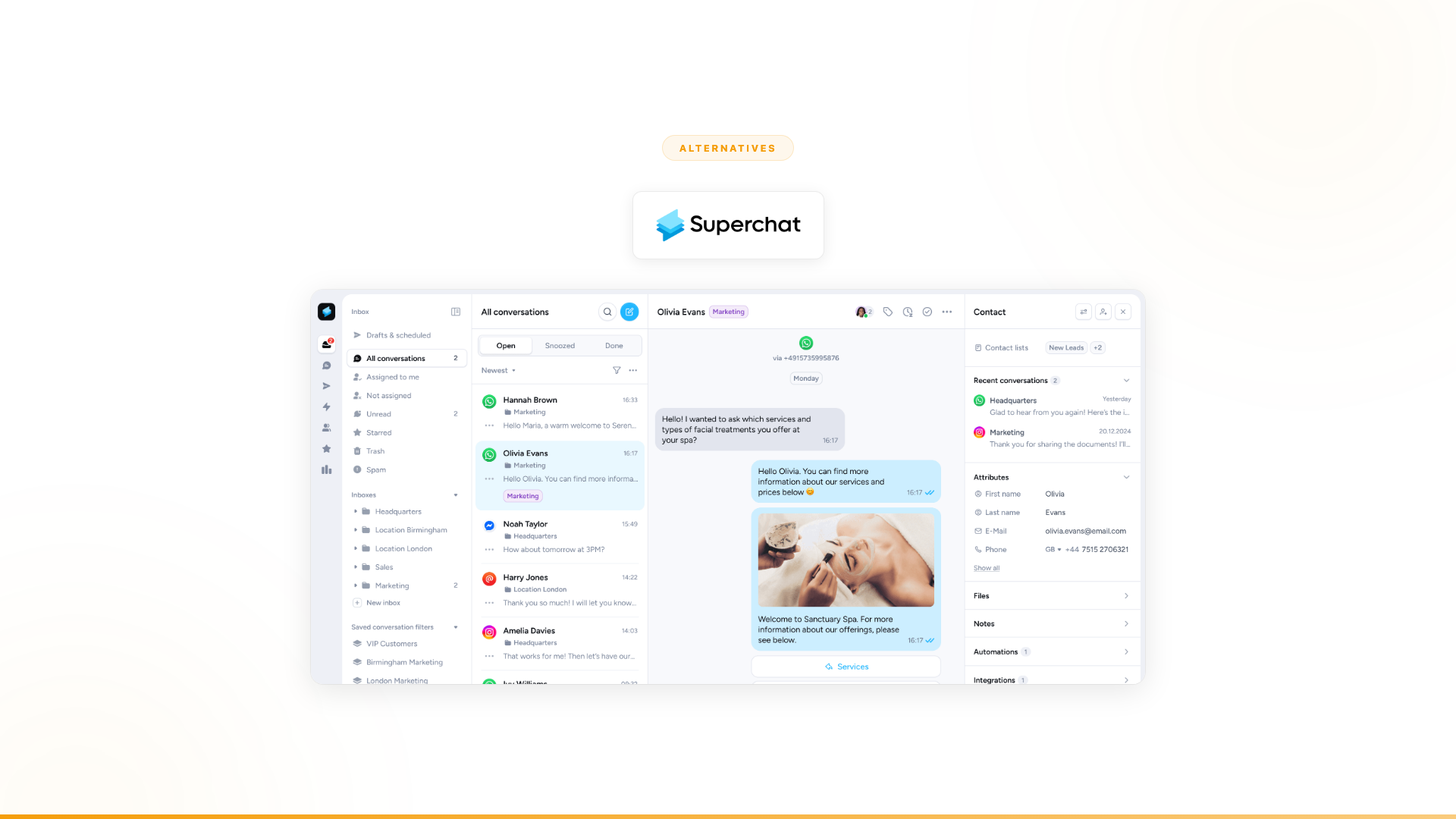
Superchat is a Berlin-based messaging platform used by 9,000+ companies, primarily in the DACH region (Germany, Austria, Switzerland). At EUR 79–249/month, it consolidates WhatsApp, Instagram, email, and webchat into a shared inbox, runs WhatsApp newsletter campaigns, and collects Google reviews. For a Vodafone franchise shop or an insurance brokerage with a handful of support reps, it covers the use case well.
But most teams searching for Superchat alternatives are not looking because the inbox failed. They are looking because the inbox succeeded at the wrong thing.
The pattern is recognizable: you deploy Superchat, conversations are consolidated, agents stop juggling five tabs, leadership is satisfied. Then the numbers plateau. Every customer interaction still triggers manual work behind it. Someone has to pull account records, verify identity, check eligibility, validate compliance, update the billing system, route exceptions, and confirm completion. Superchat handled the messages. Nobody completed the work those messages were about.
That is not a Superchat problem. It is a category problem. Messaging platforms automate the conversation layer — roughly 10% of what customer operations actually involve. The other 90% — cross-system validation, decision logic, exception handling, and execution — stays untouched.
If that gap is what is driving your search, here are 10 alternatives worth evaluating.
What is Superchat?
Superchat is a German-born business messaging platform that centralizes customer conversations across WhatsApp, Instagram, SMS, email, and webchat in a single shared inbox. Founded in Berlin and backed by a €13.6 million funding round in 2022 (EU-Startups), it is popular with SMBs and mid-market businesses across the DACH region. Core features include chatbot automation for FAQ responses, WhatsApp Business API access, bulk messaging campaigns, and Google review collection.
Pricing ranges from EUR 79/month (Starter) to EUR 249/month (Business), with a custom enterprise tier for larger organizations. For pricing details, see Superchat's pricing page.
Is Superchat suitable for large enterprises?
Superchat is purpose-built for the SMB and mid-market segment. For large enterprises, the limitations typically surface in three areas:
- Workflow depth. Superchat connects to other tools through Zapier and Make — useful for notifications and simple triggers, but not sufficient for real-time validation against an ERP or billing system during a live customer interaction.
- GDPR and EU data residency. Enterprise buyers in Germany and the EU require Data Processing Agreements (DPAs), EU-hosted data storage, and documented compliance chains under Art. 28 GDPR. Vendor selection often depends on whether message logs are hosted on ISO-certified servers within the EU — a common enterprise procurement requirement (heyData).
- German-language support and localization. Superchat's native DACH focus, including German-language customer success, is a genuine strength that not all enterprise alternatives match. Buyers switching to global platforms often lose this localization advantage.
Quick comparison
| Tool | Category | Best for | Completes work behind conversations? | Pricing model |
|---|---|---|---|---|
| Nexus | Autonomous agent platform | Full workflow completion across any department | Yes, end-to-end | Per-agent |
| Intercom | Support messaging + AI | AI-first customer messaging | Conversations only | Per-seat + per-resolution |
| Trengo | Shared inbox platform | European multi-channel inbox | Conversations only | Per-user |
| Respond.io | Conversational messaging | Multi-channel messaging at scale | Conversations only | Per-user |
| Tidio | Chatbot + live chat | SMB chat automation | Conversations only | Per-seat |
| Freshdesk | Support suite + AI | Budget-friendly support with AI layer | Partial (within Freshdesk) | Per-agent |
| Crisp | Messaging + helpdesk | Startups and SMBs needing all-in-one | Conversations only | Per-workspace |
| Front | Shared inbox + collaboration | Team-based email and messaging | Conversations only | Per-seat |
| Zendesk | Enterprise support suite | AI within a full support ecosystem | Partial (within Zendesk) | Per-agent + AI add-on |
| Custom build | Developer framework | Full control, unlimited scope | Depends entirely on team | Engineering cost |
The alternatives, ranked
1. Nexus
What it is: An autonomous agent platform with embedded Forward Deployed Engineers. Nexus agents do not just handle the conversation. They complete the entire business process behind it: collecting data from multiple systems, validating it, making decisions within guardrails, handling exceptions, and executing actions. Any department. Any workflow. Business teams build and own the agents.
Why teams switch from Superchat to Nexus:
Superchat manages conversations. Nexus agents complete the work those conversations are about. That is not a feature difference. It is a category difference.
When a customer sends a WhatsApp message, the conversation — understanding their request, responding — is roughly 10% of the effort. The other 90% is what happens behind that message: pulling records from the CRM, checking eligibility in the billing system, validating compliance, creating or modifying records, routing exceptions, sending confirmations. Superchat handles the 10%. Nexus agents complete the 90%.
Superchat connects to other tools through Zapier and Make. Useful for notifications and simple triggers. Not sufficient for real-time validation against a billing system during a customer interaction, or for executing a multi-step compliance check across backend platforms while the customer waits. Nexus has 4,000+ native integrations that reach into enterprise systems directly.
What it looks like in production:
- Orange Group (multi-billion euro telecom, 120,000+ employees): Replaced their previous CX chatbot platform — which had a 27% drop-out rate — with Nexus agents that complete customer onboarding end-to-end. Deployed in 4 weeks. 50% conversion improvement. ~$6M+ yearly revenue impact. 90% autonomous resolution. Built by the business team, not engineering. (Nexus client data)
- European telecom (13,000+ employees): Needed agents across support, compliance, registration, and escalation handling — not just a messaging inbox. Nexus agents freed 40% of support capacity across millions of interactions while maintaining 100% regulatory compliance. (Nexus client data)
Pricing: Per-agent, tied to value delivered. Not per-message or per-user. An agent handling millions of interactions costs the same regardless of volume.
Best for: Teams that have realized conversation management is 10% of the problem, and the real cost sits in the operational work behind those conversations. Any department, any workflow.
Full Nexus vs Superchat comparison -->
2. Intercom
What it is: A customer messaging platform with an AI assistant called Fin. Fin resolves customer questions using help center content, past conversations, and custom data sources. Deeply integrated with Intercom's inbox, ticketing, and reporting.
How it compares to Superchat: More mature AI layer, stronger support tooling. Intercom has spent years building out workflows, custom bots, and now Fin for AI resolution. Superchat is primarily a messaging inbox with chatbot automation added in 2024. For teams that need a proper support platform with AI-first resolution, Intercom is the more established option. Superchat is simpler and cheaper for basic shared inbox needs.
GDPR and EU data residency: Intercom offers EU data hosting as part of its enterprise tier, which is a relevant consideration for German enterprise buyers. Confirm data processing agreements during procurement.
Why it might not solve the problem: Same category limitation. Fin resolves conversations — it answers questions, deflects common tickets, and routes complex cases to humans. The operational work behind those conversations (multi-system validation, compliance checks, cross-department coordination) stays manual. Switching from Superchat to Intercom upgrades the conversation tool. It does not change the category.
Pricing: Starts at $29/seat/month. Fin AI agent at $0.99 per resolution. Scales significantly at high volume.
Best for: Teams that need a full support platform with native AI resolution, not just a messaging inbox.
3. Trengo
What it is: A shared inbox platform based in the Netherlands, built for European businesses. Consolidates WhatsApp, email, SMS, voice, and social channels into one inbox. Includes team collaboration features, chatbot builders, and WhatsApp Business API support.
How it compares to Superchat: The most direct European competitor. Trengo covers more channels natively (including voice and SMS) and has broader European presence beyond DACH. Superchat is stronger in Germany specifically — German-language support, DACH localization, and WhatsApp newsletter features are more polished. Trengo offers more robust team collaboration tools and flowbot builders. For businesses that need multi-channel coverage beyond WhatsApp-first, Trengo fills gaps Superchat leaves. Both are BSP-certified for WhatsApp Business API access in the EU.
GDPR and EU data residency: Trengo is EU-based (Netherlands), which simplifies GDPR compliance for European enterprise buyers and reduces cross-border data transfer complexity.
Why it might not solve the problem: Trengo is a better inbox. It is still an inbox. Conversations are consolidated and team collaboration improves, but the 90% of operational work behind those conversations remains untouched. Better conversation management does not become workflow completion.
Pricing: Starts at EUR 99/month for 5 users. Higher tiers for additional channels and automation.
Best for: European businesses that need a shared inbox with broader channel coverage than Superchat, particularly voice and SMS, while remaining within an EU-based vendor.
4. Respond.io
What it is: A conversational messaging platform designed for businesses that communicate at scale across WhatsApp, Messenger, Instagram, Telegram, and more. Stronger automation capabilities than most inbox tools, with workflow builders that can route, assign, and trigger actions based on conversation events.
How it compares to Superchat: More sophisticated automation. Respond.io's workflow builder handles branching logic, conditional routing, and multi-step automations that go beyond Superchat's automation actions. For teams with high message volume across multiple channels that need more complex routing and assignment rules, Respond.io is the more capable platform. Superchat is simpler to set up and stronger on WhatsApp newsletters.
GDPR and EU data residency: Respond.io is headquartered outside the EU. Enterprise buyers in Germany should verify their data processing agreements and server locations before procurement, particularly if customer message logs include personal data subject to GDPR.
Why it might not solve the problem: The automations are more powerful but still conversation-scoped. Respond.io can route a conversation to the right agent based on conditions. It cannot validate a customer's account against a billing system, run a compliance check, or execute a multi-step workflow across backend platforms. More capable messaging automation is still messaging automation.
Pricing: Starts at $79/month for 5 users. Growth and Advanced plans for higher volumes.
Best for: High-volume messaging teams that need more sophisticated conversation routing and automation than Superchat provides.
5. Tidio
What it is: Chatbot and live chat platform for small and mid-size businesses. Combines AI chatbots (Lyro) with live chat, email, and social messaging in one inbox. Simpler than Superchat in some areas, with faster setup and a generous free tier.
How it compares to Superchat: Lighter-weight and lower cost. Tidio's free tier and $29/month starting price make it accessible for very small teams. Its AI chatbot (Lyro) handles FAQ automation competently. Superchat has stronger WhatsApp-native features (newsletters, review collection) and is better positioned for WhatsApp-first businesses. Tidio is better for teams that need webchat and basic AI on a tight budget.
Why it might not solve the problem: Tidio solves a smaller version of the same problem. It automates simple conversations for smaller teams. The operational work behind those conversations is entirely manual. For growing businesses, Tidio's capabilities plateau quickly when support complexity increases. Teams that outgrew Superchat will outgrow Tidio faster.
Pricing: Free tier available. Paid plans from $29/month. Lyro AI add-on from $39/month.
Best for: Small businesses that need affordable chat automation and are not yet at the scale where Superchat is necessary.
6. Freshdesk
What it is: Freshworks' support suite with a built-in AI layer called Freddy. Handles ticketing, auto-resolution, response suggestions, and sentiment analysis. The budget-friendly option in the support platform space, with native CRM integration through Freshworks.
How it compares to Superchat: Different category. Superchat is a messaging inbox. Freshdesk is a support ticketing platform. For teams that have outgrown inbox-style support and need ticket management, SLAs, knowledge bases, and reporting, Freshdesk is a step up in support maturity. Its Freddy AI adds auto-resolution and agent assist. Superchat does not offer ticketing infrastructure.
GDPR and EU data residency: Freshworks offers EU data centers and GDPR-compliant configuration. Enterprise buyers should confirm DPA terms and EU hosting options during procurement.
Why it might not solve the problem: Freshdesk makes support operations more structured. Freddy AI resolves some tickets automatically. But the work behind tickets (multi-system validation, compliance workflows, cross-department processes) stays manual. Better ticketing is valuable. It is not workflow completion.
Pricing: Free tier for up to 10 agents. Paid plans from $15/agent/month. Freddy AI credits included in higher tiers.
Best for: Teams that need structured ticketing and support operations at a lower price point than enterprise platforms.
7. Crisp
What it is: An all-in-one messaging platform combining live chat, chatbot, email, and knowledge base. Founded in France, popular with startups and SMBs across Europe. Includes a shared inbox, CRM, and campaign features in one package.
How it compares to Superchat: Similar scope, different strengths. Crisp bundles more features at the platform level (built-in CRM, knowledge base, status pages) where Superchat focuses more narrowly on messaging and WhatsApp. Crisp's chatbot builder is more flexible for web-based interactions. Superchat is stronger for WhatsApp-first businesses and has better review management. As a French company, Crisp is EU-based, which simplifies GDPR compliance for European buyers.
Why it might not solve the problem: More features in the inbox layer does not address the 90% behind it. Crisp handles conversations across more channels and adds lightweight CRM. But when a customer interaction requires validation against backend systems, compliance checks, or multi-step processes, that work stays manual regardless of how polished the inbox is.
Pricing: Free tier for 2 seats. Pro at $25/month per workspace. Unlimited plan at $95/month per workspace.
Best for: Startups and SMBs in Europe that want an all-in-one messaging, CRM, and knowledge base platform from an EU-based vendor.
8. Front
What it is: A shared inbox platform built for teams that manage high volumes of email, SMS, and messaging. Focuses on collaboration: shared drafts, internal comments, assignment rules, and SLA tracking. Integrates with CRMs and project management tools.
How it compares to Superchat: Different emphasis. Superchat is messaging-channel-first (WhatsApp, Instagram). Front is email-first with messaging support added. Front's collaboration features (shared drafts, internal threads, assignment workflows) are more sophisticated. For teams where the bottleneck is coordinating responses across a team rather than consolidating WhatsApp channels, Front is the better fit.
Why it might not solve the problem: Front makes teams faster at responding. It does not make the work behind responses go away. A well-organized inbox with perfect assignment rules and SLA tracking still requires humans to do the operational work that each message triggers. Faster conversation handling is not the same as workflow completion.
Pricing: Starts at $19/seat/month. Growth plan at $59/seat/month. Scale plan at $99/seat/month.
Best for: Teams that handle high volumes of email and need strong collaboration and assignment workflows around shared inboxes.
9. Zendesk
What it is: The enterprise support platform. Zendesk includes ticketing, knowledge base, live chat, phone, and now AI agents and intelligent triage. The most comprehensive support suite on this list, with the broadest ecosystem of integrations and marketplace apps.
How it compares to Superchat: Different league. Zendesk is an enterprise support platform. Superchat is an SMB messaging inbox. If you have outgrown Superchat and need enterprise-grade support operations (SLAs, multi-tier routing, advanced analytics, compliance reporting, 1,000+ marketplace integrations), Zendesk is the standard. Its AI features (automated resolutions, intelligent triage, agent assist) go well beyond Superchat's chatbot.
GDPR and EU data residency: Zendesk offers EU data residency options and GDPR-compliant configurations for enterprise contracts. For German enterprise buyers, this is worth verifying as a procurement condition.
Why it might not solve the problem: Zendesk enhances the support ticket paradigm. It triages better, routes smarter, and resolves some tickets automatically. But it operates within the support ticket paradigm. The cross-system operational work behind those tickets is not what Zendesk was built to handle. You get the best support tooling available. You do not get business process completion.
Pricing: Suite plans from $55/agent/month. AI features as add-ons with per-resolution pricing.
Best for: Enterprise support teams that need a comprehensive platform and have outgrown SMB messaging tools entirely.
10. Custom build
What it is: Building your own messaging and workflow platform using developer frameworks (LangChain, LangGraph, CrewAI) or APIs from WhatsApp, Twilio, and LLM providers directly. Your engineering team designs the architecture, handles integrations, manages deployment, and maintains the system.
How it compares to Superchat: Maximum flexibility. No vendor limitations on scope, capabilities, or integration depth. You can build exactly what your operations need, including the workflow completion behind conversations that no vendor tool on this list (except Nexus) handles.
Why it might not solve the problem: Most companies do not have surplus AI engineering capacity. A platform that actually completes workflows requires integrations with CRM, ERP, billing, compliance, and dozens of internal systems. Security, governance, monitoring, and maintenance are all on your team. For most organizations, the opportunity cost of building is higher than the cost of buying — particularly when enterprise WhatsApp Business API access, GDPR-compliant infrastructure, and ongoing LLM maintenance are factored into the full build cost.
Pricing: Engineering salaries plus infrastructure. 3–6 months for initial deployment, with ongoing maintenance.
Best for: Organizations with dedicated AI engineering teams, unique technical requirements, and timelines that can absorb 6+ months of development.
Superchat pricing: how does it compare to enterprise alternatives?
| Platform | Starting price | Model | Enterprise tier |
|---|---|---|---|
| Superchat | EUR 79/month | Per workspace | Custom |
| Trengo | EUR 99/month | Per user | Custom |
| Tidio | Free / $29/month | Per seat | Custom |
| Crisp | Free / $25/month | Per workspace | Custom |
| Freshdesk | Free / $15/agent/month | Per agent | Custom |
| Front | $19/seat/month | Per seat | Custom |
| Intercom | $29/seat/month | Per seat + AI | Custom |
| Zendesk | $55/agent/month | Per agent + AI | Custom |
| Respond.io | $79/month | Per user | Custom |
| Nexus | Per agent | Value-based | Per agent |
Note: Superchat pricing sourced from superchat.com/pricing. All prices subject to change.
The real question: what are you actually trying to solve?
Most Superchat alternatives on this list solve the same problem Superchat solves. They manage conversations. Some do it across more channels (Trengo, Respond.io). Some do it cheaper (Tidio, Crisp). Some do it within a full support platform (Zendesk, Freshdesk). Some add better team collaboration (Front, Intercom). But they all operate within the same category: the conversation layer. The 10%.
If the problem you are trying to solve is actually the 10% — if all you need is a better inbox, a cheaper one, or one that works across more channels — several tools on this list will work. Pick the one that fits your stack and budget.
But if the reason you are looking for Superchat alternatives is that managing conversations did not deliver the operational transformation leadership expected, then the problem is not which inbox you use. The problem is that messaging tools structurally cannot reach the 90% of work behind those conversations. No amount of switching between inbox vendors changes that.
If the conversation is the bottleneck: Pick the best messaging tool for your channels and team size. Superchat, Trengo, Intercom, Zendesk. They are all capable.
If the work behind the conversation is the bottleneck: That is a different category of problem. That requires agents that complete workflows, not conversations. That requires embedded engineering support, not just software. That is what Nexus was built for.
Orange did not need a better messaging inbox. Their previous chatbot had a 27% drop-out rate. They needed agents that complete customer onboarding autonomously. The result: ~$6M+ yearly revenue impact, 4-week deployment, 90% autonomous resolution. (Nexus client data)
A European telecom did not need smarter ticket routing. They needed agents that handle support, compliance, registration, and escalation across millions of interactions. 40% of support capacity freed. Full regulatory compliance. (Nexus client data)
The gap between managing a conversation and completing the work that conversation represents is not a feature gap. It is a category gap.
Frequently asked questions
What is Superchat?
Superchat is a German-born business messaging platform that centralizes customer conversations across WhatsApp, Instagram, SMS, email, and webchat. It is popular with SMBs and mid-market businesses across the DACH region (Germany, Austria, Switzerland), with 9,000+ companies on the platform. Core use cases include shared inbox management, WhatsApp Business API access, bulk messaging campaigns, and Google review collection. Pricing starts at EUR 79/month.
Is Superchat suitable for large enterprises?
Superchat is purpose-built for the SMB and mid-market segment. Enterprise buyers typically encounter limits in three areas: workflow automation depth (Zapier/Make integrations rather than native enterprise system connections), GDPR and EU data residency documentation requirements, and the absence of enterprise-grade SLAs, multi-department governance, and deep CRM integration. For large organizations, enterprise-grade alternatives like Zendesk, Intercom, or purpose-built workflow completion platforms like Nexus are more commonly evaluated.
What are the main GDPR considerations when choosing a Superchat alternative in Germany?
For enterprise buyers in Germany, key GDPR requirements include: a signed Data Processing Agreement (DPA) with the vendor under Art. 28 GDPR; EU-based or German server hosting for message logs and customer data; ISO-certified data centers; and documented data retention and deletion controls. EU-based vendors (Trengo, Crisp) simplify compliance. For non-EU vendors (Respond.io, some Zendesk configurations), verify data processing terms and server locations before procurement. See heyData's GDPR guide for WhatsApp Business for a detailed breakdown.
What is the difference between Superchat and Intercom?
Superchat is an SMB-focused shared inbox built around WhatsApp and DACH-market needs. Intercom is a full customer support platform with a mature AI resolution layer (Fin), ticketing, and workflow automation. Superchat is cheaper and simpler. Intercom is a higher-investment platform with more enterprise features — AI-first resolution, multi-team routing, and stronger analytics. Neither platform executes business processes behind the conversation; both are conversation management tools.
Why do companies move from Superchat to enterprise platforms?
The most common triggers are: Superchat's automation is limited to Zapier/Make connections that are insufficient for real-time backend validation; enterprise procurement requires vendor certifications and SLAs that Superchat's SMB pricing tier does not cover; multi-department deployment (sales, support, compliance, operations all running agents simultaneously) requires governance that inbox tools do not provide; and the realization that managing conversations is 10% of the operational work — the other 90% requires a different category of tool entirely.
Worth exploring?
Every Nexus engagement starts with a 3-month proof of concept tied to measurable outcomes. Forward Deployed Engineers embed with your team from day one. You see the results before committing. You can exit anytime.
100% of clients who started a POC converted to an annual contract.
See the full Nexus vs Superchat comparison -->
Related reading
- Nexus vs Superchat: full comparison
- Why SMB Messaging Tools Hit Enterprise Limits
- WhatsApp Business vs AI Agents for Telecom
- How Nexus Agents Work Across Telecom Operations
External sources: Superchat pricing · EU-Startups: Superchat €13.6M raise · heyData: WhatsApp GDPR compliance guide · Qualimero: WhatsApp Business API providers Germany