Top 10 Druid AI Alternatives for Enterprise Conversational AI in 2026
Druid AI orchestrates conversations and RPA bots. If you need AI that completes full workflows, here are 10 alternatives ranked by what they deliver in production.
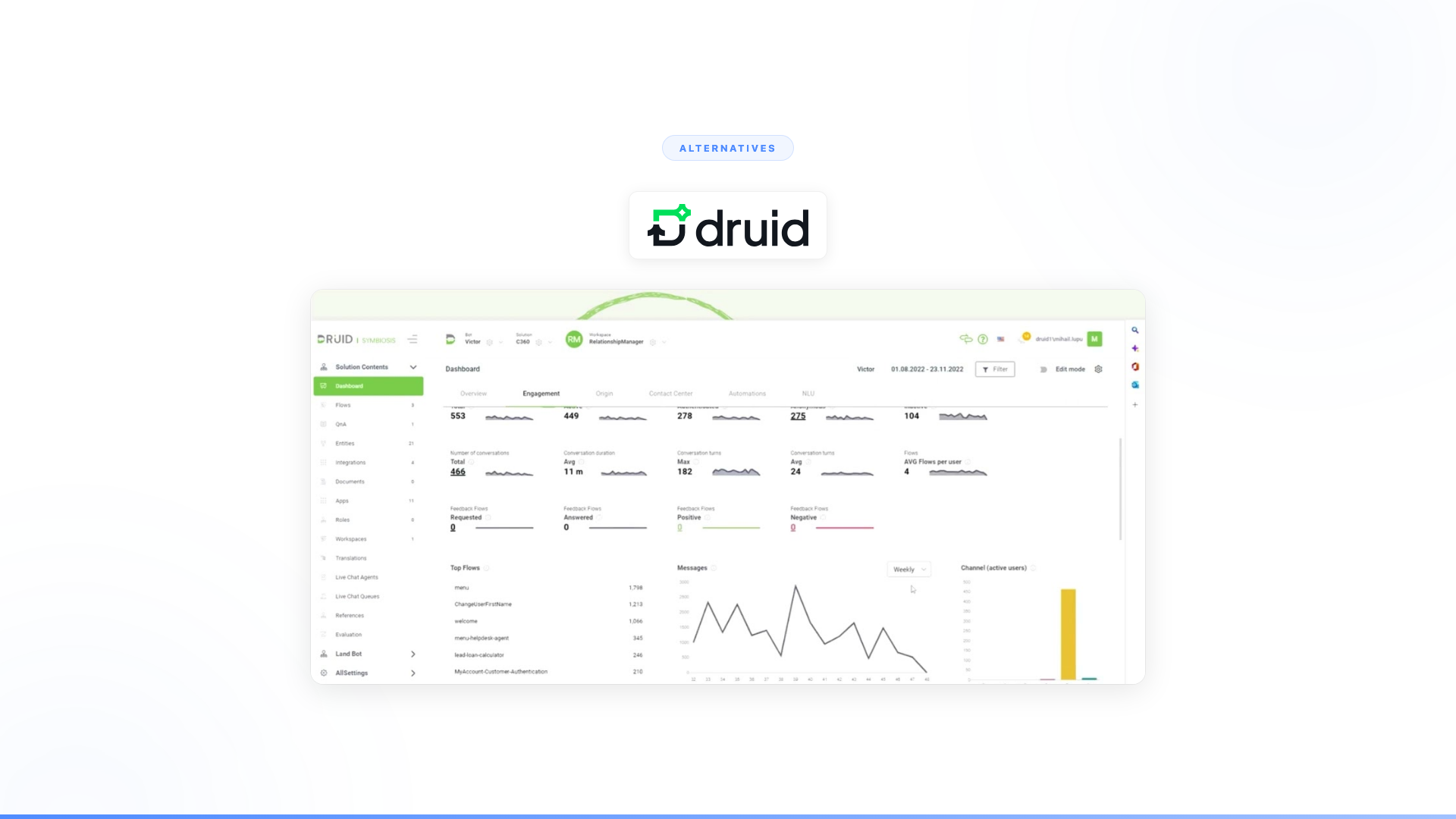
The best Druid AI alternatives in 2026 are Nexus, Cognigy (NICE), Kore.ai, Yellow.ai, UiPath AI, IBM watsonx Assistant, Boost.ai, Microsoft Copilot Studio, Ada, and custom build. Druid AI is an enterprise conversational AI platform with native UiPath RPA integration, recognized as a Gartner Challenger and IDC MarketScape Major Player, but alternatives range from stronger contact center voice AI platforms to autonomous agent systems that complete full workflows without a separate RPA layer.
Druid AI has built a real product in enterprise conversational AI. Recognized as a Challenger in Gartner's Magic Quadrant for Enterprise Conversational AI Platforms and named a Major Player in the IDC MarketScape for Conversational AI, with 250+ enterprise customers (per Druid's self-reported figures) and support for 100+ languages. Its genuinely differentiated angle: native UiPath RPA integration that lets enterprises layer a conversational front-end on top of existing robotic process automation.
For organizations that have invested heavily in UiPath and want a natural language interface for those bots, Druid does this well. It is particularly strong in Central and Eastern Europe, where it is headquartered (Bucharest, Romania), with notable traction in telecom and financial services across the region.
But enterprises are increasingly running into the same ceiling. Druid orchestrates conversations that trigger automations. The conversation is one layer. The RPA bot is another. The integration between them is a third. And the gaps between those layers — decision-making, exception handling, multi-system validation — still require humans.
Industry research supports this pattern. Gartner has documented that the majority of RPA deployments require significant human intervention to handle exceptions, and Forrester has noted that multi-layer automation architectures (conversational AI + RPA + integration middleware) create compounding failure points as complexity scales.
The conversation gets automated. The work behind it doesn't.
If your team has hit that ceiling, or if you are evaluating Druid alongside other platforms and want to understand the landscape, here are 10 alternatives worth considering. Organized by what they actually do.
Druid AI Alternatives: Quick Comparison Table (2026)
| Tool | Category | Best for | Goes beyond chatbots? | Pricing model |
|---|---|---|---|---|
| Nexus | Autonomous agent platform | Full workflow automation across any department | Yes, any department | Per-agent |
| Cognigy (NICE) | Contact center AI | Voice and chat automation in the contact center | Contact center only | Consumption-based |
| Kore.ai | Enterprise chatbot platform | Large-scale virtual assistant deployments | Customer support + IT | Enterprise license |
| Yellow.ai | Multilingual CX chatbot | High-volume multilingual conversations | CX + employee services | Usage-based |
| UiPath + AI | RPA with AI layer | Organizations deep in RPA wanting AI capabilities | RPA scope only | Per-robot licensing |
| IBM watsonx Assistant | Enterprise virtual assistant | IBM ecosystem customers | Customer + employee service | Per-session |
| Boost.ai | Conversational AI | Scandinavian and financial services organizations | Customer support | Enterprise license |
| Microsoft Copilot Studio | Low-code bot builder | Microsoft ecosystem organizations | Limited by platform | Bundled with Microsoft 365 |
| Ada | CX automation | Customer service ticket deflection at scale | Customer service only | Resolution-based |
| Custom build | Internal development | Teams with dedicated AI engineering capacity | Depends on scope | Engineering cost |
Top 10 Druid AI Alternatives Ranked for Enterprise Use
1. Nexus: Best Druid AI Alternative for Full Workflow Automation
What it is: An autonomous agent platform with Forward Deployed Engineers (FDEs) embedded with your team. Nexus agents complete entire business workflows end-to-end: collecting data from multiple systems, validating it, making decisions within guardrails, handling exceptions, and executing actions. Any department. Any workflow. Business teams build and own the agents.
Why enterprises evaluate Nexus after Druid:
The structural difference is the point. Druid orchestrates conversations that trigger automations across separate layers (conversational AI + RPA + APIs). Nexus agents handle the full workflow natively: the conversation, the validation, the decision, the execution. No separate conversation layer and automation layer. No RPA bots to maintain. No gaps between tools where exceptions fall through.
And it goes far beyond customer support chatbots. Druid's deployments are concentrated in support and IT helpdesk. Nexus covers every department: customer onboarding, sales intelligence, compliance monitoring, HR operations, reporting, marketing operations.
What it looks like in production:
- Orange Group (multi-billion euro telecom, 120,000+ employees): Business team built autonomous customer onboarding agents. Not a chatbot that asks onboarding questions. Agents that complete the full onboarding workflow: identity validation, eligibility checks, device compatibility, appointment booking, exception handling. Deployed across multiple European markets in 4 weeks. 50% conversion improvement.
- European telecom (13,000+ employees): Spent 6 months with Copilot Studio without delivering production use cases. Deployed a dozen Nexus agents covering support, compliance, registration, data harmonization, and escalation routing. 40% support volume freed.
Pricing: Per-agent, tied to value delivered. Not per-interaction, not per-seat. Every engagement starts with a 3-month proof of concept tied to measurable outcomes.
Best for: Enterprises where customer support chatbots are one need among many. Organizations that want AI to complete high-volume business workflows across departments, with business team ownership and Forward Deployed Engineers from day one.
Full Nexus vs Druid AI comparison -->
2. Cognigy (NICE): Best Druid AI Alternative for Voice AI and Contact Centers
What it is: Enterprise contact center AI platform for voice and chat automation. Named a Leader in the Gartner Magic Quadrant for Enterprise Conversational AI Platforms. Acquired by NICE in September 2025, now part of the CXone Mpower platform. (Source: NICE press release, September 2025.)
How it compares to Druid: Cognigy is stronger in voice AI and telephony integration. Where Druid differentiates on RPA orchestration, Cognigy differentiates on contact center depth: IVR replacement, real-time voice conversations, agent assist. The NICE acquisition gives Cognigy access to a broader CX ecosystem but also ties its roadmap to NICE's priorities.
Why it might not solve the problem: Same scope ceiling as Druid. It automates the conversation, not the work behind it. Validation, compliance checks, multi-system execution, and exception handling across departments are outside scope. And you are now buying into the NICE ecosystem.
Pricing: Consumption-based per conversation/interaction. Separate charges for voice, chat, and LLM workloads.
Best for: Contact centers that need voice AI and are comfortable with NICE as the long-term vendor.
Nexus vs Cognigy comparison -->
3. Kore.ai: Best Druid AI Alternative for Large-Scale Virtual Assistants
What it is: Enterprise chatbot and virtual assistant platform. Gartner Magic Quadrant Leader for Enterprise Conversational AI Platforms. Known for deep NLU capabilities and its XO Platform for building and managing virtual assistants at scale. Recent additions include an Agent Platform for orchestrating multiple AI agents.
How it compares to Druid: Kore.ai has broader scope than Druid across customer service, IT helpdesk, and employee self-service. More mature NLU capabilities and stronger analyst positioning (Leader vs. Challenger). The Agent Platform is newer and competing for the same "beyond chatbots" positioning. Both require IT teams to build and manage.
Why it might not solve the problem: Agent Platform adds orchestration, but the architecture is still conversation-first. The work behind conversations — multi-system validation, decision-making, exception routing, compliance — requires separate tooling or human intervention. Enterprise deployments typically require significant IT-driven configuration investment and take months to reach production.
Pricing: Enterprise licensing. Deployments are typically substantial multi-year commitments.
Best for: Organizations that need large-scale virtual assistant deployments with enterprise-grade NLU and are willing to invest in IT-driven configuration.
Nexus vs Kore.ai comparison -->
4. Yellow.ai: Best Druid AI Alternative for Multilingual CX
What it is: Customer experience and employee experience chatbot platform supporting 135+ languages across 35+ channels. Strong in APAC markets. Focused on high-volume multilingual conversations for customer support and employee self-service.
How it compares to Druid: Yellow.ai has stronger multilingual coverage (135+ languages vs. Druid's 100+) and deeper channel breadth (35+ channels). Druid has stronger RPA integration. Both handle conversations, not the work behind them.
Why it might not solve the problem: Multilingual conversations at scale is a real capability. But language coverage does not equal workflow completion. The same gap applies: conversation automated, work behind it still manual.
Pricing: Usage-based tied to conversation volume and channels.
Best for: Multinational enterprises with high-volume, multilingual customer support needs, particularly in APAC.
5. UiPath Native AI: Do You Still Need Druid for RPA Orchestration?
What it is: UiPath is the leading RPA platform. Its recent AI capabilities — Autopilot, GenAI activities, and LLM integration — add intelligence directly inside robotic process automation. Since Druid's core differentiation is native UiPath integration, evaluating UiPath's own AI capabilities is the logical first question.
How it compares to Druid: Druid adds a conversational layer on top of UiPath bots. UiPath's native AI adds intelligence directly inside the automation. The question is whether you need the conversational front-end (Druid's value) or smarter automation behind the scenes (UiPath Autopilot). In many cases, organizations evaluating Druid for UiPath orchestration find that UiPath's own AI additions reduce the need for a separate conversational layer.
Why it might not solve the problem: RPA, even with AI added, is still architecturally brittle. Bots follow predefined paths through screens and systems. When something unexpected happens, the bot breaks. Industry analysts have consistently noted that RPA maintenance costs and exception-handling failures are among the top reasons enterprises seek alternatives. Adding a conversational front-end (Druid) or adding AI intelligence (UiPath Autopilot) doesn't change the underlying fragility. If your RPA bots break on exceptions today, AI-enhanced RPA bots will break on different exceptions.
Pricing: Per-robot licensing. Enterprise contracts vary by deployment scale.
Best for: Organizations deeply invested in UiPath that want to enhance existing automations with AI, not replace them.
6. IBM watsonx Assistant: Best Druid AI Alternative for Regulated Industries
What it is: Enterprise conversational AI platform, previously Watson Assistant, now part of the watsonx suite. Mature product with strong NLU, multi-channel deployment, and enterprise security. Long track record in banking, insurance, and telecom.
How it compares to Druid: Stronger enterprise pedigree and deeper security certifications. IBM's brand carries weight in regulated industries. But the product is heavier to deploy and configure. Druid's low-code builder is more accessible. Both handle conversations, not full workflows.
Why it might not solve the problem: Same ceiling. Enterprise-grade conversation automation. The work behind the conversation — multi-step validation, decision logic, cross-system execution — requires separate IBM tools, custom integration, or human handling.
Pricing: Per-session pricing. Enterprise tier available.
Best for: IBM ecosystem customers in regulated industries who need enterprise-grade conversation AI with IBM security and compliance.
7. Boost.ai: Best Druid AI Alternative for Nordic Financial Services
What it is: Conversational AI platform from Norway, strong in Scandinavian markets and financial services. Known for a hybrid NLU approach and high-volume virtual agent deployments. Serves banks, insurance companies, and government agencies across the Nordics.
How it compares to Druid: Narrower geographic and vertical focus (Nordics, financial services) vs. Druid's broader CEE/enterprise positioning. Boost.ai is more mature in banking and insurance use cases. Druid is stronger in RPA orchestration and telco. For European financial services buyers, Boost.ai's Norwegian data residency is a genuine differentiator on data sovereignty grounds — an advantage Druid's Romania-based infrastructure does not match for organizations with strict data localization requirements.
Why it might not solve the problem: Regional strength does not equal workflow completion. Boost.ai handles conversations for Nordic financial services well. The work behind those conversations stays manual.
Pricing: Enterprise licensing. Custom pricing.
Best for: Scandinavian financial services organizations that want a local, proven conversational AI vendor with Norwegian data residency.
8. Microsoft Copilot Studio: Best Druid AI Alternative for Microsoft Ecosystem
What it is: Low-code bot builder in the Microsoft Power Platform ecosystem. Build conversational agents with visual flows, connect to Microsoft 365, Dynamics, and Azure services. Successor to Power Virtual Agents.
How it compares to Druid: Copilot Studio is part of the Microsoft ecosystem. If your organization runs on Microsoft 365 and Dynamics, the integration is native. Druid is platform-agnostic and adds RPA orchestration that Copilot Studio lacks. Copilot Studio is simpler to start with; Druid handles more complex multi-system scenarios.
Why it might not solve the problem: A major European telecom spent 6 months with Copilot Studio and narrowed scope from "autonomous onboarding" to "a chatbot that answers three questions." The low-code promise is real for simple bots. For enterprise-scale workflows with exceptions, compliance, and multi-system integration, the platform hits ceilings fast.
Pricing: Included in Microsoft 365 plans with usage-based pricing for additional capacity.
Best for: Small-scale conversational AI projects within the Microsoft ecosystem.
9. Ada: Best Druid AI Alternative for Customer Service Deflection
What it is: Customer service automation platform focused on resolving support conversations without human intervention. Resolution-based pricing model: you pay for conversations the AI resolves, not for volume.
How it compares to Druid: Ada is narrower in scope (customer service only) but deeper in that vertical. Where Druid orchestrates conversations across support, IT, and HR with RPA, Ada focuses entirely on automating customer support resolution. The resolution-based pricing aligns costs with outcomes.
Why it might not solve the problem: Customer service is one department. If your AI needs extend to sales, compliance, HR, onboarding, or operations, Ada does not reach there. And "resolving conversations" is still the 10%. The 90% — the work behind those conversations — stays manual.
Pricing: Resolution-based. Costs scale with conversations resolved.
Best for: Customer service teams that want to maximize ticket deflection with outcome-aligned pricing.
10. Custom Build: Building Conversational AI Internally
What it is: Building conversational AI and workflow automation internally using frameworks like LangChain, LangGraph, or Rasa, combined with custom integrations.
How it compares to Druid: Full control over architecture, features, and data. No vendor dependency. But everything takes longer: NLU training, conversation design, system integration, exception handling, testing, maintenance. What Druid or Nexus deploys in weeks, custom builds deliver in quarters.
Why it might not solve the problem: Engineering teams are stretched across competing priorities. AI projects compete with core product work. The technology cycle moves faster than enterprise development cycles. By the time IT ships, the underlying models and best practices have already evolved. And building means IT owns it, while AI agents increasingly need business team ownership.
Pricing: Engineering cost. Typically 2-4 engineers for 6-12 months for production-grade conversational AI.
Best for: Organizations with dedicated AI engineering teams, long timelines, and narrow, well-defined scope.
Why Druid AI Customers Are Evaluating Alternatives in 2026
Every tool on this list handles conversations. Some handle them exceptionally well: across 100+ languages, across voice and chat, across complex multi-turn dialogues. The technology for automating conversations is mature.
What none of them do, except Nexus, is complete the work behind the conversation. The 90% that happens after "I want to change my plan" or "onboard this customer" or "check this compliance filing." The validation across systems, the decision-making, the exception handling, the execution.
Orange didn't need a better chatbot. Their previous one had a 27% dropout rate. They needed agents that complete onboarding end-to-end. 50% conversion improvement. 4 weeks to production.
A major European telecom tried Copilot Studio for 6 months. Then deployed a dozen Nexus agents in the same timeframe. 40% support volume freed.
The question is not which conversation tool to buy. It is whether the conversation is actually the problem you need to solve.
Talk to our team -- 15 minutes
Frequently Asked Questions
What is Druid AI and what makes it different from other conversational AI platforms?
Druid AI is an enterprise conversational AI platform headquartered in Bucharest, Romania, recognized as a Challenger in Gartner's Magic Quadrant for Enterprise Conversational AI Platforms and a Major Player in the IDC MarketScape for Conversational AI. Its primary differentiation is native UiPath RPA integration: Druid adds a natural language front-end to existing UiPath robotic process automation. This makes it particularly strong for organizations already invested in UiPath that want conversational interfaces for their existing bots. It has traction across Central and Eastern Europe, telecom, banking, and insurance, with 250+ enterprise customers (self-reported) and support for 100+ languages.
Does Druid AI require UiPath to work?
No. Druid AI can operate without UiPath and supports integrations with other automation and backend systems. However, native UiPath RPA integration is its primary differentiator — it is the feature that sets Druid apart from other conversational AI platforms and the main reason enterprises in UiPath-heavy environments choose it. Organizations without a significant UiPath footprint will find Druid's differentiation less relevant, and alternatives like Cognigy, Kore.ai, or Nexus may be more appropriate depending on the use case.
What is the difference between Druid AI and Cognigy for enterprise deployments?
Druid AI differentiates on RPA orchestration (native UiPath integration), making it stronger for enterprises that want to add conversational interfaces to existing automation bots. Cognigy differentiates on contact center depth: voice AI, IVR replacement, telephony integration, and real-time agent assist. Cognigy is a Gartner Magic Quadrant Leader (Druid is a Challenger), has stronger analyst recognition, and following its acquisition by NICE in September 2025, has deeper CX ecosystem integration. For pure contact center voice automation, Cognigy is typically the stronger choice. For UiPath-centric RPA environments, Druid may be more relevant.
How much does Druid AI cost for enterprise licensing?
Druid AI does not publish pricing publicly. Like most enterprise conversational AI platforms, pricing is custom-negotiated based on deployment scale, number of virtual agents, conversation volumes, and integration complexity. Enterprise conversational AI platforms in this category — including Druid, Kore.ai, and Cognigy — typically involve annual contracts in the six-figure range for mid-to-large enterprise deployments. Contact Druid directly for a quote; be prepared for a discovery process before pricing is shared.
Is Druid AI a Gartner Magic Quadrant Leader or Challenger?
Druid AI is positioned as a Challenger in Gartner's Magic Quadrant for Enterprise Conversational AI Platforms, not a Leader. The Challenger quadrant indicates strong execution capability but more limited completeness of vision compared to Leaders like Cognigy and Kore.ai. Druid is also recognized as a Major Player in the IDC MarketScape for Conversational AI. These are legitimate analyst recognitions, but they reflect Druid's current market position — a platform with proven execution in specific niches (UiPath environments, CEE markets) rather than broad enterprise vision leadership.
Related Content
- Nexus vs Druid AI: Full Comparison — Detailed side-by-side with pricing, architecture, and telecom case studies
- Nexus vs Cognigy (NICE) — Contact center AI vs. autonomous agents
- Nexus vs UiPath — RPA bots vs. agents that adapt
- Top 10 AI Tools for Telecom Customer Service — Telecom-specific AI landscape
- Build vs Buy AI Agents — Framework for the build vs. buy decision
- Back to all comparisons -->