Top 10 Open-Source Automation Tools for Enterprise in 2026
Open-source automation tools give enterprises flexibility and infrastructure control. But they share a common architectural ceiling: rules, not judgment. Here are 10 tools ranked by what they actually deliver at scale.
Open-source automation tools are freely available platforms for automating repetitive workflows — spanning visual workflow builders like n8n, process orchestration frameworks like Temporal and Apache Airflow, and event-driven tools like Node-RED. They offer real advantages: transparency, extensibility, and infrastructure control. What they share is a common architectural ceiling.
The workflow automation market is growing fast — Mordor Intelligence valued it at $23.77 billion in 2025, on a path to $40.77 billion by 2031. And 76% of enterprises plan to increase their use of open-source tools specifically (Open Source Software market data, 2025). The momentum is real.
The ceiling is also real. Every tool on this list follows the same architecture: define logic, execute logic, fail when reality doesn't match logic. For the predictable subset of enterprise work — scheduled data syncs, webhook triggers, structured form processing — these tools perform well. For the exception-heavy majority, the architecture runs out. Ambiguous inputs, judgment calls, compliance edge cases, conversations with context: rules don't reach there.
This article covers all 10 tools honestly: what they do well, where they break, and what enterprises need when they outgrow rule-based automation.
What are open-source automation tools?
Open-source automation tools are software platforms whose source code is publicly available, allowing teams to inspect, modify, and self-host them without per-task or per-user licensing fees. They span several distinct categories:
- Workflow builders (n8n, Activepieces, Automatisch): Visual, trigger-action tools. Connect apps, route data, automate repetitive SaaS workflows. Closest to Zapier or Make in behavior.
- Orchestration engines (Apache Airflow, Prefect, Kestra): Designed for data pipelines. Schedule and manage complex batch jobs across systems.
- Durable execution platforms (Temporal): Developer infrastructure for long-running, stateful distributed workflows. Code-first. No visual builder.
- Developer automation platforms (Windmill): Code-first internal tooling with auto-generated UIs. Typed execution. Fast.
- Personal/event-driven tools (Huginn, Node-RED): Personal automation and IoT use cases. Not enterprise-scale.
Understanding the category before evaluating a tool saves significant time. Airflow is not a Zapier replacement. Temporal is not an n8n replacement. Matching a tool to its actual category is the first decision.
Quick comparison
| Tool | Category | Language/Interface | GitHub stars | AI/LLM integration | Enterprise support |
|---|---|---|---|---|---|
| n8n | Workflow builder | Visual (TypeScript) | 100,000+ | Native AI nodes (LangChain) | Cloud + Enterprise plan |
| Apache Airflow | Data orchestration | Python | 39,000+ | Via Python operators | Managed services (MWAA, Astronomer) |
| Temporal | Durable execution | Go, Java, Python, TypeScript, .NET | 13,000+ | Via SDK activities | Temporal Cloud |
| Windmill | Developer platform | TypeScript, Python, Go, SQL | 12,000+ | Via scripted integrations | Enterprise plan |
| Prefect | Data orchestration | Python | 18,000+ | Via Python flows | Prefect Cloud |
| Huginn | Personal automation | Ruby (agents) | 44,000+ | No | No |
| Node-RED | IoT / event-driven | JavaScript (visual) | 21,000+ | Community LLM nodes | No |
| Activepieces | Workflow builder | Visual (TypeScript) | 12,000+ | AI piece (OpenAI) | Cloud + Enterprise plan |
| Automatisch | Workflow builder | Visual (TypeScript) | 6,000+ | No | No |
| Kestra | Declarative orchestration | YAML (any language) | 14,000+ | Via plugin tasks | Enterprise plan |
The tools, ranked
1. n8n
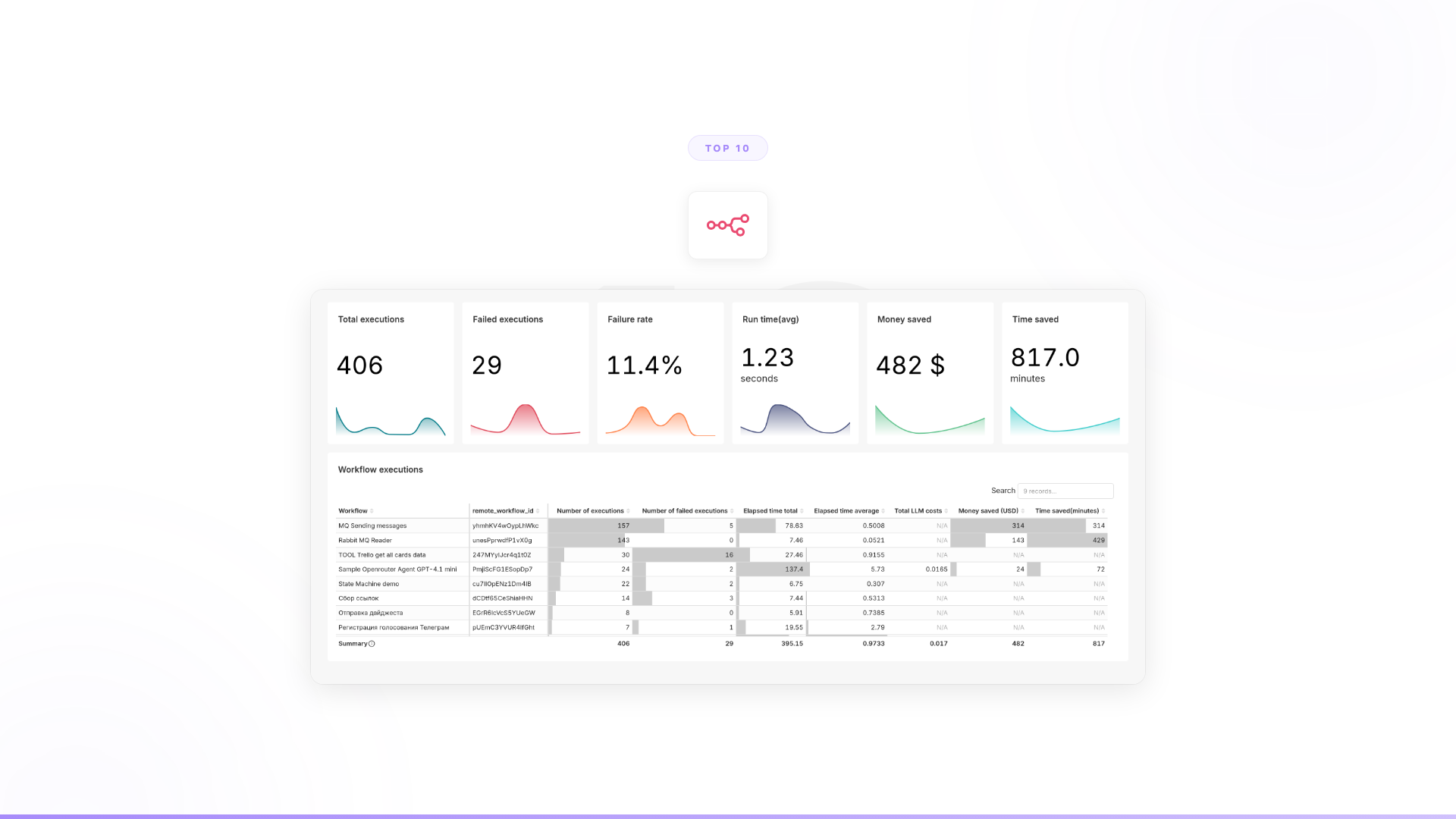
What it is: The fastest-growing open-source workflow automation platform. Visual node-based builder, 400+ integrations, self-hosted or cloud. Fair-code licensed. In October 2025, n8n raised $180M in Series C funding at a $2.5B valuation, led by Accel with participation from NVIDIA Ventures — a signal of where enterprise-grade workflow tooling is heading (n8n Series C announcement). Native AI agent nodes powered by LangChain add LLM capabilities to workflows.
Where it excels: Developer-friendly workflow automation with full infrastructure control. The visual builder is mature, the community has over 200,000 members, and the integration library covers nearly every major SaaS tool. For technical teams that want to own their automation stack, n8n is the most capable open-source option. The AI nodes allow LLM calls to be embedded in workflows without custom code.
Where it breaks: The moment an input doesn't match expectations — an ambiguous customer message, a compliance edge case, a situation the workflow designer didn't anticipate — n8n errors out or routes to a human. Every new exception demands a new node path. Maintenance complexity scales linearly with workflow complexity. Self-hosting shifts the full compliance and security burden to your team.
Who it's best for: Technical teams that want self-hosted, visual workflow automation for structured, predictable tasks. Teams with DevOps capacity to maintain the infrastructure.
Full Nexus vs n8n comparison -->
2. Apache Airflow
What it is: The industry standard for data pipeline orchestration. Workflows defined as Directed Acyclic Graphs (DAGs) in Python. Built at Airbnb, now an Apache Software Foundation top-level project. 39,000+ GitHub stars and active deployment at thousands of data engineering teams globally.
Where it excels: Batch data pipelines. If you need to extract, transform, and load data across systems on a schedule, Airflow is proven at scale. The Python-native approach is natural for data engineers. The scheduler is mature. The plugin ecosystem covers every major data source and warehouse. Managed options via AWS Managed Workflows for Apache Airflow (MWAA) and Astronomer reduce the infrastructure burden.
Where it breaks: Airflow is purpose-built for data orchestration, not business process automation. It does not handle real-time triggers, interactive workflows, or conversational inputs. DAGs are batch-oriented by design. Error handling is retry-based, not judgment-based. If a pipeline fails in a way that requires interpretation, Airflow retries or stops. It does not reason about what went wrong.
Who it's best for: Data engineering teams that need Python-based batch pipeline orchestration. Not for application integration or business workflows.
3. Temporal
What it is: A durable execution platform for building reliable distributed applications. Workflows survive process restarts, server crashes, and network failures without losing state. SDKs for Go, Java, Python, TypeScript, and .NET. Originally built by the team behind Uber's Cadence workflow system. 13,000+ GitHub stars, with production deployments at Uber, Stripe, Netflix, and Coinbase.
Where it excels: Long-running, mission-critical workflows where durability matters. Payment processing, order fulfillment, multi-step transactions that cannot lose state. Temporal's execution model guarantees that workflows resume exactly where they left off after any failure. For engineering teams building production-grade distributed systems, it is a genuine differentiator.
Where it breaks: Temporal is developer infrastructure, not an automation platform. There is no visual builder, no pre-built integrations, no business user interface. Every workflow is code. Every exception handler is code. The ceiling is higher than n8n because developers can write more sophisticated logic — but the architecture is still deterministic. Ambiguous inputs and judgment calls require human intervention or pre-coded heuristics.
Who it's best for: Engineering teams building durable, long-running distributed workflows. Not for business users or teams without significant engineering capacity.
4. Windmill
What it is: Open-source developer platform for building internal tools, workflows, and scripts. Supports TypeScript, Python, Go, SQL, Bash, and more. Type-safe with auto-generated UIs. Positions itself as a faster, typed alternative to n8n and Retool. 12,000+ GitHub stars.
Where it excels: Speed and developer experience. Windmill scripts execute quickly, types are enforced, and the auto-generated UI means developers can build internal tools without frontend work. The workflow engine handles branching, error routing, and approval flows. For developer teams building internal tooling, Windmill's code-first approach feels natural and reduces boilerplate.
Where it breaks: The same category ceiling as n8n. Workflows follow predefined logic. Exceptions require coded fallback paths. The difference between Windmill and n8n is development experience — code-first versus visual-first — not capability. If automation needs to handle judgment, neither tool reaches there.
Who it's best for: Developer teams that prefer typed, code-first automation over visual node builders. Internal tool development.
5. Prefect
What it is: Modern data workflow orchestration, Python-native. Define flows as decorated Python functions. Built-in observability, scheduling, caching, and retry logic. Positions itself as a developer-friendly alternative to Airflow with less boilerplate. 18,000+ GitHub stars.
Where it excels: Pythonic data orchestration with better developer experience than Airflow. Flows are just Python functions. The observability dashboard is clean. Deployment is more straightforward than Airflow's DAG management. For Python data teams, Prefect reduces friction. A generous free tier and a managed cloud option make the cost structure accessible.
Where it breaks: Same scope as Airflow. Data pipelines, not business processes. No real-time triggers, no conversational workflows, no autonomous decisions. A better developer experience does not change the category. If you need business workflow automation with intelligence, Prefect is the wrong tool.
Who it's best for: Python data teams that want modern, Pythonic pipeline orchestration with less Airflow complexity.
6. Huginn
What it is: Open-source system for building personal automation agents. Huginn agents monitor websites, filter data, and trigger actions based on events. Self-hosted IFTTT for developers, written in Ruby. 44,000+ GitHub stars, reflecting strong developer curiosity — though production enterprise deployments are rare.
Where it excels: Personal automation and web monitoring. Huginn agents can watch web pages for changes, scrape data, send notifications, and chain actions together. For individual productivity automation, it is genuinely useful. The "agents" concept predates modern AI agent platforms and shows how long this problem space has been explored.
Where it breaks: Huginn is a personal tool, not an enterprise platform. No enterprise governance, no compliance features, no team management, no audit trails. The "agents" are scheduled tasks — not intelligent decision-makers. Maintenance is entirely on the deployer. For enterprise use cases, it is not a viable option.
Who it's best for: Individual developers who want self-hosted personal automation. Not for enterprise or team use.
7. Node-RED
What it is: Flow-based programming tool for wiring together hardware devices, APIs, and online services. Originally built by IBM for IoT use cases. Visual editor runs in a browser. Strong in edge computing and IoT scenarios. 21,000+ GitHub stars, with an active community in the industrial automation and IoT space.
Where it excels: IoT and event-driven automation. Node-RED's flow model is well-suited for connecting sensors, devices, and APIs in real time. The visual editor is lightweight. The community has built thousands of nodes for hardware integrations. For edge computing and device automation, it is a natural fit. Community-contributed LLM nodes are beginning to appear, though they are early-stage.
Where it breaks: Node-RED was built for IoT, not enterprise business workflows. No enterprise governance, limited scalability for high-volume processes, no native compliance features. Extending it to business automation requires significant custom development. If your automation needs are business processes — not device orchestration — Node-RED is the wrong tool.
Who it's best for: IoT developers and teams building event-driven automation with hardware integrations.
8. Activepieces
What it is: Open-source, no-code workflow automation platform. Visual builder similar to Zapier and Make. 200+ integrations. Self-hosted or cloud. MIT licensed. Positions itself as the open-source alternative to Zapier for business users. 12,000+ GitHub stars. Includes a native AI piece for OpenAI integration.
Where it excels: Accessibility. Activepieces is the most business-user-friendly open-source automation tool. The visual builder is clean, integrations are easy to configure, and the learning curve is lower than n8n. For teams that want open-source without n8n's developer orientation, Activepieces fills that gap. The MIT license is the most permissive on this list.
Where it breaks: The same rule-based ceiling as every other trigger-action tool. Exceptions break the flow. Judgment stays manual. Activepieces is newer than n8n, with a smaller integration library, which means connector gaps are more likely to appear in production. The simplicity that makes it accessible also limits build complexity.
Who it's best for: Small to mid-size teams that want open-source, no-code workflow automation with a Zapier-like experience.
9. Automatisch
What it is: Open-source workflow automation closely mirroring Zapier's model. Trigger-action flows with a simple visual interface. Self-hosted Zapier replacement. TypeScript-based. 6,000+ GitHub stars.
Where it excels: Simplicity. If you want something that works like Zapier, is self-hosted, and has no licensing cost, Automatisch delivers that. The interface is familiar. Flow setup is straightforward. For teams migrating off Zapier on cost grounds and willing to manage their own hosting, it is a reasonable starting point.
Where it breaks: Early-stage compared to n8n and Activepieces. Fewer integrations, smaller community, less documentation, slower release cadence. Same rule-based architecture ceiling. For enterprise use cases, the maturity gap is significant.
Who it's best for: Individuals or small teams that want a simple, self-hosted Zapier-like tool. Not enterprise-ready.
10. Kestra
What it is: Open-source, declarative orchestration and scheduling platform. Workflows defined in YAML. Supports any language for task execution. Built-in event triggers, scheduling, and monitoring. Positioned as a universal orchestrator for data, infrastructure, and business workflows. 14,000+ GitHub stars, growing rapidly since its 2023 public launch.
Where it excels: Versatility. Kestra's YAML-based, language-agnostic approach means you can orchestrate virtually anything: data pipelines, infrastructure provisioning, microservice coordination, business workflows. The declarative model is clean. The plugin ecosystem is expanding. For teams that want one orchestration layer across multiple use cases, Kestra is compelling.
Where it breaks: YAML-based workflow definitions require developer involvement. No business user interface. Same rule-based architecture: workflows follow predefined logic, exceptions require coded handling. The tool is younger than Airflow and Temporal, with a smaller production track record at scale.
Who it's best for: Engineering teams that want a versatile, language-agnostic orchestration platform and are comfortable with YAML-based workflow definitions.
Which open-source automation tools have AI agent capabilities?
This is where the market is moving fast, and the distinctions matter.
n8n has the most developed native AI integration. AI agent nodes powered by LangChain allow workflows to make LLM calls, chain prompts, and use tools like web search or code execution inside an automation. This is genuinely useful for adding intelligence to specific steps in a structured workflow.
Apache Airflow and Prefect can orchestrate LLM calls as Python tasks. They treat AI calls the same way they treat any other Python function — schedulable, retriable, monitorable. This is useful for batch AI jobs (nightly summarization, document processing pipelines) but is not real-time or conversational.
Temporal can orchestrate LLM calls as activities in a durable workflow. If an AI-driven process needs to be long-running, stateful, and failure-resistant, Temporal is the right infrastructure layer. It does not provide AI capabilities — it provides reliable execution of whatever AI capabilities you build on top.
Activepieces includes a native OpenAI integration piece, making it easy to add text generation to a trigger-action workflow without code.
The key distinction: every tool on this list can call an LLM API. None of them becomes an autonomous agent by doing so. The AI call is one step in a predefined flow — the flow still breaks when the LLM output doesn't match the expected format, and the system still can't exercise judgment. Adding LLM nodes to a rule-based architecture does not change the architecture.
Open-source automation vs enterprise automation platforms: when to use each
Open-source automation tools are appropriate when:
- Workflows are structured and predictable (scheduled reports, data syncs, webhook triggers)
- Your team has DevOps capacity to manage infrastructure, security, and updates
- You need full data residency control and cannot use cloud-hosted tools
- Per-task pricing on commercial platforms is cost-prohibitive at your volume
- The use case is well-defined enough to express entirely in rules
The trade-off becomes unfavorable when:
- Workflows involve exceptions that require interpretation or judgment
- Compliance requirements demand auditable, traceable decisions — not just logs
- The engineering cost of maintaining and extending rule-based workflows exceeds the cost of a commercial platform
- Business users (not developers) need to build, monitor, or adapt automations
- The 90% of enterprise work that is unstructured, conversational, and exception-heavy is where you most need automation
Gartner estimates that structured workflow automation reached 70% organizational adoption by 2025, up from 20% in 2021. The next phase of automation investment is in the unstructured 80-90% of work — where rules cannot go.
Open-source automation tools handle structured workflows. Here's what they miss.
Read the list again. Every tool follows the same architecture: define logic, execute logic, break when reality doesn't match logic. Some define logic visually (n8n, Activepieces, Node-RED). Some define it in Python (Airflow, Prefect). Some define it in code (Temporal, Windmill). Some define it in YAML (Kestra). The interface varies. The ceiling is the same.
The pattern is consistent in production: a team automates the structured 10-20% of their workflows. Speed increases. Errors drop. Then someone asks whether the same approach can handle the compliance review, the customer onboarding exception, the support ticket that requires context from three systems. The answer is always no — not because the tool was built badly, but because the category was built for a different problem.
This is a category problem, not a product problem. Open-source gives you transparency, extensibility, and control. It does not give you intelligence.
What enterprises need beyond open-source automation
Governance and compliance built in, not bolted on
Self-hosted tools mean you build and maintain the compliance stack yourself. Security posture, audit trails, decision traceability, role-based access, regulatory documentation. For enterprises with SOC 2, ISO 27001, ISO 42001, and GDPR requirements, this is a full-time job layered on top of the automation itself.
Nexus provides enterprise-grade compliance natively. Every agent decision is traceable: what data informed it, which rules applied, why it escalated or approved. No configuration required, no self-managed compliance stack.
Intelligent decision-making, not just rule execution
The fundamental gap in every tool on this list: they follow rules, they do not make decisions. When a customer sends an ambiguous message, rule-based automation breaks. When a support ticket involves a situation the designer didn't anticipate, it routes to a human. When compliance requirements change, every affected workflow needs manual rewiring.
Nexus agents combine process execution with conversational intelligence and autonomous decision-making. They reason through exceptions, interpret ambiguous inputs, hold conversations, and adapt when conditions change. The intelligence is the foundation, not an add-on node.
A deployment partner, not just a platform
Open-source communities provide documentation, forums, and issue trackers. They do not provide Forward Deployed Engineers who embed with your team, identify the highest-impact use cases, design agents for your specific reality, and manage the organizational change that adoption requires.
The gap between "we have automation" and "automation is actually delivering business outcomes" is almost never a technology gap. It is an organizational change gap. Community support does not cover that.
What it looks like in production
Orange Group (multi-billion euro telecom, 120,000+ employees) had automation tools in place for customer onboarding. The automation handled the structured path. Non-standard requests, missing data, and ambiguous inputs still required manual intervention. After building autonomous onboarding agents with Nexus: 4-week deployment, 50% conversion improvement, approximately €6M in yearly revenue impact, 100% team adoption.
European telecom (13,000+ employees) had workflow automations running for support operations. The automations worked on the structured path. When compliance entered the picture, they broke. After deploying Nexus agents: 40% of support volume handled autonomously, full regulatory compliance maintained, 12-week deployment.
Worth exploring?
If your team has automated the structured workflows with open-source tools and is hitting the same walls — exceptions keep breaking flows, maintaining brittle rule chains is becoming its own job, compliance requirements are beyond what self-hosted can handle — it may be worth seeing how enterprises made the shift.
Every Nexus engagement starts with a 3-month proof of concept tied to measurable outcomes. Forward Deployed Engineers embed with your team from day one. You see the results before committing.
See the full Nexus vs n8n comparison -->
Frequently asked questions
What is an open-source automation tool?
An open-source automation tool is a software platform whose code is publicly available and freely modifiable. Teams can self-host it, inspect it, and adapt it without per-task licensing fees. Examples include n8n (workflow builder), Apache Airflow (data orchestration), and Temporal (durable execution). The "open-source" label covers several distinct categories — choosing the right one requires understanding which category matches your use case.
What is the best open-source alternative to Zapier?
n8n is the most mature open-source alternative to Zapier for technical teams. It has the largest integration library (400+), the most active community (200,000+ members), and both visual and code-based workflow options. Activepieces is a closer UX match to Zapier for non-technical users. Automatisch is the simplest option for teams migrating from Zapier who want minimal learning curve. None of these tools handle exceptions or judgment the way Zapier-like tools cannot.
Are open-source automation tools free to use?
The software itself is free. The infrastructure is not. Running a self-hosted n8n or Airflow instance requires compute, storage, networking, monitoring, backups, and engineering time for maintenance and upgrades. For low-volume use cases, infrastructure costs are minimal. For enterprise-scale deployments, the total cost of ownership — including developer time — can exceed the cost of a commercial platform. The "free isn't free" calculation matters at scale.
Can open-source automation tools handle AI workflows?
They can call LLM APIs, yes. n8n has native AI agent nodes powered by LangChain. Airflow and Prefect can run LLM calls as Python tasks. Temporal can orchestrate LLM activities durably. But adding an LLM call to a rule-based workflow does not make the workflow intelligent. The automation still follows predefined logic — the LLM output is one step in that logic, and the flow still breaks when the output doesn't match expected parameters. True AI agent behavior (autonomous reasoning, exception handling, contextual decisions) is a different architectural category.
When should I switch from an open-source automation tool to a commercial platform?
When one or more of these is true: (1) exceptions are breaking workflows faster than you can patch them, (2) compliance requirements demand auditability that self-hosted tools cannot provide without significant custom work, (3) the engineering cost of maintaining your automation stack exceeds the cost of a commercial platform, (4) business users need to build or modify automations without engineering involvement, or (5) the use cases you need to automate require judgment — not just rules.
Related reading
- Top 10 n8n alternatives for workflow automation
- n8n vs Make: workflow automation compared
- Nexus vs n8n: full comparison
- Nexus vs Zapier: rule-based automation vs intelligent agents
- How to choose a workflow automation platform
- How to automate business workflows with AI agents
- Top 10 AI tools for business process automation