Top 10 Langdock Alternatives for Enterprise AI in 2026
Langdock gives European teams governed LLM access. But if you need AI that completes workflows, not just answers questions, here are 10 alternatives ranked by what they deliver in production.
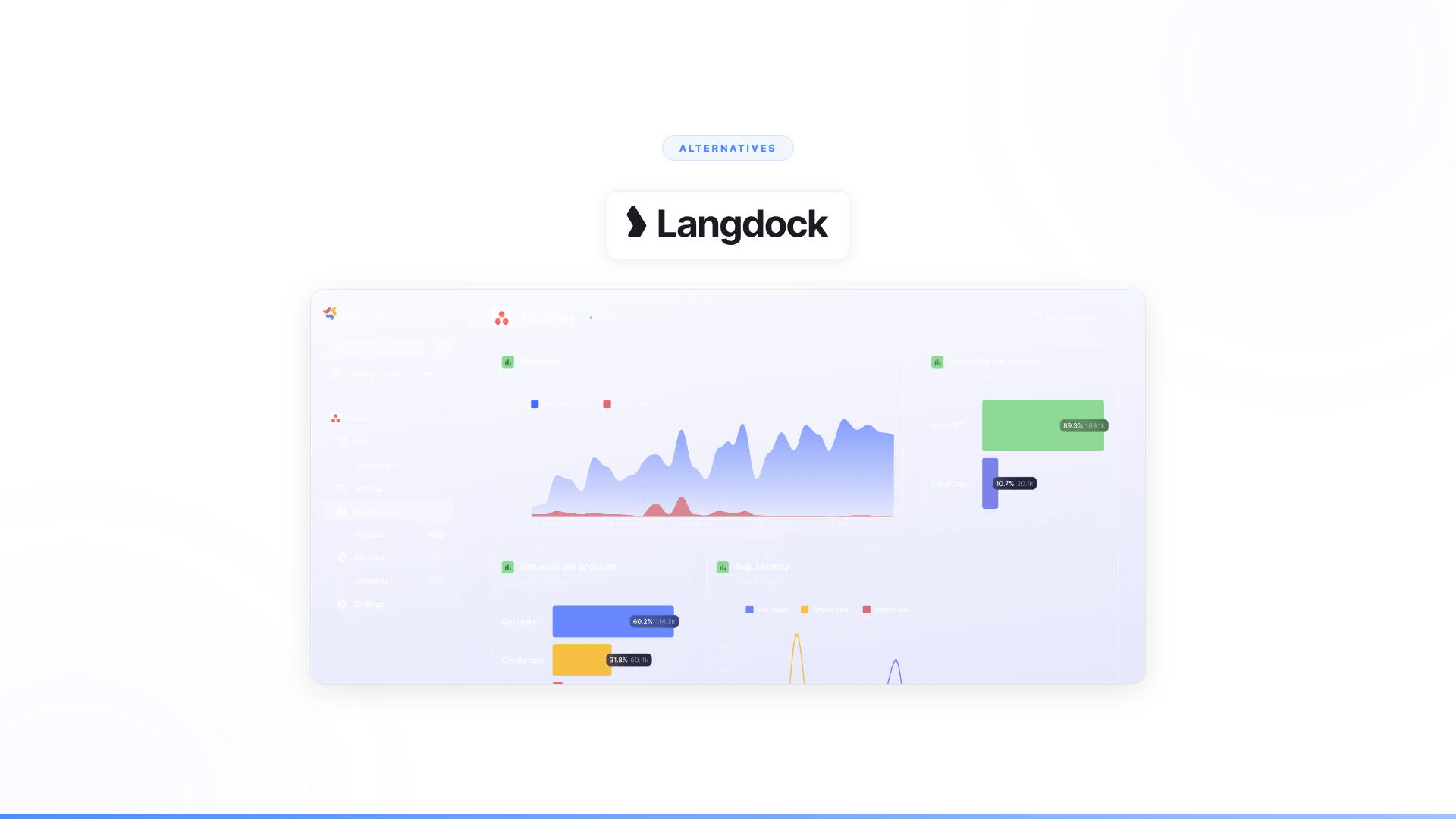
Langdock is a German-built AI assistant platform that connects company knowledge to multiple LLMs, with strong GDPR and EU data residency controls. It has real traction — Merck, Personio, and Der Spiegel are reported customers. The reason enterprises look for alternatives usually comes down to one of two things: they want a different assistant, or they've realized they need something beyond an assistant entirely.
This article covers both cases. Ten alternatives, organized by what they actually do.
What is Langdock used for?
Langdock is an AI workspace for teams. It connects enterprise knowledge sources — Confluence, SharePoint, Google Drive, Notion — to a multi-model chat interface, then gives employees governed access to query that knowledge. The platform is built around GDPR compliance, European data residency, and granular permissions. Teams use it to search internal knowledge, draft documents, and answer questions without copying sensitive data into consumer AI tools.
That's the job it's designed for, and it does it well. The ceiling becomes visible when organizations expect the same platform to complete workflows, not just answer questions about them.
Why do enterprises look for Langdock alternatives?
There are two distinct reasons enterprises evaluate alternatives, and they lead to completely different decisions.
The first: teams want a better or different assistant. Maybe they need stronger enterprise search, a different model selection, deeper Microsoft 365 integration, or tooling that fits a specific workflow like document analysis or content generation. Several alternatives in this list address that directly.
The second: teams have realized that AI assistance hasn't delivered the business transformation they expected. Assistants help individuals work faster. They don't collect data from five systems, validate it against business rules, make a decision, handle an exception, and execute an action. That requires a different category of technology — autonomous agent platforms — not an improved assistant.
Knowing which problem you're solving determines which tool you pick, and whether it will hit the same ceiling Langdock does.
What is the difference between an AI assistant and an AI agent platform?
An AI assistant augments individual work. The employee stays in the driver's seat: they open the interface, ask a question, get a response, and then decide what to do next. Assistants retrieve, draft, and summarize. The human executes.
An AI agent platform automates the full workflow. The agent monitors triggers, collects data across systems, validates against business rules, makes decisions within defined guardrails, handles exceptions, and completes the action — without the employee prompting each step. The human defines the rules; the agent runs the process.
Langdock, Dust, Glean, Microsoft Copilot, Notion AI, and Writer are assistants. Nexus is an agent platform. The distinction matters because no amount of improving an assistant closes the gap — it's a structural difference in how the two categories work.
Quick comparison
| Tool | Category | Best for | Completes workflows? | Pricing model |
|---|---|---|---|---|
| Nexus | Autonomous agent platform | Full enterprise workflow automation across any department | Yes, end-to-end | Per-agent |
| Dust | AI assistant platform | Custom AI assistants for teams | No | Per-user ($29/mo) |
| Glean | Enterprise search + assistant | Finding information across enterprise systems | No | Per-user |
| Microsoft Copilot | AI assistant | Individual productivity inside Microsoft 365 | No | Per-user ($30/mo) |
| Writer | Enterprise AI for content | Content generation and brand compliance | No | Per-user |
| Notion AI | Workspace AI | Teams already using Notion for knowledge management | No | Per-user add-on |
| Copilot Studio | Low-code bot builder | IT teams building chatbots within Microsoft ecosystem | Partial (scripted) | Per-message |
| Moveworks | IT self-service assistant | IT helpdesk ticket deflection | Partial (IT only) | Per-employee |
| Hebbia | AI for deep document analysis | Financial, legal, and research document processing | No | Enterprise license |
| Custom build | Developer framework | Engineering teams building from scratch | Depends on team | Engineering cost |
The alternatives, ranked
1. Nexus
What it is: An autonomous agent platform paired with Forward Deployed Engineers who embed with your team. Nexus agents complete entire business workflows end-to-end: collecting data from multiple systems, validating against business rules, making decisions within guardrails, handling exceptions, and executing actions. Any department. Any workflow. Business teams build and own the agents.
Why enterprises move from Langdock to Nexus:
The distinction isn't about features. It's about categories. Langdock helps individuals find information and draft content through AI chat. Nexus agents complete the full workflows that information supports. An assistant helps someone look up the customer onboarding procedure. An agent performs the onboarding: collecting data via WhatsApp, validating compatibility in the ERP, routing exceptions, notifying stakeholders, and logging the outcome. One answers questions about work. The other does the work.
What it looks like in production:
- Orange Group (multi-billion euro telecom, 120,000+ employees): Business team built autonomous customer onboarding agents. Deployed across multiple European markets in 4 weeks. 50% conversion improvement. Approximately €5–6M yearly revenue impact (Nexus client data). 90% autonomous resolution. 100% team adoption. They previously used a CX chatbot with a 27% drop-out rate.
- A major AI infrastructure company: Their CTO evaluated building internally but chose Nexus instead. Agents now monitor 12,000+ accounts, synthesize buying signals, and surface pipeline opportunities autonomously. Over $4B in pipeline discovered. 24,000+ hours of research capacity added annually. Built by a non-engineer (Nexus client data).
- European telecom (13,000+ employees): Spent 6 months with Copilot Studio and could not deliver a single production use case. Deployed a dozen Nexus agents in the same timeframe. 40% of support volume freed across millions of interactions (Nexus client data).
How it differs from Langdock specifically:
Langdock is per-seat (starting at approximately EUR 25/user/month). Nexus is per-agent, tied to value delivered. An agent serving millions of customers costs the same whether you have 500 or 50,000 employees. Langdock connects to knowledge sources for read-only search. Nexus connects to 4,000+ enterprise systems with full read and write access. Langdock requires employees to open a chat interface and ask questions. Nexus agents deploy into the channels teams already use — Slack, Teams, WhatsApp, email, phone, web — and complete work as it arrives.
Best for: Enterprises that need AI to complete high-volume business processes, not just help individuals find answers. Sales, support, compliance, HR, onboarding, operations, reporting.
Full Nexus vs Langdock comparison -->
2. Dust
What it is: An AI assistant platform that lets teams build custom assistants connected to their data sources. More configurable than Langdock in some areas. You can create role-specific assistants — sales assistant, support assistant, engineering assistant — that pull from your internal knowledge.
How it compares to Langdock: Similar category, slightly different strengths. Dust focuses on custom assistant building with deeper integration hooks. Langdock focuses on multi-model flexibility and European data residency. Both connect to company knowledge and give teams a chat interface. If you want more control over assistant behavior and data source configuration, Dust may fit better. If EU data residency and model choice are the priority, Langdock has the edge.
Why it might not solve the problem: Same structural ceiling. Dust is an assistant platform. Better at answering questions and generating context-aware content, but it doesn't complete multi-step workflows, make decisions, handle exceptions, or execute actions across systems. If you're leaving Langdock because assistants haven't transformed your business processes, a better assistant won't close that gap.
Pricing: $29/user/month (Pro), custom enterprise pricing.
Best for: Teams that want customizable AI assistants with broader integration options, and whose work doesn't require autonomous workflow completion.
Full Nexus vs Dust comparison -->
3. Glean
What it is: Enterprise AI search and knowledge assistant. Connects to 100+ enterprise data sources — Confluence, Slack, Drive, SharePoint, Salesforce, Jira — and lets employees search across all of them with natural language. Also generates answers from your company's knowledge.
How it compares to Langdock: Glean is genuinely stronger at enterprise-wide search. It indexes more systems, has deeper connectors, and is purpose-built for finding information across large organizations. Where Langdock excels at multi-model chat with company context, Glean excels at making every piece of company knowledge instantly findable. For knowledge workers who spend hours hunting for information across tools, Glean saves real time.
Why it might not solve the problem: Finding information is one step in a larger process. Glean tells you the answer. It doesn't act on it. If the bottleneck is what happens after someone finds the information — validation, decisions, cross-system actions, exception handling — Glean doesn't reach there.
Pricing: Per-user, custom enterprise pricing. Reportedly $15–25/user/month depending on scale.
Best for: Enterprises where information discovery across many systems is the primary bottleneck, and the work after discovery is already handled.
Full Nexus vs Glean comparison -->
4. Microsoft Copilot
What it is: Microsoft's AI assistant embedded across Microsoft 365. Drafts emails in Outlook, summarizes meetings in Teams, generates slides in PowerPoint, analyzes data in Excel.
How it compares to Langdock: Different positioning, same category. Copilot is locked to Microsoft 365 but deeply embedded in that ecosystem. Langdock is ecosystem-agnostic and offers multi-model flexibility. For Microsoft-heavy organizations, Copilot is the native option. For teams that use diverse tools and want model choice, Langdock is more flexible.
The deployment data is telling: according to Gartner's 2025 Microsoft 365 and Copilot Survey, only 5–6% of organizations that completed Copilot pilots moved to larger-scale deployment (Gartner, 2025). The structural ceiling is the same as any assistant.
Why it might not solve the problem: If you're leaving Langdock because assistants haven't delivered business transformation, Copilot is the same category with tighter ecosystem constraints. The adoption pattern will likely repeat.
Pricing: $30/user/month (Microsoft 365 Copilot).
Best for: Microsoft 365 organizations that want deeply embedded AI assistance and don't need cross-system workflow completion.
See our full Microsoft Copilot alternatives breakdown -->
5. Writer
What it is: Enterprise AI platform focused on content generation with brand governance. Generates marketing copy, reports, and communications that follow your brand guidelines, tone, and terminology. Includes Palmyra (their proprietary LLM) and application-building tools.
How it compares to Langdock: Writer is more specialized. Where Langdock is a general-purpose AI assistant, Writer focuses specifically on content teams and brand-consistent output. For marketing, communications, and content teams, Writer produces better results for that specific job. But it doesn't try to be a general knowledge assistant across the organization.
Why it might not solve the problem: Content generation is one task. If the real bottleneck is the business process around content — approvals, compliance checks, distribution, performance tracking, iteration — Writer handles the generation step but not the workflow around it.
Pricing: Per-user, custom enterprise pricing.
Best for: Marketing and communications teams where content generation quality and brand consistency are the primary need.
6. Notion AI
What it is: AI features built into Notion's workspace platform. Summarizes pages, answers questions from your Notion knowledge base, generates content, and helps manage information within the Notion ecosystem.
How it compares to Langdock: If your team already lives in Notion, Notion AI is the native option. It understands your Notion workspace deeply and integrates seamlessly into the tools you're already using. Langdock is broader — connects to Notion plus many other sources — and offers multi-model choice, but requires a separate interface. For Notion-centric teams, the native experience is often more natural and generates less friction.
Why it might not solve the problem: Even more constrained than Langdock. Notion AI operates within Notion. It doesn't reach into Salesforce, SAP, or your CRM. And it's an assistant: it helps individuals work faster within a single tool, not complete cross-system workflows.
Pricing: $10/user/month as a Notion add-on.
Best for: Notion-centric teams that want AI-assisted productivity within their existing workspace.
7. Copilot Studio
What it is: Microsoft's low-code platform for building custom chatbots and conversational AI. Part of the Power Platform ecosystem. Lets IT teams design bot flows, connect to enterprise data, and deploy across Microsoft channels.
How it compares to Langdock: Different approach. Langdock is a ready-to-use assistant platform. Copilot Studio is a builder for custom bots. If you want to design specific conversational flows with branching logic, Copilot Studio gives you more control. If you want to deploy AI chat quickly across the organization, Langdock is faster.
Why it might not solve the problem: Enterprise reality is messy. Copilot Studio works well for simple, scripted flows but struggles with complex, multi-system processes. A major European telecom with 13,000+ employees spent 6 months with Copilot Studio and could not deliver a single production use case. They then deployed a dozen Nexus agents in the same timeframe, freeing 40% of support volume. The issue isn't the tool. It's that scripted bot flows can't handle the exceptions and edge cases that define real enterprise workflows.
Pricing: Per-message pricing, with Microsoft 365 Copilot licenses including limited Copilot Studio usage.
Best for: Microsoft-native IT teams building simple, scripted chatbot flows that don't require deep cross-system execution.
8. Moveworks (ServiceNow)
What it is: AI-powered IT self-service assistant, now owned by ServiceNow. Employees ask questions — "how do I reset my VPN?", "can I get access to Salesforce?" — and Moveworks resolves or routes the request automatically. Purpose-built for IT helpdesk ticket deflection.
How it compares to Langdock: Completely different focus. Langdock is a general-purpose assistant for knowledge access. Moveworks is specialized for IT support. For IT helpdesk automation, Moveworks is significantly more capable. For everything else, it doesn't apply.
Why it might not solve the problem: Scope. Moveworks handles IT and employee service requests. It doesn't touch sales workflows, customer onboarding, compliance monitoring, or any process outside the IT helpdesk. And it's now fully part of the ServiceNow ecosystem, which means you're buying into that platform's roadmap and pricing.
Pricing: Per-employee licensing ($100–200/employee/year).
Best for: ServiceNow-native organizations where IT ticket deflection is the primary AI use case.
9. Hebbia
What it is: AI platform purpose-built for deep document analysis. Specializes in processing large volumes of complex documents — financial filings, legal contracts, research reports — and extracting structured insights from unstructured data.
How it compares to Langdock: Different job entirely. Langdock helps employees chat with company knowledge. Hebbia is built for analysts, researchers, and compliance teams who need to process hundreds or thousands of documents and extract specific data points. For financial due diligence, regulatory analysis, and research workflows, Hebbia goes deeper than any general-purpose assistant.
Why it might not solve the problem: Hebbia excels at document analysis but doesn't handle the broader enterprise workflows around that analysis. It can extract data from 500 contracts. It doesn't route the results, trigger follow-up actions, or update systems. The analysis is excellent; the execution afterward is still manual.
Pricing: Enterprise licensing, custom pricing.
Best for: Financial services, legal, and research teams that need deep document analysis at scale.
10. Custom build (LangChain, CrewAI)
What it is: Open-source frameworks for building AI applications from scratch. Your engineering team designs the architecture, writes the code, handles deployment, monitoring, security, governance, and maintenance.
How it compares to Langdock: Maximum flexibility but maximum effort. You can build exactly what you need, including things that go beyond the assistant category. For organizations with strong AI engineering teams, building custom can produce something Langdock can't: autonomous agents that complete workflows.
Why it might not solve the problem: Most enterprises don't have surplus AI engineering capacity. A world-class AI infrastructure company with strong internal engineering considered building agents internally but chose to work with Nexus instead — the opportunity cost of diverting core engineers was too high. Custom builds also require you to solve governance, security, compliance, monitoring, and maintenance yourself. What looks like a 3-month project often becomes 12 months with ongoing maintenance.
Pricing: Engineering salaries plus infrastructure. Typically 3–6 months for a first production agent, with ongoing maintenance costs.
Best for: Organizations with dedicated AI engineering teams, unique technical requirements, and timelines that can absorb 6+ months of development.
When Langdock is the right choice
This article is written from the perspective of companies evaluating alternatives. That's worth balancing.
Langdock is a well-executed product. For European enterprises that need governed, multi-model AI access across team knowledge, with strong GDPR compliance and a clean user experience, Langdock is a legitimate fit. The Europe AI assistant software market is growing at a 16.6% CAGR through 2032 (KBV Research), and Germany-based Langdock is well positioned for organizations prioritizing EU data sovereignty.
If the primary requirement is: give our employees a governed way to chat with our internal knowledge across multiple LLMs, without data leaving European infrastructure — Langdock serves that use case well. Several large German and European enterprises use it for exactly that.
The alternatives in this list are relevant when that use case is insufficient, not when it's the wrong fit.
So which alternative should you actually choose?
The answer depends on what problem you're solving. Being precise about that saves months of evaluation.
If the problem is knowledge access and you want a better or different assistant, look at Dust (custom assistants), Glean (enterprise search), Microsoft Copilot (Microsoft 365 native), or Notion AI (if you're Notion-native). These are solid assistants that may fit your specific environment better than Langdock. They share the same structural ceiling: they help individuals, they don't complete workflows.
If the problem is content quality, Writer is purpose-built for that. Specialized and effective within its scope.
If the problem is IT support automation, Moveworks is the targeted tool.
If the problem is deep document analysis, Hebbia goes further than any general-purpose assistant.
If the problem is that AI assistants haven't delivered the business process transformation leadership expected — and you need AI that completes high-volume, multi-step workflows across systems while making decisions, handling exceptions, and maintaining full compliance — that's a different category of problem entirely. That's what Nexus was built for.
Orange didn't need a better assistant. They needed agents that complete customer onboarding autonomously. 50% conversion improvement. 4-week deployment. 100% team adoption.
A major European telecom didn't need another pilot. They spent 6 months with Copilot Studio and couldn't deliver. Then they deployed a dozen Nexus agents. 40% of support volume freed.
The gap between an assistant and an agent isn't a feature gap. It's a category gap. No amount of improving the assistant closes it.
Frequently asked questions
What is the difference between Langdock and an AI agent platform?
Langdock is an AI workspace where employees chat with AI assistants using company knowledge. Agent platforms like Nexus run autonomous multi-step workflows — collecting data, making decisions, executing actions — without human prompting at each step. Assistants augment individual work. Agents complete processes.
Is Langdock suitable for enterprise automation?
Langdock is strong for knowledge retrieval and assisted drafting inside team workspaces. For end-to-end workflow automation that spans multiple systems and departments — for example, a customer onboarding process that touches a CRM, ERP, WhatsApp, and a compliance database — enterprises typically need a dedicated agent platform rather than an AI assistant.
What are the main reasons enterprises switch from Langdock?
The most common reason is that assistants haven't delivered the business process transformation leadership expected. Specifically when workflows require cross-system integration, autonomous decision-making, or exception handling that sits outside what an AI chat interface can do. A secondary reason is ecosystem fit: teams deeply embedded in Microsoft 365, Notion, or a specific document workflow often find a more native tool works better for their context.
How much does Langdock cost?
Langdock pricing starts at approximately EUR 15–25 per user per month, with enterprise plans available for larger teams. The company operates on a per-seat model, meaning costs scale with headcount. Nexus, by contrast, is priced per agent — a model that becomes more cost-effective at scale when an agent is serving large customer or employee populations.
Can Langdock replace tools like Microsoft Copilot or ChatGPT Enterprise?
Langdock positions as a team AI workspace with stronger data control and customization than Microsoft Copilot or ChatGPT Enterprise. It connects to more enterprise data sources, allows more granular permissions, and is built for GDPR compliance and EU data residency. For European teams with data sovereignty requirements, Langdock is often the stronger choice over US-hosted alternatives. Both operate in the same assistant category, however — neither completes autonomous workflows.
Worth exploring?
Every Nexus engagement starts with a 3-month proof of concept tied to measurable outcomes. Forward Deployed Engineers embed with your team from day one. You see the results before committing. You can exit anytime.
See the full Nexus vs Langdock comparison -->