Top 10 AI Agent Platforms for Enterprise in 2026
Most "agent platforms" are really assistant builders or developer frameworks. Here are 10 enterprise AI agent platforms ranked by what they actually deliver in production, from autonomous workflow completion to DIY toolkits.
The best AI agent platforms for enterprise in 2026 are Nexus (autonomous workflow completion with embedded engineers), Microsoft Copilot Studio (Microsoft 365 assistant builder), Dust (team AI assistants), Relevance AI (low-code for SMBs), CrewAI (developer framework for multi-agent), AutoGen (Microsoft Research framework), Dify (LLM app builder), Langdock (European teams), Writer (content AI), and custom LangChain/LangGraph builds. Most marketed "agent platforms" are actually assistant builders or developer frameworks — only a few complete autonomous business workflows end-to-end.
The term "AI agent platform" gets applied to at least three fundamentally different categories of product. That makes searching for one genuinely confusing.
Some products marketed as agent platforms are really assistant builders. They help you create AI-powered chat interfaces that answer questions and draft content. Useful, but the AI doesn't complete workflows independently. The human still drives every step.
Some are developer frameworks. They give engineers building blocks (chains, memory, tool use) to construct agents from scratch. Powerful if you have a dedicated AI team. Not a platform in any enterprise sense: no governance, no compliance, no integrations, no support.
And some are actual agent platforms. They let organizations deploy AI that autonomously completes multi-step business processes: collecting data, validating it, making decisions within guardrails, handling exceptions, and executing actions across enterprise systems.
The category you actually need determines which platform fits. Here are 10 options, organized by what they really are.
Why this list includes assistant builders and frameworks: "AI agent platform" is searched by buyers who may actually need any of these three categories. We've included all three and labeled them clearly so you can quickly identify which lane each product occupies — and whether it matches what you're actually looking for.
Quick comparison
| Platform | Real category | Best for | Autonomous workflow completion | Embedded engineering support | Time to first production agent |
|---|---|---|---|---|---|
| Nexus | Autonomous agent platform + service | Full enterprise workflow automation, any department | Yes, end-to-end | Yes (Forward Deployed Engineers) | 2–6 weeks |
| Microsoft Copilot Studio | Assistant builder | Custom copilots inside Microsoft 365 | No | No | Weeks to months |
| Dust | AI assistant platform | Knowledge-connected assistants for teams | No | No | Days to weeks |
| Relevance AI | Low-code agent builder | Sales and support automation for SMBs | Partial (single-domain) | No | Days to weeks |
| CrewAI | Developer framework | Multi-agent orchestration for engineers | Depends on build | No | 3–6 months |
| AutoGen (Microsoft) | Research framework | AI research teams building multi-agent systems | Depends on build | No | 3–6 months |
| Dify | LLM app builder | Prototyping AI applications quickly | Limited | No | Days to weeks |
| Langdock | AI assistant platform | European teams wanting LLM flexibility | No | No | Days to weeks |
| Writer | Enterprise AI for content | Content generation and brand governance | No | No | Weeks |
| Custom build | Developer framework | Engineering teams with unique requirements | Depends on team | Self-built | 6–12 months |
The platforms, ranked
1. Nexus
What it is: An autonomous agent platform paired with Forward Deployed Engineers who embed with your team. Nexus agents complete entire business workflows end-to-end: collecting data from multiple systems, validating against business rules, making decisions within guardrails, handling exceptions, and executing actions. Any department. Any workflow. Business teams build and own the agents.
Why it ranks first:
Most entries on this list require you to choose between two things: enterprise readiness (governance, compliance, integrations, support) and actual autonomous capability (completing workflows, making decisions, handling exceptions). Developer frameworks give you autonomy without enterprise infrastructure. Assistant platforms give you enterprise features without autonomy. Nexus doesn't require that tradeoff.
The platform connects to 4,000+ enterprise systems with full read and write access. Agents deploy into the channels teams already use (Slack, Teams, WhatsApp, email, phone, web). Every agent decision is logged with full audit trails. SOC 2 Type II, ISO 27001, ISO 42001, GDPR certified. And because deploying AI at scale is 10% technology and 90% organizational change, every engagement includes Forward Deployed Engineers who embed with your team.
What it looks like in production:
- Orange Group (multi-billion euro telecom, 120,000+ employees): Business team built autonomous customer onboarding agents. Deployed across multiple European markets in 4 weeks. 50% conversion improvement. ~$6M+ yearly revenue. 90% autonomous resolution. 100% team adoption. (per Nexus engagement data)
- European telecom (13,000+ employees): Spent 6 months with Copilot Studio, couldn't deliver a single production use case. Deployed a dozen Nexus agents in the same timeframe. 40% support volume freed across millions of interactions. (per Nexus engagement data)
Pricing: Per-agent, tied to value delivered. Not per-seat. Every engagement starts with a 3-month POC tied to measurable outcomes. 100% POC-to-contract conversion rate. (per Nexus internal metric)
Best for: Enterprises that need AI to complete high-volume business processes across systems, with governance, compliance, and embedded engineering support from day one.
2. Microsoft Copilot Studio
What it is: Microsoft's platform for building custom copilots (AI assistants) within the Microsoft ecosystem. Extends Copilot for Microsoft 365 with custom topics, knowledge sources, and connectors to Dataverse, Power Automate, and Azure services.
What it really is: An assistant builder, not an agent platform. You can create chatbots that answer questions and trigger Power Automate flows, but the AI doesn't autonomously complete multi-step workflows with decision-making and exception handling. It's a more customizable version of Copilot, constrained to the Microsoft ecosystem.
Why enterprises hit the ceiling: A major European telecom spent 6 months with Copilot Studio and couldn't deliver a single production use case. The platform is designed for building conversational interfaces, not autonomous agents that orchestrate across CRMs, ERPs, and communication channels. If your entire stack is Microsoft and your use cases are simple Q&A with basic automation triggers, Copilot Studio works. For anything deeper, the architecture doesn't support it.
Gartner names Microsoft the "Company to Beat in the Enterprisewide AI Race" — citing its ecosystem control and governance platform. That ecosystem strength is also the constraint: Copilot Studio is optimized for depth inside Microsoft, not breadth across heterogeneous enterprise stacks. (Gartner, December 2025)
Pricing: Included with some Microsoft 365 plans; per-message pricing for standalone ($200/month for 25,000 messages).
Best for: Microsoft-native organizations building simple chatbots and FAQ assistants within the Microsoft ecosystem.
See how Nexus compares to Copilot -->
3. Dust
What it is: An AI assistant platform that connects your company's knowledge (Notion, Slack, Google Drive, Confluence) to large language models. Teams build custom assistants that understand company context and interact through chat. Paris-based, Sequoia-backed, raised $16M in its Series A round in 2024.
What it really is: A well-designed assistant platform, not an agent platform. Dust helps individuals find information, draft content, and get AI-assisted answers. Recent additions (scheduled agents, MCP actions, webhook triggers) move toward automation, but the architecture still centers on a human asking questions and receiving answers with limited write actions bolted on.
Why it's not an agent platform: Adding action capabilities to a chat interface doesn't make it an agent. The human is still in the loop for every decision. There's no autonomous multi-step workflow execution, no cross-system orchestration across CRMs and ERPs, no independent decision-making within guardrails. Dust is a solid assistant that now has some automation features. That's different from a platform built for autonomous work.
Pricing: $29/user/month (Pro), custom enterprise pricing.
Best for: Teams that need a knowledge layer and AI-assisted productivity for individuals, especially European organizations that value data residency.
Full Nexus vs Dust comparison -->
4. Relevance AI
What it is: A low-code platform for building AI agents (called "workers") focused on sales and support. Lets non-technical users create agents that handle specific tasks like lead research, outreach, or support ticket triage. Australian company, growing in the SMB and mid-market segment.
What it really is: A focused agent builder for specific domains. Relevance AI is closer to a true agent platform than the assistant builders above: agents can take actions, not just answer questions. But the scope is narrower than enterprise-wide workflow automation. Most use cases center on sales automation and support.
Why enterprises may outgrow it: The platform is strongest for SMB sales and support workflows. For enterprises that need agents spanning compliance, HR, operations, finance, and customer onboarding across CRMs, ERPs, and custom systems, the integration depth and governance layer may not be sufficient. No embedded engineering support, which matters when you're deploying agents that make autonomous decisions at scale.
Pricing: Free tier available; paid plans from $19/month. Enterprise pricing custom.
Best for: SMBs and mid-market teams wanting to automate specific sales and support tasks without engineering.
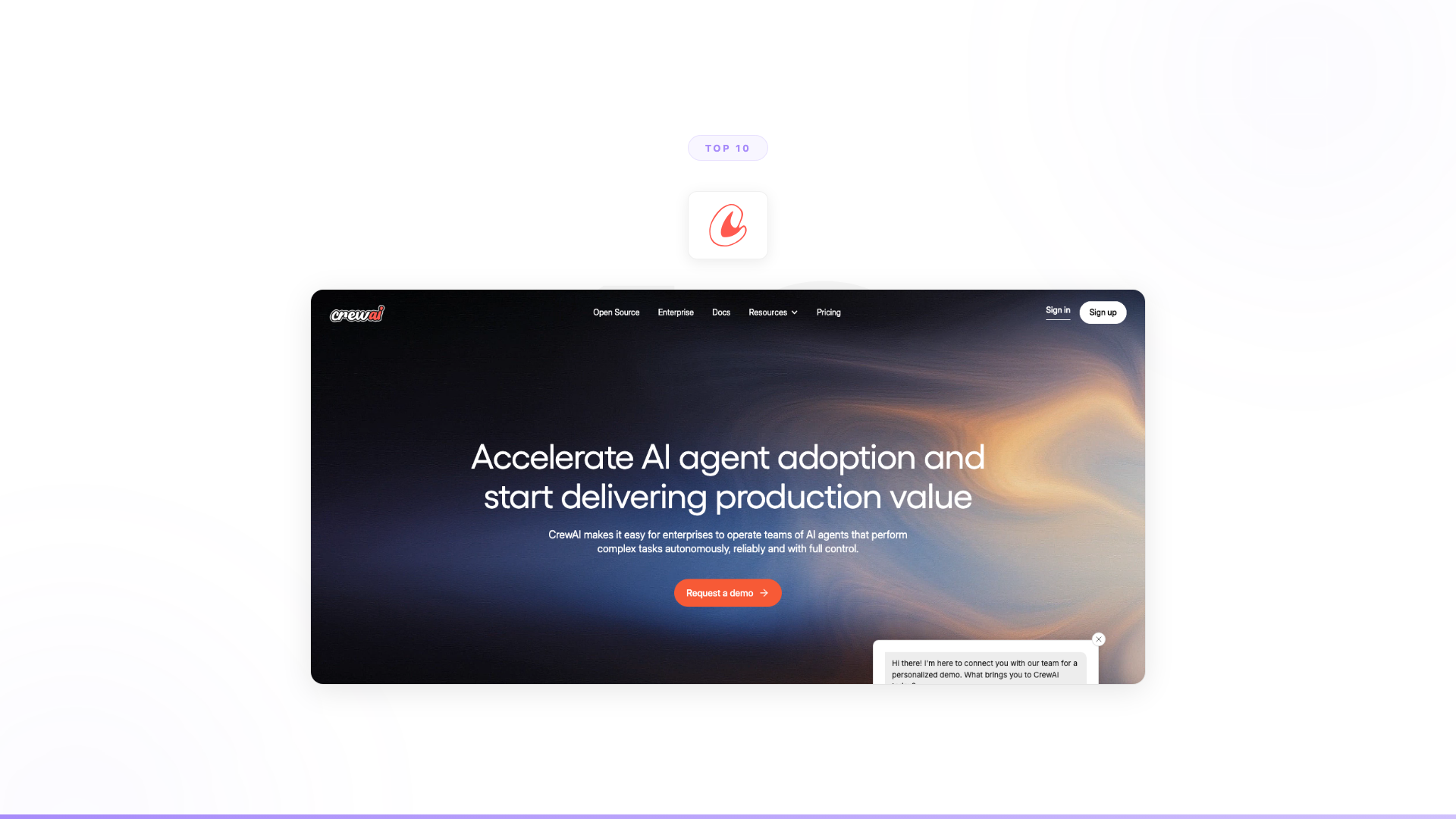
5. CrewAI
What it is: An open-source Python framework for building multi-agent systems. Lets developers define agents with specific roles, give them tools, and orchestrate them to work together on tasks. Strong community adoption among AI developers; also offers CrewAI+ as a commercial enterprise tier.
What it really is: A developer framework, not an enterprise platform. CrewAI gives engineers the building blocks to create multi-agent workflows. There's no built-in governance, compliance, integration marketplace, deployment infrastructure, or support model. Everything beyond the orchestration logic is your engineering team's responsibility.
Why enterprises should be cautious: The framework itself is capable. The gap is everything around it. To go from CrewAI code to production enterprise agents, you need to build: authentication and authorization, audit logging, integration connectors for your specific systems, monitoring and alerting, error handling and retry logic, compliance controls, deployment infrastructure, and ongoing maintenance. That's 6–12 months of engineering for most teams — before a single production use case ships.
Pricing: Open-source (free). Enterprise offering (CrewAI+) available.
Best for: AI engineering teams that want a multi-agent orchestration framework and have the capacity to build everything else.
6. AutoGen (Microsoft)
What it is: Microsoft Research's open-source framework for building multi-agent AI systems. Focuses on agent conversations: agents talk to each other and to humans to complete tasks. Strong research foundation with academic backing.
What it really is: A research-grade framework for multi-agent experimentation. AutoGen is excellent for exploring what's possible with agent-to-agent communication patterns. It's the most architecturally ambitious framework on this list. But it's built for researchers and AI engineers, not for business teams deploying production agents.
Why it's not enterprise-ready: AutoGen is designed for exploration, not production deployment. No built-in enterprise integrations, no governance layer, no compliance controls, no deployment infrastructure. The learning curve is steep even for experienced engineers. If you're a research team studying multi-agent patterns, AutoGen is a strong choice. If you need agents completing business workflows next quarter, this isn't the starting point.
Pricing: Open-source (free).
Best for: AI research teams exploring multi-agent architectures and conversation patterns.
7. Dify
What it is: An open-source LLM application development platform. Drag-and-drop interface for building AI applications including chatbots, agents, and workflow automations. Self-hostable with a cloud option. Growing community, particularly in Asia and among teams that want model flexibility.
What it really is: An LLM app builder that includes agent features. Dify makes it easy to prototype AI applications quickly: connect an LLM, define a workflow, add tool use, deploy. The visual workflow builder is well-designed. But it's a development platform for building individual AI apps, not an enterprise agent platform with governance and deep integrations.
Why enterprises may need more: Dify is strong for prototyping and simple agent workflows. For enterprise deployment (4,000+ system integrations, compliance controls, audit trails, multi-channel deployment, embedded engineering support), the platform would need significant additional infrastructure built on top. It's a good starting point for technical teams exploring what agents can do. It's not a replacement for a production enterprise platform.
Pricing: Open-source (free self-hosted); cloud plans from $59/month.
Best for: Technical teams that want to rapidly prototype AI applications and agent workflows.
8. Langdock
What it is: A European AI assistant platform that lets teams use multiple LLMs (GPT-4, Claude, Mistral) through a single interface with enterprise security controls. Berlin-based. SOC 2, GDPR-compliant. Used by large European enterprises including Merck, where it reached 33,000 monthly active users.
What it really is: An AI assistant platform, similar to Dust in category. Langdock differentiates on LLM flexibility (choose your model per task) and its German/EU data residency positioning. It helps individuals interact with AI using company context. It doesn't complete workflows autonomously.
Why it's listed here: Langdock appears in agent platform searches because they use "AI agents" in their marketing. But the product is an assistant platform: employees ask questions, get answers, and draft content. The AI doesn't independently execute multi-step business processes across systems.
Pricing: Per-user, custom enterprise pricing.
Best for: European organizations that want LLM flexibility and strong data residency controls in a team-level AI assistant.
9. Writer
What it is: Enterprise AI platform focused on content generation with brand governance. Includes Palmyra (proprietary LLM), AI application building tools, and knowledge graph integration. Serves large enterprise marketing and communications teams.
What it really is: A content-focused AI platform with an application builder. Writer's strength is generating on-brand content at scale: marketing copy, reports, communications. Their application builder (AI Studio) lets teams create workflows around content, but the platform's DNA is content generation, not cross-system workflow automation.
Why it shows up in agent platform searches: Writer has expanded from pure content generation to include "AI agents" that complete content workflows. These are more focused than general-purpose enterprise agents: they handle content-related processes (review, approval, generation, compliance) rather than arbitrary business workflows across CRMs, ERPs, and communication systems.
Pricing: Per-user, custom enterprise pricing.
Best for: Marketing and communications teams that need AI-powered content generation with brand governance and content-specific workflows.
10. Custom build (LangChain, LangGraph)
What it is: Open-source frameworks for building AI agent applications from scratch. LangChain provides the component library. LangGraph provides the stateful orchestration layer for complex agent workflows. Your engineering team designs, builds, deploys, and maintains everything.
What it really is: The most flexible option and the most expensive in fully-loaded engineering cost. You can build exactly what you need. No constraints from a vendor's architecture. But you're responsible for everything: integrations, governance, compliance, monitoring, security, deployment, and ongoing maintenance.
Why most enterprises shouldn't start here: The opportunity cost calculation is straightforward. Most enterprises don't have surplus AI engineering capacity. Custom builds typically take 3–6 months for a first production agent, with ongoing maintenance costs that compound over time. Gartner predicts over 40% of agentic AI projects will be canceled by end of 2027 due to escalating costs, unclear business value, or inadequate risk controls — and custom builds face the highest cost and governance risk of any approach on this list. (Gartner, June 2025)
When it makes sense: If you have genuinely unique technical requirements that no platform can accommodate, a dedicated AI engineering team with surplus capacity, and a timeline that can absorb 6+ months of development. Some companies need this. Most don't.
Pricing: Engineering salaries + infrastructure. Typically $200K–500K+ for a first production agent when you account for fully-loaded engineering costs.
Best for: Organizations with dedicated AI engineering teams, truly unique requirements, and long timelines.
How to choose an AI agent platform for enterprise
Every platform on this list calls itself an "AI agent platform" somewhere in its marketing. Three questions separate the categories.
Does the AI complete work, or does it help a human complete work?
If the human drives every step and the AI provides suggestions, drafts, or answers, that's an assistant. If the AI independently collects data, validates it, makes decisions, handles exceptions, and executes actions, that's an agent. Most platforms on this list are assistants that have added the word "agent" to their positioning.
Gartner defines agentic AI as systems that "autonomously plan and take actions to complete goals without step-by-step human instruction." By that definition, most platforms marketed as agent platforms don't qualify. (Gartner, Top Strategic Technology Trends 2025)
Can business teams build and deploy agents, or does it require engineers?
Developer frameworks (CrewAI, AutoGen, LangChain) give engineers building blocks. Enterprise platforms give business teams the ability to deploy agents without writing code. If your sales operations lead can't build an agent that completes a workflow in their department, it's a framework, not a platform.
This matters at scale. Gartner predicts 40% of enterprise applications will feature task-specific AI agents by 2026, up from less than 5% in 2025. (Gartner, August 2025) That scale of deployment is only achievable when business teams can build without engineering.
What happens when the agent encounters an exception?
This is where most platforms fall apart. Simple automations break on exceptions. Assistants hand the exception to a human. True agent platforms handle exceptions intelligently: applying business rules, escalating with full context when confidence is low, and adapting within guardrails. Ask every vendor on this list what happens when the agent encounters something unexpected. The answer tells you whether it's an agent or a rule-following bot.
Frequently asked questions
What is an AI agent platform?
An AI agent platform enables organizations to deploy AI that autonomously completes multi-step business processes — collecting data, validating it, making decisions within guardrails, handling exceptions, and executing actions across enterprise systems. This is distinct from AI assistant builders (which create chatbots that answer questions) and developer frameworks (which give engineers building blocks to construct agents from scratch). Gartner defines agentic AI as systems capable of autonomously planning and taking actions to complete goals without step-by-step human instruction.
What is the difference between Microsoft Copilot Studio and a real AI agent platform?
Microsoft Copilot Studio is an assistant builder — it creates AI-powered chat interfaces connected to Microsoft 365 data. It answers questions and drafts content within the Microsoft ecosystem. A real agent platform like Nexus autonomously completes workflows end-to-end: validating compliance, updating CRM records, handling exceptions, and executing actions without human prompting at each step. The practical difference: one European telecom spent 6 months with Copilot Studio without delivering a single production use case, then deployed a dozen Nexus agents in the same timeframe.
Can Dust or Langdock replace an AI agent platform?
Dust and Langdock are AI assistant platforms — they connect LLMs to your company's knowledge base and let employees ask questions or get help drafting content. They don't autonomously complete business workflows. For knowledge access and question-answering, they're capable tools. For autonomous workflow execution across CRMs, ERPs, and communication systems, they're a different category. Adding action buttons to a chat interface doesn't make it an agent.
How long does enterprise AI agent deployment take?
It depends on the approach. True agent platforms like Nexus deploy production agents in 2–6 weeks with Forward Deployed Engineers handling complexity. Low-code builders like Relevance AI take days to weeks for narrow use cases. Developer frameworks (CrewAI, LangGraph) typically require 3–6 months of engineering before a first production agent ships. Microsoft Copilot Studio takes weeks to months for simple workflows but often fails to deliver on complex cross-system processes.
Why do so many AI agent projects fail?
Gartner predicts over 40% of agentic AI projects will be canceled by end of 2027 due to escalating costs, unclear business value, or inadequate risk controls. The most common failure patterns: starting with a developer framework and underestimating the engineering required, choosing an assistant builder for a workflow automation use case, or deploying agents without exception-handling logic that breaks in production. The fix is matching the tool category to the actual requirement — not choosing the most-marketed or most-familiar option.
Worth exploring?
If you've been evaluating agent platforms and finding that most of them are either assistant builders that can't complete workflows or developer frameworks that require months of engineering, you're not wrong. The category is genuinely confusing because the terminology is inconsistent.
Nexus is an autonomous agent platform paired with Forward Deployed Engineers. Agents complete entire business workflows end-to-end. Business teams build and own them. 4,000+ integrations. Full governance and compliance. Every engagement starts with a 3-month POC tied to measurable outcomes.
Orange deployed in 4 weeks — 50% conversion improvement, ~$6M+ yearly revenue. (per Nexus engagement data) A European telecom freed 40% of support volume after 6 months of Copilot Studio delivered nothing. (per Nexus engagement data)
100% POC-to-contract conversion rate. Every client that started a proof of concept committed to an annual contract. (per Nexus internal metric)