Top 10 AI Tools for Enterprise Content Generation in 2026
Generating content is the easy part. The workflow around it (approvals, compliance, distribution, personalization) is what slows enterprises down. Here are 10 tools ranked by what they actually solve.
The best AI tools for enterprise content generation in 2026 include Writer (brand governance and emerging agent capabilities), Jasper ($49–125/month, marketing-focused), Copy.ai (GTM workflow automation), Typeface (brand visual and text content), Grammarly Business ($25/month, editing), Claude for Enterprise (reasoning and nuanced writing), Microsoft Copilot ($30/user/month, Microsoft 365 productivity), Notion AI ($10/month add-on), and Writesonic ($16–33/month, SEO content). Nexus ranks first as the platform that automates the full content workflow beyond generation — approvals, compliance, distribution, and performance tracking — making it the right choice for enterprises whose bottleneck is process, not prose.
Enterprise content teams don't have a generation problem. They have a workflow problem.
The actual writing takes an hour. The process around it — pulling data from three systems before drafting starts, waiting two weeks for legal and compliance review, manually localizing content for six markets, uploading the same asset to four distribution channels, tracking performance across disconnected dashboards — takes two weeks.
AI content tools have made the one-hour part faster. That's genuinely useful. But if the two-week process around each piece stays manual, the overall cycle barely improves. You've optimized the 5% of the process that was already the fastest part.
This is the gap most enterprises hit after adopting AI content tools. Generation speeds up. Everything else stays the same. Content still gets stuck in review queues, compliance still requires manual checks, localization still means copy-pasting into spreadsheets, and nobody can tell you which content is actually driving results.
Here are 10 AI tools for enterprise content, ranked not just by how well they generate content, but by how much of the surrounding workflow they handle.
Quick comparison
| Tool | Category | Content generation | Handles workflow beyond generation? | Pricing model |
|---|---|---|---|---|
| Nexus | Autonomous agent platform | Yes (as part of workflows) | Yes, full process end-to-end | Per-agent |
| Writer | Content AI platform | Strong, with brand voice | Content-adjacent (emerging agents) | Per-seat ($29–39/user/month; custom enterprise) |
| Jasper | Marketing content AI | Strong, marketing-focused | No | Per-seat ($49–125/mo) |
| Copy.ai | Content + GTM workflows | Good, with GTM automation | Partial (sales/marketing focus) | Per-seat ($49/mo; custom enterprise) |
| Typeface | Brand content AI | Strong, visual + text | No | Custom enterprise |
| Grammarly Business | Writing assistant | Editing/improvement only | No | Per-seat ($25/mo) |
| Claude for Enterprise | AI assistant | Excellent reasoning and writing | No | Per-seat (custom enterprise) |
| Microsoft Copilot | Productivity assistant | Generic drafting | No | Per-user ($30/mo) |
| Notion AI | Workspace AI | In-workspace writing | No (Notion only) | $10/mo add-on |
| Writesonic | SEO writing tool | Good for SEO content | No | Per-seat ($16–33/mo) |
What is the best AI content tool for enterprise in 2026?
The answer depends on what you're actually trying to solve.
If your bottleneck is writing quality and brand consistency, Writer is the most purpose-built enterprise content platform available. Brand governance, style guide enforcement, and AI-generated content in a single system. Jasper leads for marketing-focused output at volume — campaigns, ads, social posts, email sequences.
If your bottleneck is reasoning and nuanced writing, Claude for Enterprise (Anthropic) produces the highest-quality long-form content among the tools on this list. Reports, analysis, communications that require judgment rather than just fluency.
If your bottleneck is the workflow around content — not the writing, but the approvals, compliance checks, localization, distribution, and performance tracking — no content generation tool solves that. Nexus agents handle the full process that content is part of.
This distinction matters. Nine of the ten tools on this list solve the generation step. One of them handles the process.
The tools, ranked
1. Nexus
What it is: An autonomous agent platform paired with Forward Deployed Engineers who embed with your team. Nexus agents don't just generate content. They complete the entire business process content is part of: collecting data from multiple systems, running analysis, generating outputs, routing for approval, checking compliance, distributing across channels, and tracking outcomes. Content generation is one step. The agent handles all of them.
A note on this ranking: Nexus doesn't compete on content generation quality. Writer, Jasper, and Claude for Enterprise are the purpose-built tools for that. Nexus ranks first here because enterprise content workflows are primarily a process problem, not a writing problem. If your bottleneck is the workflow around content — not the writing itself — Nexus addresses that directly.
Why it's #1 for enterprise content:
Content operations involve 15–20 steps. Generation is one of them. Every other AI content tool on this list handles that one step and leaves the other 14–19 manual. Nexus agents handle the entire workflow. They pull data from CRMs and data warehouses. They check compliance requirements. They generate content that fits the context. They route it for approval. They handle exceptions: missing data, conflicting requirements, edge cases. They distribute across channels. They report on what happened.
That's not a content tool. It's an agent platform that happens to generate content as part of completing work.
What it looks like in production:
- Orange Group (multi-billion euro telecom, 120,000+ employees): Business team built autonomous customer onboarding agents. Every customer interaction involves personalized content: messages, summaries, compliance documents, internal routing notes. The agents generate all of it as part of completing the onboarding workflow. Deployed in 4 weeks. 50% conversion improvement. ~$6M+ yearly revenue impact. 90% autonomous resolution.
- European telecom (13,000+ employees): A dozen Nexus agents handle customer support interactions that involve generating responses, pulling context from multiple systems, checking policy compliance, and escalating with full written summaries when needed. 40% support volume freed across millions of interactions.
Pricing: Per-agent, tied to value delivered. Not per-seat.
Best for: Enterprises that realize content generation is one step in a larger process and need AI that handles the entire workflow end-to-end.
See the full Nexus vs Writer comparison -->
2. Writer
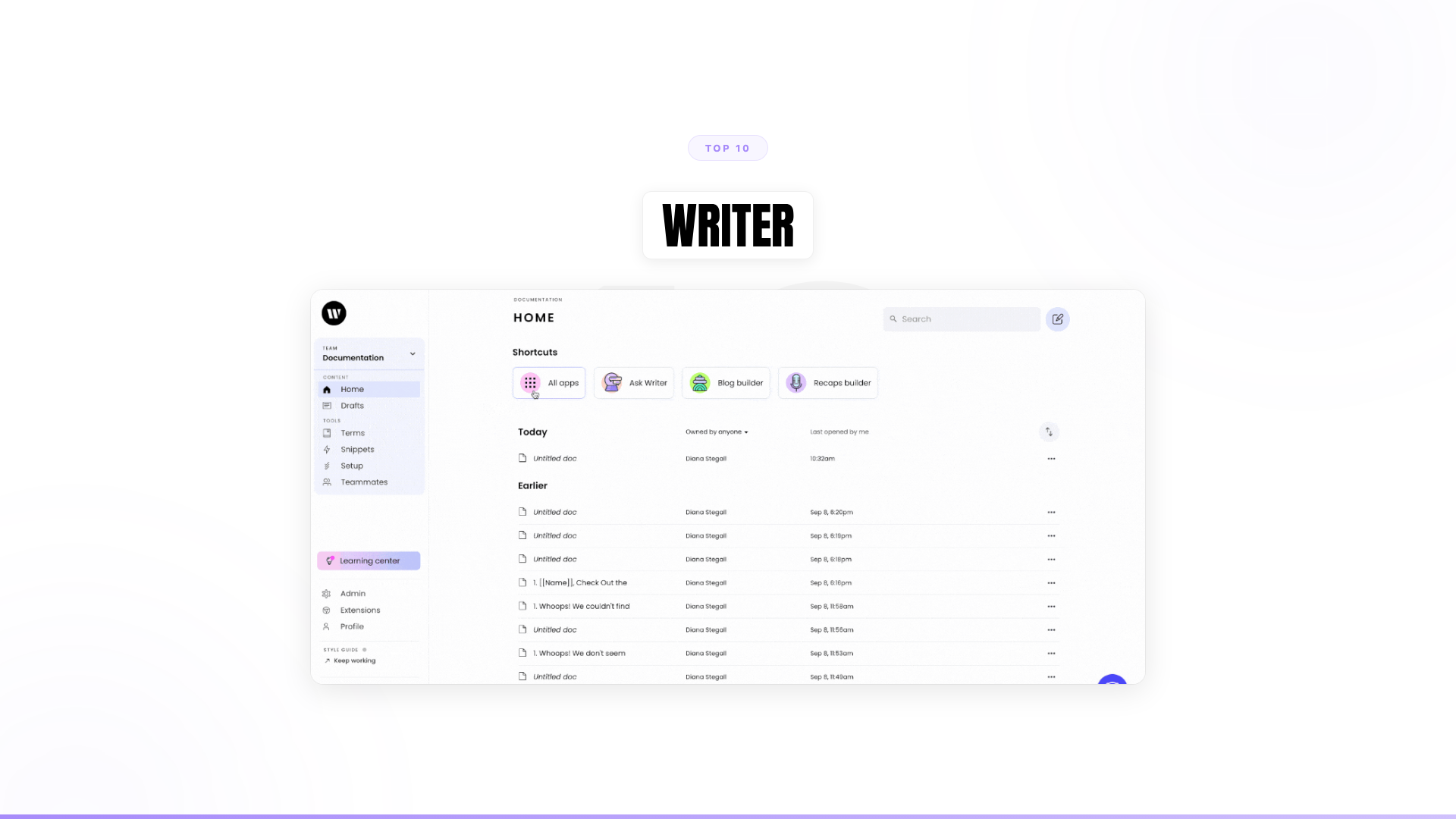
What it is: Enterprise AI platform focused on content generation with brand governance. Generates marketing copy, reports, and communications that follow brand guidelines, tone, and terminology. Powered by proprietary Palmyra LLMs. Expanding into agent capabilities with AI HQ and AI Studio.
How it handles enterprise content: Writer is the strongest pure content generation platform for enterprises. Style guides enforce brand consistency across teams. Knowledge Graph retrieves company-specific context. The Palmyra model family is cost-efficient and enterprise-tuned. For marketing, communications, and content teams producing high volumes of on-brand content, Writer delivers real value. Writer raised $200M in a Series C in 2024, bringing its total funding to over $250M — a signal that the market is treating enterprise content AI as a serious infrastructure category.
What it doesn't handle: The workflow around content. Writer generates the draft. Getting data to inform the draft, routing the draft for review, checking compliance, localizing for markets, distributing across channels, and measuring results all happen outside Writer. Writer has started building agent capabilities, but its architecture was designed around content generation and knowledge retrieval, not multi-step process execution.
Pricing: Per-seat. Starter at $29–39/user/month. Custom enterprise pricing.
Best for: Marketing and communications teams where on-brand content generation and knowledge retrieval are the primary bottleneck.
Full Writer alternatives comparison -->
3. Jasper
What it is: AI content platform for marketing teams. Generates blog posts, social media content, ad copy, email campaigns, and product descriptions. Marketing-specific templates, brand voice training, and campaign-level content creation. Jasper has raised over $130M in total funding, most recently at a $1.5B valuation, and has tens of thousands of users across enterprise marketing teams.
How it handles enterprise content: Jasper is focused on the marketing content use case. Its templates are built around marketing workflows: ad variations, landing page copy, social posts, email sequences. Brand voice training ensures consistency. Campaign features let teams generate coordinated content across channels.
What it doesn't handle: Same limitation as Writer. Jasper generates the content. The approval chain, compliance review, localization, distribution, and performance tracking stay manual. Jasper also lacks Writer's enterprise governance depth and knowledge retrieval capabilities.
Pricing: Starts at $49/month (Creator), $125/month (Pro), custom enterprise pricing.
Best for: Marketing teams that want AI-generated campaign content with templates and brand controls.
Writer vs Jasper comparison -->
4. Copy.ai
What it is: AI content and go-to-market workflow platform. Generates sales and marketing copy, and offers workflow automation for prospecting, outbound sequences, competitive analysis, and sales enablement. Has moved beyond pure content generation into GTM operations.
How it handles enterprise content: Copy.ai is the only content-focused tool on this list (besides Nexus) that attempts to handle workflow beyond generation. Its GTM workflow features automate sequences like "research a company, draft a personalized email, schedule follow-ups." For sales and marketing teams, this extends meaningfully beyond what Writer or Jasper offer.
What it doesn't handle: Workflow automation is limited to sales and marketing use cases. It doesn't extend to customer onboarding, compliance monitoring, HR, support operations, or other departments. The workflows are templated sequences, not autonomous agents that handle exceptions and make decisions.
Pricing: Free tier available. Pro at $49/month. Custom enterprise pricing.
Best for: Sales and marketing teams that want content generation plus basic go-to-market workflow automation.
5. Typeface
What it is: Enterprise AI content platform for visual and text assets. Generates images, social posts, ads, and marketing copy with brand-consistent styling. Founded by a former Adobe CTO. Focuses on the intersection of visual and textual content with enterprise brand controls. Backed by leading enterprise investors including Lightspeed Venture Partners.
How it handles enterprise content: Typeface's strength is multimodal content. Where Writer and Jasper focus on text, Typeface generates visual and text assets together. Brand controls ensure every image, ad, and social post matches brand guidelines. For marketing teams producing visual-heavy content at scale, this is a genuine advantage.
What it doesn't handle: Same content-layer limitation as the other generation tools. Generates assets but doesn't handle the workflow surrounding them. No approval routing, compliance checking, multi-channel distribution, or performance measurement.
Pricing: Custom enterprise pricing.
Best for: Marketing teams that need visual and text content generation with brand controls, especially for social, advertising, and campaign assets.
6. Grammarly Business
What it is: AI writing assistant for teams. Checks grammar, tone, clarity, and brand voice across everything employees write. Works in browsers, desktop apps, email, Slack, and documents. Grammarly Business adds team-level style guides and analytics. Grammarly reports over 50,000 teams using Grammarly Business across enterprise and mid-market organizations.
How it handles enterprise content: Grammarly doesn't generate content. It improves content people have already written. For organizations where the problem is writing quality and consistency across hundreds of employees, Grammarly works wherever they write. Real-time suggestions, tone detection, and team-wide style enforcement are genuinely useful.
What it doesn't handle: Not a content generation tool. Doesn't create content from scratch, doesn't handle any workflow beyond editing, and doesn't connect to enterprise systems. If you need content created, Grammarly isn't the tool.
Pricing: $25/member/month (Business), custom enterprise pricing.
Best for: Organizations where writing quality across teams is the primary problem, not content generation or workflow.
7. Claude for Enterprise
What it is: Anthropic's AI assistant for enterprises. Excels at complex reasoning, long-form content, analysis, and nuanced writing. The enterprise version adds SSO, admin controls, extended context windows (up to 200K tokens), and data privacy guarantees.
How is Claude for Enterprise different from regular Claude? The enterprise version adds organizational controls that individual accounts don't have: SSO and SCIM provisioning, admin dashboards for managing users and permissions, guaranteed data privacy (conversations are not used for model training), and expanded context windows for large documents. For content teams working with complex briefs, lengthy brand guidelines, or regulatory frameworks, the 200K context window handles documents that would overflow other AI assistants.
How it handles enterprise content: For raw content quality, Claude is arguably the best writer among all AI models. Long-form reports, analysis, strategic documents, and content requiring genuine reasoning are Claude's strength. The extended context window handles large documents. The reasoning capability produces content that's substantive, not just fluent.
What it doesn't handle: Claude is a conversation-based assistant. No brand voice training, no style guide enforcement, no enterprise knowledge retrieval, no workflow integration. You interact with Claude in a chat interface or via API. Everything else — getting data, distributing content, handling approvals — stays manual.
Pricing: Per-seat enterprise pricing. Custom.
Best for: Teams that need high-quality reasoning and long-form content generation and don't need brand governance or workflow integration.
8. Microsoft Copilot
What it is: Microsoft's AI assistant embedded in the Microsoft 365 suite. Drafts emails in Outlook, creates documents in Word, builds presentations in PowerPoint, analyzes data in Excel, summarizes Teams meetings.
Can Microsoft Copilot replace enterprise content tools? For most content teams with specialized workflows — approval routing, compliance review, multi-channel distribution — the answer is no. Copilot assists individuals inside Microsoft 365 applications. It doesn't connect to systems outside the Microsoft ecosystem, doesn't have brand voice training comparable to Writer, and doesn't automate multi-step content workflows. Where Copilot delivers genuine value is productivity: faster email drafting, quicker document summaries, meeting recaps. That's different from managing a content operation.
How it handles enterprise content: Copilot generates content where people already work: inside Microsoft apps. For organizations that live in Microsoft 365, the convenience factor is real. You don't switch tools to get AI help. The drafting is generic (no brand voice training like Writer), but it handles the full range of Microsoft document types.
What it doesn't handle: Copilot assists individuals with surface-level tasks inside Microsoft 365. It doesn't complete business processes, connect to systems outside Microsoft, or handle any workflow beyond drafting and summarizing. According to Gartner research on enterprise AI adoption, a significant proportion of Microsoft 365 Copilot pilots have not progressed to broader organizational deployment — consistent with the pattern of AI tools that solve individual productivity but not workflow operations.
Pricing: $30/user/month.
Best for: Microsoft 365 organizations that want in-context AI assistance for individual productivity.
9. Notion AI
What it is: AI writing and knowledge capabilities built into the Notion workspace. Generates content, summarizes pages, answers questions, fills databases, and assists with writing directly inside Notion.
How it handles enterprise content: For teams that use Notion as their primary workspace, Notion AI generates content where they're already working. It can reference existing Notion pages and databases, which gives it some context about your organization. The integration is seamless if you're a Notion-first team.
What it doesn't handle: Locked to the Notion ecosystem. Doesn't connect to CRMs, ERPs, marketing tools, or any system outside Notion. No brand voice training. No enterprise content governance. If content needs to flow outside Notion — which enterprise content always does — you're back to manual workflows.
Pricing: $10/member/month add-on to any Notion plan.
Best for: Notion-first teams that want in-workspace AI writing assistance without additional tools.
10. Writesonic
What it is: AI writing tool focused on SEO content, blog posts, and digital marketing copy. Includes an AI article writer with SEO optimization, a chatbot builder, and integrations with common marketing tools. More affordable than enterprise-focused alternatives.
How it handles enterprise content: Writesonic is practical for teams that need SEO-optimized blog content at volume. Its article writer produces structured posts with keyword optimization. For content marketing teams focused on organic search, it delivers reasonable output at a lower price point than Writer or Jasper.
What it doesn't handle: No enterprise governance, no brand voice depth, no knowledge retrieval, no compliance features, and no workflow beyond generation. Writesonic is a lighter tool for a simpler use case. If you're evaluating enterprise content AI, it's likely below the capability threshold you need.
Pricing: Starts at $16/month (Individual), $33/month (Teams), custom enterprise pricing.
Best for: Small to mid-size teams focused on SEO blog content who don't need enterprise-grade governance or workflow.
Writer vs Jasper: which AI content tool is better for enterprise?
This is one of the most-searched comparisons in the enterprise content AI category, and the answer depends on your primary use case.
Writer is better for: Organizations where brand governance and consistency across teams is the core requirement. Writer's Knowledge Graph, style guide enforcement, and compliance guardrails give it an edge in regulated industries and large organizations with strict brand standards. The Palmyra model is built for enterprise use, not adapted from a consumer product. Writer is increasingly expanding into agent workflows through AI HQ and AI Studio.
Jasper is better for: Marketing teams that need high-volume campaign content fast. Jasper's templates are purpose-built for marketing output: ad variations, landing pages, social posts, email sequences. For performance marketers who need 50 ad variations tested in a week, Jasper's workflow is faster than Writer's.
The shared limitation: Both generate content. Neither handles the approval chain, compliance review, localization, distribution, or performance measurement that surrounds content in enterprise operations. If that surrounding workflow is your bottleneck, neither tool solves it.
Full Writer vs Jasper comparison -->
The real gap: generation vs. workflow
Here's the pattern across every tool on this list except Nexus:
They all make content generation faster. None of them handle what happens before and after.
Before generation: Someone needs to pull data from CRM, check what the audience cares about, review compliance requirements, align with product messaging, and define the brief. This takes hours. It happens in spreadsheets, email threads, and meetings. No content AI tool touches it.
The generation itself: Takes minutes with any of these tools. This is the step they all optimize. It's the smallest part of the overall process.
After generation: Someone needs to route the draft for review, incorporate feedback, check for regulatory compliance, localize for different markets, adapt for different channels, upload to distribution platforms, schedule publication, and track performance. This takes days or weeks. Again, no content AI tool touches it.
When enterprises say "we need better AI content tools," they usually mean "our content operations are too slow." Faster generation doesn't fix slow operations. Workflow automation does.
That's the category difference. Writer, Jasper, Copy.ai, and every other content tool on this list optimize one step. Nexus agents handle the process.
How to decide
If content generation is actually your bottleneck, and everything around it works fine, pick the content tool that matches your needs. Writer for enterprise governance and brand voice. Jasper for marketing campaigns. Claude for Enterprise for complex reasoning and long-form writing. Grammarly Business for editing quality across teams.
If the workflow around content is your bottleneck, and generation is the easy part, you need a different category of tool. No amount of improving the content generation step will fix a broken approval chain, manual compliance review, or disconnected distribution process.
If you need AI that handles the entire content workflow — data collection, generation, approval routing, compliance, distribution, measurement — as part of a complete business process, that's what Nexus was built for. Content generation is one thing agents do. The process is the point.
Orange didn't deploy Nexus for content generation. They deployed it for customer onboarding. Content is generated as part of the workflow. ~$6M+ yearly revenue impact. 4 weeks to production.
Generating content has never been easier. Running the business process that content belongs to is still hard. That's the gap worth closing.
Frequently asked questions
Q: What is the best AI tool for enterprise content generation?
Writer is the most purpose-built enterprise content AI — brand governance, style enforcement, and AI-generated content within a single platform. Jasper leads for marketing-focused content at scale. Claude for Enterprise (Anthropic) excels at complex reasoning and nuanced writing. Microsoft Copilot integrates with Microsoft 365 for productivity-focused drafting. For full content workflow automation — approvals, compliance, distribution — Nexus agents handle processes that individual content tools don't reach.
Q: What is Writer used for in enterprises?
Writer is an enterprise AI content platform focused on brand consistency and governance. It maintains brand voice and style guidelines as AI generates content, includes compliance guardrails, and is expanding into agent capabilities for content workflow automation through AI HQ and AI Studio. It's used by content teams, marketing operations, and communications functions at mid-market and enterprise organizations.
Q: How does Jasper compare to Claude for Enterprise for content?
Jasper is optimized for marketing content at volume — campaigns, ads, social posts, blog content — with templates and brand voice training. Claude for Enterprise (Anthropic) excels at complex, nuanced writing and reasoning tasks — reports, analysis, communications, and content requiring judgment. Jasper is better for high-volume marketing output. Claude for Enterprise is better for sophisticated content requiring depth and reasoning.
Q: Is Microsoft Copilot worth it for content teams?
Copilot ($30/user/month) is valuable for Microsoft 365 users who want AI-assisted drafting in Word, PowerPoint, and Teams. For dedicated content teams with specialized workflows — approval routing, compliance review, multi-channel distribution — Copilot's constraint to the Microsoft ecosystem limits its usefulness. Gartner and industry analysts have noted that a significant portion of Microsoft 365 Copilot pilots have not progressed to broader deployment, consistent with the pattern of tools that improve individual productivity but not operational workflows.
Q: Do enterprise AI content tools support multiple languages?
Multilingual capability varies significantly across the category. Writer, Jasper, and Copy.ai support content generation in major European and Asian languages, with quality varying by language pair. Writesonic markets explicit multilingual features for SEO content across 25+ languages. Claude for Enterprise handles complex multilingual content well given its broad training. For organizations operating across multiple markets that need localization as part of an automated workflow — not just a translation toggle — most of these tools require separate localization tooling or manual processes downstream.
Worth exploring?
Every Nexus engagement starts with a 3-month proof of concept tied to measurable outcomes. Forward Deployed Engineers embed with your team from day one. You see the results before committing. You can exit anytime.
100% of clients who started a POC converted to an annual contract. Every one.
See how Nexus compares to Writer -->