The best AI tools for document analysis in 2026 include Hebbia (the category leader for deep document analysis in finance and legal, priced at $3K–15K/seat/year), AlphaSense (financial research across public filings and broker reports, estimated $10K–25K/seat/year), Glean (enterprise search across 100+ systems), Kira Systems (contract clause extraction for legal teams), Luminance (AI across the full contract lifecycle), Eigen Technologies (structured data extraction from complex financial documents), Writer (brand-compliant content generation from research outputs), and Langdock (EU data residency AI assistant). Nexus ranks first not because it is the deepest document analysis tool — Hebbia holds that position — but because it is the only platform that completes the full business workflow after the documents are analyzed: decisions, routing, exception handling, and execution across enterprise systems.
Every enterprise runs on documents. Contracts, financial filings, research reports, customer records, compliance paperwork, internal memos. The information that drives decisions sits buried in unstructured text, and someone has to extract it, validate it, and act on it. AI has changed the reading part — tools now parse thousands of pages in minutes, surface insights that would take analysts days to find manually, and extract structured data from formats that used to require specialist human attention. According to Gartner, intelligent document processing is one of the fastest-growing enterprise AI categories, driven by the volume of unstructured content that organizations must process to operate.
But here's what most enterprises discover after deploying a document analysis tool: reading the documents was never the whole problem. The bottleneck isn't just extracting insights. It's collecting data from multiple sources, cross-referencing it against business rules, making decisions based on what you find, routing exceptions to the right people, and executing the next steps across systems. Analysis is step one. Execution is the other nine steps.
The tools on this list span that full spectrum, from pure document analysis to full workflow automation. The right choice depends on where your actual bottleneck sits.
Quick comparison
| Tool | Category | Best for | Goes beyond analysis? | Pricing model |
|---|---|---|---|---|
| Nexus | Autonomous agent platform | Full workflow automation including document analysis | Yes, end-to-end | Per-agent |
| Hebbia | Analytical AI engine | Deep document analysis for finance and legal | No | Per-seat (~$3K–15K/yr, based on reported enterprise contracts) |
| AlphaSense | Market intelligence | Financial research across public filings and broker reports | No | Per-seat (~$10K–25K/yr, based on reported enterprise contracts) |
| Glean | Enterprise search | Finding information across enterprise systems | No | Per-user (~$15–25/user/month) |
| Kira Systems | Contract analysis AI | Extracting clauses from legal contracts | No | Enterprise license (~$50K–200K/yr) |
| Luminance | Legal AI | Contract review, drafting, and negotiation | Partial (legal only) | Enterprise license (~$50K–150K/yr) |
| Eigen Technologies | Document intelligence | Structured data extraction from unstructured documents | No | Enterprise license (custom) |
| Writer | Enterprise AI for content | Content generation from research outputs with brand governance | No | Per-user (~$18–30/user/month) |
| Langdock | European AI assistant | AI assistants with EU data residency | No | Per-user (~EUR 15–20/user/month) |
| Custom build (LangChain, etc.) | Developer framework | Engineering teams building tailored solutions | Depends on team | Engineering cost |
Pricing estimates are based on reported enterprise contracts and publicly available information. Enterprise pricing varies significantly by team size, contract length, and feature tier.
What is the best AI tool for document analysis?
The answer depends on what kind of document work you're doing and where in the workflow the actual bottleneck sits.
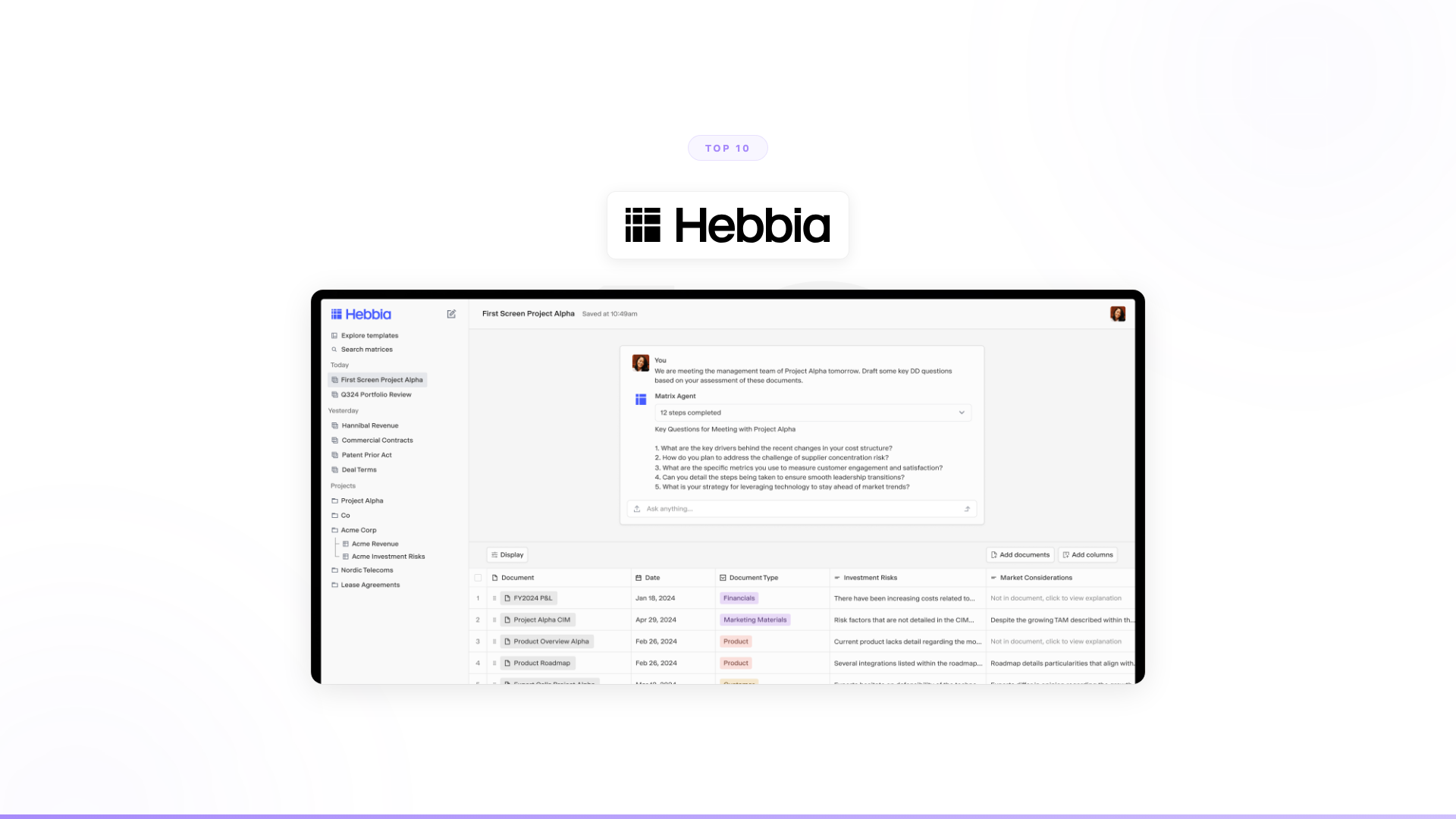
For deep document analysis in financial services and legal — the highest-volume, highest-stakes document environments — Hebbia is the category leader. Its Matrix product reasons over millions of pages simultaneously with a multi-agent architecture purpose-built for analytical depth. BlackRock, KKR, and Carlyle are among its known clients.
For financial market intelligence across public filings, earnings transcripts, and broker research, AlphaSense leads on breadth of coverage. It aggregates external content that Hebbia's internal-document focus doesn't address.
For legal contract review and extraction, Kira Systems and Luminance are purpose-built, with Luminance extending into drafting and negotiation.
For enterprise-wide document search across systems, Glean provides the broadest index — 100+ integrations, permission-aware results, natural language queries.
For complete workflow automation that goes beyond document reading to decisions and execution across systems, Nexus agents handle the full process end-to-end.
No single tool wins every category. The question isn't which tool is "best" — it's which tool addresses your specific bottleneck.
The tools, ranked
1. Nexus
What it is: An autonomous agent platform paired with Forward Deployed Engineers who embed with your team. Nexus agents don't just analyze documents. They complete the entire workflow those documents are part of: collecting data from multiple systems, validating findings against business rules, making decisions within guardrails, handling exceptions, escalating when uncertain, and executing actions across enterprise systems. With 4,000+ integrations, agents operate wherever the work happens.
Why it's ranked first:
Nexus is not the deepest document analysis tool on this list — that distinction belongs to Hebbia for analytical depth, Kira for contract extraction, and AlphaSense for market intelligence breadth. Nexus ranks first because it is the only platform that treats document analysis as one step in a larger process and then executes the rest.
Most document analysis tools stop at insights. They tell you what's in the documents. You still have to figure out what to do about it and then go do it. For enterprises where the bottleneck has already shifted from "we can't read documents fast enough" to "we can't act on what we find fast enough," that distinction matters.
Consider what this looks like in practice. A financial research workflow doesn't end when you've extracted the relevant data from a stack of filings. Someone still needs to cross-reference that data against your CRM, validate it against compliance rules, score the opportunity, route it to the right team, and follow up. Nexus agents handle the full sequence. Analysis is built in, not bolted on.
What it looks like in production:
- Lambda (AI cloud infrastructure company, serving tens of thousands of enterprise customers): Agents autonomously research 12,000+ enterprise accounts annually. Each account gets the equivalent of 2 hours of deep analysis across dozens of data sources. The agent collects data, synthesizes findings, identifies buying signals, scores opportunities, and delivers structured intelligence — without human involvement in each step. Nexus client data: $4B+ in cumulative pipeline identified; 24,000+ hours of research capacity added annually. Built by a non-engineer.
- Orange Group (multi-billion euro telecom, 120,000+ employees): Autonomous customer onboarding agents deployed across multiple European markets in 4 weeks. Nexus client data: 50% conversion improvement, ~$6M+ yearly revenue impact, 90% autonomous resolution, 100% team adoption.
- European consulting firm: Five agents running across their consulting lifecycle on a single Nexus deployment. Research, matching, proposals, and operations handled autonomously across departments.
Pricing: Per-agent, tied to value delivered. Not per-seat.
Best for: Enterprises where the bottleneck isn't reading documents but completing the business processes those documents are part of.
Full comparison: Nexus vs Hebbia -->
2. Hebbia
What it is: AI analytical reasoning engine purpose-built for document-heavy research. The flagship product, Matrix, lets analysts run complex queries across thousands of documents simultaneously. Uses a proprietary ISD architecture (Inference, Search, Decomposition) with multi-agent "swarm" processing that chains context windows to reason over millions of pages. Trusted by BlackRock, KKR, Carlyle, and the U.S. Air Force. Raised $130M in Series B funding led by a16z in 2024.
Where it's strong: For pure document analysis in financial services and legal, Hebbia is the category leader. It goes well beyond basic RAG. If a PE associate needs to review an entire data room, compare terms across hundreds of credit agreements, or extract specific provisions from fund documents, Hebbia's analytical depth is genuinely impressive. The platform claims to process over 1 billion pages across its client base.
Where it falls short: Hebbia analyzes documents. It doesn't complete the workflows those documents feed into. The insights are strong, but the execution — cross-system validation, decision-making, exception handling, multi-step process completion — stays manual. The platform is also deeply vertical: finance, legal, consulting, and defense. If your document analysis needs span other departments or connect to broader business processes, the platform doesn't extend there.
Pricing: ~$3,000–3,500/seat/year (Lite), ~$10,000–15,000/seat/year (Professional). Based on reported enterprise contracts; actual pricing varies by team size.
Best for: Financial analysts, lawyers, and consultants who need faster, deeper analysis of large document sets and whose bottleneck is analytical throughput.
Full comparison: Nexus vs Hebbia -->
3. AlphaSense
What it is: Market intelligence and research platform. Aggregates public filings, earnings transcripts, broker research, news, trade publications, and proprietary expert content. AI-powered search with smart synonyms, sentiment analysis, and trend detection. Serves financial services, corporate strategy, and life sciences.
Where it's strong: For research that spans public market intelligence, AlphaSense is comprehensive. Analysts can search across SEC filings, earnings call transcripts, broker notes, and news in a single query with AI that understands financial context. The Smart Synonyms feature catches relevant results that keyword search would miss. Expert call transcripts add qualitative intelligence that most platforms lack. This external-content breadth is where AlphaSense differs from Hebbia, which focuses on internal document analysis.
Where it falls short: AlphaSense is a research and discovery tool. It helps you find and understand external market intelligence. It doesn't analyze your internal documents in the way Hebbia does, and it doesn't execute workflows based on what you find. The work after discovery — validation, decision-making, cross-system actions — remains manual.
Pricing: ~$10,000–25,000+ per seat per year depending on content access tier. Based on reported enterprise contracts.
Best for: Financial analysts and strategy teams who need comprehensive market intelligence across public and proprietary content sources.
4. Glean
What it is: Enterprise AI search and knowledge assistant. Connects to 100+ enterprise data sources and lets employees search across everything with natural language. Generates answers from your company's knowledge with source attribution and respects existing access permissions. Raised over $600M in funding as of 2024, with enterprise adoption across technology, financial services, and professional services firms.
Where it's strong: If the problem is that your team can't find information scattered across Confluence, Slack, Drive, SharePoint, Salesforce, and Jira, Glean solves that well. It's the broadest enterprise search tool available, with strong relevance and permission-aware results. For knowledge workers who spend hours searching for the right document, Glean saves real time.
Where it falls short: Glean finds documents. It doesn't deeply analyze them — for that, see Hebbia. It doesn't complete workflows based on what's found — for that, see Nexus. If you need to search across 100 tools and get an answer, Glean works. If you need to analyze 500 contracts for specific provisions, Glean isn't deep enough. If you need to act on what you find across multiple systems, Glean doesn't reach there.
Pricing: ~$15–25/user/month. Custom enterprise pricing. Based on reported contracts.
Best for: Enterprises where information discovery across many tools is the primary bottleneck.
Full comparison: Nexus vs Glean -->
5. Kira Systems
What it is: Contract analysis AI for legal teams. Uses machine learning to identify and extract specific clauses, provisions, and data points from contracts. Purpose-built for due diligence, M&A document review, and lease abstraction. Supported by a large library of pre-trained extraction models for common contract provisions. Used by major law firms and in-house legal teams globally, and acquired by Litera in 2021.
Where it's strong: For high-volume contract review, Kira is deeply specialized. Its pre-trained models can identify hundreds of contract provision types out of the box. Legal teams running due diligence on M&A deals, reviewing lease portfolios, or auditing vendor agreements can extract structured data from contracts significantly faster than manual review. The combination of pre-trained models and custom training means teams don't start from scratch.
Where it falls short: Kira extracts data from contracts. That's one step. The workflow around that extraction — validation against your internal standards, routing exceptions to the right lawyer, updating your contract management system, triggering follow-up actions — is still manual. The scope is also narrow: legal contracts only.
Pricing: Enterprise licensing. ~$50,000–200,000/year based on firm size and volume. Custom pricing.
Best for: Legal teams with high-volume contract review requirements, particularly for due diligence and M&A.
6. Luminance
What it is: AI platform for the full contract lifecycle. Goes beyond extraction to include contract drafting, review, redlining, and negotiation. The platform can identify issues in contracts and suggest alternative language. Expanded into AI-powered contract negotiation where the system autonomously reviews and redlines contracts against your playbook. Used by law firms and in-house legal teams across Europe and North America.
Where it's strong: Luminance is one of the few document AI tools that moves beyond pure analysis into action within its domain. The ability to draft and negotiate contract terms — not just extract them — puts it closer to workflow completion than most analytical tools. For law firms and in-house legal teams, the coverage of the full contract lifecycle (review, draft, redline, negotiate) in a single platform reduces the switching between tools.
Where it falls short: Scope is limited to legal documents and the contract lifecycle. The platform doesn't extend to financial research, sales workflows, customer onboarding, compliance monitoring, or any process outside of legal. If your document analysis needs are broader than contracts, you'll need additional tools for everything else.
Pricing: Enterprise licensing. ~$50,000–150,000/year based on firm size. Custom pricing.
Best for: Legal teams and law firms that need AI across the full contract lifecycle, from review through negotiation.
7. Eigen Technologies
What it is: Intelligent document processing platform focused on turning unstructured documents into structured, queryable data. Uses NLP and machine learning to extract specific data points from complex documents like loan agreements, insurance policies, prospectuses, and regulatory filings. Primarily serves financial services and insurance, where document formats are complex and extraction requirements are consistent at scale.
Where it's strong: Eigen excels at the specific task of structured data extraction. If you have thousands of loan agreements and need to pull 50 specific fields from each one into a structured database, Eigen handles that reliably. The platform's strength in financial services and insurance comes from training on the document types those industries process at volume: credit agreements, policy documents, regulatory filings.
Where it falls short: Extraction is not analysis, and neither is execution. Eigen gives you structured data from documents. Hebbia would tell you what that data means. Nexus would act on it. If the bottleneck is getting data out of documents in a defined format, Eigen fits. If the bottleneck is the judgment and workflow that follow, you need something else.
Pricing: Enterprise licensing, custom pricing.
Best for: Financial institutions and insurance companies with large-scale structured data extraction requirements from complex documents.
8. Writer
What it is: Enterprise AI platform focused on content generation with brand governance. Included here because it sits at the output end of many document analysis workflows: turning research findings into reports, briefings, and communications. Includes a proprietary LLM (Palmyra) and application-building capabilities designed for enterprise brand compliance.
Why it's on this list: Writer doesn't analyze documents — it produces from them. But many teams evaluating document analysis tools also need a production layer. The output of a research workflow is often a report, a briefing, or a client communication. Most analytical tools (Hebbia, AlphaSense, Kira) produce structured data or annotated findings — they don't produce polished output. Writer fills that specific step for teams that need brand-compliant content from their research.
Where it falls short: Writer creates content. It doesn't analyze existing documents deeply and it doesn't execute business workflows. If your need is analytical depth or workflow completion, Writer doesn't address that. It's a production tool for the output stage.
Pricing: ~$18–30/user/month. Custom enterprise pricing.
Best for: Teams that need to produce brand-compliant content and communications from their research outputs, as a complement to an analytical tool.
9. Langdock
What it is: European AI assistant platform with guaranteed EU data residency. Provides AI assistants connected to your enterprise data, supports multiple LLMs (GPT-4, Claude, Mistral), and connects to enterprise tools. GDPR-compliant by design. Built specifically for European enterprises where data sovereignty requirements are non-negotiable.
Why it's on this list: For European enterprises, data residency isn't optional — GDPR requirements and internal data governance policies make US-hosted tools either unusable or legally complex. Langdock provides AI assistant capabilities for document summarization, research questions, and content generation while keeping data within the EU. The compliance guarantee is the differentiator, not the analytical depth.
Where it falls short: Langdock is a general-purpose AI assistant, not a specialized document analysis tool. It can summarize documents and answer questions about them, but it doesn't have the analytical depth of Hebbia or the workflow execution capabilities of Nexus. For European teams with lighter document work and hard data residency requirements, it fits. For heavy analytical or operational workloads, it's not deep enough.
Pricing: ~EUR 15–20/user/month. Custom enterprise pricing.
Best for: European enterprises that need an AI assistant with EU data residency and whose document analysis needs are lighter than what specialized tools handle.
Full comparison: Nexus vs Langdock -->
10. Custom build
What it is: Build your own document analysis and research system using open-source frameworks like LangChain, LangGraph, or CrewAI. Your engineering team designs the pipeline, handles document ingestion, embedding, retrieval, analysis prompting, output formatting, and everything else.
Where it's strong: Maximum control. You design the exact analytical pipeline for your documents, with your business logic, your output formats, and your quality thresholds. For organizations with unique document types or proprietary analytical methods that no existing tool addresses, building custom ensures the tool fits your exact needs.
Where it falls short: Most enterprises don't have the AI engineering capacity to build and maintain production-grade document analysis systems. The initial build takes 3–6 months. Then there's ongoing work: model updates, security patches, governance, monitoring, and integration maintenance. Lambda, an AI cloud infrastructure company with engineers who build AI systems for a living, chose to buy from Nexus instead of building internally. Their reasoning: the opportunity cost of diverting engineering from their core product was too high, and Nexus agents could be built and deployed by a non-engineer in days rather than months.
Pricing: Engineering salaries + infrastructure. Typically 6+ months and several hundred thousand dollars for a production-grade system.
Best for: Organizations with dedicated AI engineering teams and document analysis requirements that no existing tool addresses.
How to choose: where does the work actually stall?
The tools on this list fall into three tiers, and the right choice depends on a question most enterprises don't ask explicitly enough: where does the work actually stall?
If the work stalls at reading and understanding documents, you need better analysis. Hebbia (deep analytical reasoning over large document sets), AlphaSense (external market intelligence across public filings), Kira (contract provision extraction), Luminance (legal contract lifecycle), and Eigen (structured data extraction from financial documents) all address this tier. They'll help your team understand documents faster and deeper. The work after understanding stays with humans.
If the work stalls at finding the right documents, you need better search. Glean handles this well across 100+ enterprise tools. Langdock provides a GDPR-compliant alternative for European organizations.
If the work stalls at everything that happens after someone reads the document — the validation, decision-making, cross-system updates, exception handling, and follow-through that turn insights into outcomes — that's a workflow execution problem. Document analysis tools don't reach there because they were built to solve the reading problem, not the doing problem.
Lambda's agents don't just read about 12,000 accounts. They research, synthesize, score, and deliver structured intelligence across every one of them. Autonomously. $4B+ in pipeline identified (Nexus client data).
Orange's agents don't just understand customer data. They validate it, check compatibility, route exceptions, and complete onboarding end-to-end. 50% conversion improvement. ~$6M+ yearly revenue impact in 4 weeks (Nexus client data).
The most common mistake in enterprise AI is buying a better reading tool when the bottleneck is the work that comes after reading. Get clear on where your work actually stalls. The answer determines the category, and the category determines the tool.
Frequently asked questions
Q: What is the best AI tool for document analysis?
A: It depends on the type of document work. For deep analytical reasoning over large document sets — financial due diligence, legal review, complex research — Hebbia is the category leader. For market intelligence across public filings and broker reports, AlphaSense leads on coverage breadth. For legal contract extraction and review, Kira Systems and Luminance are purpose-built. For finding documents scattered across enterprise systems, Glean provides the broadest index. For completing the full business workflow that starts with document analysis — decisions, routing, execution — Nexus agents handle the end-to-end process. Most enterprises need more than one of these, depending on where they sit in the analysis-to-action chain.
Q: What is the difference between Glean and Hebbia?
A: Glean is an enterprise search tool — it finds information across your organization's systems (email, Slack, Drive, Confluence, Salesforce). Hebbia is an analytical AI engine — it reasons over complex documents, extracts specific data points, and performs quantitative analysis across multiple sources simultaneously. Glean answers "where is this information?"; Hebbia answers "what does this corpus of information tell me about this specific question?" If the problem is finding the right document, use Glean. If the problem is extracting deep analytical insight from a document set you already have, use Hebbia.
Q: How much does Hebbia cost?
A: Hebbia is priced at approximately $3,000–$15,000 per seat per year for enterprise contracts, based on reported enterprise pricing. Lite tiers start around $3,000–3,500/seat/year; Professional tiers run $10,000–15,000/seat/year. Pricing varies by team size, usage volume, and contract terms. Hebbia targets financial services firms, legal practices, and management consultancies — buyers where the ROI on accelerated document research justifies the investment.
Q: Can AI tools analyze legal contracts automatically?
A: Yes. Kira Systems and Luminance are purpose-built for legal contract review — extracting specific clauses, comparing terms across agreements, flagging anomalies, and supporting due diligence workflows. Kira specializes in extraction from large contract portfolios; Luminance extends into drafting and negotiation assistance. Both require enterprise licensing and professional services for deployment. For organizations with contracts that feed into broader operational workflows beyond legal, Nexus agents can handle post-extraction steps like compliance validation, exception routing, and system updates.
Q: What is intelligent document processing (IDP)?
A: Intelligent document processing (IDP) refers to AI-powered systems that automatically classify, extract, and process data from unstructured documents — contracts, invoices, filings, claims, applications. IDP combines OCR (optical character recognition) with NLP and machine learning to identify specific data fields without manual configuration for each document type. Tools like Eigen Technologies and Kira Systems sit in this category for structured data extraction; Hebbia extends into higher-level analytical reasoning beyond extraction. Gartner covers IDP as a distinct technology category within document automation.
Worth exploring?
If your team's bottleneck isn't analyzing documents but completing the business processes those documents feed into, it might be worth seeing what autonomous agents can do.
Every Nexus engagement starts with a 3-month proof of concept tied to measurable outcomes. Forward Deployed Engineers embed with your team from day one. You see the results before committing. You can exit anytime.
See how Nexus compares to Hebbia -->
Related reading
- Nexus vs Hebbia: document analysis AI vs autonomous agents
- Top 10 Hebbia alternatives for enterprise AI research
- Hebbia vs Glean: enterprise AI research compared
- How to automate document analysis with AI
- Top 10 Glean alternatives for enterprise AI
- Top 10 Microsoft Copilot alternatives
- Nexus vs Glean: full comparison