Top 10 Hebbia Alternatives for Enterprise AI Research in 2026
Hebbia built impressive document analysis for finance and legal. But most enterprises need AI that goes beyond reading documents. Here are 10 alternatives ranked by what they deliver in production.
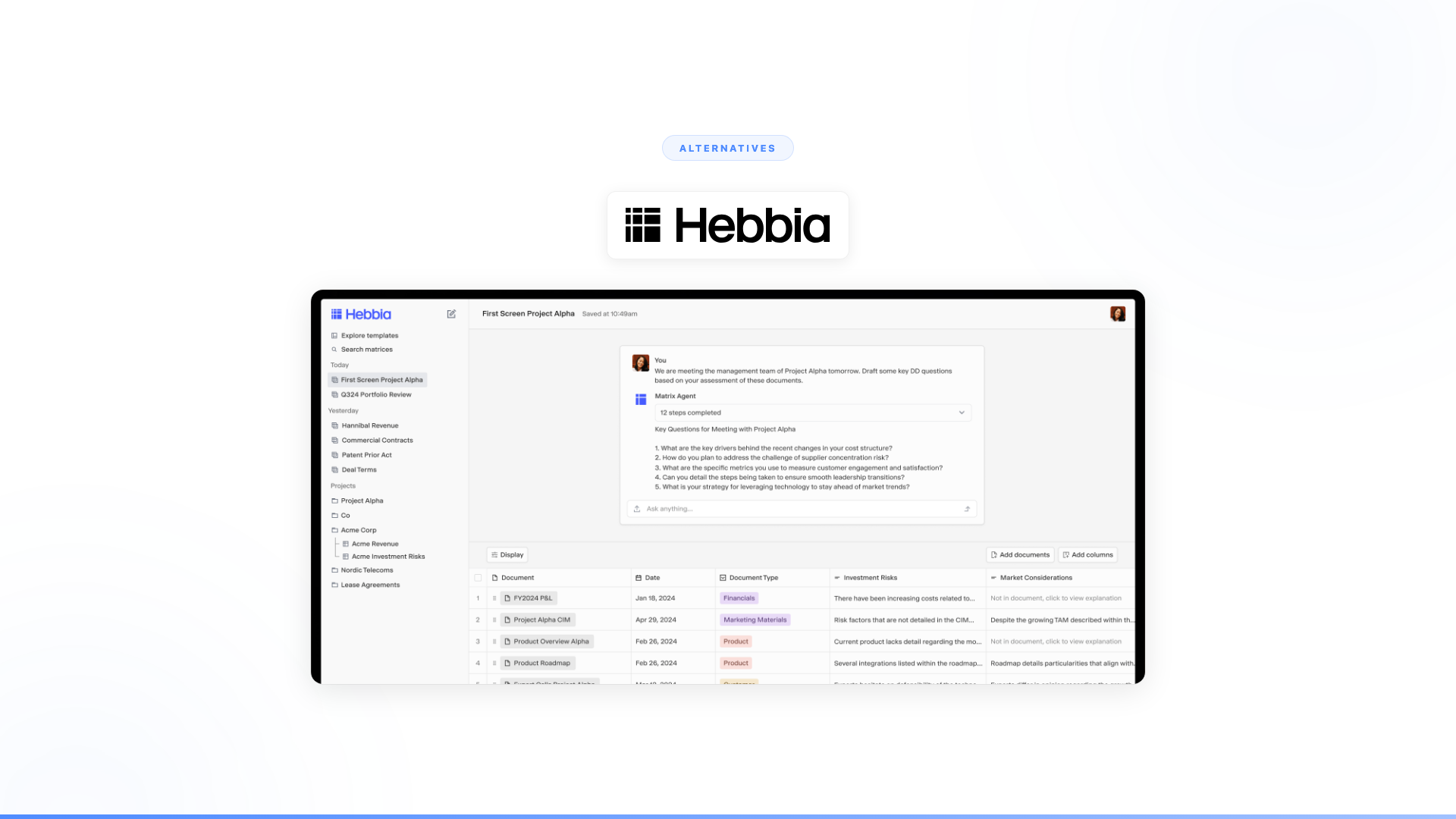
The best Hebbia alternatives in 2026 are Nexus, AlphaSense, Glean, Langdock, Writer, Notion AI, Kira Systems, Luminance, Eigen Technologies, and custom build. Hebbia is an enterprise AI platform for deep document analysis — originally built for financial services and legal due diligence — that raised $130M in Series B funding led by a16z in 2024. Alternatives range from competing financial research tools to autonomous agent platforms that go beyond document analysis to complete full investment, compliance, and operational workflows end-to-end.
Enterprises looking for Hebbia alternatives aren't usually leaving because the analysis is weak. Hebbia's Matrix product is genuinely impressive for document-heavy work. The reason most teams start looking elsewhere is simpler: they realized document analysis was only one step in the actual business process.
The pattern repeats across industries. Analysts used Hebbia to work through hundreds of documents faster than before. The insights were good. But then the work started. Someone still had to collect data from three other systems, validate findings against internal rules, make a decision, route it to the right person, handle exceptions, and follow up. The 40-hour document review became a 4-hour document review — which is real progress. But the 60 hours of work surrounding it stayed exactly the same.
That's not a Hebbia problem. It's a category problem. Analytical AI reads documents. It doesn't complete the work those documents point to. If the bottleneck has shifted from "we can't read fast enough" to "we can't execute fast enough," that requires a different category of tool entirely.
Here are 10 alternatives worth evaluating, organized by what they actually do.
Hebbia Alternatives: Quick Comparison Table (2026)
| Tool | Category | Best for | Completes workflows? | Pricing model |
|---|---|---|---|---|
| Nexus | Autonomous agent platform | Full enterprise workflow automation across any department | Yes, end-to-end | Per-agent |
| AlphaSense | Market intelligence | Financial research and competitive intelligence | No | Enterprise license |
| Glean | Enterprise search + assistant | Finding information across enterprise systems | No | Per-user |
| Langdock | European AI assistant | AI assistants with EU data residency | No | Per-user |
| Writer | Enterprise AI for content | Content generation and brand compliance | No | Per-user |
| Notion AI | Workspace assistant | AI inside a single workspace tool | No | Per-user ($10/mo add-on) |
| Kira Systems | Contract analysis AI | Extracting clauses from legal contracts | Partial (extraction only) | Enterprise license |
| Luminance | Legal AI | Contract review and negotiation | Partial (legal only) | Enterprise license |
| Eigen Technologies | Document intelligence | Structured data extraction from documents | Partial (extraction only) | Enterprise license |
| Custom build (LangChain, CrewAI) | Developer framework | Engineering teams building from scratch | Depends on team | Engineering cost |
Top 10 Hebbia Alternatives Ranked for Enterprise Teams
Nexus: Best Hebbia Alternative for Full Enterprise Workflow Automation
What it is: An autonomous agent platform paired with Forward Deployed Engineers who embed with your team. Nexus agents complete entire business workflows end-to-end: collecting data from multiple systems, validating it against business rules, making decisions within guardrails, handling exceptions, escalating when uncertain, and executing actions. Any department. Any workflow. Business teams build and own the agents — no engineering background required.
Why enterprises switch from Hebbia to Nexus:
The switch isn't about better document analysis. It's about moving past analysis entirely. Hebbia reads documents and tells you what's in them. Nexus agents handle the entire process those documents are part of: researching an account across dozens of sources, onboarding a customer across multiple systems, triaging a compliance issue end-to-end, synthesizing competitive intelligence and acting on it. One reads. The other executes.
This distinction matters most in financial services and legal, where Hebbia has its deepest footprint. Analysts using Hebbia to review loan agreements, regulatory filings, or M&A data rooms still face the same post-analysis bottleneck: validating findings against internal rules, routing decisions through approval chains, updating compliance systems, and handling exceptions. Nexus agents handle that entire chain, not just the reading step.
What it looks like in production:
- Lambda (a leading AI infrastructure company): Their bottleneck wasn't understanding documents — it was executing deep research across 12,000+ enterprise accounts at scale. Nexus agents now perform deep analysis per account, autonomously. Over $4 billion in pipeline discovered. 24,000+ hours of research capacity added annually. Built by the Head of Sales Intelligence, who has no engineering background.
- Orange Group (multi-billion euro telecom, 120,000+ employees): Business team built autonomous customer onboarding agents. Deployed across multiple European markets in 4 weeks. 50% conversion improvement. Approximately $6M in yearly revenue added. 90% autonomous resolution. 100% team adoption.
- European telecom (13,000+ employees): Deployed a dozen Nexus agents. 40% of support volume freed across millions of interactions. Business teams own the agents, not engineering.
Security and compliance: Nexus supports deployment within enterprise security perimeters, including private cloud and data residency configurations. Forward Deployed Engineers work within your existing security framework from day one.
Pricing: Per-agent, tied to value delivered. Not per-seat. An agent serving millions of customers costs the same whether you have 500 or 50,000 employees.
Best for: Enterprises where the bottleneck isn't analyzing documents but completing the work those documents point to. Financial services compliance workflows, sales research at scale, customer onboarding, support operations, HR processes.
Full Nexus vs Hebbia comparison →
AlphaSense: Best Hebbia Alternative for Market Intelligence and Financial Research
What it is: Market intelligence and research platform for financial services and corporate strategy. Aggregates public filings, earnings transcripts, broker research, news, and trade publications. AI-powered search with sentiment analysis and smart synonyms. AlphaSense has been expanding its AI capabilities, including the acquisition of Tegus in 2023 to add expert call transcript coverage.
How it compares to Hebbia: The closest competitor in spirit. Both serve financial research workflows. AlphaSense focuses on aggregating and searching public market intelligence — earnings calls, SEC filings, broker research. Hebbia focuses on analyzing your own document sets — data rooms, internal contracts, fund documents. AlphaSense is about finding external intelligence. Hebbia is about analyzing internal documents. Some financial services teams use both.
Why it might not solve the problem: AlphaSense is research and discovery. It helps analysts find relevant information faster across public and proprietary content. But the work after finding it — synthesizing, validating against internal data, making decisions, executing across systems — stays manual. If the bottleneck is execution rather than discovery, AlphaSense has the same structural limitation as Hebbia.
Security and compliance: AlphaSense is SOC 2 Type II certified. Financial data handling complies with standard institutional security requirements. Pricing is enterprise-licensed; publicly available pricing for comparable enterprise research platforms typically runs in the range of $10,000–$25,000 per seat annually, though AlphaSense does not publish seat pricing and actual contracts vary by tier and content access. Contact AlphaSense for current pricing.
Best for: Financial analysts and corporate strategy teams who need faster access to market intelligence, public filings, and expert transcripts.
Glean: Best Hebbia Alternative for Enterprise Search Across All Systems
What it is: Enterprise AI search and knowledge assistant. Connects to 100+ enterprise data sources (Confluence, Slack, Drive, SharePoint, Salesforce, Jira) and lets employees search across all of them with natural language. Also generates answers from your company's knowledge base.
How it compares to Hebbia: Different focus. Hebbia goes deep on document analysis, reasoning across thousands of pages to extract structured insights. Glean goes broad across enterprise search, indexing everything so employees can find information fast. Hebbia is a scalpel for document-heavy research. Glean is a search engine for your whole company.
Why it might not solve the problem: If you're leaving Hebbia because document analysis wasn't enough, Glean gives you broader search but even less analytical depth. It finds things. It doesn't analyze them deeply, and it doesn't complete any workflow. The gap between "I found the answer" and "the work is done" stays open.
Pricing: Per-user, custom enterprise pricing. Glean does not publish pricing; estimates from buyer reviews and analyst coverage put it in the range of $15–25/user/month depending on scale and features.
Best for: Enterprises where information discovery across many tools is the primary bottleneck, and the work after discovery is already handled.
Full Nexus vs Glean comparison →
Langdock: Best Hebbia Alternative for EU Data Residency and GDPR Compliance
What it is: European AI assistant platform with EU data residency. Provides AI assistants connected to your enterprise data, with a focus on GDPR compliance and European hosting. Supports multiple LLMs (GPT-4, Claude, Mistral) and connects to enterprise tools.
How it compares to Hebbia: Different category. Hebbia is an analytical engine for document-heavy research. Langdock is a general-purpose AI assistant for European enterprises that need data residency guarantees. Langdock is broader and lighter. Hebbia is narrower and deeper.
Why it might not solve the problem: Langdock is still an assistant. It answers questions and generates content, but it doesn't execute multi-step workflows, validate data across systems, make operational decisions, or handle exceptions autonomously. If the need is EU-compliant AI assistants, Langdock fits. If the need is autonomous workflow execution with EU data residency, it falls short.
Pricing: Per-user, starting at around EUR 15–20/user/month. Custom enterprise pricing available.
Best for: European enterprises that need AI assistants with guaranteed EU data residency and don't require autonomous workflow completion.
Full Nexus vs Langdock comparison →
Writer: Best Hebbia Alternative for Enterprise Content Generation
What it is: Enterprise AI platform focused on content generation with brand governance. Generates marketing copy, reports, and communications that follow your brand guidelines, tone, and terminology. Includes Palmyra (their proprietary LLM) and application-building tools.
How it compares to Hebbia: Completely different function. Hebbia analyzes existing documents. Writer creates new content. Where Hebbia helps you understand what's in a stack of financial filings, Writer helps you produce a marketing brief that follows brand guidelines. There is no meaningful overlap in core use cases.
Why it might not solve the problem: Content generation is one task. If the real bottleneck is the business process around that content — or if you need analysis and execution rather than content creation — Writer solves a different problem than the one Hebbia was solving. It's not a replacement. It's a different category.
Pricing: Per-user, custom enterprise pricing.
Best for: Marketing and communications teams where content generation quality and brand consistency are the primary need.
Full Nexus vs Writer comparison →
Notion AI: Best for Teams Already Working Inside Notion
What it is: AI capabilities built into Notion's workspace platform. Searches across your Notion workspace, generates content, summarizes pages, and answers questions about your team's docs, projects, and wikis.
How it compares to Hebbia: Much lighter. Notion AI works inside a single workspace tool. It's useful for summarizing your team's notes and generating drafts within Notion. Hebbia reasons across thousands of documents with analytical depth that Notion AI doesn't approach. If your "document analysis" need is really "help me work with my team's Notion pages," this may be sufficient. For serious research workloads in financial services or legal, it won't be.
Why it might not solve the problem: Limited to what's in Notion. No cross-system search. No deep analytical reasoning. No workflow execution. If you're leaving Hebbia for something more capable, Notion AI moves in the opposite direction.
Pricing: $10/user/month add-on to Notion plans.
Best for: Teams already in Notion who want AI assistance within that single workspace and don't need deep document analysis or cross-system workflow completion.
Kira Systems: Best Hebbia Alternative for Contract Review and Due Diligence
What it is: Contract analysis AI for legal teams. Uses machine learning to identify and extract specific clauses, provisions, and data points from contracts and legal documents. Strong at due diligence and M&A document review. Kira was acquired by Litera in 2021, which has since expanded the platform's legal workflow integrations.
How it compares to Hebbia: Both handle document analysis, but Kira is narrower and more specialized. Kira is purpose-built for contract review: identifying specific clauses, flagging deviations from standard terms, and extracting structured data from legal documents. Hebbia covers a broader range of analytical tasks across finance, legal, and consulting. Kira is deeper on contracts specifically.
Why it might not solve the problem: Kira extracts data from contracts. The decisions, workflows, and actions that follow the extraction are still manual. If you need AI that reads contracts and then routes findings, triggers approval workflows, updates compliance systems, and escalates exceptions, Kira handles the first step only.
Security and compliance: Kira supports SOC 2 compliance and enterprise-grade security configurations. Common in law firm and M&A advisory deployments for handling sensitive deal documents.
Pricing: Enterprise licensing, custom pricing. Typically six-figure annual contracts for large deployments.
Best for: Legal teams and M&A advisors with high-volume contract review requirements who need extraction depth beyond what Hebbia provides.
Luminance: Best Hebbia Alternative for Legal Contract Drafting and Negotiation
What it is: AI platform for legal document review and contract negotiation. Goes beyond extraction to actively draft and negotiate contract terms. Used by law firms and in-house legal teams for contract lifecycle management.
How it compares to Hebbia: Luminance is more action-oriented than Hebbia within the legal domain. Where Hebbia analyzes documents and produces insights, Luminance can draft contract language and suggest negotiation positions. It's closer to executing work — but only within the legal contract lifecycle.
Why it might not solve the problem: Scope. Luminance operates within legal workflows only. It doesn't touch sales research, customer onboarding, support operations, compliance monitoring, or any cross-departmental process. If you need AI that reaches beyond legal, Luminance doesn't extend there.
Pricing: Enterprise licensing, custom pricing.
Best for: Legal teams and law firms with heavy contract review, drafting, and negotiation workloads where Hebbia's analytical breadth isn't needed.
Eigen Technologies: Best Hebbia Alternative for Structured Data Extraction from Financial Documents
What it is: Intelligent document processing platform. Extracts structured data from unstructured documents using NLP and machine learning. Specializes in financial documents — loan agreements, prospectuses, insurance policies — and regulatory filings.
How it compares to Hebbia: Similar problem space, different approach. Eigen focuses on structured data extraction: turning unstructured documents into structured, queryable data. Hebbia focuses on analytical reasoning across documents: answering complex questions, not just extracting fields. Eigen is more "pull the numbers out." Hebbia is more "what do the numbers mean."
Why it might not solve the problem: Extraction without execution. Eigen gives you structured data from documents. But the workflow that uses that data — validation, decision-making, cross-system updates, exception handling — remains manual. If the bottleneck is what happens after the data is extracted, Eigen doesn't reach there.
Pricing: Enterprise licensing, custom pricing.
Best for: Financial institutions and insurance companies that need to extract structured data from large volumes of unstructured documents with high precision.
Custom Build: Best for Engineering Teams with Unique Technical Requirements
What it is: Open-source frameworks such as LangChain and CrewAI for building AI agents and document analysis systems from scratch. Your engineering team designs the architecture, writes the code, handles deployment, monitoring, security, governance, and maintenance.
How it compares to Hebbia: Maximum flexibility. You can build exactly the analytical and execution capabilities you need, tailored to your specific documents, workflows, and business logic. Unlike Hebbia, you're not constrained to a vendor's product roadmap or vertical focus.
Why it might not solve the problem: Most enterprises don't have surplus AI engineering capacity. Custom builds typically require 3–6 months for a first production system, with ongoing maintenance costs for security, governance, model updates, and integration changes. Lambda — a leading AI infrastructure company with world-class engineers — chose to work with Nexus instead of building internally. The opportunity cost of diverting core engineering to internal tooling was the deciding factor. If a company with that engineering depth concluded it wasn't worth building, that's worth weighing.
Pricing: Engineering salaries plus infrastructure. Typically 6+ months and several hundred thousand dollars for a production-grade system.
Best for: Organizations with dedicated AI engineering teams, unique technical requirements that no vendor addresses, and project timelines that can absorb extended development cycles.
What Is Hebbia and Why Are Enterprises Looking for Alternatives?
Hebbia is an AI document analysis platform built for financial services, legal, and consulting. Its flagship product, Matrix, uses LLMs to reason across large document sets — reading hundreds of investment memos, regulatory filings, legal contracts, or research reports and returning structured analysis. The company raised a $130M Series B in 2024 led by a16z, with participation from Index Ventures and others, putting its total funding at over $160M.
The core capability is genuine: Hebbia handles document volumes and analytical complexity that general-purpose AI tools can't approach. It's used by hedge funds, private equity firms, investment banks, and large law firms for tasks that previously required armies of junior analysts.
Enterprises start looking for alternatives for two main reasons:
- Domain limitations: Hebbia is built for financial and legal document analysis. Teams in operations, sales, HR, or customer experience don't fit the product's focus.
- The execution gap: Even when Hebbia performs exactly as described, teams discover the document analysis step was smaller than the downstream execution problem. Reading documents faster doesn't automatically complete the workflows those documents trigger.
How to Choose the Right Hebbia Alternative
The honest answer depends on what problem you're actually solving.
If the problem is that Hebbia's document analysis isn't deep enough for your specific domain, look at Kira Systems (contracts), AlphaSense (market intelligence and public filings), Luminance (legal negotiations), or Eigen Technologies (structured financial data extraction). These are different shapes of the same analytical category. They analyze documents differently, but none of them complete business processes.
If the problem is that you need broader AI capabilities beyond document analysis, look at Glean (enterprise search across all tools), Langdock (EU-compliant AI assistants), Writer (brand-governed content generation), or Notion AI (workspace AI). These solve different problems than Hebbia, but they're still in the assistant or single-task category.
If the problem is that document analysis was supposed to transform your business but didn't — because the real bottleneck was never reading documents but completing the work at scale — that's a different category of problem. That's what Nexus was built for.
Lambda, a leading AI infrastructure company, didn't need faster document reading. They needed agents that autonomously research 12,000+ accounts and surface billions in pipeline. Built by a non-engineer.
Orange didn't need better document analysis. They needed agents that complete customer onboarding autonomously across multiple countries. Approximately $6M in yearly revenue added. 4-week deployment. 100% team adoption.
A European telecom didn't need another analytical tool. They deployed a dozen Nexus agents. 40% of support volume freed across millions of interactions.
The gap between analyzing documents and completing business processes isn't a feature gap. It's a category gap. No amount of improving the analytical layer closes it.
Frequently Asked Questions About Hebbia Alternatives
How much does Hebbia cost per seat?
Hebbia does not publish pricing. Based on the company's enterprise focus and comparable tools in the financial AI research category (AlphaSense, for example, typically runs in the range of $10,000–$25,000 per seat per year for institutional tiers), Hebbia is understood to be enterprise-priced and contract-based. Buyers should contact Hebbia directly for current pricing; the figures vary significantly by use case, volume, and negotiated terms.
What is the difference between Hebbia and AlphaSense for investment research?
Hebbia and AlphaSense address adjacent but distinct problems. Hebbia is designed to analyze documents you already have — data rooms, internal contracts, proprietary fund materials, M&A filings. AlphaSense aggregates external market intelligence — public SEC filings, earnings call transcripts, broker research, and expert interview content (via the Tegus integration). If the research workflow involves internal documents, Hebbia is the stronger fit. If it involves monitoring public market signals across thousands of companies, AlphaSense is more appropriate. Many institutional research teams use both.
Is Hebbia SOC 2 and GDPR compliant?
Hebbia supports enterprise security requirements including SOC 2 compliance, which is a baseline for financial services and legal deployments. For specific compliance certifications, data residency configurations, or air-gapped deployment options, buyers should verify directly with Hebbia's security team — requirements vary significantly across institutional investors, regulated banks, and law firms operating in different jurisdictions.
What types of documents does Hebbia support?
Hebbia's Matrix product handles a wide range of financial and legal documents: SEC filings, earnings transcripts, M&A data room materials, loan agreements, fund documents, contracts, and research reports. It is not designed as a general-purpose document tool — the product is optimized for the structured analytical tasks common in investment research, due diligence, and legal review. For teams with document types outside that scope, alternatives like Eigen Technologies (structured financial data) or Kira Systems (contracts) may be more appropriate.
When does it make sense to choose Nexus over Hebbia?
The relevant question is whether document analysis is the end goal or a step in a larger process. If the deliverable is a structured analysis of a document set — an investment memo, a due diligence summary, a contract review — Hebbia is built for that. If the document analysis is input to a business process that then requires data validation, cross-system actions, decision routing, compliance checks, and exception handling, Nexus is the better fit. The two platforms are not direct competitors; they operate in different parts of the workflow.
Worth Exploring?
Every Nexus engagement starts with a 3-month proof of concept tied to measurable outcomes. Forward Deployed Engineers embed with your team from day one. You see the results before committing. You can exit anytime.
100% of clients who started a POC converted to an annual contract.
Talk to our team, 15 minutes →
See the full Nexus vs Hebbia comparison →
Related Reading
- Nexus vs Hebbia: full comparison
- Nexus vs Glean: enterprise search vs autonomous agents
- Nexus vs Langdock: AI assistants compared
- Top 10 Glean alternatives for enterprise AI
- Top 10 Microsoft Copilot alternatives
- Top 10 AI tools for document analysis and research
- How to automate document analysis with AI