The best AI SDR tools in 2026 include 11x (AI SDR with Alice for email and Julian for phone, ~$5,000+/month), Artisan (AI SDR with built-in B2B data, from ~$1,500–2,000/month), Apollo AI (sales intelligence and outreach, freemium to $119/user/month), Amplemarket (multichannel with intent signals), Outreach and Salesloft (enterprise sales execution), Instantly (cold email infrastructure, from $30/month), and Lavender (email coaching). For full revenue cycle automation beyond outbound SDR tasks, Nexus — an autonomous agent platform — is ranked first.
The AI SDR market has expanded fast. Every sales team is evaluating some version of the same promise: an AI that does the SDR job — finds prospects, writes emails, books meetings — without the hiring, ramp time, or turnover. That promise is real, as far as it goes. The problem is how far it goes. Most AI SDR tools automate outbound email. That is one step in a much larger revenue process. Account research, buying signal detection, competitive intelligence, lead qualification, pipeline management, deal progression, customer onboarding, support, and renewal all stay manual unless you solve for the full cycle.
This creates a specific problem: tool sprawl. One AI for outbound. One for enrichment. One for intent data. One for call recording. One for pipeline forecasting. Each vendor, each contract, each integration, each data silo. The AI stack grows linearly with every workflow you add. None of the tools share data or context in any meaningful way.
The alternative isn't a better SDR tool. It's a different category: AI agents that complete the full revenue cycle, from account intelligence to deal execution to post-sale operations, on one platform.
Here are 10 tools, ranked from full autonomous platforms to narrower point solutions.
Quick comparison
| Tool | Category | What it automates | Full revenue cycle? | Pricing model |
|---|---|---|---|---|
| Nexus | Autonomous agent platform | Sales intelligence, prospecting, pipeline, onboarding, support — any department workflow | Yes, end-to-end | Per-agent |
| 11x | AI SDR | Email prospecting + meeting booking (Alice); phone outbound + inbound qualification (Julian) | No | ~$5,000+/mo |
| Artisan | AI SDR | Email prospecting + meeting booking (Ava); built-in 300M+ contact database | No | ~$1,500–2,000+/mo |
| Apollo AI | Sales intelligence + outreach | Prospecting with 275M+ contact database; AI-assisted sequences | No | Freemium to $119/user/mo |
| Amplemarket | AI sales platform | Multichannel outbound (email, LinkedIn, phone) with intent signals | No | Custom pricing |
| Outreach | Sales execution | Sequences, pipeline visibility, deal intelligence, forecasting | Partial (sales only) | Custom enterprise (~$100+/user/mo) |
| Salesloft | Sales engagement | Cadences, conversation intelligence, deal management, forecasting | Partial (sales only) | Custom enterprise |
| Instantly | Cold email infrastructure | Email sending, inbox warmup, deliverability optimization | No | From $30/mo |
| Lavender | Email coaching | Real-time email quality scoring for individual reps | No | Freemium to $29/user/mo |
| Custom build | Developer framework | Whatever your engineering team designs | Depends on team | Engineering cost |
What is the best AI SDR tool in 2026?
The answer depends on what problem you're actually solving.
If your only bottleneck is outbound email volume, 11x or Artisan are purpose-built for it. If you need multichannel outbound across email, LinkedIn, and phone with intent signal prioritization, Amplemarket adds genuine breadth. If you want AI-assisted sales with humans still in the loop, Apollo AI, Outreach, and Salesloft cover different parts of the funnel.
If your problem is that outbound is one of five workflows you need to automate, and buying a separate tool for each one has already created the kind of disconnected sprawl that makes AI investments fail, that's a platform problem — and it's where Nexus sits in this list.
The tools, ranked:
1. Nexus
What it is: An autonomous agent platform paired with Forward Deployed Engineers who embed with your team from day one. Nexus isn't an AI SDR. It's a platform where your business teams build AI agents that handle any workflow: sales intelligence, qualification, pipeline management, customer onboarding, support, compliance, HR, operations. Any department. Connected to 4,000+ enterprise systems.
Why it's here: The best way to solve the AI SDR problem is to solve the whole revenue problem. Teams that buy an AI SDR still need separate tools for account research, qualification, pipeline management, onboarding, and retention. Nexus handles all of it on one platform — and each agent built compounds the value of every subsequent one.
What it looks like in production:
- Orange Group (multi-billion euro telecom): Customer onboarding agents deployed across multiple European markets in 4 weeks. 50% conversion improvement. ~$6M+ yearly revenue impact. 100% team adoption. Sales, support, and onboarding on the same platform.
- European telecom (13,000+ employees): 40% support volume freed across millions of interactions. A dozen agents deployed in the same timeframe another platform couldn't deliver a single production use case.
The SDR tool problem Nexus solves: You don't need one AI for outbound, one for research, one for qualification, one for pipeline, and one for support. You need one platform that handles all of them — connected, compounding, and built once.
Pricing: Per-agent, tied to value delivered. Not per-user, not per-contact.
Full Nexus vs 11x comparison →
2. 11x
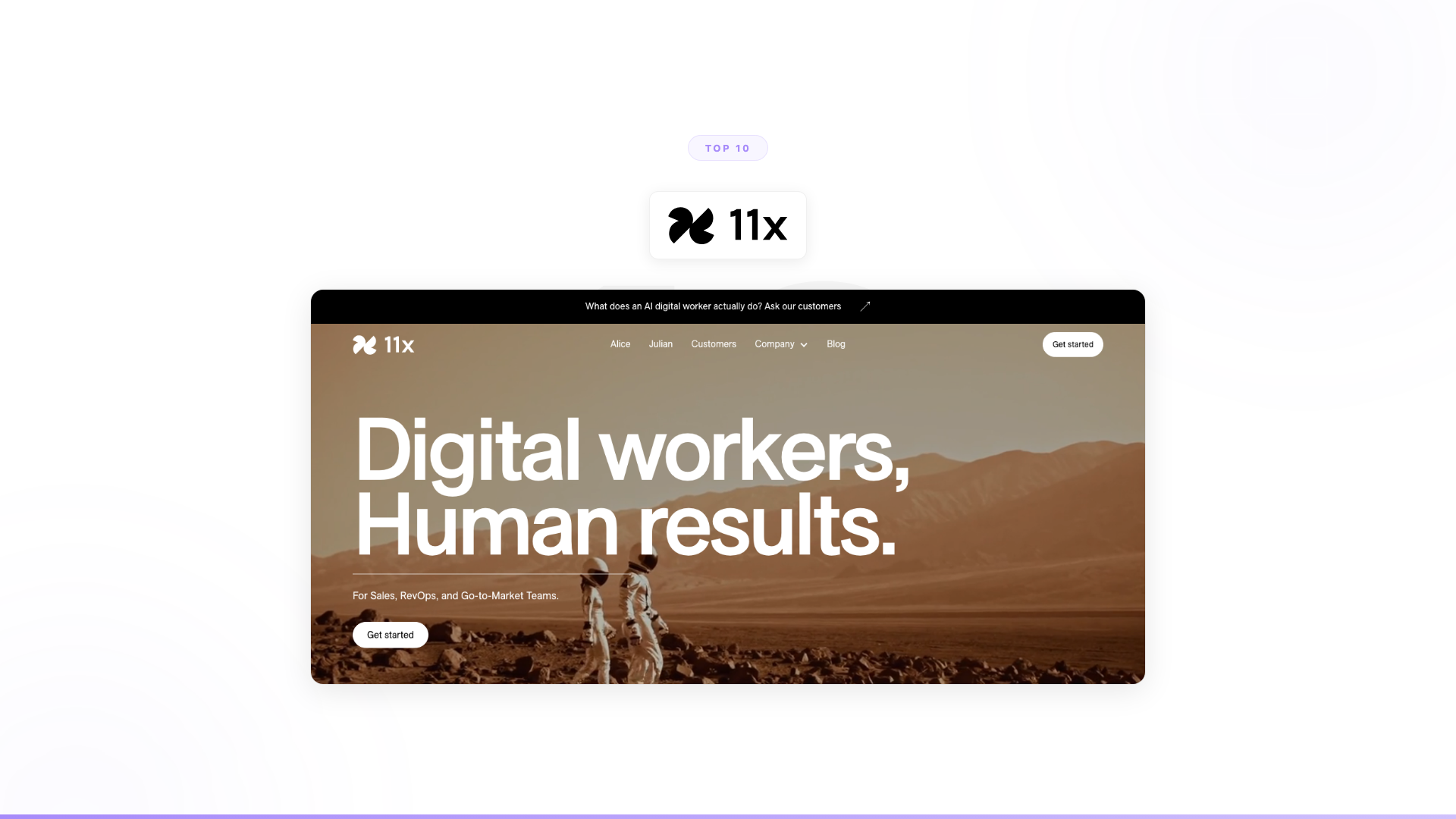
What it is: AI SDR platform with two agents: "Alice" for outbound email prospecting and "Julian" for phone qualification and outbound calling. Alice finds prospects matching your ICP, writes personalized sequences, handles follow-ups, and books meetings. Julian handles inbound call qualification and outbound calling at scale.
Strengths: Purpose-built for outbound volume. If your primary metric is meetings booked from cold outbound, 11x is designed for that use case. The dual-agent approach — email plus phone — covers more of the outbound motion than email-only tools. Fast to set up: configure your ICP, and Alice starts prospecting.
Limitations: G2 reviewers are divided on personalization quality. The platform has a mixed review profile on G2, with reported scores ranging widely depending on setup quality. Some teams report strong pipeline generation; others find the emails feel generic. Annual commitment required before you've validated performance — and multiple reviewers have flagged difficulty exiting early when results don't meet expectations. Scope is fixed: outbound SDR and phone qualification. No account intelligence, no pipeline management, no post-sale workflows.
What the reviews say: Independent analysis on Medium by an SDR Manager (tested 11x alongside other AI SDR platforms) noted that results are "highly sensitive to setup quality and operational readiness" — teams with a well-defined ICP and tested messaging see better outcomes than teams expecting the tool to solve targeting problems autonomously.
Pricing: Starts around $5,000/month. Annual commitment required.
Best for: Sales teams where outbound volume is the primary bottleneck and the only current AI priority. Evaluate personalization quality carefully — test before committing to an annual contract.
See also: Top 10 11x Alternatives →
3. Artisan
What it is: AI SDR with "Ava," a virtual sales development rep. Similar scope to 11x's Alice: automated outbound prospecting, email sequences, and meeting booking. Key differentiator: built-in B2B contact database with 300M+ contacts and waterfall enrichment, so you don't need a separate data provider.
Strengths: Bundled data eliminates the need for ZoomInfo, Lusha, or similar tools — saving cost and reducing integration friction. The outbound workflow is end-to-end within one platform: find contacts, write sequences, send emails, book meetings. Some G2 reviewers note positive initial setup experience and a clean onboarding flow that guides you through ICP definition without technical expertise.
Limitations: G2 and independent reviews surface a consistent pattern: Ava's emails frequently read as AI-generated — "overly formal and lacking the personalization depth needed to break through crowded inboxes," as one Artisan review on Salesrobot describes. Multiple reviewers report sending 1,000+ emails and receiving zero replies. Annual contracts with auto-renewal are standard, and cancellation friction is a recurring complaint. Same category ceiling as 11x: outbound email prospecting only.
Pricing: External sources put pricing at approximately $1,500–2,000+/month. Annual commitment. (Artisan does not publish pricing directly on their website.)
Best for: Teams that want outbound prospecting with bundled data in one tool, and don't need AI beyond cold email.
See also: 11x vs Artisan comparison →
4. Apollo AI
What it is: Sales intelligence and engagement platform with a large B2B contact database (275M+ contacts). Apollo combines data, outreach, and AI-assisted features: lead scoring, email writing assistance, sequence automation, and basic analytics. Not a fully autonomous AI SDR, but an AI-assisted sales platform.
Strengths: Best-in-class contact database with a functional free tier. Combines prospecting data and outreach in one platform. More affordable than dedicated AI SDR tools. The AI features are assistive, which means reps keep control over messaging and strategy — useful for teams that want AI help without full autopilot mode.
Limitations: The AI is assistive, not autonomous. Reps are still running the process: selecting leads, writing emails (with AI suggestions), managing follow-ups. Apollo helps a human SDR do the job faster. That's a meaningful difference from tools like 11x or Artisan that aim to replace the human altogether. Still sales prospecting only.
Pricing: Free tier available. Basic plan from $49/user/month ($59 billed monthly). Professional from $79/user/month. Organization plan at $119/user/month (billed annually, minimum 3 users). Sourced from Apollo.io pricing.
Best for: Sales teams that want integrated data and outreach with AI assistance, and prefer human-in-the-loop over full automation.
5. Amplemarket
What it is: AI-powered sales platform combining prospecting, multichannel outbound (email, LinkedIn, phone), and intent data signals.
Strengths: Multichannel is a genuine differentiator. Automates LinkedIn outreach and phone alongside email — more channel coverage than 11x's Alice or Artisan's Ava. Intent data integration helps prioritize in-market buyers, improving conversion rates compared to sequential list-based outreach.
Limitations: Still outbound only, just across more channels. Account research, pipeline management, onboarding, and support are out of scope. Teams that need AI beyond prospecting will reach the ceiling quickly.
Pricing: Custom pricing. Typically positioned at mid-market to enterprise.
Best for: Sales teams that want multichannel outbound — email, LinkedIn, and phone — with intent signal prioritization built in.
6. Outreach
What it is: Enterprise sales execution platform covering sequence management, pipeline visibility, deal intelligence, and forecasting.
Strengths: Broader than AI SDR tools. Covers deal progression through the pipeline, not just meeting booking. Strong analytics for sales leadership. Well-suited to complex, multi-touch enterprise sales cycles where pipeline visibility matters as much as top-of-funnel volume.
Limitations: Sales-only. AI augments reps; it doesn't complete workflows autonomously. No cross-department capability. Enterprise pricing that's hard to justify for teams that only need outbound prospecting.
Pricing: Custom enterprise pricing. Third-party sources estimate starting at approximately $100+/user/month; full deployments are considerably higher. Outreach and Salesloft are both listed as category leaders in G2's Sales Engagement category.
Best for: Enterprise sales teams with complex multi-stage cycles that need pipeline management and deal intelligence, not just outbound automation.
7. Salesloft
What it is: Sales engagement platform with conversation intelligence, cadence management, deal management, and forecasting. Owned by Vista Equity Partners.
Strengths: Strong cadence management and conversation intelligence. Call recording gives leadership deal visibility and helps reps self-improve. Mature platform widely deployed in enterprise sales organizations. Consistently rated among category leaders on G2's Sales Engagement and Sales Analytics categories.
Limitations: Same structural constraints as Outreach. Sales-only. AI assists reps rather than replacing workflows. Cross-department use cases aren't in scope.
Pricing: Custom enterprise pricing. Comparable to Outreach.
Best for: Revenue teams that want conversation intelligence, engagement tracking, and cadence management in a single platform.
8. Instantly
What it is: Cold email infrastructure platform. Unlimited email accounts, automated inbox warmup, deliverability optimization, and sequence management.
Strengths: Best-in-class deliverability at a fraction of AI SDR tool cost. The unlimited accounts model scales send volume without per-seat cost pressure. Widely used by agencies and growth teams. According to Instantly's own benchmark data, campaigns on well-warmed infrastructure see significantly higher open and reply rates than those on cold domains.
Limitations: Infrastructure, not intelligence. Sends emails but doesn't write them, research prospects, qualify responses, or book meetings. You need another tool or human team handling strategy and content creation.
Pricing: Starts at $30/month. Scales with volume.
Best for: Teams that need cold email infrastructure with strong deliverability, and have targeting and content handled separately.
9. Lavender
What it is: AI email coaching tool. Analyzes drafts in real time, scores emails on personalization, clarity, length, and tone, and learns from your team's best-performing messages.
Why it's in this list: Many teams pair AI email coaches with AI SDR platforms — Lavender helps human SDRs improve quality while AI SDRs handle volume. Research cited by Lavender and external benchmarks consistently shows that hyper-personalized emails deliver 2–3x higher reply rates, yet only a small percentage of reps personalize consistently. Lavender addresses this for human-written outreach.
Limitations: Coaches humans; doesn't replace them. You still need SDRs writing emails. It makes the human SDR more effective. It doesn't eliminate the role.
Pricing: Free tier available. Pro from $29/user/month.
Best for: Sales teams that want to keep human SDRs but improve their email quality and reply rates systematically.
10. Custom build
What it is: Building your own AI sales development system using frameworks like LangChain, LangGraph, or CrewAI. Full control over architecture, models, and workflows. Your engineering team handles design, implementation, deployment, security, and maintenance.
Strengths: Maximum flexibility. You can build exactly the sales intelligence system you need, integrated exactly how your organization works, with no vendor constraints. For companies with strong AI engineering teams, custom builds can outperform any commercial tool because they're designed for your specific use case.
Limitations: Most sales organizations don't have AI engineering capacity to spare. Custom builds mean you own security, governance, monitoring, and maintenance from day one. Expect 3 to 6 months for a first production agent, with ongoing engineering costs that don't decrease.
Pricing: Engineering salaries plus infrastructure. Timeline: months to get to production.
Best for: Organizations with dedicated AI engineering teams and unique requirements that no commercial tool can serve.
11x vs Artisan: which AI SDR is better?
This is the highest-volume comparison query in the AI SDR space, so it warrants a direct answer.
11x costs more (~$5,000+/month) and offers a dual-agent model: Alice for email and Julian for phone. If phone outreach is part of your outbound motion, 11x is the only dedicated AI SDR platform with a phone agent built in. Reviews on G2 and Trustpilot are polarized — a portion of users report strong pipeline results; a roughly equal portion report generic emails and missed expectations. The quality ceiling appears strongly correlated with how well-defined your ICP is before deployment.
Artisan starts lower (~$1,500–2,000+/month) and bundles a 300M+ B2B contact database. If you're currently paying for ZoomInfo or a similar data provider, Artisan consolidates that cost. Ava is email-only. Independent reviews are more consistently critical of output quality than 11x's reviews — the "AI-slop" complaint is specific and recurring across multiple platforms.
The honest bottom line: Neither platform reliably delivers the reply rates their marketing implies when dropped into cold markets without refined ICP targeting and message testing. Average B2B cold email reply rates sit at 5–10% for well-optimized campaigns, and 3–5% is considered realistic for most teams according to Belkins' 2025 cold email benchmarks. AI SDR tools don't change these fundamentals — they automate volume, not quality.
If you're choosing between them: run a defined pilot (60–90 days, clear pipeline metrics) before committing to an annual contract on either.
Full 11x vs Artisan comparison →
How much does an AI SDR tool cost?
AI SDR pricing varies significantly by product scope and vendor model:
| Tool | Starting price | Contract structure |
|---|---|---|
| Lavender | Free (Pro from $29/user/mo) | Monthly or annual |
| Instantly | From $30/mo | Monthly |
| Apollo AI | Free (paid from $49/user/mo) | Monthly or annual |
| Artisan (Ava) | ~$1,500–2,000+/mo | Annual |
| 11x (Alice + Julian) | ~$5,000+/mo | Annual |
| Amplemarket | Custom | Custom |
| Outreach | Custom (~$100+/user/mo) | Enterprise annual |
| Salesloft | Custom | Enterprise annual |
| Nexus | Per-agent, tied to value | POC to annual |
The key variable is contract structure. Artisan and 11x both require annual commitments before you've validated results. Multiple users across G2 and Trustpilot flag difficulty exiting early. Budget for a clear 90-day pilot with measurable pipeline targets before signing either.
Can AI SDRs replace human SDRs?
For high-volume outbound to cold lists with well-defined ICPs, AI SDR tools are increasingly capable. They can send thousands of personalized emails per week at a pace no human team can match.
For complex enterprise deals requiring relationship-building, industry expertise, and nuanced judgment — particularly in accounts where relationships matter more than volume — human SDRs remain essential.
The realistic deployment pattern for most teams: AI SDRs handle volume and initial outreach; human SDRs focus on high-value accounts, multi-threading, and late-stage conversation management. The cold email reply rate benchmarks support this framing: even optimized AI outreach sits at 5–10% reply rates according to Belkins research, which means 90%+ of targets don't engage. Human SDRs are needed for the follow-through.
One practical note on deliverability: AI SDR tools send at high volume, which accelerates domain aging and inbox reputation degradation if warmup and inbox rotation aren't actively managed. Teams using 11x or Artisan at scale often pair them with dedicated cold email infrastructure (like Instantly) to protect deliverability.
The narrow tool problem
Here's what happens when organizations buy AI SDR tools.
They start with one. Outbound email automation. Then they need account research. Different tool. Lead enrichment. Different vendor. Intent signals. Another subscription. Call recording. Pipeline forecasting. Customer onboarding. Support triage.
Each tool is a separate vendor, contract, integration, and data silo. The AI stack grows linearly. The tools don't share data or context. Every workflow is automated in isolation.
This is the fundamental problem with buying one AI tool per job-to-be-done: you end up with disconnected automations, not a system that works together.
What a platform approach looks like instead: Orange Group deployed customer onboarding agents across multiple European markets in 4 weeks — not just outbound, but the entire onboarding and support workflow on the same platform, connected to the same data. 50% conversion improvement. ~$6M+ yearly revenue impact. Sales, support, and onboarding. One platform, not five.
So which tool should you actually choose?
If you want an autonomous AI SDR for outbound email and that's your only current need, evaluate 11x, Artisan, or Amplemarket. They're purpose-built for that use case. Check personalization quality carefully, test deliverability on your domains, and negotiate a pilot before committing to an annual contract.
If you want AI-assisted sales with humans in the loop, look at Apollo AI (data plus outreach), Outreach (pipeline execution), or Salesloft (engagement plus conversation intelligence). More scope than pure AI SDRs, but still sales-only and still human-driven.
If you need email infrastructure, Instantly handles deliverability at scale. If you want email coaching for human reps, Lavender improves individual performance systematically. Both are components, not complete solutions.
If outbound is one of many workflows you need to automate, and buying a separate AI tool for each one will create the exact kind of disconnected sprawl that makes AI deployments fail, that's a platform problem. And that's what Nexus solves.
If your only problem is outbound email volume, 11x or Artisan will solve it faster. If your problem is that you're managing 5+ AI tools that don't share data or context — and the ROI on each individual tool is diluted by the overhead of managing the stack — Nexus is built for that.
The difference between an AI SDR tool and an AI agent platform isn't a feature gap. It's a category gap. One sends emails. The other transforms how your entire revenue organization works.
Frequently asked questions
Q: What is the best AI SDR tool in 2026?
11x (with Alice for email and Julian for phone) is the most comprehensive dedicated AI SDR platform for enterprises that want to automate outbound at scale. Artisan offers similar email SDR capabilities with a built-in B2B contact database at a lower starting price. For teams already using Apollo for data, Apollo AI adds SDR-like sequencing on top of its contact database without requiring a separate tool. Instantly is the strongest option specifically for cold email infrastructure and deliverability. For full revenue cycle automation beyond outbound, Nexus is the category leader.
Q: How much do AI SDR tools cost?
AI SDR pricing ranges widely: Instantly starts at $30/month for cold email infrastructure; Lavender starts free for email coaching; Apollo AI has a free tier with paid plans from $49/user/month; Artisan starts at approximately $1,500–2,000+/month on an annual contract; 11x starts at approximately $5,000+/month on an annual contract. Amplemarket, Outreach, and Salesloft are custom enterprise pricing. Nexus is priced per-agent, tied to value delivered.
Q: Can AI SDRs replace human SDRs?
AI SDR tools can handle high-volume outbound email and initial personalization at scale impossible for human teams — and 11x's Julian now handles phone outreach too. For high-volume cold outreach to well-defined ICPs, AI SDRs are increasingly capable. For complex enterprise deals requiring relationship-building and nuanced judgment, human SDRs remain essential. Most effective deployments use AI to handle volume while human SDRs focus on high-value accounts and late-stage conversations.
Q: Is 11x worth the cost?
11x has polarized reviews across G2 and Trustpilot. Teams with well-defined ICPs and tested outbound messaging report strong pipeline results. Teams expecting the tool to solve targeting problems from scratch report poor results. At $5,000+/month on an annual commitment, the ROI requires generating consistent pipeline to justify the cost. Independent reviewers consistently recommend a defined 90-day pilot with clear pipeline metrics before committing to an annual contract. The dual-agent model (email plus phone) is genuinely differentiated if phone outreach is part of your motion.
Q: What's the difference between an AI SDR and an AI agent platform?
An AI SDR automates the outbound prospecting workflow: finding contacts, writing sequences, sending emails, booking meetings. An AI agent platform — like Nexus — automates any business workflow across any department. An AI SDR solves one job. An agent platform solves the organizational problem of building, deploying, and managing AI across your entire operation. The tradeoff: an AI SDR is faster to deploy for a single use case; an agent platform requires more upfront scoping but compounds in value as you add workflows.
Worth exploring?
Every Nexus engagement starts with a 3-month proof of concept tied to measurable outcomes. Forward Deployed Engineers embed with your team from day one. You see the results before committing.
Talk to our team, 15 minutes →
See the full Nexus vs 11x comparison →