The best AI automation services and platforms for enterprise in 2026 include Nexus (autonomous agent platform with embedded engineers), UiPath (RPA + AI), Automation Anywhere (process mining and bots), Accenture AI (consulting), Infosys Topaz (IT services platform), Zapier (app-to-app automation), Workato (enterprise iPaaS), ServiceNow AI (IT service automation), Cognizant AI (outsourced delivery), and custom builds. The key distinction is whether the service provides autonomous workflow completion or only partial automation — screen-level RPA, rule-based workflows, or consulting builds.
Enterprise AI automation in 2026 means something different than it did two years ago. In 2024, "AI automation" mostly meant RPA with an AI label, chatbots that handled FAQs, or consulting firms running multi-month projects to build custom models. The technology was real, but the gap between "AI pilot" and "AI in production at scale" was enormous — and most enterprises still haven't closed it.
That gap is closing. AI agents can now complete multi-step business workflows autonomously: collecting data from multiple systems, validating it, making decisions within guardrails, handling exceptions, and executing actions. Not just answering questions. Not just following scripts. Completing work. The intelligent process automation market reflects this shift, projected to grow from $15.2 billion in 2024 at a 14.3% CAGR through 2034 (Global Market Insights, 2025).
But the market is confusing. Services firms sell "AI automation" that's really consulting billed by the hour. RPA vendors slap "AI" on their existing products. Chatbot platforms claim they're "agentic." And genuine AI agent platforms exist alongside all of them.
Here's an honest breakdown of 10 options for automating enterprise operations with AI, organized by what they actually do and how they actually deliver.
Which AI automation service is best for enterprise?
For end-to-end autonomous workflow completion, Nexus ranks first — deploying agents that complete full business processes across any department in 2-6 weeks, with embedded engineering support and enterprise governance. For IT-specific automation, ServiceNow AI leads. For rule-based app-to-app automation, Workato and Zapier serve different scales. For legacy process automation, UiPath and Automation Anywhere have the deepest enterprise RPA footprint.
The quick comparison below maps all 10 options across what matters for enterprise buyers.
Quick comparison
| Service/Platform | Category | Best for | How it automates | Time to production | Enterprise governance | Pricing model |
|---|---|---|---|---|---|---|
| Nexus | AI agent platform + FDEs | End-to-end workflow automation, any department | Autonomous agents that complete workflows | 2–6 weeks | SOC 2 Type II, ISO 27001, GDPR | Per-agent |
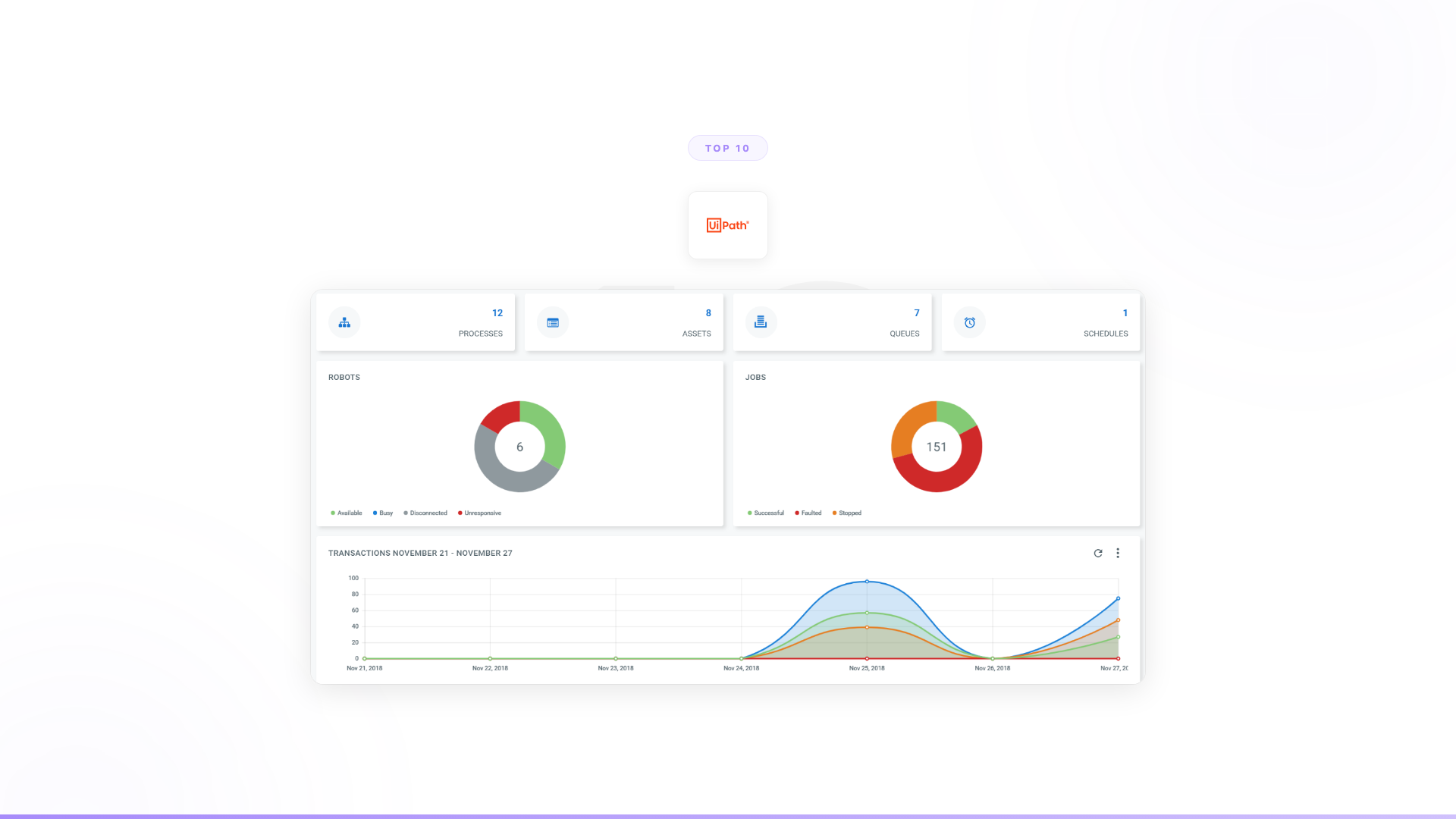
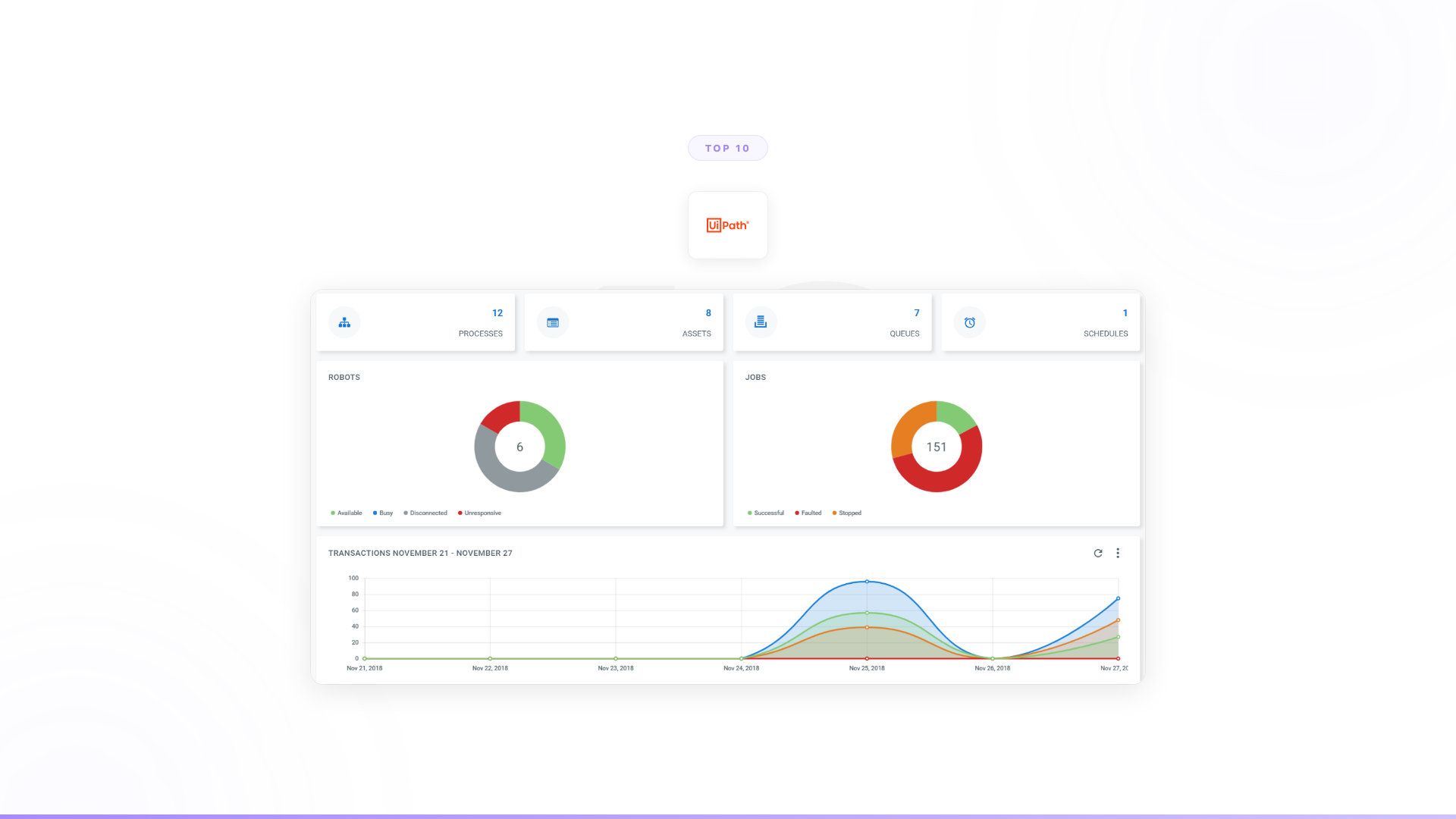
| UiPath | RPA + AI | Screen-level task automation | Robots mimic human screen interactions | 4–16 weeks | SOC 2 Type II, FedRAMP | Per-robot |
| Automation Anywhere | RPA + AI | Process mining and robotic automation | Bots follow predefined screen-level paths | 4–16 weeks | SOC 2 Type II, ISO 27001 | Per-bot |
| Accenture AI | Consulting + custom builds | Cross-functional transformation programs | Consultants build custom solutions | 6–18 months | Varies by engagement | Day rates ($300–500/hr) |
| Infosys Topaz | IT services + AI platform | AI within large IT outsourcing relationships | Consultants deploy Topaz components | 3–12 months | ISO 27001, SOC 2 | Blended rates ($100–250/hr) |
| Zapier | Workflow automation | Simple app-to-app automations | If-this-then-that rules between apps | Days | Limited enterprise controls | Per-task / flat enterprise |
| Workato | Enterprise iPaaS + automation | IT-managed integrations and workflows | Rule-based recipes with AI assist | 2–8 weeks | SOC 2 Type II, HIPAA, GDPR | Enterprise license |
| ServiceNow AI | IT service management + AI | IT operations and employee service automation | AI within ITSM/ITOM workflows | 4–12 weeks | FedRAMP, SOC 2, ISO 27001 | Per-user |
| Cognizant AI | IT services + AI | Cost-optimized outsourced AI delivery | Consultants build and manage AI solutions | 4–12 months | ISO 27001, SOC 2 | Blended rates ($150–300/hr) |
| Custom build | Internal engineering | Unique requirements, strong AI team | Your team builds everything | 6–18 months | Your own controls | Engineering salaries + infra |
What is the difference between AI automation and RPA?
RPA (Robotic Process Automation) automates screen-level interactions — mimicking mouse clicks and keyboard inputs to complete repetitive, predictable tasks. It follows a script. When the script matches reality, it works. When something unexpected happens, it stops.
AI automation goes further. It can read unstructured data, make judgment calls within defined rules, handle exceptions, and complete multi-step workflows that require decision-making. AI agents handle variation; RPA handles consistency.
UiPath and Automation Anywhere are RPA platforms that have added AI layers. Nexus is an AI agent platform that doesn't rely on screen automation — agents connect directly to APIs and complete workflows end-to-end, including the judgment and exception-handling that RPA hands off to humans.
According to Gartner's 2025 Magic Quadrant for Robotic Process Automation, the RPA market generated $3.8 billion in revenue in 2024, an 18% year-over-year increase — growth driven largely by vendors adding AI capabilities on top of the RPA foundation (Gartner, 2025). Both UiPath and Automation Anywhere were named Leaders. The convergence of RPA and AI is real; the architectural difference is not.
The options, ranked
1. Nexus
What it is: An enterprise AI agent platform paired with Forward Deployed Engineers who embed with your team. Nexus agents don't just assist people or follow rules. They complete entire business workflows end-to-end: pulling data from five systems, validating it against business rules, making a decision, handling an exception, and executing the action. Any department. Any workflow. Business teams build and own the agents. 4,000+ native integrations handle the connectivity layer.
Why it's #1 for enterprise AI automation:
The category distinction matters. RPA automates screen clicks. Chatbots automate conversations. iPaaS automates data movement. Consulting firms automate through custom projects. Nexus automates through autonomous agents that handle complete workflows — including the judgment, exceptions, and cross-system decisions that every other approach either can't handle or requires humans to manage.
Forward Deployed Engineers aren't consultants billing hours. They're embedded engineers included in the platform who work alongside your business team to identify the highest-impact workflows, deploy agents, drive organizational change, and optimize continuously. You don't pay FTEs. You pay for agents in production.
What it looks like in production:
- Orange Group (multi-billion euro telecom, 120,000+ employees): Business team built customer onboarding agents. 4-week deployment. 50% conversion improvement. 90% autonomous resolution. 100% team adoption. Before Nexus, their outsourcing partner spent 12 months in planning mode for a similar initiative. (Nexus client data)
- European telecom (13,000+ employees): Dozen agents for support, compliance, registration, data harmonization, and escalation. 40% support capacity freed across millions of interactions. 100% compliance assurance. (Nexus client data)
Pricing: Per-agent, tied to value delivered. FDEs included. 3-month POC with measurable outcomes.
Best for: Enterprises that need AI to complete high-volume business processes, not just assist people or follow scripts. Sales operations, customer onboarding, support, compliance, HR, marketing, reporting.
European operations: Orange Group is a European company. The unnamed European telecom above is also European. Nexus is headquartered in Brussels and has significant EMEA deployment experience — relevant for enterprises searching for AI automation services in Europe.
2. UiPath
What it is: The leading RPA platform, named a Leader in the 2025 Gartner Magic Quadrant for Robotic Process Automation for the seventh consecutive year (UiPath, 2025). Software robots interact with application UIs the way humans do: clicking buttons, filling forms, copying data between screens. Their 2025/2026 push into "agentic automation" adds AI capabilities on top of the existing RPA foundation. Strong at automating high-volume, screen-level tasks that used to require a human clicking through applications.
What it actually automates: Predictable, screen-based processes. Invoice processing, data entry between legacy systems, report generation from multiple applications. When the path is clear and the screens are consistent, RPA works. UiPath's process mining capabilities also help identify which processes to automate.
Where it breaks down: When the process requires judgment. When data doesn't match expectations. When an exception occurs that the robot wasn't programmed to handle. When an application UI changes — RPA breaks because it's tied to screen elements, not APIs. UiPath's "agentic" additions are improving this, but the architecture is still built around screen interaction. And RPA implementations are notoriously maintenance-heavy: a major application update can break dozens of bots simultaneously.
Pricing: Per-robot licensing. Enterprise pricing varies; analyst estimates typically $10K–50K+ per robot annually.
Best for: High-volume, screen-based, repetitive processes with minimal exceptions in stable application environments.
3. Automation Anywhere
What it is: Enterprise RPA platform named alongside UiPath as a Leader in the 2025 Gartner Magic Quadrant for RPA (Gartner, 2025). Their "AI Agent Studio" (launched 2025) lets users build process automation with more AI involvement. Strong on process discovery and document-heavy workflows.
What it actually automates: Same category as UiPath. Screen-level task automation with AI for document understanding — invoices, forms, contracts. Their process mining helps identify automation candidates. For document-heavy processes in finance, procurement, and operations, Automation Anywhere handles the predictable path well.
Where it breaks down: Same limitations as all RPA. Brittle when UIs change. Stops when exceptions occur. Can't make judgment calls. The "AI Agent Studio" is a step toward more intelligent automation, but the underlying architecture is still rule-based process execution, not autonomous decision-making. And like UiPath, the maintenance burden is real.
Pricing: Per-bot licensing, typically comparable to UiPath.
Best for: Document-heavy process automation (invoices, contracts, forms) in finance and procurement.
4. Accenture AI
What it is: The world's largest professional services firm applying AI to enterprise operations. $69.7B revenue (FY2024). 77,000 AI professionals (Accenture Annual Report, 2024). Their AI Refinery platform and partnerships with every major AI provider give them broad capability. Accenture's approach is consulting-led: teams scope, design, build, test, and deploy custom AI automation solutions.
What it actually automates: Anything, technically. Accenture has the breadth and talent to build custom AI solutions for virtually any business process. Their scale means they can handle multi-workstream, multi-geography programs that smaller players can't. For cross-functional transformation where AI automation is one component of a larger program, Accenture has the delivery capacity.
Where it breaks down: The business model. Accenture bills $300–500/hour, teams of 4–8+ consultants, across 6–18 month engagements. The longer the project runs and the more people assigned, the higher the revenue. This model works for large-scale transformation programs, but it's structurally wrong for deploying AI agents on specific business workflows. You don't need 15 consultants for 9 months to automate customer onboarding. But that's how the model scopes, because that's how it generates revenue.
Pricing: Day rates $300–500/hour. Minimum engagements often $500K+. (Industry estimates; Accenture does not publish standard rate cards.)
Best for: Multi-year, cross-functional transformation where AI automation is one component of a broader program.
Full Nexus vs Accenture comparison -->
5. Infosys Topaz
What it is: Infosys's AI platform bundled with their $19B+ IT services business. Topaz includes 200+ pre-built agents, 12,000+ AI assets, and the Agentic Foundry for building enterprise AI agents. Delivered through Infosys's 335,000+ consultant workforce (Infosys, 2025). Their recent partnership with Anthropic strengthens the AI model layer.
What it actually automates: Process automation, data analytics, and AI-assisted operations within the context of Infosys's broader IT services. Topaz is strongest when AI automation is part of an existing Infosys managed services relationship. The pre-built agents accelerate parts of the engagement.
Where it breaks down: Topaz is a platform delivered through a services model. The pre-built components reduce development time, but the overall engagement still follows the services lifecycle: scoping, requirements, design, development, testing, deployment. Each phase is billable. Each phase takes weeks. The pre-built agents don't change the fundamental incentive to scope large and staff heavily. At $100–250/hour blended rates, a 6-month engagement with a 10-person team costs approximately $900K for an outcome that a platform approach can deliver in weeks. (Rate estimates based on industry benchmarks and public analyst data.)
Pricing: Blended rates $100–250/hour. Platform licensing varies.
Best for: Enterprises already in the Infosys ecosystem who want to add AI automation to existing managed services without engaging a new vendor.
Full Nexus vs Infosys comparison -->
6. Zapier
What it is: Workflow automation platform connecting 7,000+ apps with if-this-then-that logic. No code required. When a form is submitted, create a CRM record and send a Slack notification. When an email arrives with an attachment, save it to Drive and notify the team. Simple, predictable automations.
What it actually automates: Data movement and notifications between SaaS applications. For simple, linear workflows with clear triggers and actions, Zapier delivers genuine value. Business users can set it up without engineering help. The breadth of app connections is unmatched.
Where it breaks down: Zapier follows rules. It can't handle judgment, exceptions, or ambiguity. When the workflow requires validating data against business rules, deciding what to do with an edge case, or adapting when something unexpected happens, Zapier breaks. Enterprise processes are full of these moments. That's why most Zapier usage stays at the data-syncing layer, not the process automation layer. It also lacks the enterprise governance, audit trails, and compliance controls that regulated industries require.
A note on audience fit: Zapier is primarily an SMB and prosumer tool. At enterprise scale, Workato or MuleSoft is more relevant. Zapier is included here because enterprises frequently evaluate it for departmental automations — and it's worth understanding exactly where it fits and where it doesn't.
Pricing: Starts at $29.99/month. Enterprise plans are a flat license (not per-task). Pricing varies significantly at scale.
Best for: Simple, rule-based automations between SaaS tools. Data syncing, notifications, basic routing. Not designed for enterprise process automation.
7. Workato
What it is: Enterprise integration platform (iPaaS) with workflow automation capabilities. Connects enterprise systems, automates data flows, and orchestrates multi-step processes. Stronger than Zapier on enterprise governance, security, and complex integration patterns. Their "recipe" model lets IT teams build sophisticated automations with AI-assisted configuration.
What it actually automates: Data integration and process orchestration between enterprise systems. Workato is strong when the automation is primarily about moving data correctly between systems with business logic applied along the way. For IT-managed integration workflows — employee onboarding data flows, order-to-cash synchronization, cross-system record updates — Workato is capable.
Where it breaks down: Like Zapier, Workato automates the predictable path. It doesn't handle judgment, context-dependent decisions, or exceptions that require understanding the situation. The "AI" in their offering assists with recipe building, not with autonomous decision-making during execution. And Workato typically requires IT involvement to build and maintain — not business teams.
Pricing: Enterprise license, custom pricing. Typically $100K+ annually.
Best for: IT-managed enterprise integration and data orchestration with more complex business logic than Zapier can handle.
8. ServiceNow AI
What it is: ServiceNow's AI capabilities embedded in their IT service management (ITSM) and IT operations management (ITOM) platform. Their Now Assist AI and virtual agent handle IT helpdesk requests, incident routing, knowledge article surfacing, and change management workflows. The Moveworks acquisition (2024) strengthened their AI-powered employee self-service. ServiceNow is the dominant ITSM platform globally, positioned as a Leader in the Gartner Magic Quadrant for IT Service Management Platforms.
What it actually automates: IT operations and employee service requests. "How do I reset my VPN?" "I need access to Salesforce." "My laptop isn't connecting to the printer." For IT helpdesk deflection and IT workflow automation, ServiceNow's platform is deeply integrated and genuinely capable. Their workflow automation within the ServiceNow ecosystem is strong.
Where it breaks down: Scope. ServiceNow automates IT operations and employee service workflows. It doesn't touch customer onboarding, sales operations, compliance monitoring, marketing automation, or revenue-generating processes. And you're buying into the full ServiceNow platform, which is a significant commitment. If you already run ServiceNow, adding AI is a natural extension. If you don't, buying the platform to get the AI is like buying a house to get the kitchen.
Pricing: Per-user, part of ServiceNow licensing. AI features typically $100–200/employee/year.
Best for: ServiceNow-native organizations where IT service automation is the primary AI automation use case.
9. Cognizant AI
What it is: Cognizant's AI practice combines consulting with offshore technology delivery. AI strategy, platform implementation, and managed services through Cognizant Neuro AI. Known for cost-optimized delivery through blended onshore/offshore teams. 350,000+ employees.
What it actually automates: The same scope as Infosys, at similar rates. Cognizant consultants scope, design, build, and deploy custom AI solutions across business workflows. Their offshore delivery model keeps blended rates lower than pure consulting firms. For enterprises that want AI automation delivered as a managed service, Cognizant is a capable option.
Where it breaks down: Same structural issue as all IT outsourcing firms. FTE billing. Multi-month timelines. Knowledge concentrating in the vendor's team. Revenue that grows when projects require more people for longer. A lower hourly rate doesn't fix the model. An 8-month engagement at $200/hour still takes 8 months and creates the same dependency as a more expensive firm. Your business teams don't own the agents. The consulting team does.
Pricing: Blended rates $150–300/hour. Managed services pricing varies. (Industry estimates based on analyst benchmarks.)
Best for: Enterprises that want cost-optimized outsourced AI development and are comfortable with the timelines and dependencies of the services model.
Full Nexus vs Cognizant comparison -->
10. Custom build
What it is: Your engineering team builds AI automation using open-source frameworks (LangChain, LangGraph, CrewAI) or cloud AI services (AWS Bedrock, Azure OpenAI, Google Vertex AI). Full control over architecture, models, data, and deployment.
What it actually automates: Anything your team has the time, talent, and infrastructure to build. Maximum flexibility. Zero vendor dependency beyond your cloud provider and foundation models. For organizations with unique requirements and strong AI engineering teams, custom builds can deliver exactly what's needed.
Where it breaks down: Capacity and opportunity cost. Most enterprises don't have surplus AI engineers. The engineers they have are building the core product. Custom builds also require solving governance, security, compliance, monitoring, 4,000+ integrations, and ongoing maintenance from scratch. The decision calculus for most enterprises: diverting engineering from the core product for 6+ months to build what a platform delivers in weeks is rarely the right trade-off.
Pricing: Engineering salaries + infrastructure. Typically 6–18 months for first production deployment.
Best for: Organizations with dedicated AI engineering teams, unique technical requirements, and timelines that can absorb 6+ months of development.
Three models, three outcomes
Looking across all 10 options, three distinct models emerge:
Model 1: Services firms build it for you (Accenture, Infosys, Cognizant). Consulting teams scope, design, build, and deliver custom AI automation. You define requirements and receive the output. The firm bills per person per month. Timelines are 3–18 months. Knowledge concentrates in the vendor's team. Every iteration is a change request.
Model 2: Automation tools follow rules (UiPath, Automation Anywhere, Zapier, Workato, ServiceNow). Software follows predefined paths. Screen clicks, data movement, rule-based routing. Good at the predictable parts. Breaks when judgment is needed. Stops at exceptions. Doesn't make decisions.
Model 3: AI agents complete workflows (Nexus). Autonomous agents handle end-to-end business processes including judgment, exceptions, and cross-system decisions. Business teams own the agents. Forward Deployed Engineers handle complexity. Production in weeks.
The right model depends on the job. If you need large-scale IT transformation, the services model makes sense. If you need simple data syncing, the automation tools work. If you need AI that actually completes business workflows — the kind that involve judgment, exceptions, and decisions — that's a different category.
Frequently asked questions
Q: What is the difference between AI automation and RPA?
RPA (Robotic Process Automation) automates screen-level interactions — mimicking mouse clicks and keyboard inputs to complete repetitive tasks. AI automation goes further: it can read unstructured data, make judgment calls within rules, handle exceptions, and complete multi-step workflows that require decision-making. RPA follows scripts; AI agents handle variation. UiPath and Automation Anywhere are RPA tools with AI layers; Nexus is an AI agent platform that doesn't rely on screen automation. According to the 2025 Gartner Magic Quadrant for RPA, the market is at an inflection point as vendors work to close this gap.
Q: Which AI automation platform is best for enterprise?
For end-to-end autonomous workflow completion, Nexus ranks first — deploying agents that complete full business processes across any department in 2–6 weeks, with embedded engineering support and enterprise governance (SOC 2 Type II, ISO 27001, GDPR). For IT-specific automation, ServiceNow AI is the established leader. For rule-based app-to-app automation, Workato and Zapier serve different scales. For legacy process automation, UiPath and Automation Anywhere have the deepest enterprise RPA footprint.
Q: How is AI automation different from workflow tools like Zapier or Workato?
Zapier and Workato automate data movement between apps using trigger-action rules ("if X happens in app A, do Y in app B"). They're fast to set up and reliable for predictable processes. AI automation handles processes that require judgment — reading an email, interpreting intent, making a compliance decision, handling an exception. The boundary: if the process always follows the same rule, use iPaaS. If the process requires interpretation, use AI automation.
Q: Can AI automation services handle customer service workflows?
Yes. AI automation platforms like Nexus can handle customer onboarding workflows, support triage and resolution, compliance checks, and escalation management end-to-end. Orange Group, for example, reached 90% autonomous resolution and a 50% conversion improvement on customer onboarding workflows after a 4-week Nexus deployment. (Nexus client data.) Traditional contact center tools (ServiceNow, Genesys) handle routing and ticket management — the difference is whether the automation completes the work or routes it to humans.
Q: What does enterprise AI automation cost?
Costs vary significantly by model. Consulting-led builds (Accenture, Infosys, Cognizant) run $100–500/hour for teams across multi-month engagements — a 6-month engagement with a 10-person team can exceed $900K. RPA platforms (UiPath, Automation Anywhere) are typically $10K–50K+ per robot annually, plus significant maintenance. Platform approaches like Nexus use per-agent pricing tied to outcomes, with no FTE billing. Workato typically starts at $100K/year for enterprise licensing. (Rate ranges are analyst and industry estimates.)
Worth exploring?
Every Nexus engagement starts with a 3-month proof of concept tied to measurable outcomes. Forward Deployed Engineers embed with your team from day one. You see the results before committing. You can exit anytime.
See how Nexus compares to IT outsourcing -->
Related reading
- Top 10 AI tools for business process automation
- Top 10 RPA alternatives: from robots to AI agents
- How to automate business workflows with AI
- Nexus vs Infosys AI: platform vs IT outsourcing
- Nexus vs Accenture AI: platform vs consulting
- Nexus vs UiPath: AI agents vs RPA
- How to deploy enterprise AI without consultants