Top 10 UiPath Alternatives for Process Automation in 2026
UiPath automates screen clicks. These 10 alternatives range from traditional RPA to autonomous AI agents. Ranked by what they deliver when processes need judgment, not just scripts.
Most enterprises searching for UiPath alternatives already have UiPath deployed. The problem isn't that it failed — it's that it succeeded at the wrong layer. UiPath executes scripts on screens. The processes that drive revenue, retention, and compliance require something it structurally can't do: judgment.
RPA automates screen clicks. It follows scripts. When a process needs judgment — when an input is ambiguous, when an exception doesn't match any rule, when a customer's situation requires interpretation — the robot stops and a human takes over. For most enterprises, the processes with the highest business impact are exactly the ones full of these moments. Customer onboarding, sales intelligence, compliance monitoring, support triage. These workflows don't fail because they lack automation. They fail because they need decisions.
That's the real reason people search for alternatives. Not because UiPath is broken, but because the category has a ceiling. If you've hit it, here are 10 alternatives worth evaluating, organized from rule-based tools to intelligent platforms.
What is UiPath?
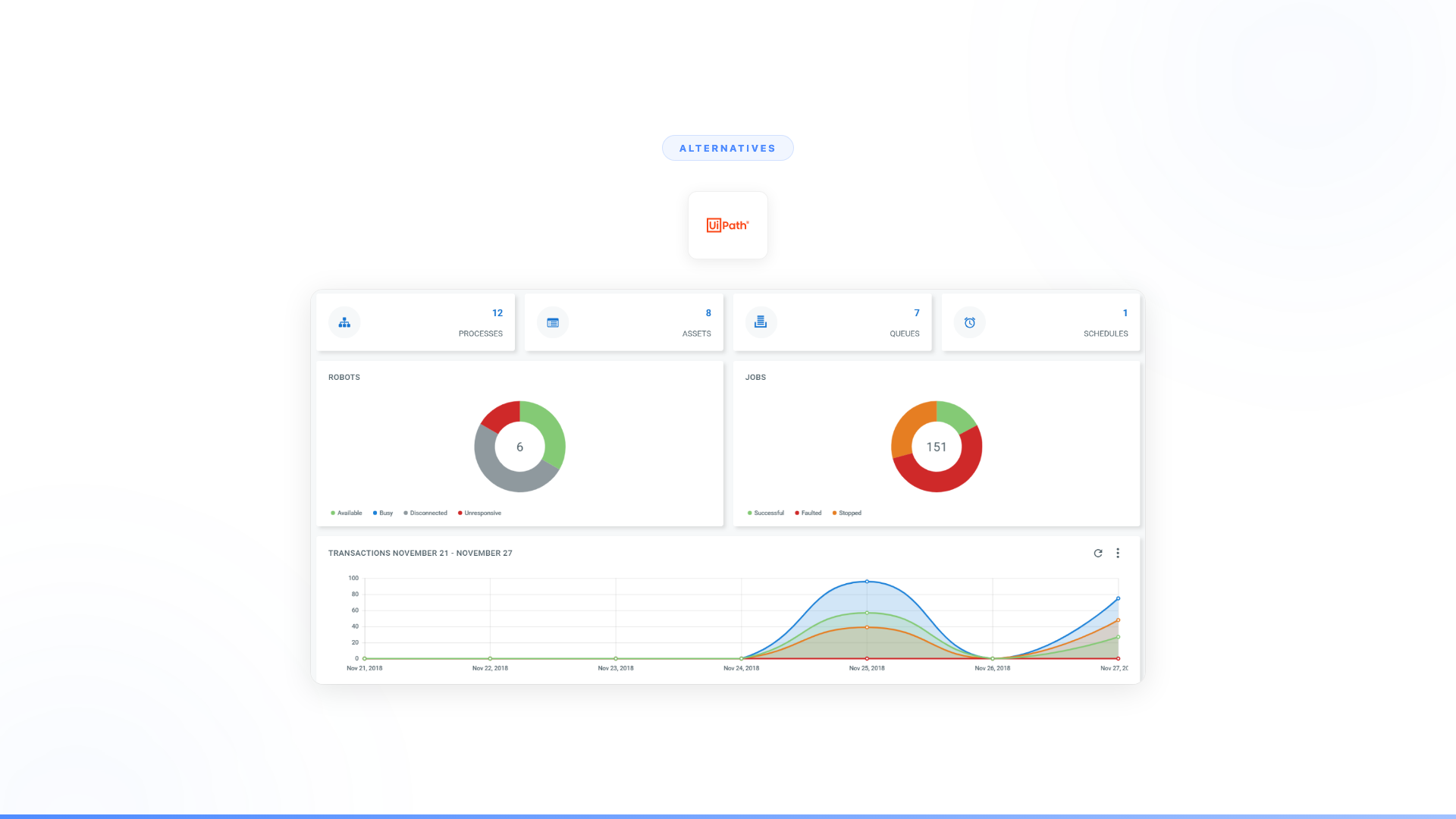
UiPath is the market-leading Robotic Process Automation (RPA) platform. Founded in Bucharest in 2005 and listed on the NYSE (PATH) in 2021, it uses software robots to automate repetitive, screen-based processes in enterprise environments. UiPath reported $1.43 billion in revenue for fiscal year 2025 — a 9% year-over-year increase — with an Annual Recurring Revenue (ARR) of $1.67 billion (UiPath FY2025 Earnings, April 2025).
Key capabilities include: software robots for UI-based task automation, document understanding, process mining (UiPath Process Mining), AI computer vision, and workflow orchestration. In 2024 and 2025, UiPath pivoted aggressively toward "agentic automation" with the launch of UiPath Autopilot — combining AI agents, robots, and human workers to handle more complex, exception-heavy processes. The UiPath Platform was named one of TIME's Best Inventions of 2025.
That pivot matters for buyers evaluating the platform today. UiPath is no longer purely an RPA vendor. But understanding where its agentic capabilities begin and where they stop is essential before evaluating alternatives.
What are UiPath's main limitations?
Even with the agentic automation roadmap, UiPath carries structural constraints that lead enterprises to look elsewhere:
- Exception handling still requires human intervention. UiPath's robots follow predefined scripts. When a process falls outside those scripts, the robot stops. Autopilot can handle more dynamic flows, but it still requires developer configuration of the agent's decision rules — it doesn't reason through novel situations autonomously.
- Maintenance burden scales with complexity. Every time an application UI changes — a button moves, a field is renamed, a screen layout is updated — bots break. For large bot estates across enterprise applications, maintenance costs often approach or exceed the value the automation delivers.
- Licensing and total cost of ownership. UiPath pricing is complex. Robot licenses typically run $8,000–$20,000+ per robot annually for attended automation, with enterprise deployments commonly running hundreds of thousands to millions of dollars annually. Per-robot licensing means cost scales directly with automation volume (estimate based on publicly disclosed tiers; exact pricing depends on edition and negotiated terms).
- Process mining is a separate product. UiPath Process Mining is genuinely differentiated — it discovers automation opportunities by analyzing event logs from ERP and CRM systems. But it's not included in standard RPA licenses, adding cost and implementation effort.
- The agentic gap. UiPath's Autopilot is a meaningful step forward, but the underlying architecture remains orchestration-first: you configure what the agent can do, and it executes within those bounds. Truly autonomous reasoning — where an agent interprets a novel situation, decides a course of action, and executes it without predefined rules — is not what UiPath was built for.
Is UiPath really "agentic"?
UiPath's agentic automation refers to AI-assisted workflows where agents can plan across tasks, leverage large language models for document understanding and natural language processing, and handle more complex branching logic than classic RPA. Autopilot, announced in 2024 and updated through 2025, allows users to build agents that orchestrate robots, AI models, and human-in-the-loop steps.
This is a meaningful evolution. But it's different from what autonomous agent platforms do. UiPath agents operate within a developer-configured orchestration layer — the agent's decision scope is bounded by what a developer explicitly built into the workflow. An autonomous agent platform reasons through novel inputs, interprets business context, and decides what to do when the situation doesn't match any predefined path. The categories are converging, but they're not the same yet.
How much does UiPath cost?
UiPath enterprise pricing is complex and varies by edition, deployment model, and negotiated agreement. General ranges based on publicly available information:
- Attended automation robots: Approximately $8,000–$15,000 per robot/year (estimate; varies by contract)
- Unattended automation robots: Approximately $10,000–$20,000+ per robot/year
- Large enterprise deployments: Typically $200,000 to multi-millions annually for full bot estates
- UiPath Process Mining: Separate licensing; adds to base platform cost
- Autopilot / agentic features: Included in some enterprise tiers; add-on in others
These are estimates based on publicly disclosed pricing ranges and industry benchmarks. Actual costs require direct vendor negotiation.
Quick comparison
| Tool | Category | Best for | Handles exceptions? | Pricing model |
|---|---|---|---|---|
| Nexus | Autonomous agent platform | Full enterprise workflow automation with judgment and decisions | Yes, autonomously | Per-agent |
| Automation Anywhere | RPA + AI agents | Screen-based automation with agentic AI features | Limited | Per-bot / credits |
| Blue Prism (SS&C) | Enterprise RPA | Regulated industries, legacy systems, governance | No | Per-digital-worker |
| Microsoft Power Automate | Low-code automation | Simple workflows within Microsoft ecosystem | Rule-based only | Per-user / per-flow |
| Zapier | Workflow automation | Simple, trigger-based SaaS integrations | No | Per-task |
| Workato | iPaaS + automation | API-level integrations and IT automations | Rule-based only | Per-recipe |
| Pega | BPM + decisioning | Large-scale case management and decisioning | Rule-based decisioning | Enterprise license |
| Appian | Low-code + BPM | Process orchestration with custom apps | Rule-based only | Per-user |
| Camunda | Process orchestration | Developer-led workflow orchestration (BPMN) | Configurable | Per-instance |
| Custom build | Developer framework | Engineering teams building from scratch | Depends on team | Engineering cost |
The alternatives, ranked
1. Nexus
What it is: An autonomous agent platform paired with Forward Deployed Engineers who embed with your team. Nexus agents don't automate screen clicks. They understand business logic, reason through exceptions, hold conversations when clarification is needed, and complete entire workflows end-to-end. Any department. Any workflow. Business teams build and own the agents.
Why enterprises switch from UiPath to Nexus:
RPA automates the structured path. Nexus replaces the human judgment that automation requires at every exception point. That's the category difference. A UiPath bot copies data from screen A to screen B. A Nexus agent understands why that data matters, validates it against business rules, decides what to do when something doesn't match, and handles the full workflow — including the steps that RPA can't touch because they need interpretation.
What it looks like in production:
- Orange Group (multi-billion euro telecom, 120,000+ employees): Business team built autonomous customer onboarding agents. Deployed in 4 weeks. 50% conversion improvement. ~$6M+ yearly revenue impact. 90% autonomous resolution. 100% team adoption. Their previous automation couldn't handle the ambiguous inputs and edge cases that characterize real customer interactions.
- European telecom (13,000+ employees): Had existing RPA infrastructure. Bots handled the predictable steps. But the highest-impact workflows — support, compliance, registration — involved too many exceptions. Deployed a dozen Nexus agents. 40% of support volume freed across millions of interactions. 12-week deployment.
Results above represent Nexus client data from individual deployments. Specific outcomes vary by use case and organization.
Pricing: Per-agent, tied to value delivered. Every engagement starts with a 3-month proof of concept. 100% POC-to-contract conversion rate.
Best for: Enterprises where the highest-value processes are still manual because they involve exceptions, judgment, and cross-system coordination that bots can't handle.
Full Nexus vs UiPath comparison -->
2. Automation Anywhere
What it is: UiPath's closest RPA competitor. Software robots for screen-level automation, plus growing AI capabilities. Their platform includes Bot Insight (analytics), AARI (human-in-the-loop), and AI Agent Studio for building more intelligent automations. In 2024 and 2025, Automation Anywhere launched its "AI + Automation Enterprise System" — including the industry's first Process Reasoning Engine (PRE), Enterprise UI Agents (adaptive "computer use" agents), and Reasoning AI Agents that can be given a goal and plan their own execution path.
How it compares to UiPath: Similar in core RPA capability, but Automation Anywhere has positioned more aggressively around AI agents. Their cloud-native architecture, consumption-based pricing model, and Process Reasoning Engine distinguish them from UiPath's orchestration-first approach. Both companies are racing to add genuine AI reasoning on top of their RPA foundations — and Automation Anywhere's 2025 product push has been substantive.
Why it might not solve the problem: Even with the agentic additions, Automation Anywhere shares UiPath's fundamental architecture. The agents operate within developer-configured bounds. When processes need genuine autonomous reasoning — where the agent must interpret a novel situation, form a judgment, and act without predefined rules — both platforms hit the same ceiling. If you're leaving UiPath because the category has limits, you need to evaluate whether Automation Anywhere's AI agent capabilities specifically address your exceptions, not just add more automation surface area.
Pricing: Consumption-based (Cloud credits) or per-bot. Enterprise deals typically six figures annually.
Best for: Enterprises committed to RPA that want a cloud-native alternative to UiPath with stronger AI agent capabilities for high-volume, structured processes.
See: UiPath vs Automation Anywhere -->
3. Blue Prism (SS&C)
What it is: Enterprise RPA platform, acquired by SS&C Technologies in 2022 for approximately $1.6 billion. Known for its focus on governance, security, and regulated industries. Blue Prism positions itself as the enterprise-grade RPA option with strong audit trails and compliance features. Under SS&C, the platform has been integrated with SS&C's financial services and insurance technology stack.
How it compares to UiPath: More governance-focused, less community-driven. Blue Prism was designed for large enterprises in regulated industries — banking, insurance, healthcare. It lacks UiPath's marketplace breadth and developer community but offers tighter controls and better audit capabilities. The SS&C acquisition means the product roadmap is now shaped by SS&C's core financial services customer base, which is relevant if you're not in those verticals.
Why it might not solve the problem: Same category, same ceiling. Blue Prism robots follow scripts. They can't interpret ambiguous inputs, hold conversations, or make judgment calls. The governance features are genuinely strong, but governance applied to rule-based bots still gives you rule-based bots. If the problem is that your processes need intelligence, not just compliance, the structural limitation remains.
Pricing: Per-digital-worker licensing. Enterprise pricing typically starts at $15,000+ per digital worker annually (estimate based on publicly reported ranges).
Best for: Heavily regulated enterprises — banking, insurance, financial services — that need strong governance around screen-level automations and are already embedded in the SS&C ecosystem.
4. Microsoft Power Automate
What it is: Microsoft's automation platform. Combines cloud flows (API-level integrations between Microsoft and third-party services) with desktop flows (screen-level RPA similar to UiPath). Deeply embedded in the Microsoft 365 ecosystem.
How it compares to UiPath: Less powerful for complex RPA, but significantly easier to start with. For simple automations within Microsoft 365 — route an email, update a SharePoint list, create a Teams notification — Power Automate is fast and accessible. Many organizations already have licenses through M365 agreements, which lowers the procurement barrier significantly.
Why it might not solve the problem: Two separate limitations. The cloud flows are rule-based: if-this-then-that logic that stops when conditions fall outside predefined rules. The desktop flows are RPA, with the same brittleness and maintenance burden as UiPath. And Microsoft's own track record is instructive: according to Gartner's 2025 Microsoft 365 and Copilot Survey, only 6% of organizations that piloted Copilot moved to broader deployment (Gartner, 2025). The pattern of adoption stalling at the pilot stage isn't unique to AI assistants — it reflects a broader challenge with Microsoft's automation stack when applied to judgment-heavy workflows.
Pricing: Included in some M365 plans (limited flows). Premium: $15/user/month. Per-flow plans available for unattended automation.
Best for: Microsoft-native organizations that need simple, rule-based automations within their existing ecosystem and want to avoid additional vendor relationships.
5. Zapier
What it is: Workflow automation platform connecting 7,000+ SaaS applications with trigger-based logic. No code required. Excellent for simple integrations: when a form is submitted, create a CRM record and send a Slack message.
How it compares to UiPath: Different layer entirely. UiPath automates screens. Zapier automates API connections. For simple, multi-app workflows that follow predictable logic, Zapier is faster to set up and easier to maintain because it operates at the API level rather than the screen level — no UI fragility, no bot maintenance when interfaces change.
Why it might not solve the problem: Zapier follows rules. It executes when X happens, do Y logic. It can't handle judgment, ambiguity, or exceptions. When the workflow requires interpreting intent, validating against complex business rules, or deciding what to do in an edge case, Zapier stops. For enterprises that outgrew UiPath because their processes need intelligence, Zapier is a step sideways, not forward.
Pricing: Free tier (limited). Starter: $29.99/month. Professional: $73.50/month. Enterprise plans available.
Best for: Simple, trigger-based automations between SaaS tools. Data syncing, notifications, basic routing. Not for exception-heavy enterprise workflows.
Full Nexus vs Zapier comparison -->
6. Workato
What it is: Integration and automation platform (iPaaS) focused on IT and business teams. Connects enterprise systems at the API level with "recipes" that define automated workflows. Stronger integration capabilities than Zapier, with enterprise-grade security and more complex branching logic.
How it compares to UiPath: Workato operates at the API level, which means fewer breakage issues than UiPath's screen-level approach. For integration-heavy automations — syncing data between Salesforce, NetSuite, and Workday — Workato is a solid choice. It also handles more complex logic than Zapier and is designed for enterprise IT requirements around security and governance.
Why it might not solve the problem: Workato automates integrations, not decisions. Its recipes follow predefined logic. When a workflow needs judgment — should this lead be qualified? does this claim meet compliance requirements? what's the right escalation for this exception? — Workato can't help. It moves data between systems reliably. It doesn't reason about what that data means or what to do when it doesn't match expectations.
Pricing: Per-recipe or workspace-based. Enterprise pricing typically starts at $10,000+/year.
Best for: IT teams that need reliable, API-level integrations between enterprise systems with more complexity than Zapier can handle.
7. Pega
What it is: Business process management (BPM) and decisioning platform. Pega combines workflow automation with a rules engine and customer decisioning capabilities. Used heavily in banking, insurance, telecom, and healthcare for complex case management.
How it compares to UiPath: Different category. UiPath automates screen actions. Pega orchestrates business processes and applies decisioning rules. For large-scale case management — claims processing, customer service routing, loan origination — Pega offers more process intelligence than pure RPA. Pega's rules engine is genuinely powerful and has decades of refinement in regulated industries.
Why it might not solve the problem: Pega's decisioning is rule-based. Powerful rules, but rules nonetheless. You define the logic. When a scenario falls outside defined rules, someone manually updates them — and large Pega implementations often have hundreds of thousands of rules, making changes slow and expensive. Pega also carries significant implementation complexity. Deployments typically take months, require certified Pega developers, and run into seven figures for major enterprise rollouts. For enterprises looking for speed and flexibility, the weight of the platform can become its own bottleneck.
Pricing: Enterprise license. Major deployments typically $500,000+ to multi-millions annually.
Best for: Large enterprises in regulated industries that need complex case management and rules-based decisioning, and have the budget, timeline, and specialist headcount for a major platform investment.
8. Appian
What it is: Low-code platform combining BPM, automation, and application development. Appian lets teams build process applications with visual designers, incorporating RPA, AI, and business rules. Positions itself as "process automation reimagined" and has made deliberate moves toward AI-assisted case management.
How it compares to UiPath: Broader scope. UiPath focuses on robotic automation. Appian combines process orchestration with custom application building. For organizations that need both workflow automation and custom process interfaces, Appian offers a more unified approach than assembling separate RPA and low-code tools.
Why it might not solve the problem: Appian's AI capabilities are rule-based and augmented with ML models that you train and maintain. It doesn't reason through exceptions or make autonomous decisions outside configured parameters. Like Pega, the platform carries implementation complexity — low-code still means building applications, which requires time, resources, and ongoing maintenance by trained platform developers.
Pricing: Per-user licensing. Enterprise pricing varies widely based on deployment scope and user count.
Best for: Organizations that need both process automation and custom application development in a single platform, and have the resources for a sustained platform investment.
9. Camunda
What it is: Process orchestration platform built on open standards (BPMN, DMN). Developer-friendly. Lets engineering teams design, automate, and monitor complex workflows using visual process models and code. Camunda 8, the current platform version, runs on a cloud-native stack (Zeebe workflow engine) designed for high throughput and scalability.
How it compares to UiPath: Camunda is for developers. It doesn't record screen actions or offer no-code bot builders. Instead, it provides a flexible orchestration layer where engineering teams define workflows programmatically. For teams that want granular control over process logic and the ability to version-control their workflow definitions like code, Camunda offers that. It also integrates well with microservices architectures.
Why it might not solve the problem: Camunda orchestrates. It doesn't decide. You define the workflow logic, and Camunda executes it. When exceptions occur outside defined paths, the workflow fails or routes to a human. It also requires engineering resources to build and maintain, which reintroduces the bottleneck of business teams waiting for developers to update workflow definitions.
Pricing: Free open-source tier (Zeebe). SaaS: consumption-based. Enterprise: per-instance licensing, custom pricing.
Best for: Engineering teams that want a flexible, standards-based process orchestration framework and have the development resources to build and maintain workflows as code.
10. Custom build (LangChain, LangGraph, CrewAI)
What it is: Open-source frameworks for building AI agents from scratch. Your engineering team designs the agent architecture, writes the code, handles deployment, monitoring, security, governance, and maintenance. LangChain provides LLM orchestration building blocks. LangGraph adds stateful, graph-based agent workflows. CrewAI provides multi-agent coordination patterns.
How it compares to UiPath: Maximum flexibility. You can build exactly what you need, including the intelligence and decision-making capabilities that RPA lacks. For organizations with strong AI engineering teams and genuinely unique requirements that no platform can satisfy, custom builds can deliver powerful results.
Why it might not solve the problem: Most enterprises don't have surplus AI engineering capacity. The engineers you do have are working on your core product. Custom builds also require you to solve governance, security, compliance, monitoring, and maintenance yourself — problems that mature platforms have already solved. Timeline is typically 3 to 6 months for a first production agent, and ongoing maintenance diverts engineering from product work. The opportunity cost is real: enterprises with world-class engineering teams have evaluated build-vs-buy and chosen platforms because the time-to-value gap was too significant.
Pricing: Engineering salaries + infrastructure. Typically $200,000–$500,000+ for a first production agent when accounting for full engineering time, not just direct costs.
Best for: Organizations with dedicated AI engineering teams, genuinely unique technical requirements that no platform can satisfy, and timelines that can absorb 6+ months of development before production value.
UiPath vs Automation Anywhere: which is better?
Both are enterprise RPA leaders and both are investing heavily in agentic capabilities. The honest comparison:
UiPath strengths: Deeper process mining integration (UiPath Process Mining), stronger partner ecosystem and marketplace, well-established developer community, broader enterprise references across industries. The Autopilot agentic platform has been recognized for innovation (TIME's Best Inventions of 2025).
Automation Anywhere strengths: More cloud-native architecture, stronger 2024–2025 AI agent push (Process Reasoning Engine, Enterprise UI Agents, Reasoning AI Agents with goal-based planning), consumption-based pricing that scales more predictably for variable workloads.
When to choose UiPath: If process mining is a priority, if you have existing UiPath investments and want agentic expansion on the same platform, or if your use cases are primarily high-volume structured automation.
When to choose Automation Anywhere: If you're starting fresh and want the more cloud-native architecture, or if Automation Anywhere's specific AI agent capabilities (particularly the Process Reasoning Engine) address your exception-handling requirements better.
Both are appropriate for structured, high-volume RPA use cases. For judgment-heavy workflows with high exception rates, evaluate their agentic capabilities specifically against your use cases — don't assume marketing language about "agentic automation" translates directly to autonomous exception handling.
The real question behind the search
If you're evaluating UiPath alternatives, it helps to be honest about why.
If the issue is UiPath specifically — pricing, usability, support, or the SS&C Blue Prism ecosystem — and your processes are genuinely well-served by screen-level automation, then Automation Anywhere, Blue Prism, or Power Automate give you the same category with a different vendor. The ceiling is the same, but the fit might be better.
If the issue is that you've automated the easy stuff and the hard stuff stays manual, the problem isn't UiPath. It's the category. RPA follows scripts. Your highest-value processes need judgment. Switching to another RPA vendor doesn't close that gap. Automation Anywhere's agentic additions are meaningful, but they're additions to an RPA foundation — not a different architecture.
If the issue is that maintenance costs are eating the automation value, you need to look at either API-level tools (Workato, Zapier) for integration-focused work, or autonomous agent platforms for complex workflows that need decisions.
The enterprises that reach Nexus share a consistent pattern. They tried automation. It worked for the predictable portion. The rest — the part that actually drives revenue, retention, and compliance — stayed manual because it needed judgment at every step. Orange went from a chatbot with a 27% drop-out rate to autonomous agents with 90% resolution and ~$6M+ yearly revenue impact. A European telecom deployed a dozen Nexus agents in 12 weeks and freed 40% of support volume after months of failed automation attempts.
RPA automates screen clicks. AI agents automate decisions. That's not a feature upgrade. It's a category change.
Frequently asked questions
What is UiPath? UiPath is the market-leading Robotic Process Automation (RPA) platform. It uses software robots to automate repetitive, screen-based processes in enterprise environments — button clicks, data entry, form filling, screen scraping — with added capabilities for document understanding, AI computer vision, process mining, and workflow orchestration. UiPath reported $1.43 billion in revenue for fiscal year 2025 and is listed on the NYSE (PATH). It serves enterprises across banking, healthcare, insurance, manufacturing, and telecom.
How much does UiPath cost? UiPath enterprise pricing varies by edition, deployment model, and negotiated agreement. Attended automation robots typically run in the range of $8,000–$15,000 per robot annually; unattended robots run higher. Large enterprise deployments with full bot estates commonly run hundreds of thousands to millions of dollars per year. These are estimates based on publicly reported pricing ranges — exact costs require direct vendor negotiation. UiPath Process Mining and Autopilot agentic features are priced separately or included in higher-tier enterprise packages.
What is "agentic automation" in UiPath? UiPath's agentic automation refers to Autopilot — a platform feature launched in 2024 that combines AI agents, robots, and human-in-the-loop steps to handle more complex, dynamic workflows. Autopilot can plan across tasks, use large language models for document understanding and natural language processing, and orchestrate robots and AI models together. This is distinct from fully autonomous AI agents: UiPath's agents operate within a developer-configured decision scope. When a process falls entirely outside predefined parameters, the agent still escalates to a human or fails gracefully rather than reasoning through the novel situation independently.
UiPath vs Automation Anywhere: which is better? Both are enterprise RPA leaders with growing AI agent capabilities. UiPath is generally stronger on process mining integration, partner ecosystem breadth, and enterprise reference volume. Automation Anywhere is stronger on cloud-native architecture and has made a more aggressive 2024–2025 push on AI agents, including its Process Reasoning Engine and goal-based Reasoning AI Agents. For structured, high-volume RPA, either is appropriate — the choice often comes down to existing investments, pricing negotiation, and which platform's specific agentic features map better to your exception-handling needs.
What are the main reasons enterprises replace UiPath? The most common reasons include: robot maintenance burden (bots break when application UIs change, creating an ongoing maintenance cycle that erodes ROI), inability to handle exceptions requiring judgment (the bot stops, a human takes over, and the "automation" becomes a partial solution), limited applicability to unstructured or knowledge-intensive processes, and high total cost of ownership at scale. Enterprises increasingly complement RPA with — or replace it with — autonomous AI agents for judgment-heavy workflows that bots structurally cannot complete.
Worth exploring?
Every Nexus engagement starts with a 3-month proof of concept tied to measurable outcomes. Forward Deployed Engineers embed with your team from day one. You see the results before committing. You can exit anytime.
100% of clients who started a POC converted to an annual contract.
See the full Nexus vs UiPath comparison -->
Related reading
- Nexus vs UiPath: full comparison
- Top 10 RPA Alternatives: Why Enterprises Are Moving to AI Agents
- UiPath vs Automation Anywhere: RPA Platforms Compared
- How to Move from RPA to AI Agents: Enterprise Migration Guide
- Nexus vs Zapier: rule-based automation vs intelligent agents
- Nexus vs Microsoft Copilot: AI assistants vs autonomous agents