Top 10 Moveworks Alternatives for IT Self-Service AI in 2026
Moveworks is now part of ServiceNow. If you need IT AI that goes beyond ticket deflection and covers every department, here are 10 alternatives ranked by what they deliver in production.
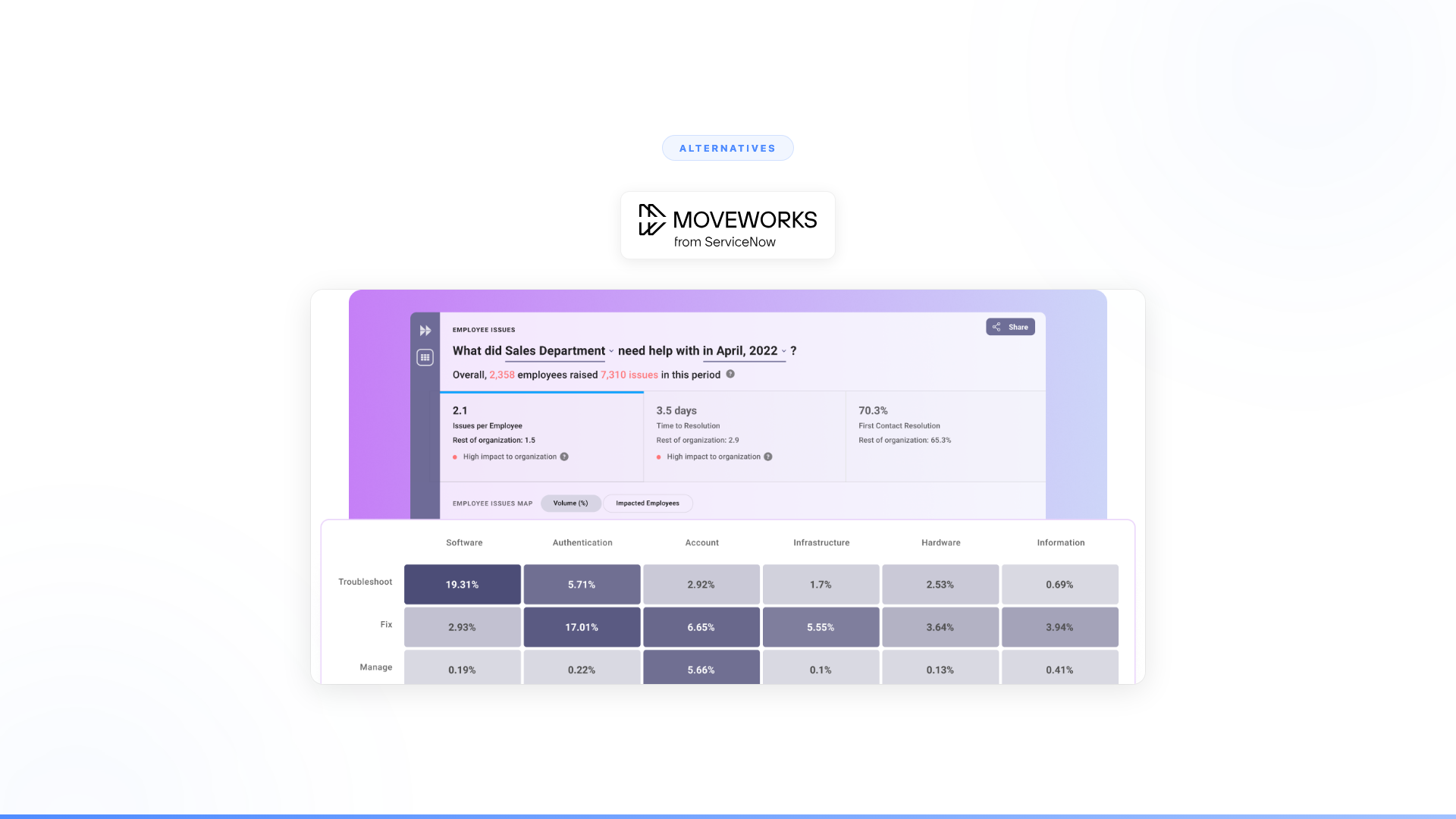
ServiceNow acquired Moveworks for $2.85 billion in March 2025 — a transaction that closed in December 2025 (TechCrunch, ServiceNow press release). That changed the calculus for every organization evaluating or already running Moveworks. An independent platform now sits inside one vendor's ecosystem, and the roadmap is no longer its own.
But the acquisition is not the biggest reason enterprises are searching for alternatives.
Moveworks was always built around one use case: IT self-service. It understood employee requests, resolved known ticket types, and routed everything else to a human. That is the conversation layer. The 10% of the problem. The other 90% — the multi-step work behind those tickets (validating data across systems, making decisions, handling exceptions, executing actions) — still landed on a person.
IT helpdesk AI is one use case. Enterprises that need AI across sales, customer onboarding, compliance, HR, marketing, and operations need something structurally different. Not a better conversation tool. A platform that completes work.
Here are 10 alternatives worth evaluating, organized by what they actually do.
What is Moveworks?
Moveworks was an enterprise AI platform built for IT helpdesk and employee self-service. Employees asked questions in Slack or Microsoft Teams, and Moveworks resolved common requests autonomously — password resets, software access, VPN troubleshooting, benefits questions — or routed them to the right human. It came out of stealth in 2019, expanded from IT into HR, finance, and facilities, and reached a reported $100 million annual revenue run rate by September 2024 before the ServiceNow acquisition.
Its core strength: high out-of-the-box resolution rates for predictable IT requests, strong natural language understanding for employee-facing interactions, and faster deployment than custom-built IT service automation.
Its structural ceiling: the conversation layer. Moveworks resolved or routed. It did not complete the complex multi-step workflows that sit behind those conversations.
What happened to Moveworks after the ServiceNow acquisition?
ServiceNow announced the acquisition on March 10, 2025 and completed it in December 2025 for $2.85 billion in cash and stock. The stated rationale: combine Moveworks' conversational AI and enterprise search with ServiceNow's agentic AI and workflow automation — extending AI assistance to "every employee for every corner of the business."
In practice, this means Moveworks functionality is migrating into ServiceNow's NOW Assist offering. For current Moveworks customers, the implications are:
- Product roadmap: Controlled by ServiceNow, not Moveworks' original team
- Pricing: Increasingly bundled into ServiceNow SKUs, moving away from standalone contracts
- Non-ServiceNow integrations: Receiving quieter investment than ServiceNow-native integrations
- Migration timeline: Customers on standalone Moveworks contracts should expect transition guidance from ServiceNow over a 12–24 month horizon
If you are a current Moveworks customer evaluating your options, the practical path depends on one question: are you already committed to ServiceNow? If yes, ServiceNow Virtual Agent (now converging with Moveworks' capabilities) is the natural path. If no, the alternatives below are worth a structured evaluation.
Is Moveworks still available as a standalone product?
Following the acquisition close in December 2025, Moveworks is being integrated into ServiceNow's product suite. Standalone Moveworks contracts are still being honored, but new customers are directed toward ServiceNow's combined offering. Organizations currently on Moveworks contracts should review their terms regarding support continuity, integration maintenance, and migration paths to NOW Assist.
The ITSM AI market context
The global ITSM market is valued at approximately $13–15 billion in 2025 and is projected to reach $28–37 billion by 2030, driven primarily by AI adoption (Mordor Intelligence, Fortune Business Insights). According to industry analysts, approximately 60% of enterprises are now using AI-driven ITSM tools, and AI-based automation can reduce incident resolution times by up to 50% (Service Desk Institute, 2024). More than 57% of new ITSM products introduced between 2023 and 2025 feature embedded AI capabilities.
The ServiceNow/Moveworks deal accelerated this consolidation. Independent IT AI vendors are either being acquired into platform suites or differentiating by expanding beyond IT entirely.
Quick comparison
| Tool | Category | Best for | Goes beyond IT? | Pricing model |
|---|---|---|---|---|
| Nexus | Autonomous agent platform | Full workflow automation across any department | Yes, any department | Per-agent |
| ServiceNow Virtual Agent | IT/HR self-service bot | ServiceNow-native orgs that want built-in chat | IT/HR/facilities only | Bundled with ServiceNow |
| Freshservice Freddy AI | IT helpdesk AI | Mid-market IT teams on Freshworks | IT-focused | Per-agent seat |
| Espressive Barista | Employee self-service AI | Employee experience across IT/HR/facilities | Employee services only | Per-employee |
| Aisera | AI service management | IT and customer service automation | IT + customer service | Enterprise license |
| Rezolve.ai | IT helpdesk AI (Teams) | Teams-native IT support | IT-focused | Per-employee (~$3/mo) |
| Microsoft Copilot | AI assistant | Individual productivity in Microsoft 365 | No (assists individuals) | Per-user ($30/mo) |
| Glean | Enterprise search + assistant | Finding information across systems | Search only | Per-user |
| Zendesk AI | Customer support AI | Ticket triage and customer self-service | Customer support only | Per-agent seat |
| Custom build | Developer framework | Teams building from scratch | Depends on scope | Engineering cost |
The alternatives, ranked
1. Nexus
What it is: An autonomous agent platform with Forward Deployed Engineers (FDEs) who embed with your team. Nexus agents complete entire business workflows end-to-end: collecting data, validating across systems, making decisions within guardrails, handling exceptions, and executing actions. Any department. Any workflow. Business teams build and own the agents.
Why enterprises switch from Moveworks to Nexus:
The category difference is the point. Moveworks handles the conversation: an employee asks, the AI responds or routes. Nexus agents handle the work behind that conversation: the multi-system orchestration, the conditional logic, the exception handling, the actual execution.
And it goes far beyond IT. Moveworks does one department well. Nexus covers every department on one platform. Customer onboarding. Sales intelligence. Proposal generation. Compliance monitoring. Marketing operations. HR coordination. IT support too, but as one use case among many, not the ceiling.
What it looks like in production:
- Orange Group (multi-billion euro telecom, 120,000+ employees): Business team built autonomous customer onboarding agents. Deployed across multiple European markets in 4 weeks. 50% conversion improvement. ~$6M+ yearly revenue impact. 90% autonomous resolution. 100% team adoption. (Nexus client data)
- European AI infrastructure company: Agents monitor 12,000+ accounts, synthesize buying signals, and surface pipeline opportunities autonomously. 24,000+ hours of research capacity added annually. Built by a non-engineer. (Nexus client data)
- European telecom (13,000+ employees): Spent 6 months with Copilot Studio and couldn't deliver a single production use case. Deployed a dozen Nexus agents in the same timeframe. 40% support volume freed across millions of interactions. (Nexus client data)
Pricing: Per-agent, tied to value delivered. Not per-seat, not per-employee. An agent serving millions of customers costs the same whether you have 500 or 50,000 employees. Every engagement starts with a 3-month proof of concept tied to measurable outcomes.
Best for: Enterprises where IT self-service is one need among many. Organizations that want AI to complete high-volume business processes across departments, not just deflect IT tickets.
Full Nexus vs Moveworks comparison →
2. ServiceNow Virtual Agent
What it is: ServiceNow's own conversational AI for employee self-service. Built natively into the Now Platform. Handles IT, HR, and facilities requests through pre-built conversation flows. With the Moveworks acquisition complete, these two products are actively converging into NOW Assist.
How it compares to Moveworks: Virtual Agent has been ServiceNow's built-in chatbot for years. Moveworks brought stronger NLU and a more polished employee-facing experience. The combined product will eventually offer both: ServiceNow's deep workflow automation plus Moveworks' conversational layer. If you are already a ServiceNow customer, this is the natural path forward. It is effectively what Moveworks is becoming.
Why it might not solve the problem: Same scope ceiling as Moveworks. IT, HR, facilities, and employee self-service. It doesn't touch customer-facing workflows, sales processes, compliance monitoring, or any business process outside the employee service domain. And you are committing fully to the ServiceNow ecosystem and its pricing trajectory.
Pricing: Bundled with ServiceNow ITSM/HRSD licenses. Pricing varies by module and scale. ServiceNow's enterprise contracts typically run six to seven figures annually for mid-to-large organizations.
Best for: Organizations already running ServiceNow that want a native conversational AI layer without adding another vendor. Current Moveworks customers on ServiceNow who want a clear migration path.
3. Freshservice Freddy AI
What it is: AI capabilities built into Freshworks' IT service management platform. Freddy AI handles ticket categorization, auto-assignment, knowledge base suggestions, and employee self-service through chatbot interactions. More accessible than enterprise ITSM platforms.
How it compares to Moveworks: Significantly simpler and more affordable. Freddy doesn't have Moveworks' depth of NLU or breadth of integrations, but for mid-market IT teams that need basic ticket deflection and automation, it does the job without enterprise-tier complexity or pricing.
Why it might not solve the problem: Narrower than Moveworks in AI capability, and narrower still in scope. Purely IT-focused, with less sophisticated natural language understanding. If Moveworks wasn't enough because it only covered IT, Freddy covers less of IT.
Pricing: Included in Freshservice plans. Enterprise tier starts at $115/agent/month.
Best for: Mid-market IT teams on Freshworks that want built-in AI without a separate vendor or enterprise contract.
4. Espressive Barista
What it is: AI-powered employee self-service platform. Covers IT, HR, finance, and facilities requests through a single employee portal. Espressive focuses on employee experience: one place for employees to get help across departments, powered by natural language understanding and pre-built knowledge for common enterprise topics.
How it compares to Moveworks: Similar category and scope. Both handle employee self-service across IT, HR, and facilities. Espressive differentiates on breadth of pre-built knowledge (they call it the "Employee Language Cloud") and faster time to value without extensive training. A competitive alternative for organizations that want the same category without ServiceNow dependency.
Why it might not solve the problem: Same structural limitation. Employee self-service is the conversation layer: understanding what an employee needs and resolving or routing it. The complex work behind those requests — multi-system validation, decision-making, exception handling, execution — still falls to humans. And it doesn't extend to customer-facing workflows or business process automation outside employee services.
Pricing: Per-employee licensing. Enterprise pricing varies by organization size and scope.
Best for: Enterprises that want Moveworks-level employee self-service without ServiceNow lock-in, and whose AI ambitions stay within the employee experience scope.
5. Aisera
What it is: AI service management platform for IT, HR, and customer service. Uses a combination of conversational AI, ticket intelligence, and workflow automation. Covers both internal employee support and external customer support, which gives it slightly broader scope than Moveworks. (Note: Aisera was acquired by Automation Anywhere in 2025, positioning it within a broader automation portfolio.)
How it compares to Moveworks: Similar in the IT self-service domain. Aisera's differentiator is extending into customer-facing support alongside internal services. For organizations that want one platform for both employee and customer ticket deflection, Aisera covers more ground.
Why it might not solve the problem: "Ticket deflection" is the operative phrase. Aisera automates the conversation layer for both internal and external requests. It handles answering and routing better than completing complex multi-step workflows. Customer-facing AI that deflects tickets is different from customer-facing AI that completes onboarding workflows autonomously.
Pricing: Enterprise licensing. Custom pricing based on scope and volume.
Best for: Organizations that want IT and customer service ticket deflection on one platform, and where the work behind those tickets is already well-handled.
6. Rezolve.ai
What it is: AI-powered IT helpdesk assistant built specifically for Microsoft Teams. Employees submit IT requests directly in Teams, and Rezolve.ai resolves common issues — password resets, software provisioning, knowledge lookups — without leaving the chat.
How it compares to Moveworks: Narrower but more focused. Rezolve.ai is Teams-native, which means minimal change management for Teams-heavy organizations. The setup is simpler and faster than Moveworks, though the AI capabilities are less sophisticated.
Why it might not solve the problem: IT-only, Teams-only. If your needs extend beyond the IT helpdesk, or if your organization uses Slack or other channels, Rezolve.ai is too narrow. The same structural limitation applies: it handles the conversation, not the work behind it.
Pricing: Per-employee. Starts around $3/employee/month. Significantly less expensive than Moveworks ($100–$200/employee/year).
Best for: Teams-native organizations with straightforward IT support needs and a limited budget.
7. Microsoft Copilot
What it is: Microsoft's AI assistant across Microsoft 365. Drafts emails, summarizes meetings, generates content in Word, analyzes data in Excel, and answers questions from your Microsoft ecosystem.
How it compares to Moveworks: Different category entirely. Copilot is an individual productivity assistant. Moveworks is a conversation automation tool. Copilot helps a single person work faster in Office apps. Moveworks automated the front door to your IT helpdesk. They don't overlap much.
Why it might not solve the problem: If you're leaving Moveworks because it only handles conversations, Copilot handles even less. It assists individuals with drafting and summarizing. It doesn't complete workflows, resolve tickets, or automate business processes. As of early 2026, only 3.3% of Microsoft 365 subscribers had purchased full Copilot licenses — adoption has remained limited despite broad availability.
Pricing: $30/user/month (Copilot for Microsoft 365).
Best for: Individual productivity within Microsoft 365. Not a replacement for IT self-service or workflow automation.
Related: Top 10 Microsoft Copilot alternatives →
8. Glean
What it is: Enterprise AI search and knowledge assistant. Connects to 100+ data sources and lets employees search across everything with natural language. Generates answers from your company's knowledge.
How it compares to Moveworks: Complementary more than competitive. Moveworks resolved tickets. Glean finds information. Neither completes the work behind the employee's need.
Why it might not solve the problem: Finding information is one step. Acting on it is the rest. Glean tells you the answer. It doesn't execute across systems.
Pricing: Per-user, custom enterprise pricing.
Best for: Enterprises where finding information across tools is the primary bottleneck.
Full Nexus vs Glean comparison →
9. Zendesk AI
What it is: AI capabilities built into Zendesk's customer support platform. Automates ticket triage, suggests responses, powers customer self-service bots, and helps agents resolve issues faster. Customer-facing, not employee-facing.
How it compares to Moveworks: Different direction. Moveworks faces inward (employee support). Zendesk AI faces outward (customer support).
Why it might not solve the problem: Same category limitation on the customer side. Automates the conversation, not the multi-step process behind it — order processing, account validation, compliance checks. Useful if you need customer-facing ticket deflection; not useful if you need end-to-end workflow completion.
Pricing: Included in Zendesk Suite plans. AI add-on pricing varies.
Best for: Customer support teams on Zendesk that want AI-powered triage and self-service, not full workflow completion.
10. Custom build
What it is: Building IT automation from scratch using frameworks like LangChain, LangGraph, CrewAI, or direct API integrations. Your engineering team designs, builds, deploys, and maintains the solution.
How it compares to Moveworks: Maximum flexibility, maximum effort. You own every piece: architecture, security, compliance, monitoring, and scaling.
Why it might not solve the problem: Opportunity cost. Custom builds typically take 3–6 months to reach a first production agent, with ongoing maintenance that compounds over time. Engineering time spent on internal tooling is engineering time not spent on your core product.
Pricing: Engineering salaries plus infrastructure. Typically $300K–$1M+ for a first production system.
Best for: Organizations with dedicated AI engineering teams and unique requirements that no platform addresses.
The real question: what scope do you need?
Most enterprises searching for Moveworks alternatives are really searching for a different scope of AI. The alternatives above fall into three groups.
If you need a Moveworks replacement within the same scope — IT self-service, employee requests, ticket deflection — look at ServiceNow Virtual Agent (if you are already on ServiceNow), Espressive (if you want independence), or Freshservice Freddy (if you want simplicity). These handle the conversation layer for employee services.
If you need AI for customer-facing support conversations, Zendesk AI and Aisera extend the conversation layer to the customer side. They deflect tickets and route requests, but the work behind those requests stays manual.
If you need AI that completes the work behind those conversations — across IT and every other department — that is a different category. That is the 90% problem: multi-system orchestration, decision-making, exception handling, and autonomous execution.
Orange didn't need a better front door for employee requests. They needed agents that complete customer onboarding autonomously across multiple markets. ~$6M+ yearly revenue impact. 4-week deployment.
A European telecom didn't need a chat layer. They needed agents that freed 40% of support volume across millions of interactions — built in the same time their previous vendor couldn't ship a single production use case.
IT helpdesk AI is one use case. The enterprise has hundreds of workflows that need the same treatment. Choosing an alternative that only covers the IT helpdesk means you'll be searching for another alternative when the next department needs AI.
Frequently asked questions
What is Moveworks?
Moveworks was an enterprise AI platform that automated IT helpdesk, HR, and employee support through conversational AI. It handled password resets, ticket routing, benefits questions, and software access requests autonomously via Slack or Microsoft Teams. Moveworks came out of stealth in 2019, reached $100M+ ARR by 2024, and was acquired by ServiceNow for approximately $2.85 billion in a deal that closed December 2025.
What happened to Moveworks after the ServiceNow acquisition?
ServiceNow acquired Moveworks to integrate its conversational AI and enterprise search capabilities into the ServiceNow platform. Moveworks functionality is migrating into ServiceNow's NOW Assist offering. Customers should expect transition timelines and migration guidance from ServiceNow over the next 12–24 months. The acquisition was announced March 10, 2025 and closed December 2025 (ServiceNow press release).
Is Moveworks still available as a standalone product?
Following the acquisition close in December 2025, Moveworks is being integrated into ServiceNow's product suite. Existing contracts are being honored, but new customers are directed toward ServiceNow's combined offering. Organizations on standalone Moveworks contracts should review their renewal terms and ServiceNow's stated migration path for support continuity.
What were Moveworks' main strengths?
Moveworks was known for: high out-of-the-box resolution rates for common IT requests, strong natural language understanding for employee-facing interactions, rapid deployment compared to custom-built IT automation, and pre-built integrations across major ITSM platforms. Its limitations were scope (IT and employee services only) and depth (conversation and routing, not multi-step execution).
What are the best Moveworks alternatives for IT helpdesk automation?
For direct IT helpdesk replacements: ServiceNow Virtual Agent (if already on ServiceNow), Espressive Barista (for ServiceNow independence), and Aisera (for combined IT and customer service). For enterprises that need AI beyond IT helpdesk — covering multiple departments and completing full workflows — autonomous agent platforms address the broader 90% of work that ticket deflection tools never reach.
Worth exploring?
Every Nexus engagement starts with a 3-month proof of concept tied to measurable outcomes. Forward Deployed Engineers embed with your team from day one. You see the results before committing.
See the full Nexus vs Moveworks comparison →