Top 10 Glean Alternatives for Enterprise AI in 2026
Glean built a strong enterprise search platform, but most enterprises need more than search. Here are 10 alternatives ranked by what they actually deliver beyond finding information.
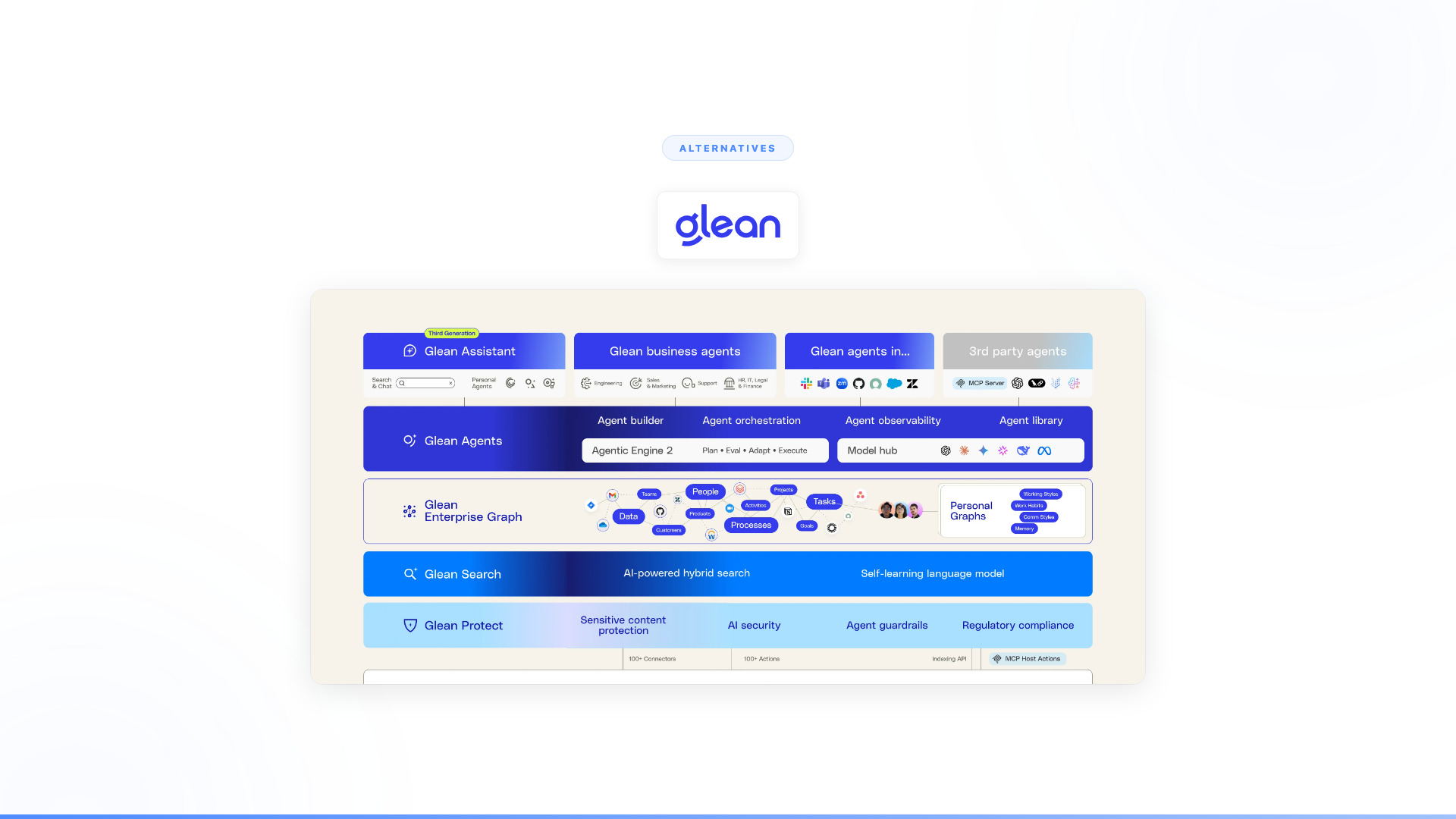
The top Glean alternatives in 2026 are Nexus, Microsoft Copilot, Dust, Hebbia, Writer, Coveo, Guru, Notion AI, Perplexity Enterprise, and custom build (LangChain/CrewAI). Glean is an enterprise AI search and knowledge platform used by organizations across 27+ countries — its per-seat pricing starts at approximately $50/user/month, with a generative AI add-on of ~$15/user/month and minimum contracts typically around $50,000–60,000/year. The case for alternatives isn't that Glean's search is poor. It's that McKinsey research estimates employees spend 1.8 hours per day searching for information — and even eliminating that entirely leaves the multi-step execution work that actually drives business outcomes completely untouched.
Why Glean Alternatives Are Worth Evaluating
The pattern enterprises report with AI search tools follows a predictable arc. Search deploys. Employees find things faster. Internal knowledge becomes accessible. Leadership celebrates the early adoption numbers.
Then results plateau. The business metrics AI was supposed to move — support resolution time, sales research throughput, onboarding conversion, compliance review speed — haven't changed. People can find information faster, but the multi-step workflows that actually drive revenue and efficiency are still 100% manual.
That is not a Glean problem. It is a category problem. Enterprise search, even great enterprise search, solves the information discovery step. The work that comes after — collecting data from five systems, validating it, making a decision, handling an exception, executing an action — is where enterprise value lives. And search tools structurally cannot reach there.
The enterprise AI market is projected to reach $407 billion by 2027, with a growing share of that investment shifting from knowledge layer tools toward workflow execution platforms. That shift is what is driving most searches for Glean alternatives.
If that gap sounds familiar, here are the 10 alternatives worth evaluating.
Glean Alternatives: Quick Comparison Table (2026)
| Tool | Category | Best for | Goes beyond search? | Pricing model |
|---|---|---|---|---|
| Nexus | Autonomous agent platform | Full enterprise workflow automation across any department | Yes, end-to-end | Per-agent |
| Microsoft Copilot | AI assistant | Individual productivity inside Microsoft 365 | No | Per-user ($30/mo) |
| Dust | AI assistant platform | Custom AI assistants for teams | No | Per-user ($29/mo) |
| Hebbia | AI for document analysis | Deep document analysis and extraction (legal, finance) | Partial (document workflows) | Enterprise license |
| Writer | Enterprise AI for content | Content generation and brand compliance | No | Per-user |
| Coveo | AI-powered search | E-commerce and website search relevance | No | Per-query / enterprise |
| Guru | Knowledge management | Team wikis and verified knowledge sharing | No | Per-user ($15/mo) |
| Notion AI | Workspace assistant | AI inside a single workspace tool | No | Per-user ($10/mo add-on) |
| Perplexity Enterprise | AI search assistant | Research and question answering across internal and external sources | No | Per-user |
| Custom build | Developer framework | Engineering teams building from scratch | Depends on team | Engineering cost |
Top 10 Glean Alternatives for Enterprise AI Search
Nexus: Best Glean Alternative for AI That Acts, Not Just Answers {#nexus-best-glean-alternative-for-ai-that-acts-not-just-answers}
What it is: An autonomous agent platform paired with Forward Deployed Engineers who embed with your team. Nexus agents complete entire business workflows end-to-end: collecting data from multiple systems, validating it against business rules, making decisions within guardrails, handling exceptions, escalating when uncertain, and executing actions. Any department. Any workflow. Business teams build and own the agents.
Why enterprises switch from Glean to Nexus:
The switch isn't about better search. It's about moving past search entirely. Glean helps an employee find the right document. Nexus agents handle the entire process that document is part of: qualifying a lead across 12,000 accounts, onboarding a customer across multiple countries, triaging support tickets against compliance requirements, and reporting the outcome. One finds information. The other completes the work.
What it looks like in production:
- Orange Group (multi-billion euro telecom, 120,000+ employees): Business team built autonomous customer onboarding agents. Deployed in 4 weeks. 50% conversion improvement. ~$6M+ yearly revenue. 90% autonomous resolution. 100% team adoption. They previously used a chatbot with a 27% drop-out rate.
- European telecom (13,000+ employees): Spent 6 months with Copilot Studio without delivering a single production use case. Deployed a dozen Nexus agents in the same timeframe. 40% support volume freed across millions of interactions.
- AI infrastructure company (global, engineering-led): Their CTO weighed building internally versus buying. Agents now autonomously analyze 12,000+ enterprise accounts for buying signals. $4B+ pipeline discovered. 24,000+ hours of research capacity added annually. Built by the Head of Sales Intelligence — not an engineer.
Pricing: Per-agent, tied to value delivered. Not per-seat. An agent that serves millions of customers costs the same whether you have 500 or 50,000 employees.
Best for: Enterprises where the bottleneck isn't finding information but completing the work that information points to. Sales, support, compliance, onboarding, operations, HR, reporting.
Full Nexus vs Glean comparison →
Microsoft Copilot vs Glean: Which Enterprise Search AI Is Better? {#microsoft-copilot-vs-glean-which-enterprise-search-ai-is-better}
What it is: Microsoft's AI assistant embedded across Microsoft 365. Drafts emails in Outlook, summarizes meetings in Teams, generates content in Word, analyzes data in Excel. Works within the Microsoft ecosystem.
How it compares to Glean: Different focus. Glean is about finding information across all your enterprise tools. Copilot is about assisting individuals within Microsoft 365. Copilot is weaker at cross-system search but stronger at helping with specific tasks inside Microsoft apps.
Why it might not solve the problem: If you're leaving Glean because search wasn't enough, Copilot gives you even less scope. It's limited to Microsoft 365, doesn't index your other systems, and doesn't complete multi-step business processes. Only 6% of organizations that piloted Microsoft 365 Copilot moved to larger-scale deployment, according to Gartner. The category ceiling is the same as Glean's, just in a different shape.
Pricing: $30/user/month (Microsoft 365 Copilot).
Best for: Organizations heavily invested in Microsoft 365 who want individual productivity assistance inside that ecosystem.
See our full Copilot alternatives guide →
Dust: Best Glean Alternative for Role-Specific AI Assistants {#dust-best-glean-alternative-for-role-specific-ai-assistants}
What it is: An AI assistant platform that lets teams build custom assistants connected to their data sources. More configurable than Glean for building role-specific assistants — sales assistant, support assistant, engineering assistant.
How it compares to Glean: Dust is more about building tailored assistants than unified enterprise search. Where Glean gives every employee one powerful search bar, Dust lets you build specialized assistants that understand specific team contexts deeply.
Why it might not solve the problem: Still an assistant. Better context, better customization, but the fundamental limitation is the same: it answers questions and generates content. It doesn't collect data from multiple systems, validate it, make decisions, handle exceptions, and execute actions across your enterprise. If the gap between "I found the answer" and "the work is done" is your bottleneck, Dust doesn't close it.
Pricing: $29/user/month (Pro), custom enterprise pricing.
Best for: Teams that want better-than-Glean contextual assistants for specific roles, and whose work gets done once people have the right information.
Full Nexus vs Dust comparison →
Hebbia: Best Glean Alternative for Deep Document Analysis {#hebbia-best-glean-alternative-for-deep-document-analysis}
What it is: AI platform for deep document analysis and extraction. Specializes in complex document workflows: analyzing hundreds of financial documents, extracting data from contracts, processing regulatory filings. Strong in finance, legal, and compliance use cases.
How it compares to Glean: Where Glean searches across all your enterprise tools broadly, Hebbia goes deep on document analysis specifically. If you have 500 contracts and need to extract specific clauses from each one, Hebbia handles that better than Glean's general search.
Why it might not solve the problem: Scope. Hebbia is excellent for document-heavy analysis workflows but doesn't extend to sales processes, customer onboarding, support operations, or cross-system workflow automation. If your problem is broader than document analysis, you're still looking for something else for the rest.
Pricing: Enterprise licensing, custom pricing.
Best for: Finance, legal, and compliance teams with heavy document analysis requirements.
Full Nexus vs Hebbia comparison →
Writer: Best Glean Alternative for Enterprise Content Generation {#writer-best-glean-alternative-for-enterprise-content-generation}
What it is: Enterprise AI platform focused on content generation with brand governance. Generates marketing copy, reports, and communications that follow your brand guidelines, tone, and terminology. Includes their proprietary LLM (Palmyra).
How it compares to Glean: Different problem entirely. Glean finds existing information. Writer creates new content. For marketing, communications, and content teams, Writer is a more specialized tool for the generation task than Glean's assistant capabilities.
Why it might not solve the problem: Content generation is one task within a larger workflow. If the real bottleneck is the process around that content — approvals, compliance checks, distribution, performance tracking, campaign execution — Writer handles the generation step but not the end-to-end workflow.
Pricing: Per-user, custom enterprise pricing.
Best for: Marketing and communications teams where content generation quality and brand consistency are the primary need.
Full Nexus vs Writer comparison →
Coveo: Best Glean Alternative for External-Facing Search {#coveo-best-glean-alternative-for-external-facing-search}
What it is: AI-powered search and recommendations platform. Primarily focused on website search, e-commerce product discovery, and customer self-service portals. Strong at relevance tuning and personalization for external-facing search experiences.
How it compares to Glean: Glean focuses on internal enterprise search — employees finding things inside the company. Coveo focuses on external-facing search — customers finding products, support articles, or information on your website. Some overlap exists in enterprise knowledge management, but the sweet spots are different.
Why it might not solve the problem: If you're leaving Glean because internal search wasn't enough, Coveo is a lateral move into a different search context, not a step toward workflow completion. And if you need Coveo for external search and something else for internal processes, you're still layering tools without solving the execution gap.
Pricing: Per-query or enterprise licensing. Custom pricing based on volume.
Best for: Organizations where the primary need is external-facing search relevance — e-commerce, customer portals, support sites.
Guru: Best Glean Alternative for Curated Team Knowledge {#guru-best-glean-alternative-for-curated-team-knowledge}
What it is: Knowledge management platform for teams. Centralized wiki with AI-powered search, verification workflows, and a browser extension that surfaces relevant knowledge cards while employees work. Strong at keeping knowledge current through expert verification.
How it compares to Glean: Guru is more structured and curated. Where Glean indexes everything automatically, Guru relies on teams creating and verifying knowledge cards. This makes Guru's answers more trustworthy — verified by subject matter experts — but requires more manual effort to maintain. Glean is broader but less curated.
Why it might not solve the problem: Same category ceiling. Better-curated knowledge is still just knowledge. If the bottleneck is what happens after someone finds the right answer, Guru doesn't reach there. And the curation overhead can be significant: someone has to write, verify, and update those knowledge cards.
Pricing: Starts at $15/user/month (Builder), enterprise pricing for larger teams.
Best for: Teams that need curated, verified internal knowledge with clear ownership and freshness tracking.
Notion AI: Best Glean Alternative for Single-Workspace Teams {#notion-ai-best-glean-alternative-for-single-workspace-teams}
What it is: AI capabilities built into Notion's workspace platform. Searches across your Notion workspace, generates content, summarizes pages, and answers questions about your team's docs, projects, and wikis.
How it compares to Glean: Narrower scope. Notion AI only searches within Notion. Glean indexes 100+ enterprise tools. If your team lives inside Notion, the AI experience is tightly integrated. If your information is spread across many tools, Notion AI only sees one slice.
Why it might not solve the problem: If you're looking for Glean alternatives because search wasn't enough, Notion AI gives you less search scope — one tool instead of many — and the same category limitation: it finds information, but doesn't complete workflows. It's a productivity feature inside a workspace tool, not an enterprise solution.
Pricing: $10/user/month add-on to Notion plans.
Best for: Teams already in Notion who want AI assistance within that single workspace.
Perplexity Enterprise: Best Glean Alternative for AI-Powered Research {#perplexity-enterprise-best-glean-alternative-for-ai-powered-research}
What it is: AI-powered research and question-answering tool for enterprises. Combines internet search with your internal data to provide sourced, referenced answers. Strong at research tasks where employees need to synthesize information from multiple sources — including public sources outside your internal systems.
How it compares to Glean: Perplexity is better at combining public information with your internal data for research-style questions. Glean is better at deep enterprise-only search with granular permissions. If your team does heavy research that spans internal and external sources, Perplexity's approach is compelling. It is the most differentiated option in this list from a pure research workflow perspective.
Why it might not solve the problem: Still answers questions. Better research, better sourcing, better synthesis, but the output is still "here's what I found." It doesn't take the next step: validate the findings against your systems, make a decision, handle exceptions, and execute an action. If the gap is between knowing and doing, Perplexity doesn't close it.
Pricing: Per-user enterprise licensing, custom pricing.
Best for: Research-heavy teams that need AI-powered synthesis across internal and external sources.
Custom Build (LangChain, CrewAI): For Teams Building From Scratch {#custom-build-langchain-crewai-for-teams-building-from-scratch}
What it is: Open-source frameworks for building AI agents and search systems from scratch. Your engineering team designs the architecture, writes the code, handles deployment, monitoring, security, governance, and maintenance.
How it compares to Glean: Maximum flexibility. You can build exactly the search and agent capabilities you need, tailored to your specific data and workflows. Unlike Glean, you're not constrained to a vendor's product roadmap.
Why it might not solve the problem: Most enterprises don't have surplus AI engineering capacity. Custom builds typically require 3–6 months for a first production system, with ongoing maintenance costs for security, governance, model updates, and integration changes. One AI infrastructure company — a global, engineering-led business with world-class engineers — weighed building internally and chose to partner with Nexus instead. Their CTO calculated that diverting engineering from their core product carried too high an opportunity cost. If a company with that engineering depth decided it wasn't worth building in-house, that's a signal worth considering.
Pricing: Engineering salaries plus infrastructure. Typically 6+ months and several hundred thousand dollars for a production-grade system.
Best for: Organizations with dedicated AI engineering teams, unique technical requirements, and timelines that can absorb extended development.
So Which Glean Alternative Should You Actually Choose?
The answer depends on what you're actually trying to solve.
If the problem is that Glean's search isn't good enough for your specific use case, look at Coveo (external search), Hebbia (document analysis), Guru (curated knowledge), or Notion AI (single-workspace). These are different shapes of the same category. They'll search differently, but they won't transform business processes.
If the problem is that you want a more flexible AI assistant, look at Dust, Copilot, Writer, or Perplexity Enterprise. They're better at specific tasks within the assistant category — content generation, research synthesis, role-specific context. Still assistants, not agents.
If the problem is that search was supposed to transform your business but didn't — because the real bottleneck was never finding information but completing the work at scale — that's a different category of problem entirely. That's what Nexus was built for.
Orange didn't need better internal knowledge management. They needed agents that complete customer onboarding autonomously across multiple countries. ~$6M+ yearly revenue. 4-week deployment. 100% team adoption.
A major European telecom didn't need another knowledge tool. They spent 6 months trying to build with Copilot Studio and couldn't deliver a single production use case. Then they deployed a dozen Nexus agents. 40% of support volume freed.
The gap between search and workflow completion isn't a feature gap. It's a category gap. No amount of improving the search layer closes it.
Frequently Asked Questions About Glean Alternatives
How much does Glean cost per user per month?
Glean's per-seat pricing starts at approximately $50/user/month for the core platform, with a generative AI add-on of approximately $15/user/month on top. Minimum enterprise contracts typically start around $50,000–60,000/year, plus a mandatory 10% support fee on ARR. Pricing is not published officially and varies by contract size — enterprise buyers should verify current pricing directly with Glean's sales team, as the figures circulating publicly ("$15–25/user/month") reflect older or partial estimates that predate their current packaging.
What is the difference between Glean and Microsoft Copilot for enterprise search?
Glean and Microsoft Copilot solve related but different problems. Glean indexes 100+ enterprise tools — Slack, Confluence, Google Drive, Salesforce, Jira, and more — and makes all of that searchable with natural language. Copilot operates within Microsoft 365 only: Outlook, Teams, Word, Excel, SharePoint. If your information lives across many tools beyond Microsoft's ecosystem, Glean's search breadth is stronger. If your team lives primarily in Microsoft 365, Copilot integrates more naturally. Both are knowledge-layer tools — neither completes multi-step workflows autonomously.
Does Glean work with all enterprise data sources or just specific integrations?
Glean supports 100+ native connectors, covering most major enterprise tools: Google Workspace, Microsoft 365, Slack, Confluence, Jira, Salesforce, Zendesk, GitHub, and many others. For tools without a native connector, Glean offers a Push API for custom indexing. Coverage is broad but not universal — less common internal systems or custom-built tools may require API-level integration work. Permissions are respected at the source level, so employees only see results they have access to.
Is Glean worth the cost compared to using Microsoft Copilot that already comes with M365?
The comparison depends on your data landscape. If your organization runs entirely in Microsoft 365, Copilot (included with some M365 licenses, or $30/user/month standalone) covers most search and assistant needs without an additional platform purchase. If your information is distributed across Salesforce, Jira, Confluence, Slack, and dozens of other tools that aren't Microsoft products, Glean's multi-system search delivers something Copilot structurally cannot. The question most enterprise buyers miss: neither platform delivers ROI if the bottleneck isn't search — it's the execution work that comes after.
What is the difference between Glean and Perplexity Enterprise?
Glean is purpose-built for internal enterprise knowledge — it indexes your private systems and answers questions using only your company's data. Perplexity Enterprise combines internet search with internal data, making it stronger for research that requires both proprietary and public information. Glean is generally better for deep enterprise-only search with strict permission controls. Perplexity is generally better for research workflows that span internal and external sources. For regulated industries where public internet access to sensitive internal search is a concern, Glean's architecture offers clearer data boundaries.
Worth exploring?
Every Nexus engagement starts with a 3-month proof of concept tied to measurable outcomes. Forward Deployed Engineers embed with your team from day one. You see the results before committing. You can exit anytime.
100% of clients who started a POC converted to an annual contract. Every one.
See the full Nexus vs Glean comparison →