Top 10 Ericsson AI Alternatives for Telecom in 2026
Ericsson's AI optimizes networks but doesn't touch business operations. Here are 10 alternatives for telecom operators who need AI across sales, support, compliance, and more. Ranked by what they deliver in production.
Scope note: This article covers Ericsson AI alternatives for customer experience, sales intelligence, operational automation, and business intelligence use cases — not for network infrastructure or RAN optimization, where Ericsson has no direct peer.
The top Ericsson AI alternatives in 2026 are: Nexus, Nokia Bell Labs AI, Amdocs (amAIz), Huawei, ZTE, Samsung Networks, Mavenir, Rakuten Symphony, Netcracker (NEC), and custom build. Ericsson is a global telecom equipment and AI vendor whose February 2026 Mistral AI partnership expanded its multi-agent network configuration capabilities. Alternatives split into two categories: competing network vendors, and enterprise AI platforms that deploy operational agents on top of existing telecom infrastructure.
Why telecom operators look for Ericsson AI alternatives
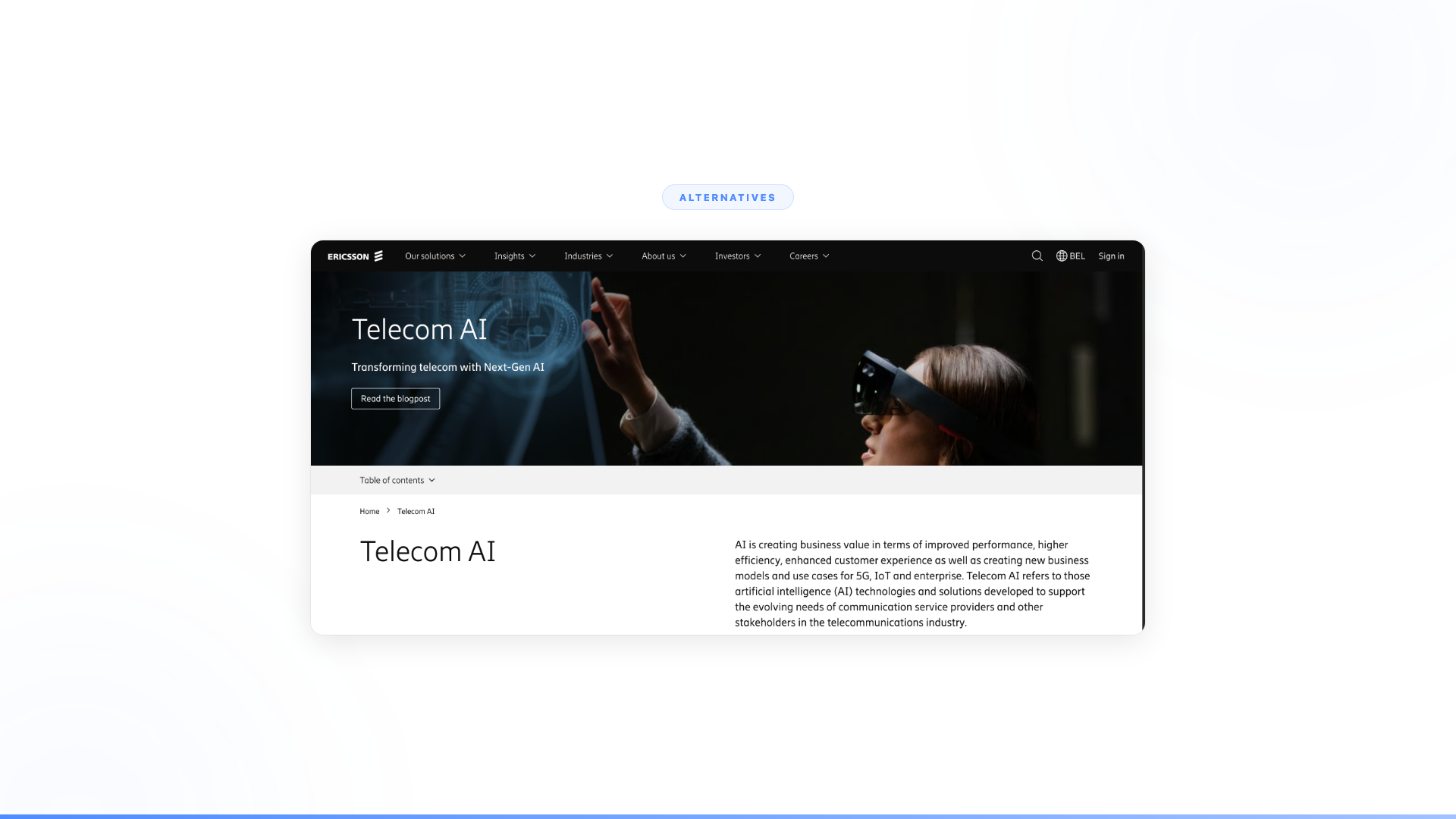
Ericsson's AI does what it's designed to do: optimize radio access networks, troubleshoot faults, configure network products, and progress toward autonomous network operations. The Ericsson Intelligence Automation Platform (EIAP) and the February 2026 Mistral AI partnership represent real, well-funded capabilities. For network infrastructure, Ericsson is among the best in the world.
The gap shows up when telecom operators try to stretch network AI into business operations. Customer onboarding. Sales intelligence. Compliance monitoring. Support automation. HR workflows. Reporting. These aren't network problems — they're operational problems. Ericsson's architecture, data models, and product roadmap aren't aimed at them.
The global telecom AI market was valued at approximately $2.5 billion in 2024 and is projected to reach $14.9 billion by 2030, growing at a CAGR of around 34% — driven by both network automation and enterprise operational AI investment. [Source: Grand View Research, Telecom AI Market Size Report, 2024] That growth is happening across two distinct layers: the network layer (where Ericsson competes) and the operations layer (where the alternatives in this article compete).
If you're trying to fill the operations gap, here are 10 alternatives worth evaluating, organized by what they actually do for telecom operations.
Ericsson AI Alternatives: Quick Comparison Table for Telecom (2026)
| Tool | Category | Best for | Handles business operations? | Scope |
|---|---|---|---|---|
| Nexus | Autonomous agent platform | Full telecom operations: sales, support, compliance, HR, onboarding | Yes, end-to-end | Enterprise-wide |
| Nokia Bell Labs AI | Network automation | Network monitoring, anomaly detection, autonomous networks | No | Network layer |
| Amdocs amAIz | BSS/OSS AI | Billing, revenue management, BSS/OSS optimization | Partial (BSS/OSS only) | BSS/OSS systems |
| Huawei | Network + cloud AI | Network optimization, cloud infrastructure AI | No | Network + cloud |
| ZTE | Network AI | Network automation, smart network management | No | Network layer |
| Samsung Networks | Network AI | RAN optimization, vRAN, Open RAN AI | No | RAN focused |
| Mavenir | Cloud-native network AI | Cloud-native network automation, Open RAN | No | Network layer |
| Rakuten Symphony | Network platform | Open RAN orchestration, network automation | No | Network orchestration |
| Netcracker (NEC) | BSS/OSS platform | BSS/OSS digital transformation, billing AI | Partial (BSS/OSS only) | BSS/OSS systems |
| Custom build | Internal development | Fully custom telecom AI solutions | Depends on investment | Custom scope |
Top 10 Ericsson AI Alternatives for Telecom Network and Operations
1. Nexus: Best Ericsson AI Alternative for Operational AI
What it is: An autonomous agent platform with Forward Deployed Engineers who embed with your telecom team. Nexus agents complete entire operational workflows end-to-end: collecting data, validating against backend systems, making decisions within business guardrails, handling exceptions, and executing actions. Any department. Any workflow. Business teams build and own the agents.
Why telecom operators look at Nexus after Ericsson:
The distinction is layer, not quality. Ericsson's AI operates at the network layer: RAN, core, transport, spectrum. Nexus operates at the operations layer: sales, support, compliance, onboarding, HR, reporting. Operators who've invested in Ericsson for network AI and then realize their business operations are still manual, fragmented, and slow need something built for a completely different problem.
According to NVIDIA's research, 44% of telecom operators identify customer experience optimization as a top AI priority. Network AI doesn't address that. Operational AI does.
What it looks like in production:
- Orange Group (multi-billion euro telecom, 120,000+ employees): Business team built autonomous customer onboarding agents. First agent live in 4 hours. Multi-market rollout in 4 weeks. 50% conversion improvement. Approximately $6M yearly revenue impact. 90% autonomous resolution. +10 CSAT points. 100% team adoption. Previous chatbot had a 27% drop-out rate.
- European telecom (13,000+ employees): A dozen production agents across support, compliance, registration, data harmonization, and escalation routing. 40% of support capacity freed. Full regulatory compliance across millions of interactions. 12-week deployment.
- Lambda (a leading AI infrastructure company): Head of Sales Intelligence — a non-engineer — built an agent monitoring 12,000+ accounts. The result was $4B+ cumulative pipeline tracked and 24,000+ hours of research capacity generated annually.
Key strengths for telecom: 4,000+ integrations across any enterprise system. SOC 2 Type II, ISO 27001, ISO 42001, GDPR compliant. EU AI Act ready. 95+ languages. 100% POC-to-contract conversion rate. Forward Deployed Engineers from day one.
Pricing: Per-agent, tied to value delivered. Not per-seat.
Best for: Telecom operators whose network AI runs well but whose business operations — customer-facing and internal — are still manual and inconsistent.
Full Nexus vs Ericsson comparison -->
2. Nokia Bell Labs AI
What it is: Nokia's AI capabilities focus on network automation, anomaly detection, real-time monitoring, and the path toward autonomous networks. Nokia's January 2026 reorganization restructured the company into two units: network infrastructure (AI/data centers) and mobile infrastructure (telecoms). The NVIDIA partnership targets AI-powered 6G and telco-trained language models.
How it compares to Ericsson: Very similar in scope. Both companies build AI for the network layer. Nokia's approach emphasizes telco-trained AI models and the convergence of networking with AI compute. Ericsson leans toward multi-agent configuration tools and the Mistral AI partnership for network agents. The technical approaches differ; the domain is the same.
Why it might not solve the problem: If you're looking for alternatives to Ericsson because the AI doesn't reach business operations, Nokia won't fill that gap either. Nokia's AI makes networks smarter. It doesn't onboard customers, automate compliance, generate sales intelligence, or handle HR workflows.
Best for: Operators who want an alternative network AI vendor, not a fundamentally different approach to telecom AI.
Full Nexus vs Nokia comparison -->
3. Amdocs amAIz
What it is: Amdocs is the largest BSS/OSS vendor serving telecom operators globally. Their generative AI platform, amAIz, focuses on billing optimization, revenue management, customer experience analytics within BSS/OSS, and digital transformation of telecom business support systems.
How it compares to Ericsson: Different layer. Ericsson handles network infrastructure AI. Amdocs handles BSS/OSS AI. If you're looking for AI that's closer to business operations — billing, customer management, order management — Amdocs is more relevant than another network vendor.
Why it might not solve the problem: Amdocs AI stays within the BSS/OSS boundary. It optimizes billing, revenue management, and order flows. It doesn't handle broader operational workflows: sales intelligence, compliance monitoring, HR operations, cross-departmental reporting, or general support automation. It also comes with BSS/OSS vendor lock-in: multi-year contracts, long implementation cycles, and heavy dependency on Amdocs professional services.
Best for: Operators whose primary AI gap is BSS/OSS optimization, not enterprise-wide operations.
Full Nexus vs Amdocs comparison -->
4. Huawei
What it is: Huawei's telecom AI spans network optimization, cloud infrastructure (Huawei Cloud), and autonomous driving networks (ADN). Their AI capabilities include intent-driven networking, predictive maintenance, network digital twins, and AI-powered energy efficiency. R&D investment is substantial, with particular strength in Asia and emerging markets.
How it compares to Ericsson: Similar scope on the network side with a broader cloud infrastructure play. Huawei bundles network AI with cloud services, which can be attractive for operators looking to consolidate vendors. The autonomous driving network initiative parallels Ericsson's autonomous network vision.
Why it might not solve the problem: Same fundamental limitation as Ericsson and Nokia. The AI serves the network, not the business operations. Geopolitical restrictions also limit Huawei's availability in North America, Europe, and several other markets.
Best for: Operators in Huawei-accessible markets looking for network AI bundled with cloud infrastructure.
5. ZTE
What it is: ZTE's AI capabilities focus on network automation, smart network operations, and the path to autonomous networks. Their approach includes AI-powered network planning, optimization, and predictive maintenance, with growing investment in 5G-Advanced and AI-native network architecture.
How it compares to Ericsson: Narrower in scope and market reach. ZTE competes primarily in Asia, Middle East, and Africa. The network AI capabilities are real but less mature than Ericsson's in terms of global deployment scale and partner ecosystem.
Why it might not solve the problem: Same category as Ericsson. Network-layer AI that doesn't extend into business operations. If the goal is operational AI for sales, support, compliance, and HR, ZTE's network focus won't address it.
Best for: Operators in ZTE's core markets looking for cost-effective network AI as part of a ZTE infrastructure deployment.
6. Samsung Networks
What it is: Samsung's network division has grown its AI capabilities around RAN optimization, vRAN (virtualized RAN), and Open RAN deployments. Their AI focuses on radio resource management, network energy efficiency, and automated RAN operations. Partnerships with major US operators have expanded their network AI footprint.
How it compares to Ericsson: More focused on RAN specifically. Samsung doesn't offer the full network stack that Ericsson does — core, transport, OSS/BSS — so the AI is concentrated on radio access optimization. For operators evaluating Open RAN or vRAN strategies, Samsung's AI is relevant.
Why it might not solve the problem: Even narrower scope than Ericsson. RAN-focused AI doesn't reach business operations. If the gap is operational, Samsung Networks doesn't address it.
Best for: Operators investing in Open RAN or vRAN who want AI specifically for radio access optimization.
7. Mavenir
What it is: Mavenir provides cloud-native network software with AI capabilities for Open RAN, core network automation, and network security. Their approach is software-defined and disaggregated, targeting operators building modern, cloud-native network architectures.
How it compares to Ericsson: More specialized in cloud-native and Open RAN. Mavenir doesn't compete across Ericsson's full infrastructure portfolio. The AI capabilities focus on optimizing cloud-native network functions and automating disaggregated network operations.
Why it might not solve the problem: Cloud-native network AI is still network AI. The scope doesn't extend to customer operations, sales, compliance, or any business workflow outside the network stack.
Best for: Operators building cloud-native, disaggregated networks who need AI purpose-built for that architecture.
8. Rakuten Symphony
What it is: Rakuten Symphony offers the Symworld platform for network orchestration and automation, born from Rakuten Mobile's experience building a fully cloud-native, Open RAN mobile network in Japan. AI capabilities include automated network deployment, optimization, and lifecycle management.
How it compares to Ericsson: Different philosophy. Rakuten Symphony comes from the operator side — built to run an actual network — rather than the vendor side. The AI is more focused on orchestration and lifecycle management across a disaggregated network than on deep radio optimization. Less mature as a global product compared to Ericsson.
Why it might not solve the problem: Network orchestration AI. Good at automating deployment and management of network functions. Doesn't touch business operations, customer workflows, or enterprise-wide processes.
Best for: Operators who want network orchestration and automation from a platform built by an operator, for operators.
9. Netcracker (NEC)
What it is: Netcracker, a subsidiary of NEC, provides BSS/OSS and network management solutions with AI capabilities. Their focus includes AI-driven service orchestration, billing optimization, customer experience management within BSS, and network lifecycle automation. They serve major telecoms globally with end-to-end digital transformation.
How it compares to Ericsson: Netcracker sits in the BSS/OSS layer, similar to Amdocs, rather than the network infrastructure layer where Ericsson operates. For AI that's closer to business operations — billing, order management, customer management — Netcracker is more relevant than switching to another network vendor.
Why it might not solve the problem: Like Amdocs, Netcracker's AI stays within the BSS/OSS boundary. It doesn't handle sales intelligence, compliance monitoring, HR workflows, general support automation, or cross-departmental processes. BSS/OSS vendor lock-in and long implementation timelines also apply.
Best for: Operators who need AI within the BSS/OSS layer, especially those already on NEC/Netcracker platforms.
10. Custom Build
What it is: Building operational AI internally using frameworks like LangChain, LangGraph, or custom architectures. Your engineering team designs, builds, deploys, and maintains the AI solutions.
How it compares to Ericsson: Maximum flexibility. You can build exactly what you need for any operational workflow. You're not constrained to network optimization or any vendor's product scope.
Why it might not solve the problem: Telecom operators rarely have surplus AI engineering capacity. The engineers they do have are working on network operations, not building internal tools for sales or compliance teams. Custom builds also require you to solve governance, security, compliance, monitoring, and the 4,000+ integrations needed to connect to every enterprise system. A leading AI infrastructure company with world-class engineers evaluated building internally and chose to buy from Nexus because the opportunity cost of diverting engineering resources was too high. For most telecom operators, that math is even more unfavorable.
Best for: Operators with dedicated AI engineering teams, unique requirements, and timelines that can absorb 6+ months of development with ongoing maintenance.
Ericsson + Mistral AI: What the February 2026 Partnership Means for Telecom Buyers
The February 2026 Ericsson-Mistral AI partnership is the most significant development in Ericsson's AI roadmap since the launch of EIAP. The partnership focuses on deploying Mistral's language models within Ericsson's network management stack, enabling more natural-language interaction with network configuration tools and multi-agent workflows for network operations.
What this means for network-focused buyers: Ericsson's network AI is getting meaningfully smarter. Natural language query interfaces for network data, automated multi-step configuration workflows, and telco-specific fine-tuning are all accelerating.
What it doesn't change for operations-focused buyers: The partnership is scoped to network operations. It doesn't extend Ericsson's AI into customer onboarding, sales intelligence, compliance automation, or any business workflow outside the network layer. The gap this article covers remains.
Nokia's January 2026 Reorganization: Impact on Telecom AI Buyers
Nokia's January 2026 structural split — separating network infrastructure (AI/data center networking) from mobile infrastructure (telco networks) — reflects the growing divergence between hyperscaler AI infrastructure and traditional telecom networks.
For telecom AI buyers, the reorganization has two practical implications. First, Nokia's mobile infrastructure AI focus (6G, RAN, autonomous networks) is now sharper and better resourced. For network AI, Nokia is a more focused competitor to Ericsson than it was in 2025. Second, Nokia's AI/data center business is now positioned for the AI training infrastructure market, which is a different buyer with different needs.
Neither business unit addresses operational AI for telecom business operations. The January 2026 reorganization doesn't change Nokia's scope relative to Nexus.
The pattern across these alternatives
There's a clear divide in this list. Alternatives 2 through 8 are all network-layer solutions. They solve the same category of problem Ericsson solves, just with different technical approaches, vendor ecosystems, or market positioning.
Alternatives 3 and 9 (Amdocs and Netcracker) sit in the BSS/OSS layer. They're closer to business operations but still scoped to billing, order management, and customer management within their platforms.
Alternative 1 (Nexus) and alternative 10 (custom build) are the only options that address enterprise-wide operational workflows: sales, support, compliance, onboarding, HR, reporting, and everything else that makes a telecom operator run.
The question is what problem you're actually solving. If it's network AI, Ericsson alternatives are other network vendors. If it's operational AI, that's a different category entirely.
What telecom operators experienced with Nexus
Orange Group: operational AI alongside world-class network infrastructure
Orange had world-class network infrastructure. The problem was operational: their customer-facing chatbot had a 27% drop-out rate. Network quality was fine. Customer operations weren't.
First Nexus agent live in 4 hours. Multi-market rollout in 4 weeks. Business team built it — no engineering dependency. 50% conversion improvement. Approximately $6M yearly revenue impact. 90% autonomous resolution. +10 CSAT points. 100% team adoption.
The agents complete full onboarding workflows: data collection, validation, eligibility checks, routing decisions, execution, and escalation. None of it required changes to the network layer.
European telecom: 40% support capacity freed in 12 weeks
A major European telecom (13,000+ employees) deployed a dozen production agents: support, compliance, registration, data harmonization, escalation routing. 40% of support capacity freed. Full regulatory compliance across millions of interactions. 12-week deployment.
Network AI kept running the network. Nexus agents started running the business operations.
Frequently asked questions
What AI capabilities did Ericsson's Mistral AI partnership add in 2026?
The February 2026 Ericsson-Mistral AI partnership integrates Mistral's language models into Ericsson's network management stack. The focus is natural-language interfaces for network configuration, multi-agent workflows for network operations, and telco-specific model fine-tuning. It strengthens Ericsson's position in network AI. It doesn't extend Ericsson's capabilities into customer operations, sales intelligence, or business workflow automation.
What is the difference between Ericsson AI and Nokia Bell Labs AI for network intelligence?
Both operate at the network layer and target autonomous network operations. Ericsson's differentiation is the Mistral AI partnership for language-model-driven network agents and the EIAP platform. Nokia's differentiation is telco-trained AI models developed through Bell Labs research and the January 2026 restructuring that sharpened its mobile infrastructure focus. For most telecom operators, the practical differences matter less than the shared limitation: neither platform extends into business operations.
Can Nexus or another AI platform work alongside Ericsson network management systems?
Yes. Nexus operates at the business operations layer and doesn't require replacing or modifying Ericsson's network management stack. Operators running Ericsson for RAN, core, and network operations management can deploy Nexus agents for customer onboarding, sales intelligence, compliance monitoring, HR workflows, and support automation independently. The two platforms don't compete — they address different problems.
What does it mean that 44% of telecom operators prioritize customer experience optimization in their AI strategy?
According to NVIDIA's telecom AI research, 44% of operators identify customer experience optimization as a top AI investment priority. This is significant because network AI — Ericsson, Nokia, Huawei — addresses network quality indirectly, not customer experience directly. Closing the gap between network performance and customer experience requires operational AI: agents that handle onboarding, support, complaints, and service fulfilment. The Orange Group case study (50% conversion improvement, +10 CSAT) is an example of what that looks like in practice.
How is Ericsson's AI different from traditional network management automation?
Traditional network management automation (rule-based scripts, static thresholds, manual playbooks) reacts to predefined conditions. Ericsson's AI — through EIAP and the Mistral AI partnership — introduces intent-driven networking, natural language configuration interfaces, and multi-agent coordination for network operations. The difference is adaptability: AI-driven network operations can respond to novel conditions, optimize continuously, and handle complex multi-step tasks without pre-scripted logic. This is a meaningful advance for network operations. It remains scoped to the network layer.
Worth exploring?
If your Ericsson network AI is performing well but your telecom operations — sales, support, compliance, onboarding, HR, reporting — are still manual and fragmented, that's the gap Nexus fills. The network vendor handles infrastructure. Nexus agents handle the business.
Every engagement starts with a 3-month proof of concept tied to measurable outcomes. Forward Deployed Engineers embed with your team from day one. You see results before committing. You can exit anytime.
100% of clients who started a POC converted to an annual contract.
See how Nexus works for telecom operators -->
Related reading
- Nexus vs Ericsson: full comparison
- Nexus vs Nokia: network automation vs operational agents
- Nexus vs Amdocs: BSS/OSS AI vs autonomous agents
- Top 10 AI tools for telecom network operations
- Ericsson AI vs Nokia AI: telecom network AI compared
- How to deploy AI across all telecom operations
- How Nexus works for telecom