Top 10 Artisan Alternatives for AI Sales Agents in 2026
Artisan's Ava handles outbound email. But reviews are mixed and the scope is narrow. Here are 10 alternatives, from AI SDRs to full autonomous agent platforms, ranked by what they actually deliver.
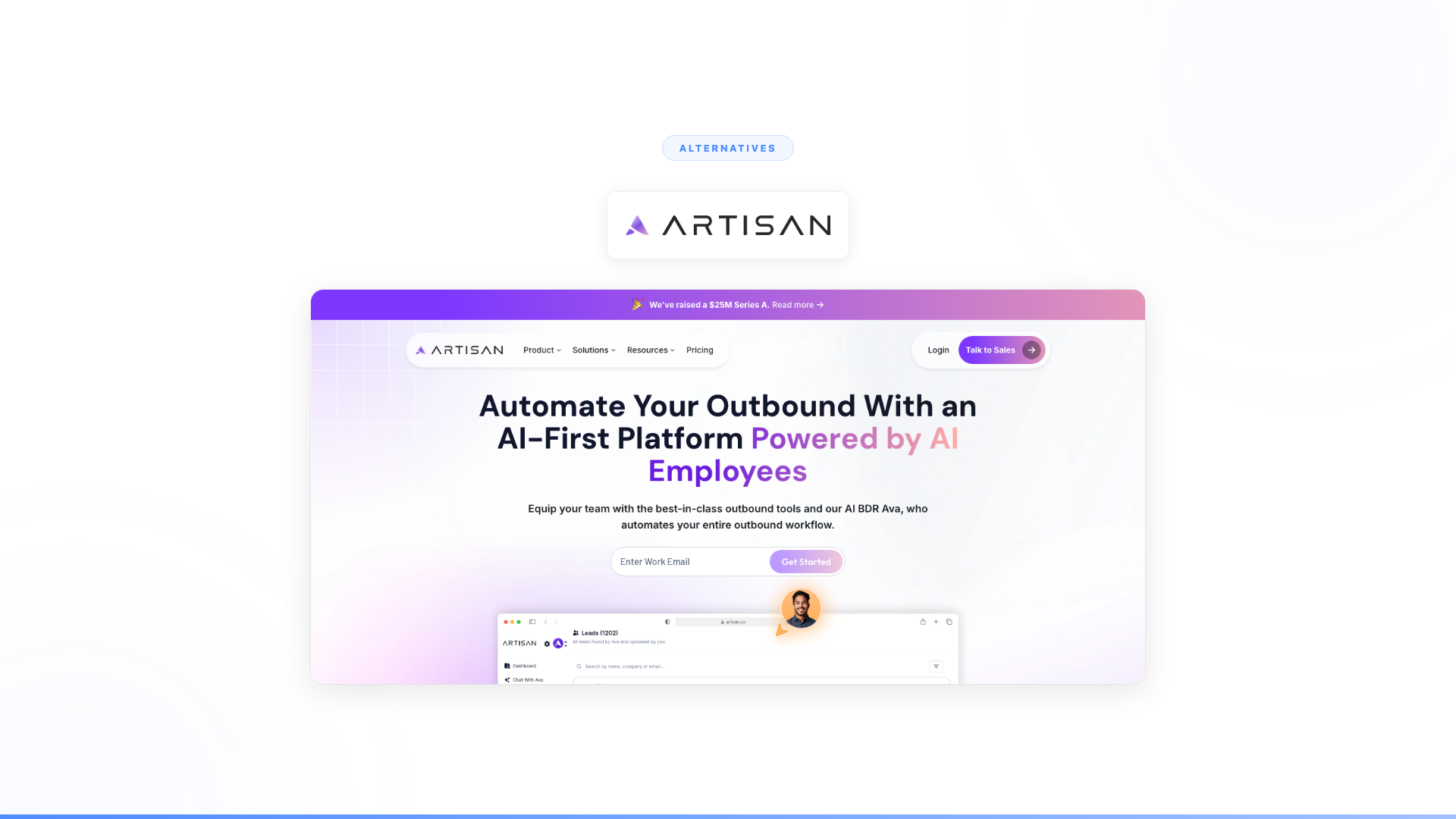
The best Artisan alternatives in 2026 are Nexus, 11x, Apollo.io, Outreach, Salesloft, Regie.ai, Lavender, Copy.ai, Jasper, and custom build. Artisan's AI SDR "Ava" automates outbound prospecting with a built-in 300M+ contact database, but alternatives range from direct AI SDR competitors to full autonomous agent platforms that handle the entire revenue cycle beyond email sequences. The AI SDR market reached approximately $4.1 billion in 2025 and is projected to grow to $15 billion by 2030, according to GlobeNewswire research.
Teams that evaluate Artisan alternatives are typically looking for one of two things.
The first is better output quality. Reviews on G2 and independent testing consistently flag Ava's emails as clearly machine-generated — overly formal, lacking depth for niche ICPs, and requiring significant manual refinement before sending. One documented case from user testing involved 1,400 emails sent with zero replies. For teams expecting autonomous production-quality outbound, the gap between the marketing and the reality is a common point of friction.
The second is scope. Artisan automates one step: outbound email prospecting. Account research, buying signal detection, qualification, pipeline management, onboarding, support, compliance — none of that is in scope. When AI ambitions expand beyond cold outbound, there is no path forward inside Artisan's platform.
Both reasons point to the same conclusion: you need something different. Here are 10 alternatives, ranked from full autonomous platforms to narrower point solutions.
Artisan Alternatives: Quick Comparison Table (2026)
| Tool | Category | Best for | Goes beyond outbound? | Pricing model |
|---|---|---|---|---|
| Nexus | Autonomous agent platform | Full sales intelligence + every other department | Yes, any workflow | Per-agent |
| 11x | AI SDR | Outbound email (Alice) + phone (Julian) | No | ~$5,000+/mo |
| Apollo.io | Sales intelligence + outreach | Prospecting with integrated contact database | No | Freemium to $119/user/mo |
| Outreach | Sales execution platform | Sequences, pipeline, deal intelligence | Partial (sales only) | Custom enterprise |
| Salesloft | Sales engagement | Cadences, conversation intel, forecasting | Partial (sales only) | Custom enterprise |
| Regie.ai | AI content for sales | AI-generated prospecting content | No | Custom pricing |
| Lavender | Email coaching AI | Improving individual email quality | No | Freemium to $29/user/mo |
| Copy.ai | AI content platform | Sales and marketing copy at scale | No | Freemium to enterprise |
| Jasper | Enterprise AI content | Brand-consistent content generation | No | From $49/mo |
| Custom build | Developer framework | Engineering teams building from scratch | Depends on team | Engineering cost |
Top 10 Artisan Alternatives for AI Sales Development
Nexus: Best Artisan Alternative for Full Revenue Cycle Automation
What it is: An autonomous agent platform paired with Forward Deployed Engineers who embed with your team. Nexus agents handle entire business workflows end-to-end: researching accounts, synthesizing buying signals, qualifying leads, managing pipeline, handling onboarding, running support triage, monitoring compliance. Any department. Any workflow. Business teams build and own the agents. Connected to 4,000+ enterprise systems.
Why teams switch from Artisan to Nexus:
The category gap is the point. Artisan sends outbound emails. Nexus handles the intelligence that makes outreach effective, the qualification after the response, the onboarding after the deal, and the retention after the deployment.
Artisan's "AI Employee" branding promises autonomy that reviews on G2 and independent platforms consistently say it does not deliver at scale. Nexus takes a different approach: Forward Deployed Engineers validate agent performance in real conditions before production deployment. That's why Nexus has a 100% POC-to-contract conversion rate.
What it looks like in production:
- Lambda (a leading AI infrastructure company): Their CTO considered building internally but chose Nexus. Agents now monitor 12,000+ accounts, synthesize buying signals, and surface pipeline opportunities autonomously. 24,000+ hours of research capacity added annually. Built by a non-engineer.
- Orange Group (multi-billion euro telecom, 120,000+ employees): Business team built autonomous customer onboarding agents. Deployed across multiple European markets in 4 weeks. 50% conversion improvement. ~$6M+ yearly revenue impact. 90% autonomous resolution. 100% team adoption.
- European telecom (13,000+ employees): Deployed a dozen Nexus agents after spending 6 months with another AI platform that couldn't deliver a single production use case. 40% support volume freed across millions of interactions.
Pricing: Per-agent, tied to value delivered. Not per-seat and not per-contact. An agent serving your entire revenue org costs the same whether you have 5 reps or 500.
Best for: Sales organizations that need AI beyond outbound email. Account intelligence, pipeline management, qualification, onboarding, support, renewal. Also every other department: compliance, HR, operations, marketing.
Full Nexus vs Artisan comparison -->
11x (Alice): Direct Artisan Competitor for AI SDR
What it is: AI SDR platform with two agents: "Alice" for outbound email prospecting and "Julian" for phone qualification and outbound calling. The most direct competitor to Artisan in the AI SDR category, with higher pricing and broader channel coverage.
How it compares to Artisan: More expensive (starting around $5,000/month vs. Artisan's $999+), but offers phone outreach through Julian, which Artisan does not have. 11x positions more squarely at enterprise with SOC 2 Type II, GDPR, and CCPA certifications. Reviews are also mixed on email personalization quality, though some teams report stronger results than Artisan once properly configured.
Why it might not solve the problem: Same structural limitation as Artisan. Outbound prospecting is the scope. No account intelligence, no pipeline management, no post-sale workflows, no cross-department capability. If you're leaving Artisan because outbound-only is too narrow, 11x is the same scope at a higher price point with a phone channel added.
Pricing: Starts around $5,000/month. Annual commitment. Contact-based pricing.
Best for: Teams that need outbound email plus phone qualification, have existing data infrastructure (ZoomInfo, etc.), and whose only AI priority is booking meetings from cold outbound.
See also: Top 10 11x Alternatives -->
Apollo.io: Sales Intelligence with Integrated Contact Database
What it is: Sales intelligence and engagement platform with a massive B2B contact database (275M+ contacts). Combines data, outreach, lead scoring, and analytics in one platform. AI features assist with prospecting and email writing, but reps still drive the process.
How it compares to Artisan: More of a platform than a pure AI agent. Apollo gives you data, sequencing, and AI-assisted features, but you're doing more of the work. The trade-off: more control over messaging and strategy. Apollo's database is comparable to Artisan's 300M+ contacts, with a generous free tier that Artisan doesn't offer. Apollo also provides stronger email deliverability tooling — domain warm-up and spam score monitoring — which Artisan's platform handles more opaquely.
Why it might not solve the problem: Apollo's AI features are assistive, not autonomous. They help reps work faster, but reps are still running the process. If you wanted AI to handle the SDR workflow rather than assist a human doing it, Apollo is a productivity tool, not an agent. And it's still limited to sales prospecting and outreach.
Pricing: Free tier available. Paid plans from $49/user/month to $119/user/month. Enterprise custom.
Best for: Sales teams that want data, outreach tools, and AI assistance in one platform, and prefer human-in-the-loop over full automation.
Outreach: Sales Execution Platform for Full-Cycle Management
What it is: Enterprise sales execution platform with AI for sequence automation, pipeline management, and deal intelligence. Broader than AI SDR tools. Covers the full sales cycle from outbound to close.
How it compares to Artisan: Fundamentally different scope. Artisan automates the act of sending outbound emails. Outreach manages the entire sales execution process: sequences, follow-ups, deal progression, pipeline forecasting. The AI augments reps rather than replacing them. More of the sales process is covered, though the AI isn't autonomous.
Why it might not solve the problem: Still sales-only. No customer onboarding, support, compliance, or cross-department capability. And it's a rep-centric tool: AI assists humans rather than completing workflows independently. Enterprise pricing is hard to justify if you only need outbound.
Pricing: Custom enterprise pricing. Typically $100+/user/month.
Best for: Enterprise sales teams with complex cycles that need pipeline management, conversation intelligence, and deal tracking beyond just outbound.
Salesloft: Sales Engagement with Conversation Intelligence
What it is: Sales engagement platform with conversation intelligence, cadence management, deal management, and forecasting. Owned by Vista Equity Partners. Mature platform widely deployed in enterprise sales organizations.
How it compares to Artisan: Similar to Outreach. Broader within sales: cadence management, call recording and analysis, deal tracking, pipeline forecasting. AI assists reps with next-best-action recommendations. Where Artisan tries to replace the SDR, Salesloft makes the existing team more effective.
Why it might not solve the problem: Sales-only, human-driven, no cross-department reach. If you want AI that completes work autonomously, Salesloft augments humans rather than replacing manual processes. Same structural ceiling as other sales engagement tools.
Pricing: Custom enterprise pricing. Comparable to Outreach.
Best for: Revenue teams that want engagement tracking, conversation intelligence, and cadence management with their existing reps.
Regie.ai: AI Content Platform for Sales Teams
What it is: AI-powered content platform for sales teams. Generates prospecting emails, sequences, and social messages. Focuses on the content creation layer of outbound, helping reps (or autonomous sequences) produce better messaging at scale.
How it compares to Artisan: Where Artisan bundles data discovery, email generation, and sending into one agent, Regie.ai focuses specifically on the content quality problem. It integrates with your existing sales stack (Outreach, Salesloft, etc.) rather than replacing it. If your issue with Artisan was email quality, Regie.ai's dedicated content intelligence may produce better messaging.
Why it might not solve the problem: Content generation is one piece of the outbound puzzle. Regie.ai doesn't find prospects, manage deliverability, book meetings, or handle any post-outbound workflow. You need it alongside other tools, not instead of them. And it's still sales-only.
Pricing: Custom pricing. Typically mid-market to enterprise.
Best for: Sales teams that already have outreach infrastructure (Outreach, Salesloft) and need better AI-generated content layered on top.
Lavender: AI Email Coaching for Individual Reps
What it is: AI email coaching tool. Analyzes drafts in real time and suggests improvements to increase reply rates. Scores on personalization, clarity, length, and tone. Learns from your team's best-performing emails.
How it compares to Artisan: Completely different approach. Artisan replaces the SDR. Lavender coaches the SDR. It improves one skill — email writing — for individual reps. If you want humans running outbound with better emails, Lavender solves a real problem. If you want automation, it doesn't.
Why it might not solve the problem: Coaching, not automation. You still need SDRs writing emails. Lavender makes the human SDR more effective. It doesn't eliminate the role or expand scope beyond email writing quality.
Pricing: Free tier available. Pro from $29/user/month.
Best for: Sales teams that want human-written outbound with AI coaching, not full SDR automation.
Copy.ai: AI Content Platform for Sales and Marketing
What it is: AI content platform that generates sales and marketing copy. Templates for prospecting emails, LinkedIn messages, ad copy, blog posts, and more. Enterprise version includes workflow automation for scaling content production across teams.
How it compares to Artisan: Copy.ai is a content tool, not a sales agent. It generates messaging but doesn't find prospects, manage deliverability, or book meetings. If Artisan's email quality was the specific issue, Copy.ai's templates and AI writing may produce better output. But it's a component, not a complete solution.
Why it might not solve the problem: Generates content. Doesn't execute sales workflows. You still need prospecting data, outreach infrastructure, and someone (or something) to manage the process. And it's not designed for autonomous operation.
Pricing: Free tier available. Pro from $49/month. Enterprise custom.
Best for: Teams that need high-volume sales and marketing content generation and have the rest of the stack already in place.
Jasper: Enterprise AI Content for Brand-Consistent Messaging
What it is: Enterprise AI content platform. Generates brand-consistent marketing and sales content with voice and style controls. Jasper campaigns can produce multi-channel content from a single brief. Strong enterprise governance features.
How it compares to Artisan: Different category. Jasper is for content creation across marketing and sales, not for autonomous SDR work. If your concern with Artisan was email quality and you want better AI-generated messaging that matches your brand voice, Jasper's content quality is generally stronger. But it doesn't prospect, sequence, or book meetings.
Why it might not solve the problem: Content generation tool, not a sales agent. Produces excellent copy but requires humans (or other tools) to handle the outreach process. Still limited to the content layer.
Pricing: Starts at $49/month (Creator). Business and Enterprise tiers for team features and governance.
Best for: Marketing and sales teams that need high-quality, brand-consistent content at scale. Not a direct Artisan replacement for SDR automation.
Custom Build: Developer Frameworks for Bespoke AI Agents
What it is: Building your own AI sales agents using frameworks like LangChain, LangGraph, or CrewAI. Your engineering team designs the architecture, writes the code, handles deployment, security, governance, and maintenance.
How it compares to Artisan: Maximum flexibility. You can build exactly the sales intelligence system your organization needs, without being constrained by Artisan's agent parameters. For companies with strong AI engineering teams and unique requirements, custom builds can outperform any off-the-shelf tool.
Why it might not solve the problem: Most sales organizations don't have surplus AI engineering capacity. The engineers you do have are working on your core product, not internal tooling. Custom builds also require you to solve governance, security, compliance, monitoring, and maintenance yourself. And the opportunity cost is real. Lambda, a leading AI infrastructure company with world-class engineers, chose to buy from Nexus instead of building because the opportunity cost of diverting engineering from their core product was too high.
Pricing: Engineering salaries plus infrastructure. Expect 3 to 6 months for a first production agent, with ongoing maintenance costs.
Best for: Organizations with dedicated AI engineering teams, unique technical requirements, and timelines that can absorb months of development.
When Artisan Is the Right Choice
To be fair: Artisan has genuine strengths. Its bundled 300M+ contact database means teams without existing data providers (ZoomInfo, Apollo) get prospecting data without an additional contract. For early-stage or small sales teams focused exclusively on cold outbound email, the all-in-one setup is convenient. Artisan's pricing ($999+/month) is also easier to trial than enterprise platforms with custom minimums.
Where Artisan works: single-channel outbound email, teams without existing data infrastructure, early-stage companies testing AI SDR before committing to a larger platform.
Where Artisan struggles: niche ICPs requiring deep personalization, teams expecting near-zero oversight, any workflow beyond booking cold meetings from outbound email.
The Pattern Behind the Search
Teams that evaluate Artisan alternatives start with a narrow question: "Which AI SDR sends better emails?" Within weeks, the conversation expands. "We also need account research." "What about qualification after the meeting?" "Support is drowning too."
This is how tool sprawl happens. One AI SDR for outbound. One tool for account management. One for support automation. One for compliance monitoring. Each vendor, each contract, each integration. None of them share data or context.
The AI SDR market is growing at roughly 29.5% CAGR through 2030, which means vendors are multiplying. The risk isn't that there are too few options. It's that every option solves a narrow slice of the problem.
Artisan's price point ($999+/month) makes it easy to adopt. But it's also easy to outgrow. And when you outgrow a point solution, you don't upgrade it. You start over with a different approach.
The question isn't which tool sends better cold emails. It's whether cold email is the only thing you'll ever need AI to do.
Artisan vs. 11x vs. Nexus: Which AI Sales Tool Should You Choose?
If you just need a different AI SDR and outbound is genuinely your only AI priority, look at 11x (email + phone) or Apollo.io (data + assisted outreach). They're in the same category with different strengths.
If you need better email content but have the rest of your stack handled, look at Regie.ai, Lavender, Copy.ai, or Jasper. They improve the content layer without replacing your outreach process.
If you need sales execution beyond outbound, Outreach or Salesloft cover pipeline management, conversation intelligence, and deal progression. Still sales-only, but broader than SDR.
If outbound is one of many workflows you need to automate, and you need AI that handles sales intelligence, account research, qualification, onboarding, support, compliance, and operations on one platform with Forward Deployed Engineers ensuring it actually works — that's a different category entirely. That's what Nexus was built for.
Lambda, a leading AI infrastructure company, didn't need a better SDR tool. They needed agents that monitor 12,000 accounts and surface pipeline opportunities autonomously. Built by a non-engineer. On one platform that now powers their entire agent fleet across sales and marketing.
Orange didn't need outbound email automation. They needed customer onboarding agents that deliver measurable revenue impact across multiple European markets. Deployed in 4 weeks. 100% team adoption.
Worth Exploring?
Every Nexus engagement starts with a 3-month proof of concept tied to measurable outcomes. Forward Deployed Engineers embed with your team from day one. You see the results before committing. You can exit anytime.
100% of clients who started a POC converted to an annual contract. Every one.
See the full Nexus vs Artisan comparison -->
Frequently Asked Questions
How much does Artisan cost compared to 11x? Artisan starts at $999+/month (annual commitment required). 11x starts around $5,000/month, also on an annual commitment. Both use contact-based pricing models. For teams evaluating both, 11x adds a phone channel (Julian) that Artisan doesn't offer, which partially explains the price gap. Neither includes post-sale workflows or account intelligence.
Is Artisan Ava's email quality better than other AI SDR tools? Results vary significantly. Reviews across G2 and independent testing platforms consistently flag Ava's emails as clearly machine-generated, with limited personalization depth for niche ICPs. Documented outcomes range from strong performance for some teams to near-zero reply rates for others. The platform allows training over time, but requires more manual oversight than the "autonomous SDR" positioning suggests. Lavender, Regie.ai, and Copy.ai generally produce better standalone email quality, though they don't include prospecting data or sending infrastructure.
Does Artisan (Ava) integrate with Salesforce and HubSpot? Yes. Artisan supports integrations with Salesforce, HubSpot, and other major CRMs for contact syncing and activity logging. However, integration depth — two-way sync, pipeline updates, deal stage management — varies. For teams whose evaluation depends on deep CRM integration rather than just contact sync, validating the specific integration requirements against Artisan's documentation before committing is recommended.
Can Artisan handle inbound lead qualification as well as outbound? No. Artisan is designed for outbound prospecting — finding and contacting cold leads from its own database. It does not include inbound routing, lead scoring from inbound sources, or qualification workflows triggered by inbound activity. Teams that need both inbound and outbound coverage in a single AI agent need a different platform.
What is the "humans are overrated" Artisan controversy? Artisan ran a billboard campaign with the phrase "Stop Hiring Humans" alongside imagery suggesting AI employees would replace SDRs. The campaign attracted significant backlash on LinkedIn and in sales communities for its positioning, and coincided with broader scrutiny of AI SDR tools' actual delivery versus their marketing claims. The controversy is relevant context for enterprise buyers evaluating vendor positioning: the gap between Artisan's marketing narrative and the product reality described in user reviews is a recurring theme in buyer discussions.