What is a low-code AI agent builder?
A low-code AI agent builder is a platform that lets users create, configure, and deploy AI agents through visual interfaces and pre-built components — rather than writing custom code. The category spans drag-and-drop prototyping tools for quick experimentation all the way to enterprise platforms designed for production deployment at scale. According to Gartner, by 2025 over 70% of new enterprise applications are expected to use low-code or no-code technologies, up from less than 25% in 2020 — and AI agent builders are now the fastest-growing segment within that shift.1
The promise is simple: business teams should be able to build and own AI agents without depending on engineering. The reality in most enterprises is messier.
Teams evaluate a platform. IT gets involved because integrations require technical work. Security reviews add weeks. The first prototype works in a sandbox but can't handle production volume, edge cases, or compliance requirements. Engineering gets pulled in to "help with the last 20%," which turns out to be 80% of the effort. Six months later, the agent is still in pilot.
This pattern plays out whether you're using Microsoft Copilot Studio, Salesforce Agentforce, or any number of platforms that call themselves low-code. The issue isn't the visual builder. It's everything that happens between building the agent and deploying it in production.
Some platforms solve this better than others. Here are 10 worth evaluating, ranked by their ability to get production agents into the hands of the business teams that need them.
Quick comparison
| Platform | Who builds agents | Production-ready? | Time to first production agent | Scope | Integration depth | Pricing model |
|---|---|---|---|---|---|---|
| Nexus | Business teams + FDEs | Yes, with FDE support | Days to weeks | Any department, any workflow | 4,000+ (FDEs handle complexity) | Per-agent |
| Microsoft Copilot Studio | IT / Power Platform devs | Prototypes fast, production slow | Months | Microsoft ecosystem | 1,300+ (Power Platform) | Per-message |
| Salesforce Agentforce | Salesforce admins | Within Salesforce | Weeks (Salesforce-native) | Sales, service, CRM | Salesforce ecosystem | Per-conversation |
| ServiceNow AI Agents | ServiceNow admins | Within ServiceNow | Weeks (ITSM-native) | IT, HR, customer service | ServiceNow ecosystem | Enterprise license |
| Relevance AI | Business teams | Partial | Weeks | Sales and marketing | Moderate | Per-agent |
| Dust | Business teams | Assistants only | Days | Knowledge work | Data source connectors | Per-user |
| Dify | Engineers (visual builder) | Depends on team | Months | General-purpose | API-based | Self-hosted / cloud |
| Zapier | Business teams | Rule-based only | Days | Simple automations | 7,000+ apps | Per-task |
| Kore.ai | Developers + business | Conversations only | Months | Customer/employee support | Enterprise connectors | Enterprise license |
| Google Vertex AI Agent Builder | Engineers | Depends on team | Months | Google Cloud-native | Google Cloud ecosystem | Per-usage |
The platforms, ranked
1. Nexus
What it is: An autonomous agent platform where business teams build and own agents, supported by Forward Deployed Engineers who handle integration complexity, agent design, and change management. Agents complete entire workflows: collecting data, validating against systems, making decisions, handling exceptions, and executing actions.
Why it ranks first for enterprise low-code:
Most low-code platforms have the same gap: the visual builder gets you 40% of the way, and the remaining 60% — integrations, compliance, edge cases, production hardening — requires engineering. Nexus closes that gap differently. Instead of pretending the gap doesn't exist or asking your IT team to fill it, Forward Deployed Engineers handle it. Business teams focus on the business logic. FDEs handle the technical plumbing.
This isn't a theoretical model. It's how production agents get built.
Production evidence:
- Orange Group (multi-billion euro telecom, 120,000+ employees): Business team — not engineering — deployed customer onboarding agents across multiple European markets in 4 weeks. First agent live in 4 hours. 50% conversion improvement. ~$6M+ yearly revenue impact. 90% autonomous resolution. 100% team adoption.
- European telecom (13,000+ employees): After 6 months with Copilot Studio yielded zero production agents, switched to Nexus. A dozen production agents in 12 weeks. 40% of support capacity freed.
What makes it genuinely low-code: The business team defines what the agent should do. FDEs wire the integrations (4,000+ systems, including legacy). No Power Platform expertise needed. No Salesforce admin certification. No Python. The person who understands the workflow builds the agent.
Pricing: Per-agent, tied to value delivered. FDE support included. No ecosystem subscription required.
Full comparison: Nexus vs Copilot Studio -->
2. Microsoft Copilot Studio
What it is: Microsoft's agent builder within the Power Platform ecosystem. Visual interface for creating conversational agents, connecting to Microsoft 365, Dynamics, and third-party systems through 1,300+ connectors. Can trigger Power Automate flows for backend actions.
Low-code reality: Copilot Studio is genuinely low-code for creating a basic conversational agent. The visual builder works. Where the "low-code" promise breaks down is in production. Building production-grade integrations, error handling, compliance logging, and exception routing requires Power Platform expertise that most business teams don't have. In practice, IT builds and maintains the agents.
Production track record: Gartner research found that only 6% of Microsoft Copilot pilots moved to larger-scale deployment.2 A European telecom with dedicated IT resources and a Microsoft enterprise agreement spent 6 months and didn't deliver a single production agent. The platform creates prototypes quickly. The path from prototype to production is where enterprises get stuck.
Best for: Organizations with dedicated Power Platform developers who have bandwidth to build and maintain agents within the Microsoft ecosystem.
Pricing: Per-message pricing for agent conversations, plus Power Platform licensing.
3. Salesforce Agentforce
What it is: Salesforce's AI agent platform built natively on the Salesforce ecosystem. Agents can access CRM data, trigger flows, and take actions within Salesforce. Positioned as the evolution beyond Einstein Copilot toward autonomous agents.
Low-code reality: If your agents live inside Salesforce, Agentforce is genuinely accessible to Salesforce admins. The platform handles CRM-native actions well. The low-code experience degrades when agents need to reach outside Salesforce. Connecting to ERP systems, custom databases, legacy tools, or compliance platforms requires MuleSoft or custom Apex development.
Production track record: Salesforce reports early adoption in sales and service use cases. The platform is still maturing for multi-system workflows. Per-conversation pricing ($2/conversation) can scale unpredictably at enterprise volume.
Best for: Salesforce-heavy organizations where the primary agent use cases live within CRM workflows.
Pricing: $2 per conversation.
4. ServiceNow AI Agents
What it is: AI agents embedded in the ServiceNow Now Platform. Built for IT service management, HR service delivery, and customer service. Agents resolve tickets, route requests, and automate structured workflows within ServiceNow's process engine.
Low-code reality: ServiceNow admins can configure AI agents within the platform's workflow designer. The low-code experience is solid for ITSM workflows because ServiceNow provides the process structure. Agents operate within well-defined ticket lifecycles, approval chains, and escalation paths. Outside ITSM and HR, the platform's agent capabilities thin out.
Production track record: Strong in IT service management. ServiceNow's acquisition of Moveworks accelerated their AI agent capabilities for employee service. For IT-centric agent use cases, it's a proven platform.
Best for: ServiceNow-native organizations focused on IT and employee service automation.
Pricing: Enterprise licensing bundled with ServiceNow platform costs.
5. Relevance AI
What it is: An AI agent platform that lets business teams build agents for sales and marketing workflows. Agents handle lead research, data enrichment, outreach personalization, and pipeline management. Visual builder with no-code agent design.
Low-code reality: Genuinely accessible to business teams for sales and marketing use cases. The platform handles the common patterns well: research a company, enrich a lead, draft an outreach email, update a CRM record. For these workflows, business users can build and iterate without engineering.
Production track record: Growing adoption in sales teams, particularly for lead research and outreach automation. Production readiness is strongest for simple, linear workflows. Complex multi-system orchestration with compliance requirements may require more support.
Best for: Sales and marketing teams that need agent-powered research and outreach without engineering dependency.
Pricing: Per-agent, starting at $19/month for basic plans.
6. Dust
What it is: AI assistant platform for building custom assistants connected to company data. Teams create role-specific assistants — sales, support, engineering — that answer questions and generate content based on internal knowledge.
Low-code reality: Very accessible. Business teams can create assistants without engineering. The key distinction: Dust builds assistants, not autonomous agents. Assistants answer questions and help with content. They don't complete multi-step workflows, make decisions, or execute actions across systems. If you're looking for smart Q&A and content help, Dust is genuinely low-code. If you need workflow automation, it's a different category.
Production track record: Solid for knowledge-work assistance. Teams report good results for internal Q&A, onboarding support, and content generation. Not designed for autonomous workflow completion.
Best for: Teams that need context-aware AI assistants for knowledge work and don't need autonomous execution.
Pricing: $29/user/month (Pro), custom enterprise pricing.
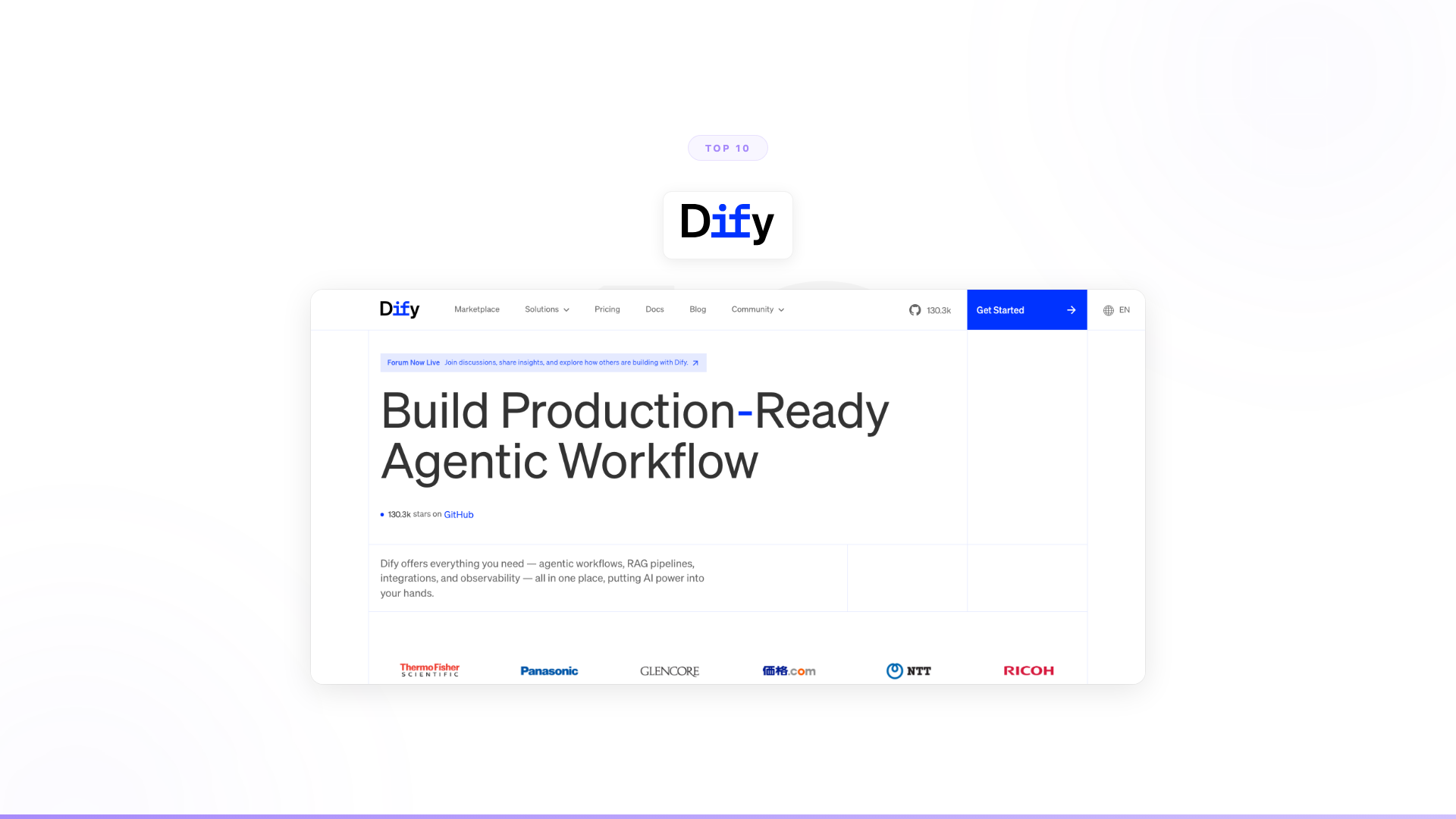
7. Dify
What it is: Open-source platform for building LLM applications and agents. Provides a visual workflow builder, supports multiple LLMs, and can be self-hosted. More technical than pure low-code, but the visual interface reduces the engineering bar.
Low-code reality: "Low-code" is generous. Dify provides visual workflow design, which is simpler than writing code from scratch. But building production agents still requires understanding of prompt engineering, API integration, error handling, and deployment. It's "lower-code," not "no-code." Engineering teams get a productivity boost. Business teams typically can't build independently.
Production track record: Growing open-source community (75,000+ GitHub stars). Strong for developer-built prototypes and internal tools. Production enterprise deployments with full compliance, governance, and multi-system integration require significant engineering investment.
Best for: Engineering teams that want visual workflow design combined with open-source flexibility.
Pricing: Free (open-source, self-hosted), cloud plans from $59/month.
8. Zapier
What it is: Workflow automation connecting 7,000+ apps with if-this-then-that logic. Recently added "Central" AI agent features and "Tables" for data management. The most accessible automation tool for non-technical users.
Low-code reality: Genuinely no-code for simple automations. Trigger-action workflows work reliably across thousands of apps. The AI agent features (Central) are newer and less mature. For rule-based automations — when a form is submitted, create a record and send a notification — Zapier is the gold standard of accessibility.
Production track record: Millions of users, billions of automations. Rock-solid for simple, predictable workflows. When processes require judgment, exception handling, or complex decision-making, Zapier reaches its ceiling. The AI agent additions are promising but early.
Best for: Simple, rule-based automations between SaaS applications. Data syncing, notifications, basic routing.
Pricing: Starts at $29.99/month, scales with task volume.
9. Kore.ai
What it is: Conversational AI platform for building chatbots and virtual assistants. Handles customer support, IT helpdesk, and employee service automation. Named a Gartner Magic Quadrant Leader in Enterprise Conversational AI.
Low-code reality: The conversation design tool is visual and accessible to trained builders. Creating dialogue flows, intent recognition, and entity extraction can be done without deep coding. However, building the backend integrations, fulfillment logic, and exception handling typically requires developer involvement. The "low-code" applies to the conversation layer, not the full agent.
Production track record: Strong in customer-facing chatbot deployments. Large enterprise customers in banking, healthcare, and telecom. Production-grade for conversational AI. The gap: conversations are 10% of the problem. The workflow behind the conversation often stays manual.
Best for: Organizations where the primary need is automating high-volume customer or employee conversations.
Pricing: Enterprise licensing, typically $300K+ annually for large deployments.
10. Google Vertex AI Agent Builder
What it is: Google Cloud's agent building platform. Part of the broader Vertex AI suite. Combines Google's search grounding, dialogue management, and LLM capabilities for building conversational and task-based agents.
Low-code reality: More developer-oriented than most platforms on this list. The visual agent builder exists, but production deployments typically require GCP expertise, API integration work, and infrastructure management. "Low-code" compared to raw LLM development, but not accessible to business teams.
Production track record: Google Cloud customers report successful deployments, particularly for search-grounded agents and customer service. The platform benefits from Google's AI research but requires cloud engineering maturity.
Best for: Google Cloud-native organizations with engineering capacity to build and maintain agents on GCP infrastructure.
Pricing: Pay-per-use (API calls, compute, storage).
What "low-code" actually means in practice
After evaluating these platforms, a pattern emerges. "Low-code" in AI agent building usually means one of three things:
1. Low-code for the prototype, engineering for production. This is the most common. Visual builders create working demos. Production requires integrations, compliance, error handling, and governance that only engineers can deliver. Copilot Studio, Dify, and Vertex AI Agent Builder fall here.
2. Low-code within a specific ecosystem. Agents that stay inside Salesforce, ServiceNow, or Microsoft 365 can be built by platform admins. The moment agents need to reach outside that ecosystem, engineering gets involved. Agentforce, ServiceNow AI Agents, and Copilot Studio (for simple M365 use cases) fall here.
3. Low-code with embedded engineering support. The business team handles the business logic. A dedicated engineering team handles the technical complexity. This is the Nexus model with Forward Deployed Engineers. The business team never writes code, but production-grade integration work still happens. It's just not their problem.
The honest answer: building production AI agents without any engineering involvement isn't realistic for complex enterprise workflows. The question is whose engineering is doing the work — your overstretched IT team (with a 6-month backlog), or a team of Forward Deployed Engineers whose sole job is getting your agents to production?
What production-ready actually requires
A lot of platforms claim to be "production-ready." In practice, production means something specific:
- Integration depth: Can the agent connect to your actual systems — including legacy databases, custom internal tools, and third-party APIs that don't have pre-built connectors?
- Error handling and exception routing: When the agent encounters an edge case it can't resolve, what happens? Does it fail silently, or does it escalate correctly?
- Compliance and audit logging: Can every agent action be traced and reported? Does the platform support your industry's regulatory requirements?
- Volume and reliability: Can the agent handle peak load without degrading? What are the SLAs?
- Governance: Who approves changes to production agents? How are versioned updates managed without disrupting live operations?
Most visual builders address the first integration point — the clean, documented API connection. Production agents in enterprise environments hit the other four requirements constantly.
Low-code AI agent vs enterprise AI platform: what's the difference?
Low-code AI agent builders and enterprise AI platforms overlap in marketing but diverge significantly in practice.
Low-code AI agent builders are optimized for speed of creation. The value proposition is reducing the engineering requirement to build an agent. The tradeoff is usually scope: they work well for defined use cases with clean data and documented systems.
Enterprise AI platforms are optimized for production reliability across complex, heterogeneous environments. The value proposition is getting to production across messy real-world conditions — legacy systems, inconsistent data, compliance requirements, organizational change management. The tradeoff is that they require more upfront investment.
The distinction matters when evaluating. A platform that deploys a prototype in an afternoon may take 6 months to reach production at enterprise scale. A platform that takes 4 weeks to deploy counts as fast if it's genuinely in production — handling real volume with real data.
5 questions to ask before choosing a low-code AI agent builder
Who actually builds in production? Ask for customer references where business teams — not engineers — built the agents. If every reference includes "our engineering team," it's not low-code in practice.
What happens at month six? Pilots are easy. Sustained production is hard. Ask about maintenance, monitoring, and iteration after launch. Who handles it?
How long from first demo to first production agent? Not the first prototype. The first agent handling real volume with real data. Orange: 4 hours to first agent live, 4 weeks to multi-market deployment. European telecom (with Copilot Studio): 6 months and counting.
What's the hardest integration they've done? Every enterprise has legacy systems, custom databases, and unusual tools. Ask about the messiest integration, not the cleanest connector.
What's the total cost of getting to production? Platform licensing is one number. IT time, professional services, delayed value, and rework are usually bigger numbers.
Frequently asked questions
What is a low-code AI agent builder?
A low-code AI agent builder is a platform that lets non-engineers create, configure, and deploy AI agents using visual interfaces, pre-built components, and drag-and-drop workflow design — rather than writing custom code. They range from simple automation tools (Zapier, Make) to enterprise platforms that combine no-code design with production-grade infrastructure (Nexus, Salesforce Agentforce). The key distinction from traditional chatbot builders is that AI agents can complete multi-step workflows autonomously — collecting data, making decisions, and taking actions across systems — rather than just responding to queries.
Can non-engineers build AI agents with low-code tools?
Yes, but the extent depends on the platform and the use case. For simple automations and conversational assistants, non-technical business users can build independently with tools like Zapier, Dust, or Relevance AI. For production-grade agents that integrate with enterprise systems, handle compliance requirements, and operate at scale, some technical support is typically required at some point in the process. The most practical model for complex enterprise workflows combines business team ownership of the agent logic with dedicated technical support for the infrastructure — the approach platforms like Nexus use with Forward Deployed Engineers.
What's the difference between a low-code AI agent builder and an enterprise AI platform?
Low-code AI agent builders emphasize speed of creation and accessibility for non-technical users. Enterprise AI platforms emphasize production reliability, governance, compliance, and integration depth across complex environments. In practice, many platforms market themselves as both. The test is in deployment: how many production agents — handling real volume with real data — does the platform have in enterprise environments where the agent needed to integrate with legacy systems and meet compliance requirements?
Which low-code AI agent builders are production-ready for enterprise?
Based on production deployment evidence, the most consistently enterprise-ready options are: Nexus (with FDE support for any workflow), Salesforce Agentforce (within the Salesforce ecosystem), and ServiceNow AI Agents (within the ServiceNow ecosystem). Microsoft Copilot Studio can reach production in Microsoft-native environments with dedicated Power Platform resources. Platforms like Dify and Google Vertex AI Agent Builder require significant engineering investment beyond the visual builder to reach enterprise production standards. According to Gartner, by 2028 agentic AI will be implemented via enterprise low-code platforms in four out of five businesses globally — but the path to production varies significantly by platform.3
How much does a low-code AI agent builder cost?
Pricing varies significantly by model and scope. Per-user SaaS tools (Dust: $29/user/month) are the most predictable for small teams. Per-task or per-message pricing (Zapier: from $29.99/month; Copilot Studio: per-message) scales with volume and can become expensive at enterprise scale. Per-conversation pricing (Salesforce Agentforce: $2/conversation) requires careful volume forecasting. Enterprise licenses (ServiceNow, Kore.ai) are typically negotiated based on deployment scope. Nexus prices per-agent, with FDE support included. The total cost of getting to production — including IT time, integration work, and delayed value from extended pilots — is typically larger than the platform licensing fee.
Worth exploring?
If your team is evaluating low-code AI agent builders because visual builders alone haven't gotten you to production, the pattern from enterprises that have been through it is worth understanding.
Orange's business team built production agents in 4 weeks. No IT dependency. ~$6M+ yearly revenue impact. 90% autonomous resolution.
A European telecom spent 6 months with Copilot Studio's low-code builder and couldn't deliver. Switched to Nexus, deployed a dozen production agents in 12 weeks.
According to Deloitte, 25% of organizations using generative AI are expected to launch agentic AI pilots or proof-of-concepts in 2025, with that number projected to double to 50% by 2027.4 Most of those pilots will follow the same pattern: prototypes that work, production that stalls. The difference is whether the platform's model is built to close that gap.
Every Nexus engagement starts with a 3-month proof of concept. Forward Deployed Engineers embed with your team from day one. 100% of POC clients converted to annual contracts.
See how Nexus compares to Copilot Studio for telecom -->
Related reading
- Top 10 Copilot Studio alternatives for AI agent building
- Top 10 Microsoft Copilot alternatives for enterprise AI
- Nexus vs Microsoft Copilot Studio: the full telecom comparison
- Nexus vs Microsoft Copilot: AI assistant comparison
- How Nexus works for telecom operators
- Copilot Studio vs Power Automate: Microsoft AI tools compared
- How to move beyond Copilot Studio for enterprise AI
Citations
Footnotes
-
Gartner, "Forecast Analysis: Low-Code Development Technologies, Worldwide." Gartner projects that by 2025, over 70% of new enterprise applications will use low-code or no-code technologies. https://www.gartner.com/en/documents/7146430 ↩
-
Gartner research on Microsoft Copilot pilot-to-production conversion rates, cited in independent analyst coverage. Only 6% of Copilot pilots moved to larger-scale deployment. ↩
-
Gartner, "Agentic AI will be implemented via enterprise LCAPs in four out of five businesses globally by 2028." Cited in Gartner low-code platform market analysis. https://www.gartner.com/en/documents/5459763 ↩
-
Deloitte, "State of Generative AI in the Enterprise." 25% of organizations leveraging generative AI are expected to launch agentic AI pilots or POCs in 2025, projected to reach 50% by 2027. ↩