Top 10 Enterprise Chatbot Platforms in 2026 (and Why Agents Are Replacing Them)
The best enterprise chatbot platforms in 2026, ranked. Plus the shift that matters more: why autonomous agents are replacing chatbots entirely for high-value enterprise work.
Enterprise chatbot platforms are a $9.5 billion market in 2025, growing at nearly 20% annually according to Grand View Research — and most deployments still disappoint. Not because the technology fails, but because the category has a ceiling. Chatbots handle conversations. Enterprise work requires completing processes. Those are different things, and understanding that difference is the most important decision a buyer can make in 2026.
What is an enterprise chatbot platform?
Enterprise chatbot platforms provide conversational AI for customer service, employee support, and business processes — ranging from basic FAQ bots to advanced platforms that take action in connected systems. They use natural language understanding (NLU) to interpret user requests, manage multi-turn dialogue, integrate with back-end systems via APIs, and deploy across channels including web, mobile, voice, and messaging apps.
The category has matured significantly. The NLU works. Multi-channel deployment works. Gartner publishes a dedicated Magic Quadrant for Conversational AI Platforms. Vendors are well-funded and serving hundreds of Fortune 2000 companies.
And yet, most enterprise chatbot deployments still disappoint.
Not because the technology fails. Because the category has a ceiling. A customer support chatbot answers questions, routes tickets, and deflects common inquiries. That's the conversational 10%. The other 90% — the validation against business rules, the cross-system data pulls, the exception handling, the compliance checks, the actual resolution of the issue — still requires humans. The chatbot handles the dialogue. The work behind the dialogue stays manual.
This doesn't mean chatbot platforms are worthless. For the right use cases, they're effective. But if you're evaluating enterprise chatbot platforms in 2026, it's worth understanding both the best options in the category and the structural shift that's making them less relevant for high-value work.
Here are the 10 best enterprise chatbot platforms, followed by the argument for why agents are replacing them.
Quick comparison
| Platform | Best for | Channels | Pricing model | Scope |
|---|---|---|---|---|
| Kore.ai | Large enterprise, multi-use case | Text, voice, web, mobile, messaging | Enterprise license ($300K+/yr) | Conversations only |
| Yellow.ai | Mid-market to enterprise, multilingual | Text, voice, 35+ channels | Per-interaction | Conversations only |
| Cognigy | Contact center, voice-first | Voice, text, contact center | Enterprise license | Conversations only |
| Ada | Customer support automation | Web, mobile, messaging | Per-resolution | Support conversations only |
| Moveworks | IT helpdesk self-service | Slack, Teams, web, mobile | Per-employee | IT conversations only |
| Google Dialogflow CX | Google Cloud organizations | Text, voice, telephony | Per-request | Conversations only |
| Amazon Lex | AWS organizations | Text, voice, Connect | Per-request | Conversations only |
| Microsoft Copilot Studio | Microsoft ecosystem | Teams, web, Power Platform | Per-message | Conversations only |
| Rasa | Engineering-led custom builds | Any (self-deployed) | Open-source / Enterprise | Conversations only |
| Intercom Fin | B2B SaaS support | Web, mobile, email | Per-resolution | Support conversations only |
The 10 best enterprise chatbot platforms
1. Kore.ai
What it is: Named a Leader in the 2025 Gartner Magic Quadrant for Conversational AI Platforms for the third consecutive year — the only vendor to top both "Ability to Execute" and "Completeness of Vision" axes in that report. Kore.ai's XO Platform handles customer support, IT helpdesk, and employee self-service with strong NLU, dialog management, and multi-channel deployment. 400+ Fortune 2000 customers including AT&T, Coca-Cola, and Airbus.
Strengths: Comprehensive feature set. Strong NLU engine with DialogGPT. Good contact center integrations. Broad use case coverage across customer, employee, and IT workflows. On-premise deployment option for regulated industries. Recently added an Agent Platform for multi-agent orchestration.
Limitations: Complex platform that requires dedicated bot-building teams. G2 and Gartner Peer Insights reviewers consistently note the learning curve. Implementation timelines of 6–18 months for complex deployments. Enterprise pricing starts around $300K+ annually.
Avoid if: You need rapid deployment, have a small team, or your primary need is completing work rather than managing conversation flows.
Best for: Large enterprises with dedicated conversational AI teams, multiple chatbot use cases, and budget for long deployment timelines.
2. Yellow.ai
What it is: Named a Challenger in the 2025 Gartner Magic Quadrant for Conversational AI Platforms. Yellow.ai's DynamicNLU engine blends generative and traditional AI. Strong multilingual support across 135+ languages. Accessible mid-market positioning with per-interaction pricing.
Strengths: Multilingual capability is among the best in the category. Per-interaction pricing aligns cost with usage. Faster deployment than some enterprise platforms. Good balance of capability and accessibility for growth-stage teams.
Limitations: Less mature than Kore.ai for very large, complex enterprise deployments. Gartner cautions note limited R&D investment compared to category leaders. Still a conversational platform with the same 10/90 workflow limitation.
Avoid if: You need the full depth of enterprise-grade orchestration or operate in heavily regulated industries requiring on-premise deployment.
Best for: Mid-market and growth-stage enterprises, multilingual requirements, organizations that want per-interaction pricing instead of large annual licenses.
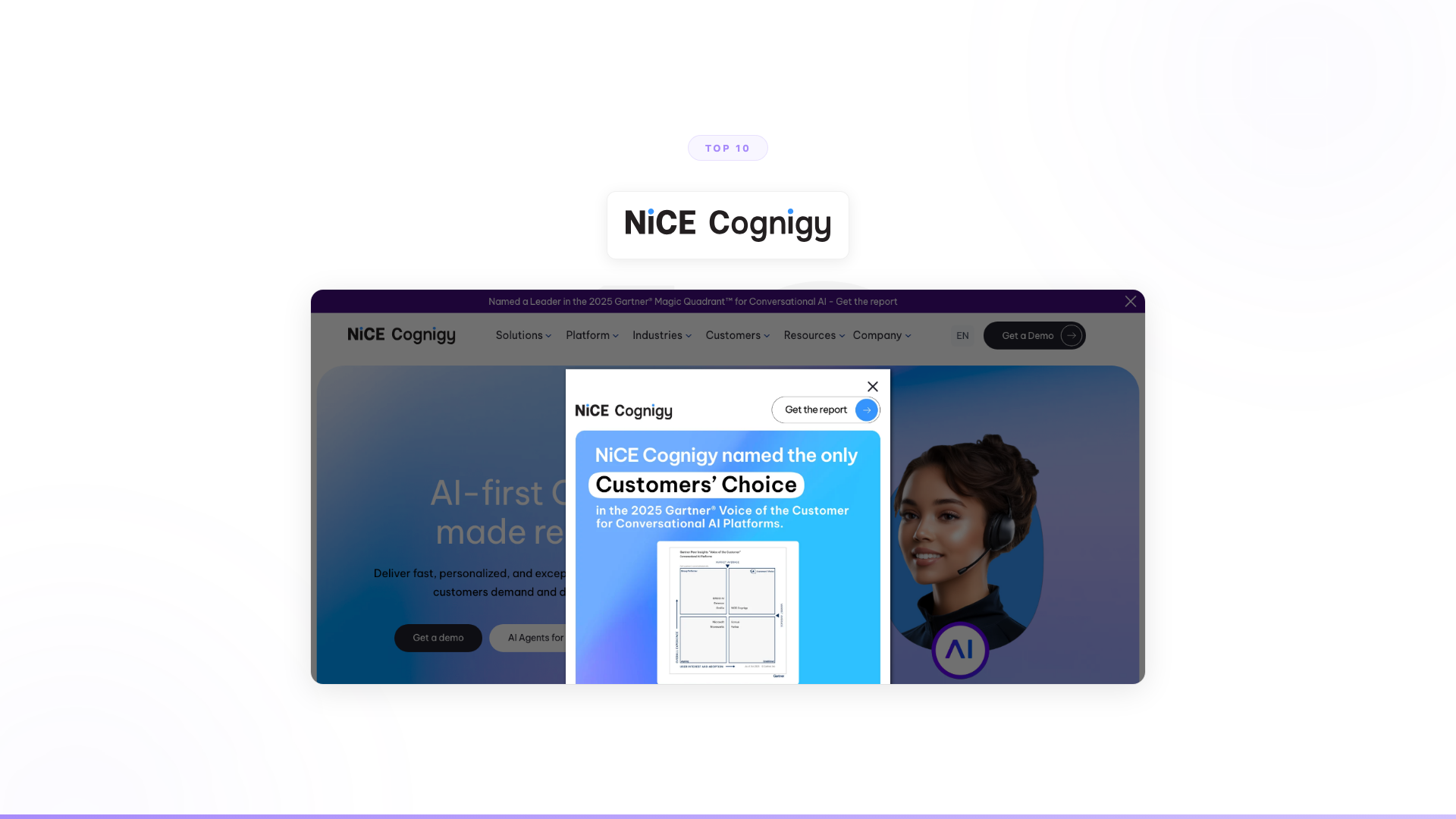
3. Cognigy
What it is: Conversational AI platform with a strong focus on contact center automation and voice bots. Particularly well-established in DACH and European markets. Deep integrations with Genesys, NICE, Five9, and other contact center infrastructure. Recognized in the 2025 Gartner Magic Quadrant for Conversational AI Platforms.
Strengths: Voice-first capabilities are among the best in the category. European data residency and compliance. Strong contact center integrations. Low-code flow builder that contact center teams can manage without engineering support.
Limitations: More contact center-focused than a general enterprise chatbot platform. Smaller ecosystem outside European markets. Less suited for employee self-service or IT helpdesk use cases.
Avoid if: Your primary need is outside the contact center, or you need strong coverage in North American markets.
Best for: Contact center-heavy organizations, especially in Europe, that need strong voice bot capabilities alongside text-based chatbots.
4. Ada
What it is: AI customer service automation platform focused on resolution rather than deflection. You pay when Ada actually resolves a customer issue, not just when it handles a conversation. Serves B2C and B2B support teams across web, mobile, and messaging.
Strengths: Resolution-based pricing is meaningfully different from per-seat or per-license models. Easy to deploy compared to full conversational AI platforms. Good at actually resolving common support issues rather than just deflecting them.
Limitations: Limited to customer support. Does not extend to IT helpdesk, employee self-service, or other enterprise use cases. Simpler platform that trades flexibility for ease of use.
Avoid if: You need more than customer support automation, or your support conversations require complex multi-system workflows.
Best for: Companies focused specifically on automating customer support resolution with outcome-aligned pricing.
5. Moveworks
What it is: AI-powered IT self-service platform, now owned by ServiceNow. Resolves employee IT requests automatically — password resets, software access, VPN issues, common troubleshooting. Deep ServiceNow integration. Employees interact through Slack and Teams.
Strengths: Purpose-built for IT helpdesk. Strongest in the specific use case of IT ticket deflection and resolution. ServiceNow integration is mature. Slack and Teams interfaces reduce friction for employees.
Limitations: IT-only scope. Does not handle customer support, sales workflows, onboarding, compliance, or any non-IT use case. Now fully part of ServiceNow's ecosystem, which means buying into that platform's roadmap and pricing. Per-employee pricing ($100–200/year) adds up quickly at scale.
Avoid if: You need anything outside IT self-service, or you're not already invested in the ServiceNow ecosystem.
Best for: ServiceNow-native organizations where IT ticket deflection is the primary need.
6. Google Dialogflow CX
What it is: Google Cloud's enterprise conversational AI platform. Uses Google's LLMs for NLU and generation. Vertex AI Agent Builder extends capabilities toward more autonomous interactions. Strong integration with Google Cloud services.
Strengths: Google's AI models underneath. Pay-per-request pricing is accessible for experimentation. Good for organizations already on Google Cloud. Vertex AI extensions add agentic capabilities on the roadmap.
Limitations: Google's frequent product rebranding — Dialogflow ES, Dialogflow CX, Vertex AI Agent Builder — creates confusion about long-term direction and roadmap stability. Less enterprise-focused than Kore.ai. Fewer pre-built industry templates and contact center integrations.
Avoid if: You need long-term roadmap stability, or your use cases require deep enterprise contact center integrations out of the box.
Best for: Google Cloud organizations with engineering capacity to build and maintain chatbots within their existing infrastructure.
7. Amazon Lex
What it is: AWS's conversational AI service, built on the same technology behind Alexa. Text and voice chatbot builder with tight AWS ecosystem integration — Lambda, Connect, S3, DynamoDB. Bedrock integration adds generative AI capabilities across multiple foundation models.
Strengths: Seamless integration for AWS-native organizations. Pay-per-request pricing is straightforward. Amazon Connect integration for contact center use cases. Bedrock gives access to multiple foundation models for generative capabilities.
Limitations: Requires more engineering effort than managed platforms like Kore.ai or Yellow.ai. Less feature-rich as a standalone conversational AI platform. Documentation and developer experience are less polished than Google's equivalent.
Avoid if: You want a managed platform with pre-built enterprise templates and minimal engineering overhead.
Best for: AWS-native organizations with engineering capacity to build chatbots within their existing infrastructure.
8. Microsoft Copilot Studio
What it is: Microsoft's platform for building custom chatbots and AI assistants, integrated with the Microsoft ecosystem — Teams, Power Platform, Dynamics 365. Evolved from Power Virtual Agents. Low-code builder with generative AI capabilities.
Strengths: Native Microsoft integration. If your organization lives in Teams and Power Platform, Copilot Studio is the path of least resistance. Low-code builder accessible to business users. Connects to Dataverse and Dynamics 365 data.
Limitations: Limited outside the Microsoft ecosystem. Gartner data shows only 6% of organizations that piloted Microsoft Copilot moved to larger-scale deployment — a signal of the gap between pilot and production value. The platform is still maturing compared to dedicated conversational AI vendors.
Avoid if: Your workflows require deep integrations outside the Microsoft stack, or your organization needs proven production-scale chatbot capabilities quickly.
Best for: Microsoft-native organizations with simple chatbot needs that fit within the Power Platform ecosystem.
9. Rasa
What it is: Open-source conversational AI framework. Full control over NLU, dialog management, and deployment. Rasa Pro adds enterprise features. The CALM (Conversational AI with Language Models) approach enables LLM-native dialog management.
Strengths: Maximum control and flexibility. No vendor lock-in. Can be deployed anywhere, including air-gapped environments. Active open-source community. Best for organizations with unique compliance or customization requirements that managed platforms cannot accommodate.
Limitations: Requires significant engineering investment to build, deploy, and maintain. No managed hosting — you run everything. Updates and maintenance are your responsibility. Most enterprises do not have the engineering bandwidth to sustain this long-term.
Avoid if: You have a small engineering team, need fast deployment, or want ongoing vendor support.
Best for: Engineering teams with dedicated capacity to build and maintain custom conversational AI.
10. Intercom Fin
What it is: Intercom's AI customer service agent, built into Intercom's existing customer messaging platform. Uses AI to resolve customer support conversations across web, mobile, and email. Positions as an "AI agent" for customer service, though its scope is limited to support conversations.
Strengths: Natural add-on for existing Intercom customers. Resolution-based pricing. Good at handling common support queries from knowledge bases. Easy to deploy within the Intercom ecosystem.
Limitations: Tied entirely to the Intercom ecosystem. Not a standalone enterprise chatbot platform. Limited to customer support conversations. Less capable for complex, multi-turn enterprise conversations than dedicated conversational AI platforms.
Avoid if: You do not already use Intercom, or your support workflows require integration with systems outside Intercom's native connections.
Best for: Existing Intercom customers who want AI-powered customer support automation without adding a separate platform.
Enterprise chatbot vs AI agent: what's the difference?
Every platform on this list shares a structural limitation. They are designed around the conversation. The conversation is 10% of the work.
Here is what this looks like in practice.
A customer calls their telecom provider to upgrade their plan. The chatbot handles the conversation: greets the customer, understands the request, asks clarifying questions, looks up the current plan. That is the 10%. The other 90% is what happens next: checking eligibility against 12 different business rules, pulling data from the billing system and the CRM and the provisioning system, validating compatibility with existing services, routing exceptions, processing the change across multiple back-end systems, confirming completion, and following up. The chatbot hands off. Humans do the rest.
This is not a failing of any specific platform. It is a failing of the category. Chatbots were designed to automate conversations. Enterprise work is not a conversation. It is a process that sometimes includes a conversation.
The key architectural differences:
| Dimension | Chatbot platform | AI agent platform |
|---|---|---|
| Built around | Dialog flow | Business process |
| Handles | Conversation steps | End-to-end workflows |
| System access | API lookups during conversation | Active read/write across systems |
| When it ends | Handoff to human | Completion of the task |
| Primary input | User messages | Messages, email, APIs, background automation |
| Exception handling | Escalates to human | Resolves within guardrails |
What should enterprise chatbots be able to do in 2026?
Buyer expectations have shifted significantly from 2020 to 2026. The question has moved from "can it understand what I'm asking?" (solved) to "can it actually do something about it?" (still largely unresolved).
The top capabilities enterprise buyers evaluate in 2026:
1. Escalation handling. How does the chatbot manage cases it cannot resolve? The best platforms distinguish between cases that need human review, cases that need more information, and cases that can be resolved via a different automated path. Clear escalation logic — and visibility into what is being escalated and why — is a top differentiator.
2. Channel coverage. Web, mobile, WhatsApp, Teams, email, voice, and telephony. Enterprise platforms differ significantly in channel depth. Cognigy leads on voice. Yellow.ai leads on multilingual messaging channels. Kore.ai covers the broadest enterprise surface area. Cloud-native platforms (Dialogflow, Lex) are strongest in their respective telephony ecosystems.
3. Analytics and performance measurement. CSAT, resolution rate, escalation rate, containment rate, and time-to-resolution. Enterprises need to measure chatbot performance to justify the investment and improve over time. Kore.ai and Cognigy have the most mature analytics. Ada's resolution-based model builds measurement into its pricing.
4. Integration depth. A chatbot is only as useful as the systems it can reach. Most platforms offer API connectivity. The question is whether the integration is shallow (read-only lookups) or deep (write operations, transactional actions, conditional logic based on back-end state).
5. Compliance and data residency. For regulated industries — banking, healthcare, insurance — on-premise deployment and regional data residency matter. Kore.ai and Cognigy both offer European data residency options. Rasa offers full self-hosted deployment.
The shift: from chatbot platforms to agent platforms
The category replacing enterprise chatbots is autonomous agents. Not "agents" in the contact center sense — human agents. AI agents that complete entire workflows end-to-end.
The difference is architecture. A chatbot is built around a dialog flow. An agent is built around a business process. The conversation is one input channel, alongside email, Slack, APIs, and background automation. The agent collects data from multiple systems, validates it, makes decisions within guardrails, handles exceptions, and takes action. The conversation does not end and hand off to a human. The agent continues through the full process.
This is what Nexus was built for. Not conversations. Workflows.
What this looks like in production
Orange Group deployed autonomous customer onboarding agents across multiple European markets. The agents do not just have an onboarding conversation — they complete the entire onboarding process: data collection, real-time validation, compatibility checks, intelligent routing, exception handling, and follow-up. Deployed in 4 weeks. 50% conversion improvement. 90% autonomous resolution. Their previous CX chatbot had a 27% drop-out rate because the conversation alone could not complete the work.
A major European telecom (13,000+ employees) had conversational AI covering the front end. That 10% worked. The 90% behind it — compliance validation, cross-system data harmonization, registration processing, escalation routing — still required humans. After deploying Nexus agents, 40% of support capacity was freed across millions of interactions.
The FDE difference
Deploying AI that completes enterprise workflows is itself a 10/90 problem: 10% technology, 90% organizational change. Which processes to automate first. How to handle change management. How to integrate with legacy systems. How to navigate internal politics.
Nexus embeds Forward Deployed Engineers with your team from day one. They are real engineers who identify the highest-impact use cases, design agents that fit your specific reality, handle integration complexity, and run change management. This is why Nexus has a 100% POC-to-contract conversion rate. Every pilot delivers measurable value because there is an engineering team ensuring it does.
Chatbot platforms sell software. You figure out the hard parts yourself. Or you hire a systems integrator. Either way, the 90% behind the technology — the organizational change, not the conversation — is your problem to solve.
Which enterprise chatbot platform is right for your use case?
| Your situation | What to evaluate | Why |
|---|---|---|
| You need a customer support chatbot and the work behind it is already handled | Kore.ai, Yellow.ai, Cognigy, Ada | The conversation IS your bottleneck. These platforms handle it well. |
| You need IT helpdesk self-service | Moveworks | Purpose-built for this specific use case on ServiceNow. |
| You're already on a cloud platform and want integrated chatbots | Dialogflow (GCP), Lex (AWS), Copilot Studio (Microsoft) | Path of least resistance within your existing ecosystem. |
| You have engineering capacity and unique requirements | Rasa, custom build | Maximum control at maximum engineering cost. |
| The chatbot handles the conversation fine but the 90% behind it is still manual | Nexus | Different category entirely. Agents complete the full workflow. |
| You've deployed chatbots and the ROI isn't there | Nexus | The ROI isn't in the conversation. It's in the 90% behind it. |
| You tried Copilot or workflow automation and saw limited results | Nexus | Most enterprises that tried Copilot and similar tools hit the same wall. Pattern-match on what actually moved the needle. |
FAQ
What is an enterprise chatbot platform?
An enterprise chatbot platform provides conversational AI software that automates interactions with customers or employees at scale. Core capabilities include natural language understanding (NLU), multi-turn dialog management, channel integrations (web, mobile, voice, messaging), back-end API connectivity, and analytics. Enterprise-grade platforms add compliance controls, on-premise deployment options, role-based access, and high-availability SLAs. The leading platforms — Kore.ai, Yellow.ai, Cognigy — are evaluated in Gartner's annual Magic Quadrant for Conversational AI Platforms.
What is the difference between an enterprise chatbot and an AI agent?
A chatbot is designed around a conversation. It understands user requests, manages dialogue, and retrieves or displays information — then hands off to a human when the conversation reaches its limit. An AI agent is designed around a business process. It collects data from multiple systems, validates it against business rules, makes decisions within defined guardrails, takes action across connected systems, handles exceptions, and completes the task without human intervention. Chatbots automate the dialogue. Agents automate the work.
Which enterprise chatbot platform handles the most languages?
Yellow.ai supports 135+ languages and is generally considered the strongest for multilingual deployments. Kore.ai and Cognigy also offer strong multilingual capabilities as part of their enterprise platforms.
How much does an enterprise chatbot platform cost?
Pricing varies significantly by model. Enterprise license platforms (Kore.ai, Cognigy) typically start at $300K+ annually for large deployments. Per-interaction platforms (Yellow.ai) align cost with usage volume. Resolution-based platforms (Ada, Intercom Fin) charge per successfully resolved conversation. Cloud-native platforms (Google Dialogflow CX, Amazon Lex) charge per API request, making them accessible for experimentation but potentially expensive at scale. Per-employee platforms (Moveworks) run approximately $100–200 per employee per year.
How long does enterprise chatbot deployment take?
For managed enterprise platforms like Kore.ai, complex deployments typically take 6–18 months. Simpler use cases or platforms like Ada can be deployed in weeks. Cloud-native platforms (Dialogflow, Lex) depend almost entirely on internal engineering capacity. The industry-wide challenge is that 70–85% of AI projects fail, often due to underestimating the integration and change management complexity rather than the technology itself, according to multiple analyst benchmarks.
Can enterprise chatbots complete transactions, or do they just answer questions?
Most enterprise chatbot platforms can initiate transactional actions — submitting forms, creating tickets, triggering API calls — but they are structurally limited in completing multi-step, multi-system processes. The chatbot can initiate a transaction; completing it across billing, CRM, provisioning, and compliance systems typically still requires human review. Platforms that move further along this spectrum — completing workflows rather than conversations — fall into the AI agent category rather than the chatbot category.
Worth exploring?
If you're evaluating enterprise chatbot platforms and suspect the conversation isn't actually the bottleneck, it might be worth seeing what happens when AI handles the full workflow — not just the dialogue.
Every Nexus engagement starts with a 3-month proof of concept tied to measurable outcomes. Forward Deployed Engineers embed with your team from day one. You see the results before committing. You can exit anytime.
100% of clients who started a POC converted to an annual contract.
See how Nexus compares to Kore.ai →
Related reading
- Top 10 Kore.ai Alternatives for Enterprise Chatbots
- Kore.ai vs Yellow.ai: Conversational AI Compared
- How to Deploy Enterprise Chatbots That Actually Work
- How to Replace Customer Service Chatbots with AI Agents
- Nexus vs Kore.ai: full comparison
- Nexus vs Cognigy: conversational AI vs autonomous agents
- Nexus vs Microsoft Copilot: AI assistant vs autonomous agents
- Top 10 Microsoft Copilot Alternatives
Market size data: Grand View Research, Chatbot Market, 2025. Gartner recognition: Kore.ai 2025 Magic Quadrant for Conversational AI Platforms (third consecutive year as Leader). Yellow.ai Challenger status: Yellow.ai 2025 Magic Quadrant announcement. AI project failure rates: multiple analyst benchmarks including MIT/Fortune reporting on enterprise AI pilots, August 2025.