What is a cloud AI platform?
Cloud AI platforms are cloud-hosted environments that provide the compute, models, APIs, and tooling needed to build and deploy AI applications. They range from hyperscaler services like AWS Bedrock, Azure AI, and Google Vertex AI — which give engineering teams raw infrastructure and model access — to specialized enterprise platforms that deliver AI outcomes without requiring teams to build from scratch. The distinction matters: one category sells you the means to build; the other sells you the result.
Most enterprise leaders don't ask the right question early enough when evaluating cloud AI platforms: are we buying infrastructure, or are we buying outcomes? The cloud AI market is crowded with powerful tools — but an MIT NANDA study found that 95% of enterprise AI pilots deliver zero measurable return on investment, not because the technology failed, but because the distance between a toolkit and a production business outcome is larger than most roadmaps account for. (Source: MIT NANDA, State of AI in Business 2025)
The cloud AI market in 2026 is crowded. Every major cloud provider — Google, Amazon, Microsoft — has an AI platform. Every major data company (Databricks, Snowflake) has added AI features. Dozens of specialized vendors offer managed model access, agent-building tools, or end-to-end deployment. The options aren't the problem. Knowing what you're actually getting is.
Here's the pattern: an enterprise evaluates cloud AI platforms and chooses one (often their existing cloud provider). Engineering spends months building. Maybe they get a proof of concept running. Then the hard part starts: integrating across 20+ enterprise systems, handling exceptions, driving adoption with business teams, maintaining the agents, measuring outcomes. That's where most projects stall or quietly get deprioritized.
Cloud AI platforms give you powerful tools. But tools aren't outcomes. And the distance between the two is larger than most enterprise roadmaps account for.
This ranking evaluates 10 platforms by what matters most to enterprise buyers in 2026: how fast they deliver production results, how much engineering they require, and whether they solve the full problem or just the technology layer.
Quick comparison
| Platform | Category | Engineering required | Deploys production agents? | Integration breadth | Pricing model |
|---|---|---|---|---|---|
| Nexus | Autonomous agent platform + service | No | Yes, end-to-end | 4,000+ systems | Per-agent |
| Google Vertex AI | Cloud AI toolkit | Yes (heavy) | Toolkit only | 100+ connectors (GCP-strongest) | Usage-based |
| AWS Bedrock | Cloud AI toolkit | Yes (heavy) | Toolkit only | AWS ecosystem + connectors | Usage-based |
| Azure AI | Cloud AI toolkit | Yes (heavy) | Toolkit only | Microsoft ecosystem + connectors | Usage-based |
| Databricks | Data + AI platform | Yes (heavy) | Toolkit only | Data source connectors | Usage-based |
| Snowflake Cortex | Data cloud + AI | Yes (SQL-focused) | No | Snowflake ecosystem | Credit-based |
| Salesforce Einstein | CRM AI platform | Moderate | CRM-scoped only | Salesforce ecosystem | Per-user add-on |
| ServiceNow AI | IT/Service AI platform | Moderate | ITSM-scoped only | ServiceNow ecosystem | Per-user add-on |
| Cohere | Enterprise LLM platform | Yes | No (API + RAG) | API-based | Usage-based |
| Palantir AIP | Decision intelligence platform | Yes (with Palantir support) | Ontology-scoped | Palantir integrations | Enterprise license |
Pricing data as of Q1 2026. Cloud pricing changes frequently — verify current rates with each vendor.
The platforms, ranked
1. Nexus
What it is: An autonomous agent platform paired with Forward Deployed Engineers who embed with your team. Nexus isn't a cloud AI toolkit you build on. It's a solution that delivers production agents completing business processes end-to-end: data collection, validation, decision-making, exception handling, and action execution. Any department. Any workflow. Business teams build and own the agents.
Why it ranks first:
Most cloud AI platforms solve the technology layer. Nexus solves the outcome layer. That distinction sounds subtle until you've spent six months with a toolkit and still don't have a production agent delivering measurable business results.
Forward Deployed Engineers handle the technical complexity that stalls every other approach: use case identification, process design, cross-system integration, change management, and ongoing optimization. Business teams define the workflows. Agents deploy in weeks, not quarters.
With 4,000+ native integrations, agents connect to CRMs, ERPs, communication tools, databases, and custom APIs. They deploy to Slack, Teams, WhatsApp, email, phone, and web. No cloud provider lock-in. No ecosystem dependency.
What it looks like in production:
- Orange Group (120,000+ employees, multi-billion euro telecom): Business team deployed autonomous customer onboarding agents across multiple European markets in 4 weeks. 50% conversion improvement. ~$6M+ yearly revenue. 90% autonomous resolution. 100% team adoption.
- European telecom (13,000+ employees): Months of platform-based tooling delivered no production use cases at scale. Deployed a dozen Nexus agents in 12 weeks. 40% of support capacity freed across millions of interactions.
Pricing: Per-agent, tied to value delivered. 3-month POC with measurable outcomes. 100% POC-to-contract conversion rate.
Best for: Enterprises that need AI to complete business processes with measurable financial outcomes, not AI infrastructure to manage.
See how Nexus compares to Google Vertex AI -->
2. Google Vertex AI
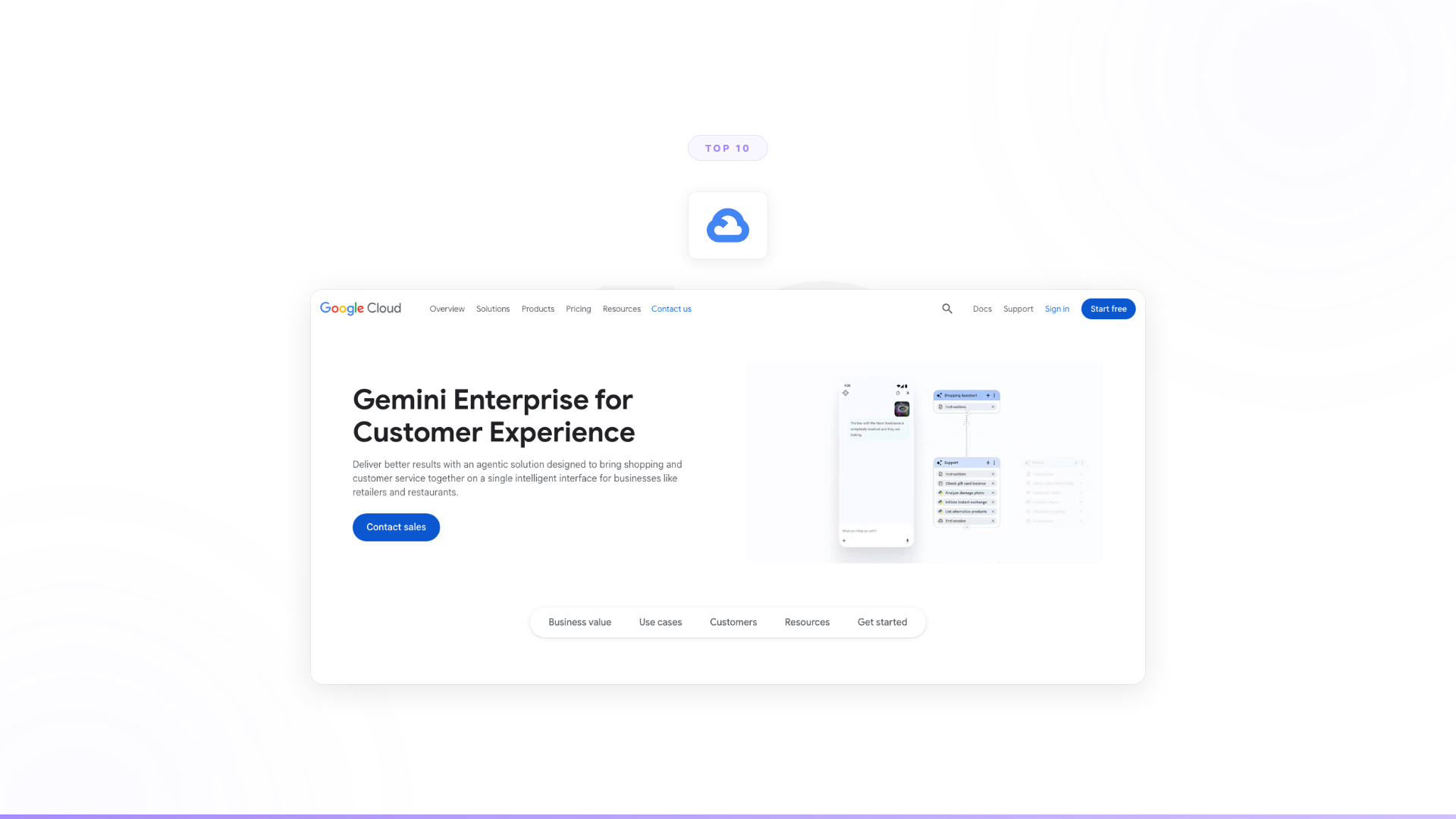
What it is: Google Cloud's AI platform. Includes Agent Development Kit (ADK, open-source), Agent Engine (managed runtime), Conversational Agents (formerly Dialogflow CX), Gemini model access, Model Garden for third-party models, and Gemini Enterprise ($30/user/month) for business users. A comprehensive developer toolkit deeply integrated with GCP.
Strengths: Open-source ADK with framework flexibility. Strong Gemini model integration. Agent-to-Agent (A2A) protocol for multi-agent communication. Deep integration with BigQuery, Cloud Storage, and Google Workspace. Solid compliance posture inherited from GCP.
Limitations: Developer-first. Requires GCP expertise, AI/ML knowledge, and ongoing engineering investment. Strongest within the Google ecosystem. 100+ connectors is solid but narrow compared to what cross-system enterprise workflows demand. Gemini Enterprise adds per-user costs on top of platform costs.
Vendor lock-in consideration: Building agents tightly integrated with GCP services (BigQuery, Cloud Storage, Google Workspace) creates meaningful switching costs. Workloads that depend on Gemini model-specific capabilities or ADK abstractions become harder to migrate. Organizations operating multi-cloud or with non-Google infrastructure should build with this in mind.
Pricing (as of Q1 2026): Usage-based. Agent Engine at $0.0994/vCPU-hour (free tier available). Plus Gemini model costs, code execution fees, session storage, and connector fees. Gemini Enterprise at $30/user/month. Verify current pricing at Google Cloud.
Best for: Engineering teams building custom AI agents on GCP who want strong Gemini integration and open-source framework flexibility.
3. AWS Bedrock
What it is: Amazon's managed service for building generative AI applications. Multi-model access (Anthropic Claude, Meta Llama, Mistral, Cohere, Amazon Titan). Agents for Bedrock (multi-step task execution), Knowledge Bases (RAG), Guardrails (safety and governance), and deep AWS infrastructure integration. AWS also recently launched Bedrock AgentCore, a managed runtime for deploying and operating AI agents at scale.
Strengths: Broadest model selection among the big three cloud providers. Strong RAG capabilities via Knowledge Bases. Guardrails for output filtering and topic control. AWS infrastructure integration means your data doesn't leave your VPC. Agents for Bedrock can orchestrate multi-step tasks with tool use. Bedrock AgentCore compresses agent deployment timelines from months to weeks on AWS infrastructure.
Limitations: AWS-centric. Complex pricing with multiple cost dimensions (model inference, knowledge base queries, agent sessions, storage). Building production agents still requires significant engineering. Integration outside the AWS ecosystem requires custom development.
Vendor lock-in consideration: AWS offers the deepest infrastructure integration on the market, which cuts both ways. Organizations already running on AWS gain real efficiency; those that aren't face friction, and those that try to migrate away later face significant re-engineering. A 2026 survey found that 45% of enterprises say vendor lock-in has already hindered their ability to adopt better tools. (Source: Swfte AI)
Pricing (as of Q1 2026): Usage-based per model. On-demand and provisioned throughput options. Agents, Knowledge Bases, and Guardrails have separate pricing. AgentCore uses consumption-based pricing with no upfront commitments. Verify current pricing at AWS.
Best for: AWS-native organizations with AI engineering teams who want multi-model flexibility and tight infrastructure integration.
4. Azure AI
What it is: Microsoft's cloud AI stack. Azure OpenAI Service (GPT models), Azure AI Foundry (unified development environment, replacing AI Studio), Azure AI Search, Copilot Studio (low-code agent building), plus integration with Microsoft 365, Dynamics 365, and Power Platform.
Strengths: Native access to OpenAI models (GPT-4o, o1, o3). Largest enterprise distribution through the Microsoft 365 install base. Copilot Studio enables citizen developers to build simpler agents. Deep integration with Microsoft's entire enterprise stack (Teams, SharePoint, Dynamics). Azure's compliance and security certifications are extensive.
Limitations: Pulls toward the Microsoft ecosystem. Complex licensing (Azure AI, Copilot, Microsoft 365 are separate cost centers). Copilot Studio handles simple use cases but production-grade agents for complex processes still need engineering. Organizations running Salesforce, SAP, or non-Microsoft tools face integration friction.
Vendor lock-in consideration: For Microsoft-heavy organizations, Azure AI's integration advantage is real. For organizations running mixed stacks, the pull toward Microsoft tooling can create long-term dependency that's expensive to unwind. According to Forrester, enterprise application vendors are increasingly leveraging entrenched positions to push high-margin AI SKUs. (Source: The Register)
Pricing (as of Q1 2026): Usage-based (per-token for Azure OpenAI). Copilot Studio from $200/month per tenant. Azure infrastructure costs on top. Verify current pricing at Microsoft Azure.
Best for: Microsoft-heavy organizations that want OpenAI models with enterprise security and integration into the Microsoft ecosystem.
5. Databricks
What it is: Unified data and AI platform. Lakehouse architecture combining data engineering, data science, and machine learning. Mosaic AI Agent Framework for building agents. Model Serving for deployment. MLflow for lifecycle management. Unity Catalog for governance. Acquired MosaicML for custom model training.
Strengths: Strongest for data-heavy AI use cases. If your AI agents need to reason over large, complex datasets, Databricks provides the full pipeline: data ingestion, transformation, model training, fine-tuning, serving, and monitoring. Unity Catalog provides enterprise governance across data and AI assets. The Mosaic AI Agent Framework is purpose-built for agents that interact with structured data.
Limitations: Data-first, not agent-first. Excellent for ML engineering teams building AI on structured data. Not designed for business process automation across operational systems (CRMs, ERPs, communication channels). The gap between a data platform agent and a business workflow agent is significant.
Pricing (as of Q1 2026): DBU-based (Databricks Units). Costs scale with compute usage. Enterprise plans are complex and typically high for production workloads. Verify current pricing at Databricks.
Best for: Data engineering teams building AI applications that are tightly coupled to data pipelines and analytics workloads.
6. Snowflake Cortex
What it is: AI capabilities built into the Snowflake Data Cloud. Cortex AI (LLM functions callable from SQL), Cortex Search (semantic search), Cortex Analyst (natural language to SQL), and Cortex Fine-Tuning. AI features accessible without leaving Snowflake's governed environment.
Strengths: Simplest path to AI for Snowflake-centric organizations. No separate AI platform to manage. Call LLM functions directly from SQL queries. Data governance through Snowflake's existing access controls. Strong for analytics, reporting, and data exploration use cases.
Limitations: Snowflake-scoped. Business processes don't live in a data warehouse. They span CRMs, ERPs, email, chat, phone, and dozens of operational systems. Cortex can add intelligence to data queries but can't reach into the operational systems where agents need to act. Not a general-purpose agent platform.
Pricing (as of Q1 2026): Credit-based per query. Costs depend on model and compute tier selected. Verify current pricing at Snowflake.
Best for: Snowflake-centric organizations that want AI capabilities on their warehouse data without adopting a separate platform.
7. Salesforce Einstein
What it is: AI capabilities embedded across the Salesforce platform. Einstein AI (predictive analytics), Einstein GPT (generative AI), Agentforce (autonomous agents within Salesforce), Copilot (conversational AI assistant), and Data Cloud for unified customer profiles. Deep CRM-native AI.
Strengths: If your primary AI use case is within Salesforce — lead scoring, opportunity insights, service case routing, automated customer responses — Einstein is the path of least resistance. Agentforce agents can handle structured CRM workflows autonomously. Data Cloud unifies customer data across Salesforce products. No separate integration needed for Salesforce-native processes.
Limitations: Salesforce-scoped. Agents operate within the Salesforce ecosystem. Business processes that span Salesforce, SAP, Slack, email, WhatsApp, and legacy systems require integration outside Einstein's reach. And Salesforce's pricing — per-user add-ons on top of already expensive CRM licenses — can escalate quickly.
Pricing (as of Q1 2026): Per-user add-on pricing on top of Salesforce licenses. Einstein AI starts at $50/user/month. Agentforce has separate pricing per conversation. Verify current pricing at Salesforce.
Best for: Salesforce-native organizations where the primary AI use cases live within CRM workflows.
8. ServiceNow AI
What it is: AI capabilities embedded in the ServiceNow platform. Now Assist (generative AI across ServiceNow modules), Virtual Agent (conversational AI for self-service), Predictive Intelligence (automated categorization and routing), and the Now Platform for building custom AI-powered workflows within ITSM, HR, and CSM modules.
Strengths: Strong for IT service management and employee service delivery. Now Assist accelerates ticket resolution, knowledge article creation, and incident summarization. Virtual Agent handles routine IT and HR requests. The Now Platform allows building custom AI workflows within ServiceNow's governance framework. If your primary AI use case is IT operations, ServiceNow is well-positioned.
Limitations: ServiceNow-scoped. Excellent for ITSM and employee-facing use cases. Doesn't extend to customer-facing processes, sales workflows, compliance monitoring, or operational processes outside ServiceNow's domain. Pricing scales with the ServiceNow platform licensing, which is already a significant enterprise investment.
Pricing (as of Q1 2026): Per-user add-on to ServiceNow licenses. Custom enterprise pricing. Premium AI capabilities require additional licensing tiers. Contact ServiceNow for current pricing.
Best for: ServiceNow-native organizations where IT service management and employee self-service are the primary AI use cases.
9. Cohere
What it is: Enterprise-focused LLM provider. Command models (generation), Embed (embeddings), Rerank (search ranking), and Compass (connector framework for RAG). Positioned for privacy-conscious enterprises. Deployable on any cloud, VPC, or on-premises. Strong multilingual capabilities.
Strengths: Deploy anywhere (cloud, VPC, on-prem). Enterprise-grade data privacy by design. Strong RAG pipeline (Embed + Rerank + Command). Excellent multilingual support across 100+ languages. Simpler pricing than cloud-native platforms. For enterprises with strict data residency requirements — particularly in regulated industries like financial services and healthcare, or in jurisdictions with strict data laws like the EU — Cohere's deployment flexibility is a genuine differentiator.
Limitations: Not an agent platform. Cohere provides the AI models and retrieval tools. Building agents that complete business processes still requires your team to handle orchestration, integration, deployment, governance, and maintenance. The gap between an LLM API and a production business agent is significant.
Pricing (as of Q1 2026): Usage-based API pricing. Enterprise agreements available. More predictable than cloud-native pricing models. Verify current pricing at Cohere.
Best for: Enterprises with strict data privacy or data residency requirements that need LLM capabilities they can deploy on their own terms.
10. Palantir AIP
What it is: Palantir's AI Platform, built on top of Foundry (their data integration and ontology platform). Connects large language models to your organization's data and operations through the ontology layer. Allows users to query data, automate workflows, and make decisions with AI assistance. Used heavily in government and defense, with growing commercial adoption.
Strengths: The ontology model is genuinely powerful for organizations with complex, interconnected data. AIP connects LLMs to your operational reality, not just your documents. Strong for decision support in complex environments (defense, manufacturing, healthcare). Palantir's Forward Deployed Engineers help with implementation.
Limitations: Palantir's approach works best when your organization commits fully to the Palantir stack. The ontology model requires significant upfront investment to build and maintain. Pricing is opaque and typically high. Commercial use cases outside traditional Palantir strongholds (defense, energy, manufacturing) are still maturing. Not designed for high-volume, routine business process automation.
Pricing (as of Q1 2026): Enterprise license agreements. Typically $1M+ annually. Custom scoping based on data volume and use cases.
Best for: Large enterprises and government organizations with complex data environments that need AI-powered decision support across interconnected operational data.
Hyperscaler AI vs enterprise AI platform: what's the difference?
This distinction shapes everything downstream in the evaluation.
Hyperscaler AI platforms (AWS Bedrock, Azure AI, Google Vertex AI) are infrastructure-first. They give you model access, compute, and developer tooling. You bring the engineering team, the integration work, the change management, and the ongoing maintenance. The upside is flexibility and control. The downside is that you own the entire delivery problem.
Enterprise AI platforms (Nexus, Salesforce Einstein, ServiceNow AI) are outcomes-first — at least within their defined scope. Einstein delivers AI within Salesforce. ServiceNow AI delivers AI within ITSM. Nexus delivers AI across any enterprise system with Forward Deployed Engineers handling the full delivery chain. The upside is faster time-to-value. The downside is that domain-specific platforms can't go beyond their walls.
The decision comes down to a direct question: does your organization have the engineering capacity, integration expertise, and change management capability to turn AI tools into production outcomes? If yes, a hyperscaler may give you more control. If not, the platform handles what your team can't.
Cloud AI infrastructure vs business outcomes: choosing the right model
Every platform on this list (except Nexus) shares a common assumption: your organization has the engineering capacity, integration expertise, and organizational change management to turn AI tools into production business outcomes.
Some of these platforms are excellent. Google Vertex AI, AWS Bedrock, and Azure AI offer genuinely powerful capabilities for AI engineering teams. Databricks and Snowflake are strong for data-centric AI use cases. Salesforce Einstein and ServiceNow AI solve domain-specific problems well.
But the enterprise AI challenge in 2026 isn't access to technology. It's turning technology into results. That requires:
- Use case identification that starts with business impact, not technical feasibility
- Cross-system integration across 20+ enterprise tools (not just one cloud ecosystem)
- Change management that drives adoption with business teams
- Ongoing optimization as processes and requirements evolve
- Measurable outcomes tied to revenue, cost savings, or capacity freed
The data bears this out. An MIT NANDA study published in 2025 found that 95% of enterprise AI pilots deliver zero measurable ROI, with the primary barriers being data readiness, lack of technical maturity, and skills gaps — not model quality. (Source: MIT NANDA) Meanwhile, Gartner projects that over 40% of agentic AI projects will be canceled by 2027 due to unclear business value and escalating costs.
Cloud AI platforms give you the technology layer. What sits between that layer and production outcomes is where most enterprise AI projects quietly die.
Vendor lock-in: what enterprise buyers need to know
Lock-in is one of the most underweighted risks in cloud AI platform evaluations. A 2026 survey found that 94% of organizations are concerned about vendor lock-in, with 45% saying lock-in has already hindered their ability to adopt better tools. (Source: Swfte AI)
The dynamics specific to cloud AI:
- Model dependency: Agents built on platform-specific model abstractions (Bedrock's Converse API, Vertex's ADK, Azure's AI Foundry) are not portable across clouds without re-engineering
- Data integration coupling: When agents are tightly integrated with cloud-native data services (BigQuery, S3, Azure Data Lake), migrating to another platform means migrating the data layer too
- Ecosystem gravity: Each hyperscaler offers discounts, credits, and tighter integrations for staying within their ecosystem, making the total cost of switching higher over time
Mitigation strategies used by enterprises include: multi-cloud deployments (nearly 50% of organizations), open-source orchestration frameworks (LangChain, LlamaIndex) as a portability layer, and model-agnostic architectures that treat the LLM as a swappable component.
Which cloud AI platform is easiest to deploy?
Ease of deployment depends on what you're trying to deploy.
For analytics and data queries: Snowflake Cortex and Databricks are the fastest if you're already on those platforms. No new infrastructure to manage.
For domain-specific workflows: Salesforce Einstein (if CRM) and ServiceNow AI (if ITSM) are the fastest within their ecosystems. Business users can configure use cases without deep engineering.
For custom AI agents on existing cloud infrastructure: AWS Bedrock AgentCore and Google Vertex Agent Engine compress deployment timelines, but still require engineering teams. Expect weeks to months for a production-grade agent.
For end-to-end business process automation across systems: Nexus is fastest to production outcomes. Forward Deployed Engineers handle the delivery chain. Measurable outcomes in 3 months.
FAQ
What is a cloud AI platform?
A cloud AI platform is a cloud-hosted environment that provides the compute, models, APIs, and developer tooling needed to build and deploy AI applications. Cloud AI platforms range from hyperscaler services (AWS Bedrock, Azure AI, Google Vertex AI) that give engineering teams raw infrastructure and model access, to specialized enterprise platforms (like Nexus) that deliver complete AI agent deployments without requiring organizations to build from scratch.
What's the difference between AWS Bedrock, Azure AI, and Google Vertex AI?
All three are hyperscaler AI platforms — they give engineering teams model access, cloud infrastructure, and developer tooling. The key differences are ecosystem depth and model selection. AWS Bedrock has the broadest model selection (Anthropic, Meta, Mistral, Cohere, Amazon Titan) and deepest AWS infrastructure integration. Azure AI has the strongest Microsoft ecosystem integration (Teams, SharePoint, Dynamics, OpenAI) and the largest enterprise distribution via Microsoft 365. Google Vertex AI has the strongest Gemini integration, open-source ADK, and deep BigQuery/Google Workspace ties. All three require significant engineering investment to build production agents.
Do I need a cloud AI platform to deploy AI agents?
No. Cloud AI platforms (AWS Bedrock, Azure AI, Vertex AI) are one route to AI agents, but they require engineering teams to build and operate. Specialized agent platforms like Nexus deploy production agents without requiring organizations to build on cloud AI infrastructure. The right choice depends on whether your organization has the engineering capacity, integration expertise, and change management to go from toolkit to production outcome.
Which cloud AI platform is best for enterprise?
It depends on what "best" means for your organization. If you need AI that completes business processes with measurable outcomes and don't want to manage infrastructure, Nexus is purpose-built for that. If you need AI within your existing cloud ecosystem (and have the engineering to build), the right hyperscaler matches your existing stack: AWS Bedrock for AWS-native organizations, Azure AI for Microsoft-heavy environments, and Google Vertex AI for GCP/Google Workspace shops. If you need AI within a specific domain, Salesforce Einstein (CRM) and ServiceNow AI (ITSM) are strong domain-specific options.
Can I use a cloud AI platform without an engineering team?
Not meaningfully — for the hyperscalers. AWS Bedrock, Azure AI, and Google Vertex AI are developer-first platforms. Deploying production agents requires AI/ML knowledge, cloud infrastructure expertise, and ongoing engineering maintenance. Salesforce Einstein and ServiceNow AI reduce the engineering requirement within their ecosystems. Nexus is the option specifically designed for organizations that don't want to own the engineering layer: Forward Deployed Engineers handle technical complexity while business teams define and own the workflows.
How much does a cloud AI platform cost?
Costs vary widely. Hyperscalers (AWS, Azure, Google) use usage-based pricing: pay per token, per API call, per compute hour. This makes costs predictable at small scale but can escalate unpredictably in production. Domain-specific platforms (Salesforce Einstein, ServiceNow AI) add per-user costs on top of existing platform licenses. Nexus charges per-agent, tied to value delivered. Palantir AIP is enterprise-licensed at $1M+ annually. The true cost of hyperscaler AI platforms includes not just the platform itself but the engineering, integration, and operational overhead — which often exceeds the platform license cost. All pricing data as of Q1 2026 — verify with each vendor.
Worth exploring?
Every Nexus engagement starts with a 3-month proof of concept tied to measurable outcomes. Forward Deployed Engineers embed with your team from day one. You see the results before committing.
100% of clients who started a POC converted to an annual contract. Every one.
See how Nexus compares to Google Vertex AI -->
Related reading
- Nexus vs Google Vertex AI: full comparison
- Top 10 Google Vertex AI alternatives for enterprise
- Google Vertex AI vs AWS Bedrock: cloud AI platforms compared
- How to choose a cloud AI platform for enterprise
- Nexus vs Microsoft Copilot: assistant vs autonomous agents
- Nexus vs LangChain: framework vs platform + service
- Top 10 AI agent platforms for enterprise