What are autonomous AI agents?
Autonomous AI agents are software systems that receive a goal, plan the steps to achieve it, execute those steps across connected systems, handle exceptions, and deliver the result — without requiring human involvement at each step. They are distinct from chatbots or copilots: they act, not just advise.
The promise has been around since AutoGPT went viral in 2023. What's changed in 2026 isn't the concept. It's the reality. Gartner named agentic AI its top strategic technology trend for 2025, predicting that 40% of enterprise applications will feature task-specific AI agents by 2026, up from less than 5% in 2025. Some platforms are delivering on that promise at enterprise scale. Others are still in beta, still require engineering teams to babysit, or still produce different results every time they run.
The difference between a platform that demos autonomy and one that delivers it in production comes down to three things: reliability (does it produce consistent results?), governance (can you trust it with enterprise data and compliance requirements?), and support (who helps when something goes wrong?).
This list ranks 10 platforms by their ability to deploy truly autonomous AI agents that complete work in production, not just in demos.
Quick comparison
| Platform | Autonomy level | Best for | Who builds agents | Governance | Pricing |
|---|---|---|---|---|---|
| Nexus | Full autonomous (with escalation) | Enterprise workflows, any department | Business teams | SOC 2, ISO 27001, ISO 42001, GDPR | POC-based, annual contract |
| AutoGPT | Autonomous (unstable) | Developer experimentation | Developers | None | Free / cloud plans |
| CrewAI | Multi-agent orchestration | Engineering teams building agents | Engineers (Python) | DIY (AMP starting) | Free / enterprise pricing |
| LangGraph | Stateful workflows | Complex agent state machines | Engineers (Python) | None | Free (open-source) |
| AutoGen | Conversational agents | Research, human-in-the-loop | Engineers (Python) | None | Free (open-source) |
| Dify | Workflow-based | AI app prototyping | Mixed (visual builder) | Limited | Free / $59+/month |
| Relevance AI | Workflow-based | Sales/marketing automation | Business teams (low-code) | Limited | Free tier / enterprise |
| Haystack | Pipeline-based | Document processing agents | Engineers (Python) | None | Free (open-source) |
| UiPath + AI | RPA + AI decision layer | Screen-level process automation | RPA developers | Enterprise (SOC 2, ISO) | $10K–$50K+ per robot/year |
| Custom build | Whatever you build | Unique requirements | Engineers | Whatever you build | 6+ months + ongoing engineering cost |
How are autonomous AI agents different from AI chatbots?
A chatbot responds. An autonomous AI agent acts. Chatbots are reactive — they answer a question or complete a single task when prompted. Autonomous agents are proactive — they receive a goal, break it into sub-tasks, execute across multiple systems, handle unexpected exceptions, and deliver a finished outcome. A chatbot can tell a customer their order status. An autonomous agent can receive a complaint, look up the order, check the warehouse, initiate a replacement, notify the logistics team, and update the CRM — without any human involvement between start and finish.
The platforms, ranked
1. Nexus
What it is: An autonomous agent platform paired with Forward Deployed Engineers who embed with your team. Nexus agents complete entire business workflows end-to-end: collecting data from multiple systems, validating against business rules, making decisions within guardrails, handling exceptions, and executing actions. When an agent can confidently handle something, it handles it. When uncertain, it escalates with full context. Every decision is logged.
This is what "autonomous" means in an enterprise context. Not uncontrolled AI running without supervision. Bounded autonomy: intelligent enough to handle the vast majority of cases independently, constrained enough to stay within guardrails, and transparent enough that every decision is traceable.
Why it ranks first:
The proof is in what it's deployed, not what it promises.
- Orange Group (multi-billion euro telecom, 120,000+ employees): Business team built autonomous customer onboarding agents. Deployed in 4 weeks. 50% conversion improvement. ~$6M+ yearly revenue impact. 90% autonomous resolution rate — 9 out of 10 interactions handled without any human involvement. 100% team adoption.
- Lambda (AI cloud infrastructure company serving tens of thousands of enterprise accounts): Agents autonomously monitor 12,000+ accounts, synthesize buying signals across dozens of data sources, and surface pipeline opportunities. $4B+ in pipeline discovered. 24,000+ hours of research capacity added annually — equivalent to 12 full-time analysts. Built by a non-engineer, deployed in days.
- European telecom (13,000+ employees): A dozen autonomous agents deployed across millions of interactions. 40% of support capacity freed. 100% compliance assurance.
Every Nexus engagement starts with a 3-month POC tied to measurable outcomes. 100% of POCs have converted to annual contracts.
Governance: SOC 2 Type II, ISO 27001, ISO 42001, GDPR. Full audit trails. Role-based access control.
Integrations: 4,000+ native connectors. Deploy across Slack, Teams, WhatsApp, email, phone, web.
Who builds: Business teams with Forward Deployed Engineer support. No Python. No engineering dependency.
See how Nexus compares to AutoGPT →
2. AutoGPT
What it is: The open-source project that started the autonomous AI agent conversation. 180,000+ GitHub stars. Created by Toran Bruce Richards, maintained by Significant Gravitas. Demonstrates that an LLM can be given a goal and autonomously break it into subtasks, execute them, reflect, and iterate. Now evolving into the AutoGPT Platform with a visual agent builder and marketplace. Backed by $12M in venture funding.
Autonomy level: AutoGPT was the first widely accessible demonstration of autonomous AI. The plan-act-reflect loop is genuinely autonomous. The challenge is reliability. The loop can get stuck repeating actions. Results differ between runs. Hallucinated outputs occur. Multiple independent reviews characterize it as best suited for semi-supervised, exploratory tasks rather than unattended production workflows.
Why it ranks here: Historical significance and community size are real. But enterprise readiness is limited. Still in beta. No SOC 2, ISO 27001, or GDPR compliance. No enterprise SLAs. No public enterprise customer references at scale. API costs can escalate unpredictably with unconstrained loops. Gartner has warned that over 40% of agentic AI projects will be canceled by end of 2027 due to escalating costs and unclear business value — a risk that is particularly acute with open-ended loops that have no governance guardrails. For developer experimentation and personal automation, AutoGPT is still interesting. For enterprise autonomous agents, the gap between demo and production is wide.
Best for: Developers exploring autonomous agent architecture. Personal automation projects. Understanding how plan-act-reflect loops work.
Full Nexus vs AutoGPT comparison →
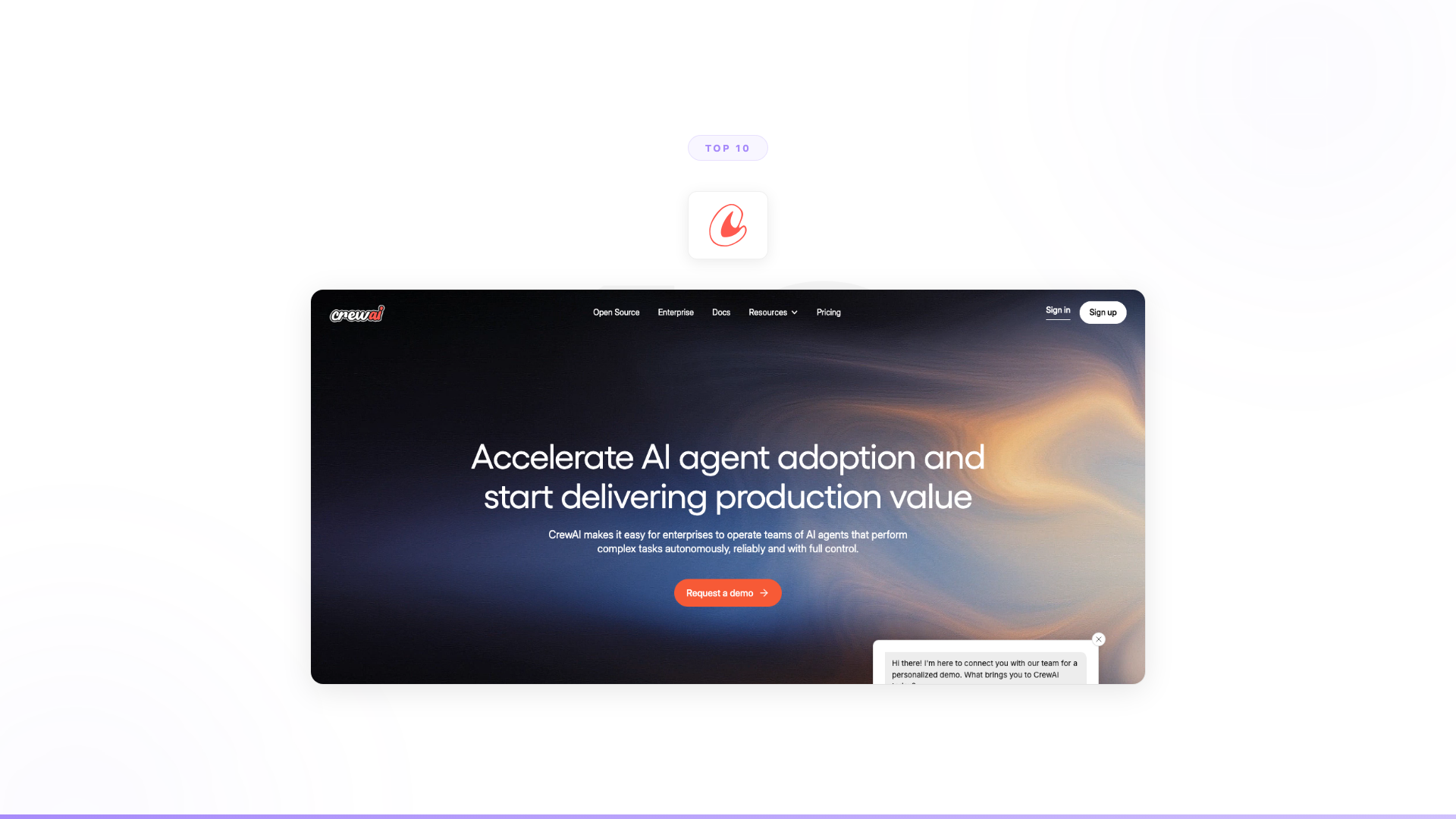
3. CrewAI
What it is: An open-source Python framework for building multi-agent AI systems. 44,000+ stars. Backed by Insight Partners. Define agents by roles, assign tasks, coordinate through "crews." Includes CrewAI AMP (hosted deployment, tracing, monitoring) and CrewAI Studio (visual builder). 100,000+ certified developers.
Autonomy level: Agents operate autonomously within the crew structure. Roles and tasks constrain behavior, which makes outputs more predictable than AutoGPT's open-ended loop. Multi-agent collaboration adds capability — a researcher agent hands off to an analyst agent, which hands off to a writer agent. But each crew is a code artifact built and maintained by engineers.
Why it ranks here: Strong framework with growing production tooling. AMP Enterprise adds hallucination detection and RBAC. But it's a framework, not a platform. Enterprise governance, compliance certifications, pre-built integrations (CRMs, ERPs, comms tools), and business-team ownership are all your engineering team's responsibility. The 20% that CrewAI covers (orchestration) is well-built. The 80% it doesn't cover (production stack) is the actual work.
Best for: Engineering teams that want structured multi-agent orchestration and are prepared to own the full production stack.
Full Nexus vs CrewAI comparison →
4. LangGraph
What it is: A framework from LangChain for building stateful, multi-agent workflows as directed graphs. Agents are nodes, edges define transitions, state persists across steps. Part of the broader LangChain ecosystem with access to its integrations and tooling.
Autonomy level: More controlled than autonomous. LangGraph trades open-ended autonomy for explicit state management. You define exactly which states the agent can be in and which transitions are allowed. This makes behavior predictable and debuggable — valuable for production — but requires more upfront design than letting an agent figure things out on its own.
Why it ranks here: For engineers who want to build autonomous agent workflows with full visibility into state and transitions, LangGraph is one of the most capable options. The graph-based approach makes complex workflows manageable. But it's purely a developer tool. No governance, no compliance certifications, no pre-built enterprise integrations, no business-team ownership. Every workflow change requires an engineer to modify the graph.
Best for: Engineers building complex, stateful agent workflows who need explicit control over every state transition.
5. AutoGen (Microsoft)
What it is: Microsoft's open-source framework for multi-agent conversational systems. 40,000+ stars. Built by Microsoft Research. Agents converse with each other and with humans. Strong support for human-in-the-loop workflows. Flexible conversation topologies including round-robin, selector, and nested chats.
Autonomy level: AutoGen supports autonomy but was designed with human participation as a first-class feature. The framework excels when agents need to negotiate, iterate, and incorporate human judgment. Full autonomy is possible but not the primary design goal. Research-oriented.
Why it ranks here: Backed by Microsoft Research, which gives it academic rigor. The conversation-based approach is elegant for workflows that genuinely benefit from multi-agent dialogue. But as a research framework, production readiness is limited. No enterprise compliance certifications. Minimal production tooling compared to CrewAI. Enterprise governance is entirely DIY.
Best for: Research teams and engineers exploring multi-agent conversation patterns, especially where human-in-the-loop is central.
Full Nexus vs AutoGen comparison →
6. Dify
What it is: An open-source LLM app development platform. 100,000+ GitHub stars. Visual workflow builder for creating AI applications including chatbots, agents, and content generation tools. Supports RAG pipelines, multi-model orchestration, and self-hosted or cloud deployment.
Autonomy level: Workflow-based rather than truly autonomous. Agents follow predefined workflows with conditional logic. Less autonomous than AutoGPT's open-ended loop, but also more reliable for defined tasks. The visual builder makes it accessible to non-engineers, though complex enterprise workflows push against the platform's limits.
Why it ranks here: Dify genuinely lowers the bar for building AI applications. The visual builder is well-designed and the open-source community is large. For prototyping and lightweight AI workflows, it's strong. For enterprise autonomous agents with compliance requirements and 4,000+ integrations, the gap is significant. No certified compliance. No embedded support. Limited enterprise governance.
Pricing: Open-source (self-hosted) or cloud plans starting at $59/month.
Best for: Teams prototyping AI applications quickly. Non-engineers who want to build AI workflows without deep technical skills.
7. Relevance AI
What it is: A platform for building AI agents and workflows with a low-code interface. Pre-built templates for sales and marketing use cases: lead research, data enrichment, content generation, outbound sequencing. Designed for business teams rather than engineers.
Autonomy level: Agents handle defined tasks autonomously within their scope. More autonomous than basic workflow automation (agents can make decisions about how to complete tasks), less autonomous than open-ended systems. Strong within sales and marketing. Narrower outside those domains.
Why it ranks here: Relevance AI is building in the right direction. Business-team ownership. Low-code building. Pre-built templates that work out of the box for common use cases. For SMBs and mid-market companies focused on sales and marketing automation, it's a practical option. Enterprise readiness — compliance certifications, governance depth, integration breadth — is still developing. Not yet proven at Fortune 500 scale.
Pricing: Free tier available. Pro and enterprise plans with custom pricing.
Best for: SMBs and mid-market teams automating sales and marketing workflows without engineering.
8. Haystack
What it is: An open-source framework by deepset for building NLP and retrieval-augmented generation (RAG) pipelines. Strong in document processing, semantic search, and knowledge-intensive agent tasks. Pipeline architecture with composable components.
Autonomy level: Pipeline-based, not open-ended autonomous. Agents follow defined pipelines with branching logic. The autonomy is in how the agent processes and retrieves information, not in free-form goal execution. Well-suited for knowledge-heavy tasks where the workflow is structured but the content is variable.
Why it ranks here: For the specific slice of autonomous agents that involves processing, retrieving, and acting on large volumes of documents and data, Haystack is purpose-built and effective. The pipeline architecture makes complex document workflows manageable. But it's a component, not a complete autonomous agent platform. Cross-system actions, enterprise governance, and business-team ownership aren't its focus.
Best for: Engineering teams building autonomous document processing and knowledge retrieval agents.
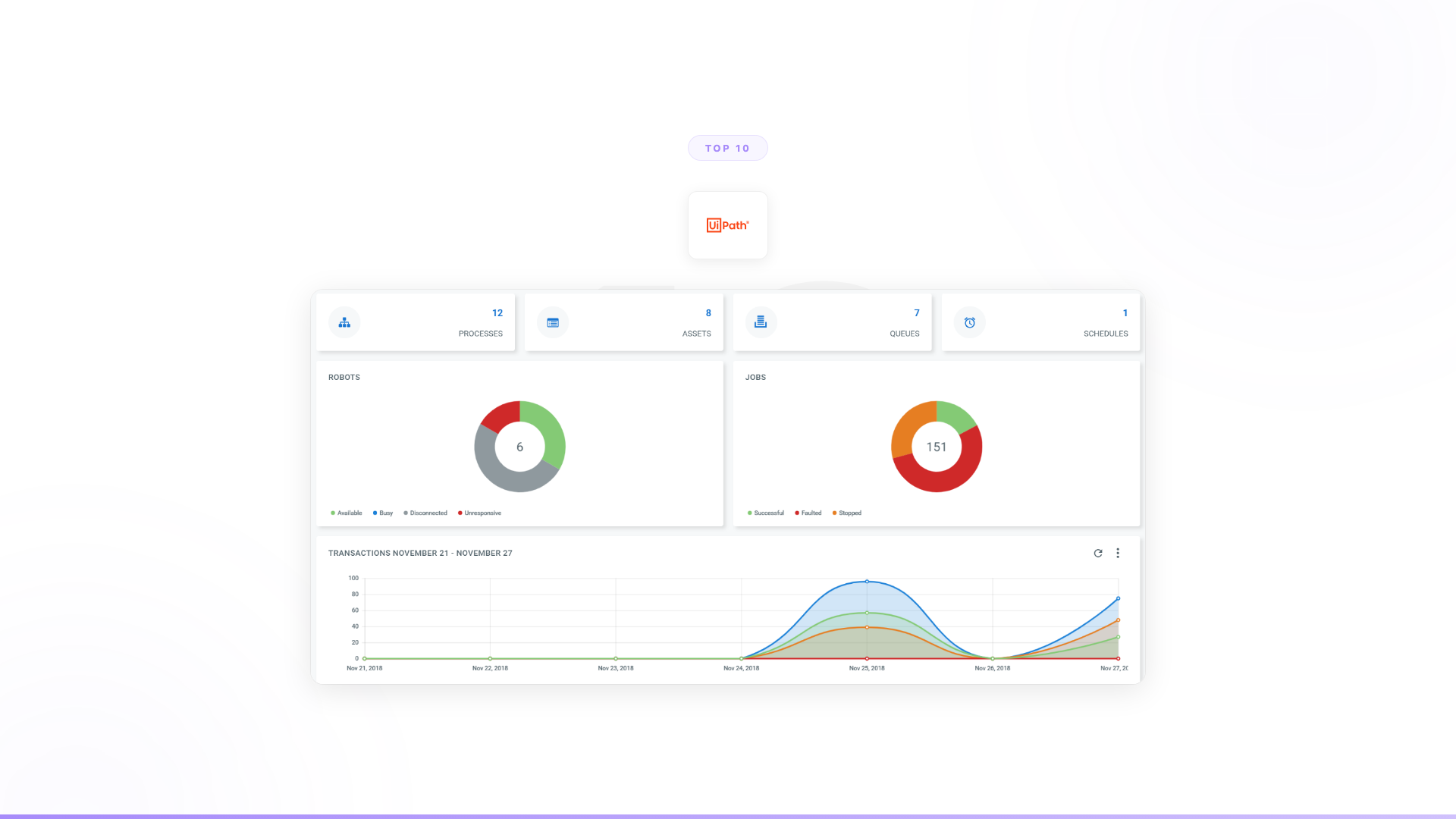
9. UiPath + AI
What it is: The dominant RPA platform, now incorporating AI decision-making layers. Software robots interact with application UIs (clicking, typing, navigating) while AI components handle decisions that traditional RPA couldn't. "Agentic automation" in UiPath's framing.
Autonomy level: The RPA layer is fully autonomous for screen-based tasks. The AI layer adds judgment capabilities, allowing agents to handle some exceptions that would previously require human intervention. But the architecture is still fundamentally screen-based. When the AI can't decide, the robot stops. And when application UIs change, automations break.
Why it ranks here: UiPath has enterprise governance (SOC 2, ISO), a large customer base, and proven deployment at scale. The AI additions are real. But the screen-interaction architecture limits what "autonomous" means. Autonomous clicking through forms is different from autonomous end-to-end workflow completion with cross-system intelligence. For high-volume, screen-based processes with some AI judgment, UiPath + AI works. For truly autonomous agents that reason across systems, it's still catching up.
Pricing: Per-robot licensing. Enterprise pricing typically $10K–$50K+ per robot annually.
Best for: Organizations with high-volume, screen-based processes that need partial AI-powered decision making.
10. Custom build
What it is: Building your autonomous agent system from scratch using base APIs and infrastructure. Maximum flexibility. Maximum engineering cost.
Autonomy level: Whatever you build. Full control over the autonomy model, decision boundaries, escalation logic, and governance. Also full responsibility for reliability, monitoring, security, compliance, and maintenance.
Why it ranks here: Custom building makes sense in exactly one scenario: your use case is genuinely unprecedented and no platform or framework addresses it. For everything else, the opportunity cost is too high.
Lambda, an AI cloud infrastructure company with engineers who build AI infrastructure for a living, evaluated this path. They calculated the opportunity cost and chose to buy. Their non-technical team now builds and owns agents that monitor 12,000+ accounts and surface $4B+ in pipeline. Building internally would have taken months and diverted engineers from Lambda's core product.
Best for: Organizations with truly unique requirements, dedicated AI engineering teams, and timelines that absorb 6+ months of development.
Three levels of AI agent autonomy
Not every business process needs the same level of autonomy. The mistake most enterprises make is treating "autonomous AI agents" as a binary: either the AI handles everything or humans handle everything.
The reality is a spectrum — and choosing the right level for each workflow is more important than choosing the most autonomous platform available.
Full autonomy works for high-volume, well-defined processes where the cost of occasional errors is low and the volume makes human review impractical. Customer FAQ resolution. Data enrichment. Lead scoring.
Bounded autonomy works for higher-stakes processes where the agent handles the majority of cases but escalates edge cases with full context. Customer onboarding. Compliance monitoring. Sales intelligence. This is where Nexus operates: 90% autonomous resolution at Orange, with intelligent escalation for the remaining 10%.
Assisted autonomy works for creative, strategic, or highly sensitive processes where humans make the final decision but agents do the research, preparation, and recommendation. M&A due diligence. Pricing strategy. Executive reporting.
The platforms above differ not just in their technical capabilities but in where they sit on this spectrum. AutoGPT aims for full autonomy but struggles with reliability. CrewAI and LangGraph give you the tools to build bounded autonomy but leave the guardrails to your engineering team. Nexus ships bounded autonomy with governance and escalation built in.
The right question isn't "which platform is most autonomous?" It's "which platform delivers the right level of autonomy for my specific workflows, with the governance and reliability my enterprise requires?"
Can autonomous AI agents be trusted with enterprise workflows?
This is the right question — and the honest answer is: it depends on the platform and the workflow.
Gartner predicts that agentic AI will autonomously resolve 80% of common customer service issues without human intervention by 2029. That same research notes that over 40% of agentic AI projects will be canceled by end of 2027 due to escalating costs and inadequate risk controls. The failure mode isn't the technology — it's deploying autonomous agents without governance.
The platforms that can be trusted for enterprise workflows share three characteristics. First, bounded decision-making: agents operate within defined guardrails and escalate when uncertain, rather than hallucinating a decision. Second, full audit trails: every action is logged, every decision is traceable, and compliance teams can verify what happened and why. Third, enterprise compliance: SOC 2, ISO 27001, GDPR — not as optional add-ons but as baseline requirements.
Platforms built for developer experimentation (AutoGPT, LangGraph, AutoGen) can be made enterprise-grade, but that work falls entirely on your engineering team. Platforms built for enterprise from the start (Nexus, UiPath + AI) ship governance as a core feature, not a roadmap item.
Security and compliance for autonomous AI agents
Enterprise security teams have specific concerns about autonomous agents that don't apply to passive AI tools. An autonomous agent doesn't just generate text — it takes actions. It reads from and writes to systems. It makes decisions that affect customers, data, and finances.
The key security questions to ask any autonomous agent platform:
- Data isolation: Where does data processed by the agent reside? Is it used to train third-party models?
- Access control: Can you limit which systems an agent can access and what actions it can take within each system?
- Audit trail: Is every agent action logged with enough detail that a compliance team can reconstruct exactly what happened?
- Escalation paths: When an agent encounters a decision outside its confidence threshold, how does it escalate — and to whom?
- EU AI Act and GDPR compliance: For European deployments, autonomous decision-making systems are subject to specific transparency and explainability requirements.
Platforms with SOC 2 Type II, ISO 27001, and ISO 42001 (the AI management standard) have been independently audited against these requirements. Platforms without these certifications leave compliance validation to your team.
FAQ
What is an autonomous AI agent?
An autonomous AI agent is a software system that receives a goal, plans the steps to achieve it, executes those steps across connected tools and systems, handles exceptions as they arise, and delivers a completed result — without requiring a human to direct each step. Unlike a chatbot (which responds to prompts) or an RPA bot (which follows a fixed script), an autonomous agent reasons about what needs to happen and takes action accordingly.
How are autonomous AI agents different from chatbots?
Chatbots are reactive: a human sends a message, the chatbot replies. Autonomous agents are proactive: they receive a goal and execute a multi-step workflow to achieve it. A chatbot answers "what's my order status?" An autonomous agent receives a complaint, looks up the order, checks inventory, initiates a replacement shipment, notifies the logistics provider, updates the CRM, and sends the customer a confirmation — all without human involvement between start and finish.
What does "bounded autonomy" mean for enterprise AI agents?
Bounded autonomy means the agent operates independently within defined guardrails. It handles the cases it can handle confidently, and escalates the cases it can't — with full context — to a human. This is the most practical model for enterprise deployment: high automation rates (90%+ in production Nexus deployments) without the risks of fully uncontrolled agents making decisions they shouldn't. Bounded autonomy requires the platform to have built-in confidence thresholds, escalation routing, and audit trails.
Which autonomous AI agent platforms work without engineering teams?
Nexus and Relevance AI are the two platforms on this list designed for business-team ownership. Nexus includes Forward Deployed Engineers who build agents alongside your team, meaning no internal Python expertise is required. Relevance AI offers a low-code builder suitable for sales and marketing automation. All other platforms on this list — AutoGPT, CrewAI, LangGraph, AutoGen, Haystack — are developer frameworks that require engineering to build, deploy, and maintain.
What governance features do autonomous AI agents need for enterprise use?
At minimum: SOC 2 Type II (data security), ISO 27001 (information security management), GDPR compliance (for European data), full audit trails (every agent action logged and traceable), role-based access control (limits on what each agent and user can do), and defined escalation paths (what happens when the agent is uncertain). For regulated industries, ISO 42001 (AI management system standard) and sector-specific requirements apply. Platforms without independent compliance certifications require your team to build and validate governance from scratch.
Worth exploring?
If your team has been evaluating autonomous AI agent options and finding that most are either unreliable experiments or developer frameworks that require months of engineering to productionize, it might be worth seeing how enterprises like Orange and a major European telecom solved this.
Every Nexus engagement starts with a 3-month proof of concept tied to specific, measurable outcomes. Forward Deployed Engineers embed with your team from day one. You see the results before committing. You can exit anytime.
100% of clients who started a POC converted to an annual contract. Every one.
See how Nexus compares to AutoGPT →