Top 10 AI Tools for Telecom Automation in 2026
Telecom operators automate networks but run business operations manually. Here are 10 AI tools that automate telecom processes end-to-end — from network monitoring to customer onboarding, compliance, and HR. Ranked by automation depth and production results.
Telecom AI automation tools span three distinct layers: network vendors like Nokia and Ericsson that automate infrastructure monitoring and optimization; BSS/OSS platforms like Amdocs and Netcracker that automate billing and order management; and business operations platforms that automate customer onboarding, support, compliance, and HR. Most telecom AI investment flows into the first two layers. Most workforce hours sit in the third.
The network side of a telecom operation is increasingly automated. AI monitors performance, detects anomalies, optimizes capacity, and advances toward self-healing infrastructure. Vendors like Nokia, Ericsson, and Huawei have invested in network automation for years. The infrastructure is getting smarter.
The business side is a different story. Customer onboarding is still a multi-step manual process. Support is a labor-intensive cost center. Compliance monitoring relies on spot checks and spreadsheets. Sales intelligence is scattered across tools. HR operations are slow. Reporting requires analysts pulling data from half a dozen systems.
The result is a two-speed automation problem. The network runs on AI. The business runs on people doing repetitive work.
This list covers 10 AI tools that address telecom automation at different layers — from enterprise-wide operational agents to network-specific optimization. Ranked by how much of the automation gap they actually close.
What is telecom AI automation?
Telecom AI automation refers to the use of AI-driven software agents, machine learning models, and intelligent workflow engines to replace manual human work in telecom operations. This spans three distinct layers: network automation (monitoring, anomaly detection, self-healing), BSS/OSS automation (billing, order management, service orchestration), and business operations automation (sales, support, compliance, HR, onboarding). Tools differ significantly in which layer they address.
According to Gartner, 30% of enterprises will automate more than half of their network activities by 2026, up from under 10% in 2023 — but that projection covers network-layer automation only. The gap at the business operations layer remains largely unaddressed. The global AI in telecommunication market was valued at USD 4.73 billion in 2025 and is projected to reach USD 88.11 billion by 2034 at a CAGR of 37.9% (Fortune Business Insights, 2025).
Network automation vs business operations automation: what's the gap?
Network automation and business operations automation are fundamentally different challenges — and the tools that solve one rarely solve the other.
Network automation uses AI to manage infrastructure: traffic prediction, fault detection, capacity optimization, and autonomous configuration. Nokia, Ericsson, Huawei, and Ciena all compete in this space. It is well-funded, maturing rapidly, and measured in infrastructure metrics.
Business operations automation uses AI to complete cross-system, cross-department workflows: customer onboarding, support resolution, compliance monitoring, HR processes, billing exception handling, sales intelligence, and reporting. These workflows involve multiple systems, require decision-making under ambiguity, and handle exceptions that rule-based automation cannot.
The gap exists because the vendors building network automation tools are not equipped to solve business operations problems — they require fundamentally different architectures, training data, and integration patterns.
Omdia's research confirms this split: while autonomous network ambitions are progressing (with 11% of CSPs at L4 High Autonomous in 2024), business operations automation remains the underinvested layer across the industry (Telco Network Automation Survey Report 2024, Omdia).
Quick comparison
| Tool | What it automates | Scope | End-to-end workflows? | Deployment speed | Best for |
|---|---|---|---|---|---|
| Nexus | Business operations: sales, support, compliance, HR, onboarding | Enterprise-wide | Yes | Days to weeks | Operators who've automated the network and need to automate the business |
| Nokia AI | Network: monitoring, anomaly detection, autonomous ops | Network infrastructure | Network tasks only | Months to years | Network monitoring, optimization, and autonomous infrastructure |
| Ericsson AI | Network: optimization, configuration, troubleshooting | Network infrastructure | Network tasks only | Months to years | Network configuration, troubleshooting, and infrastructure management |
| Amdocs amAIz | BSS/OSS: billing, order management, customer mgmt | BSS/OSS systems | Within BSS/OSS | 6–18 months | Operators on Amdocs platforms needing billing and order automation |
| ServiceNow | IT service management, employee workflows | ITSM + employee services | Partial (IT focus) | 3–9 months | Telecoms whose primary gap is internal IT and employee services |
| Pega | Case management, customer decisioning | CRM + case mgmt | Within platform | 6–12 months | Customer decisioning and case management within the Pega ecosystem |
| UiPath | Screen-level process automation (RPA) | Cross-system (screen level) | Rule-based only | Weeks to months | High-volume, screen-based, repetitive tasks on legacy systems |
| Huawei ADN | Network: autonomous driving, predictive maintenance | Network + cloud | Network tasks only | Months to years | Operators in Huawei-accessible markets pursuing network automation |
| Netcracker | BSS/OSS: orchestration, billing, lifecycle | BSS/OSS systems | Within BSS/OSS | 6–18 months | Operators on NEC/Netcracker platforms needing BSS/OSS automation |
| Custom build | Whatever you scope | Custom | Depends on investment | 6+ months | Operators with surplus AI engineering capacity and unique requirements |
The tools, ranked
1. Nexus
What it automates: The business operations that network AI doesn't reach. Customer onboarding, support resolution, sales intelligence, compliance monitoring, HR processes, billing exception handling, reporting, data harmonization, and escalation routing. Nexus agents complete entire workflows end-to-end — collecting data, validating it, making decisions, handling exceptions, executing actions, and escalating complex cases with full context.
Why it ranks first for telecom automation:
Telecom operators' biggest automation gap isn't the network. It's everything else. Customer-facing operations, compliance overhead, manual processes across departments, and slow cross-system workflows consume the majority of workforce hours and are largely untouched by existing telecom AI investments.
Contact center labor alone represents 60–70% of total operational expenses in that function (Strategic Contact, 2024), and telecom-wide labor costs totaled $262.9 billion across operators globally in 2024 (MTN Consulting). The automation opportunity at the business operations layer is significant — and largely uncaptured.
Nexus is the only tool on this list that automates these workflows with agents that complete work autonomously, across all major telecom systems, without custom engineering from the customer's side.
Production results:
- Orange Group: Autonomous customer onboarding. 50% conversion improvement. ~$6M+ in yearly revenue impact. 90% autonomous resolution. +10 CSAT points. First agent deployed in 4 hours. Multi-market rollout in 4 weeks. Built by the business team, not engineering.
- European telecom (13,000+ employees): A dozen production agents. 40% support capacity freed. Full compliance coverage across millions of interactions. 12-week deployment.
Key capabilities: 4,000+ integrations. 95+ languages. SOC 2 Type II, ISO 27001, ISO 42001, GDPR. EU AI Act ready. Forward Deployed Engineers embedded from day one. 100% POC-to-contract rate.
Best for: Telecom operators who've automated the network and need to automate the business.
See how Nexus works for telecom →
2. Nokia AI
What it automates: Network operations. Anomaly detection, real-time monitoring, capacity optimization, and the path to autonomous networks. Telco-trained AI models understand network behavior patterns specific to CSP infrastructure. The Nokia–NVIDIA partnership provides GPU-accelerated network functions for AI-native RAN and core automation.
Strengths for telecom automation: Deep expertise in network automation. Telco-trained models provide genuine understanding of network patterns that general-purpose AI misses. A Nokia and NVIDIA joint survey found 44% of operators prioritize CX optimization as a top AI investment area — though Nokia's automation tooling addresses this indirectly through network quality rather than customer-facing operations directly.
Automation limits: Scope stays at the network. Customer operations, sales, compliance, HR, and business workflows sit outside Nokia's automation reach.
Best for: Automating network monitoring, optimization, and the infrastructure path to autonomous networks.
Full Nexus vs Nokia comparison →
3. Ericsson AI
What it automates: Network optimization, troubleshooting, and product configuration. The Mistral AI partnership (February 2026) enables natural language interfaces for network operations. Multi-agent configuration tools automate complex network product setup. NetCloud handles enterprise 5G management.
Strengths for telecom automation: The Mistral partnership differentiates Ericsson's automation approach with frontier LLM capabilities applied to network troubleshooting. Multi-agent configuration tools address real complexity in network product setup. Earlier in production than many network AI competitors.
Automation limits: Same boundary as Nokia. Network infrastructure only. Business operations, customer workflows, and enterprise processes remain manual.
Best for: Automating network configuration, troubleshooting, and infrastructure management.
Full Nexus vs Ericsson comparison →
4. Amdocs amAIz
What it automates: BSS/OSS workflows. Billing optimization, revenue management, order processing, and customer experience analytics within the Amdocs platform. Generative AI applied to BSS/OSS operations.
Strengths for telecom automation: Closer to business operations than network vendors. Billing and order management are genuine business processes that affect customers directly. Deep telecom BSS/OSS domain expertise built over decades of deployments.
Automation limits: Stays within BSS/OSS. Doesn't automate sales intelligence, general support beyond billing, compliance monitoring, HR operations, or cross-departmental workflows. Multi-year contracts and long implementation timelines are typical.
Best for: Operators on Amdocs platforms who need billing and order management automation.
Full Nexus vs Amdocs comparison →
5. ServiceNow
What it automates: IT service management, employee self-service, and internal workflow routing. Strong at IT helpdesk automation, change management, and employee request handling. The Moveworks acquisition (now integrated) added AI-powered resolution for IT and employee service requests.
Strengths for telecom automation: If internal IT operations are the automation priority, ServiceNow is a proven platform. IT ticket resolution, employee requests, and change management workflows can be genuinely automated at scale.
Automation limits: IT and employee services scope. Doesn't automate customer-facing operations, compliance monitoring, sales intelligence, or the cross-system workflows that define telecom operations. Significant platform investment required.
Best for: Telecom operators whose primary automation gap is internal IT and employee services.
6. Pega
What it automates: Customer decisioning, case management, and process orchestration. Pega's AI (Customer Decision Hub) handles next-best-action recommendations, retention offers, and customer interaction routing. Strong in regulated industries including telecom.
Strengths for telecom automation: Customer decisioning is genuinely valuable for telecoms. Predicting churn, recommending retention offers, and routing interactions intelligently are all meaningful automation. Pega has deep telecom vertical expertise and a strong regulatory compliance track record.
Automation limits: Pega is strong at decisioning and case management but doesn't complete full operational workflows autonomously — it recommends actions, and humans still execute many of them. Coverage is primarily customer-facing, with limited reach into compliance, HR, sales intelligence, or cross-departmental operations. Implementation is complex and expensive.
Best for: Telecoms investing in customer decisioning and case management automation within the Pega ecosystem.
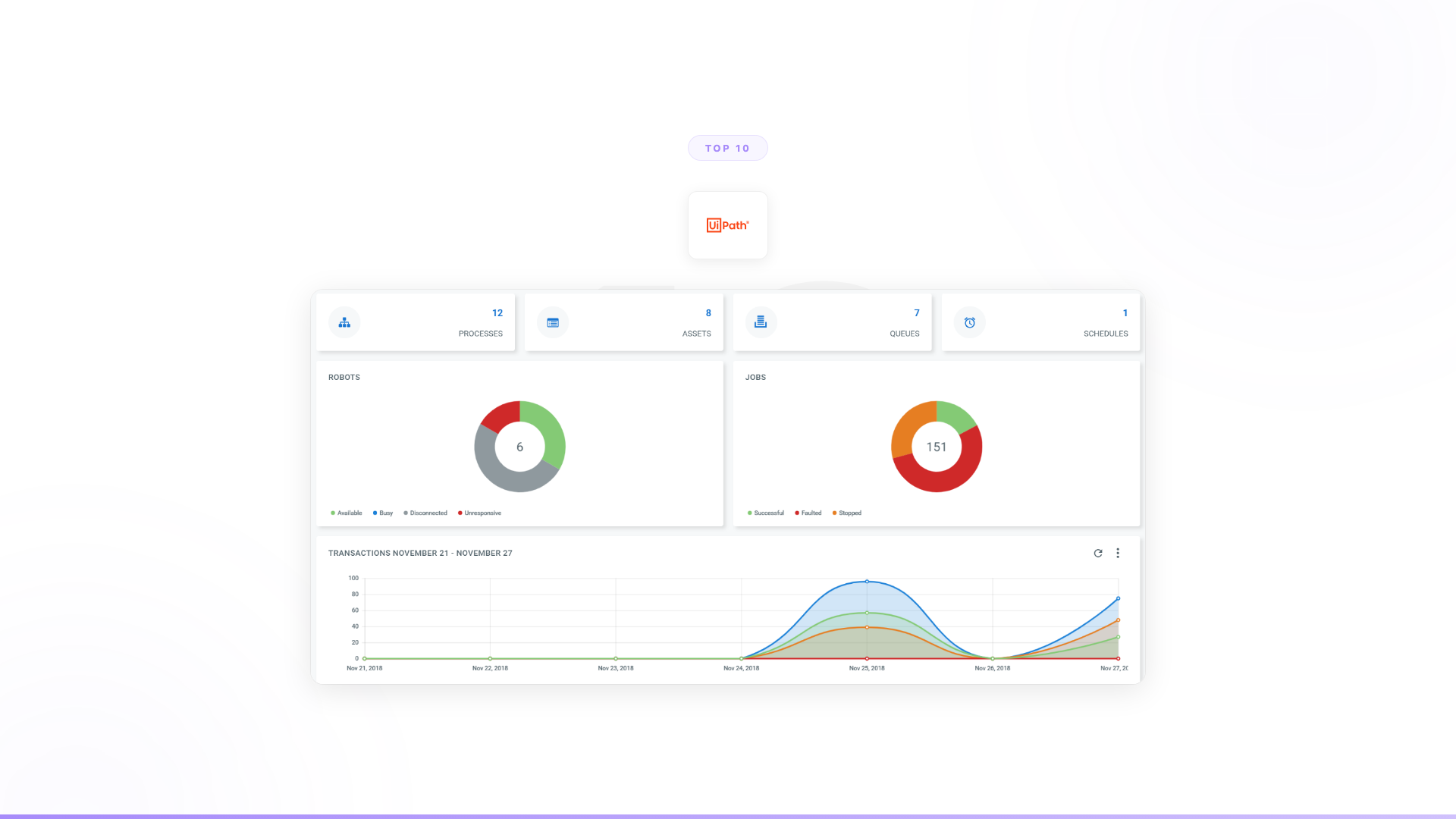
7. UiPath
What it automates: Screen-level tasks through robotic process automation (RPA). Software robots interact with application UIs: clicking buttons, filling forms, copying data between screens. Recent "agentic automation" additions bring some AI decision-making.
Strengths for telecom automation: For high-volume, repetitive, screen-based tasks — data entry, invoice processing, report formatting — RPA delivers real time savings. Can work across legacy systems without APIs, which is relevant in telecom where legacy infrastructure is common. Lower barrier to adoption than platform replacements.
Automation limits: RPA automates the predictable parts. When exceptions occur — and they always do in telecom operations — robots stop and humans take over. Brittle when UIs change. The "agentic" additions improve exception handling, but the architecture is still built around screen interaction, not autonomous workflow completion.
Best for: High-volume, screen-based, repetitive tasks with minimal exceptions. Legacy system bridges where API integration isn't feasible.
8. Huawei ADN
What it automates: Autonomous Driving Networks: intent-driven networking, predictive maintenance, digital twins, and energy optimization. Bundled with Huawei Cloud for integrated network and cloud automation.
Strengths for telecom automation: Substantial R&D investment. Strong vision for autonomous networks. Cloud bundling creates an integrated automation stack for infrastructure. Market-leading position in several regions, particularly Asia-Pacific and parts of the Middle East and Africa.
Automation limits: Network and cloud infrastructure scope. Doesn't automate business operations. Geopolitical restrictions limit availability in North America and much of Europe.
Best for: Operators in Huawei-accessible markets pursuing end-to-end network and cloud automation.
9. Netcracker
What it automates: BSS/OSS processes: service orchestration, billing, customer management, and network lifecycle automation. NEC subsidiary serving major telecoms globally.
Strengths for telecom automation: Service orchestration bridges some of the gap between network and business operations. Lifecycle management automation covers provisioning and service activation across complex multi-vendor environments.
Automation limits: BSS/OSS scope. Doesn't automate sales, general support, compliance, HR, or cross-departmental workflows. Long implementation timelines are typical.
Best for: Operators on NEC/Netcracker platforms needing BSS/OSS and lifecycle automation.
10. Custom build
What it automates: Whatever you build it for. LangChain, LangGraph, or custom architectures give full flexibility over scope, integrations, and agent behavior.
Strengths for telecom automation: No scope limitations. No vendor constraints. Full control over what gets automated and how.
Automation limits: Requires AI engineering capacity, ongoing maintenance, and significant time investment. For most telecom operators, the math doesn't favor building when production-ready platforms exist. Every engineering team diverted to internal tooling is a team not working on the core business. At an operator scale, that opportunity cost is substantial.
Best for: Operators with surplus AI engineering capacity, highly unique requirements, and 6+ month timelines who have evaluated platforms and found them insufficient.
The three automation layers in telecom
There are three distinct automation layers, and mixing them up is the most common mistake telecom operators make when evaluating AI tools.
Layer 1: Network automation. What Nokia, Ericsson, Huawei, and other network vendors provide. Making the infrastructure self-monitoring, self-healing, self-optimizing. Well-funded. Well-understood. Progressing steadily. Gartner projects 30% of enterprises will automate more than half of their network activities by 2026, up from under 10% in 2023.
Layer 2: BSS/OSS automation. What Amdocs, Netcracker, and similar vendors provide. Billing, order management, service orchestration, customer management within dedicated platforms. Valuable, but system-specific and tied to multi-year contracts.
Layer 3: Operations automation. What Nexus provides. Sales, support, compliance, HR, onboarding, reporting, data harmonization, escalation routing. The cross-system, cross-department workflows where most workforce hours go. This is the layer with the biggest automation gap.
Most telecom AI investment goes to Layer 1. Most workforce hours sit at Layer 3. The two-speed automation problem persists because the vendors building Layer 1 tools aren't equipped to solve Layer 3 problems — they're fundamentally different challenges requiring different architectures, different training approaches, and different integration patterns.
Omdia's 2025 research on agentic AI in telecom operations confirms this gap: while network automation is maturing rapidly, the operational automation layer remains underdeveloped across most CSPs (Agentic AI: An Evolution with Transformative Potential for Telecom Operations, Omdia, 2025).
How to evaluate telecom AI automation tools
Before evaluating specific vendors, clarify which automation layer you're actually trying to address.
If your gap is network automation: Nokia, Ericsson, or Huawei ADN (subject to market availability). These are infrastructure decisions, not workflow decisions. Evaluate by network domain expertise, integration with your existing RAN and core stack, and vendor roadmap for autonomous network levels.
If your gap is BSS/OSS automation: Amdocs amAIz or Netcracker, if you're already on those platforms. Evaluate by depth of BSS/OSS integration, billing automation completeness, and implementation timeline.
If your gap is business operations automation: This is where most operators are underserved. Customer onboarding, support, compliance monitoring, HR, sales intelligence, and cross-departmental reporting. Evaluate by cross-system integration breadth, autonomous workflow completion rate, ability to handle exceptions without human escalation, and deployment speed. Rule-based tools (UiPath) won't handle ambiguity; decisioning tools (Pega) won't complete full workflows; network tools (Nokia, Ericsson) aren't designed for this layer at all.
The key question: does the tool recommend actions, or does it complete them? Recommendation tools require humans to act. Completion tools close the loop autonomously.
Frequently asked questions
What is telecom AI automation?
Telecom AI automation is the use of AI agents, machine learning, and intelligent workflow engines to replace manual human work across telecom operations. It covers three layers: network automation (infrastructure self-optimization), BSS/OSS automation (billing and order management within dedicated platforms), and business operations automation (customer onboarding, support, compliance, HR, sales). Different tools address different layers; very few address all three.
What's the difference between network automation and business operations automation in telecom?
Network automation uses AI to manage infrastructure — traffic routing, fault detection, capacity planning, and configuration. Business operations automation uses AI to complete cross-system workflows involving human processes: customer onboarding, support resolution, compliance reporting, HR operations. Network vendors like Nokia and Ericsson solve the former; platforms like Nexus solve the latter. The tools don't overlap, and the automation gap at the business operations layer is significantly larger than at the network layer.
Which AI automation tools work for both network and business operations in telecom?
No single tool addresses both layers equally well. Nokia and Ericsson focus on network infrastructure. Amdocs and Netcracker focus on BSS/OSS platforms. Nexus focuses on business operations. Operators building comprehensive automation programs typically combine a network vendor for Layer 1 with Nexus for Layer 3, rather than seeking a single-vendor solution.
How long does telecom AI automation deployment take?
It depends entirely on the layer. Network automation deployments typically follow infrastructure timelines — months to years. BSS/OSS platform automation runs 6–18 months. Business operations automation with Nexus can deploy in days to weeks: Orange built their first production agent in 4 hours and completed multi-market deployment in 4 weeks. The gap in deployment speed is one of the sharpest differentiators between layers.
Can AI automate telecom customer onboarding end-to-end?
Yes. Orange Group deployed Nexus agents that handle customer onboarding end-to-end: collecting and validating customer data, making eligibility decisions, handling document exceptions, and completing the process without human involvement in 90% of cases. That deployment produced a 50% conversion improvement and ~$6M+ in yearly revenue impact. The same agent architecture applies to other onboarding workflows at mobile operators, fixed-line providers, and cable operators.
Worth exploring?
If your network automation is running well and you need to automate the rest — customer operations, sales, support, compliance, HR, reporting — that's a different category of tool. Nexus fills the operational automation gap that network vendors leave open.
Every engagement starts with a 3-month proof of concept. Forward Deployed Engineers embedded from day one. You can exit anytime.
Orange: ~$6M+ yearly revenue impact from automated customer onboarding. European telecom: 40% support capacity freed with a dozen agents in 12 weeks. 100% POC-to-contract conversion.
See how Nexus works for telecom →
Related reading
- Nexus vs Nokia: full comparison
- Nexus vs Ericsson: network AI vs operational agents
- Nexus vs Amdocs: BSS/OSS AI vs autonomous agents
- Top 10 Nokia AI alternatives for telecom
- Nokia AI vs Ericsson AI: telecom automation compared
- How to automate telecom workflows with AI agents
- How Nexus works for telecom