The best AI tools for enterprise knowledge management in 2026 include Nexus (autonomous agents that act on enterprise knowledge end-to-end), Langdock (European AI assistant, €25+/user/month), Glean (enterprise search across 100+ systems, ~$15–25/user/month), Notion AI ($10/month add-on), Guru (verified knowledge for frontline teams, $15+/user/month), Confluence AI (Atlassian teams), Slite (small teams, $10+/user/month), Tettra ($8.33+/user/month), Document360 ($199+/month), and custom RAG builds. The key distinction: most tools help employees find knowledge. Nexus agents act on it to complete entire workflows.
Enterprise knowledge management used to mean organizing documents so people could find them. Then it meant making search smarter. Now, with AI, the conversation has shifted again: instead of helping employees find information, the real question is whether AI can act on that information.
Most tools in this space focus on the "find" part. Connect your knowledge sources (Confluence, SharePoint, Notion, Google Drive, Slack), index everything, let employees ask questions in natural language. That's genuinely useful. According to McKinsey, knowledge workers spend up to 20% of their working week searching for internal information — and AI-powered search meaningfully cuts that number.
But finding information is rarely the actual bottleneck. The bottleneck is what happens after someone finds it: the validation, the decisions, the cross-system actions, the exceptions. An AI tool that helps your support team find the right policy is valuable. An AI agent that finds the policy, applies it to the customer's situation, validates against your CRM, takes the appropriate action, and communicates the result is a fundamentally different proposition.
The tools below span that spectrum. Some help people find knowledge. Some help people use knowledge. One completes the work that knowledge enables.
What is the best AI tool for enterprise knowledge management?
The right tool depends on where your bottleneck actually sits.
If the bottleneck is information discovery — employees spending too much time hunting across Confluence, SharePoint, Slack, and five other tools — Glean is the most capable purpose-built enterprise search platform. It indexes 100+ enterprise systems and makes everything searchable through a single interface. Backed by Sequoia and Kleiner Perkins, Glean is used by some of the largest enterprises in financial services and technology.
If the bottleneck is knowledge accuracy — policies changing, wikis going stale, support teams using outdated information — Guru is the most focused tool. Its verification workflows ensure frontline teams always have current, trusted answers.
If the bottleneck is governance and data residency — particularly in Europe — Langdock provides multi-model AI access with EU data residency and GDPR compliance. Merck deployed it to 33,000 monthly active users.
If the bottleneck is the work that comes after finding information — validating, deciding, executing across systems — that's a different category. Nexus agents act on enterprise knowledge end-to-end, not just retrieve it.
Quick comparison
| Tool | Category | Best for | Finds knowledge? | Acts on knowledge? | Pricing |
|---|---|---|---|---|---|
| Nexus | Autonomous agent platform | Complete workflows powered by enterprise knowledge | Yes | Yes, end-to-end | Per-agent |
| Langdock | AI assistant platform | European teams needing governed LLM access to knowledge | Yes | No | EUR 25/user/month+ |
| Glean | Enterprise search + assistant | Finding information across 100+ enterprise systems | Yes | No | ~$15–25/user/month |
| Notion AI | Workspace AI | Teams using Notion as their knowledge hub | Yes (Notion only) | No | $10/user/month add-on |
| Guru | Knowledge management + AI | Verified, up-to-date knowledge for frontline teams | Yes | No | $15/user/month+ |
| Confluence AI | Workspace AI | Atlassian teams with knowledge in Confluence | Yes (Confluence only) | No | Included in Confluence Premium |
| Slite | Team knowledge base + AI | Small to mid-size teams needing simple knowledge management | Yes (Slite only) | No | $10/user/month+ |
| Tettra | Internal knowledge base + AI | Teams needing structured internal wikis | Yes (Tettra only) | No | $8.33/user/month+ |
| Document360 | AI knowledge base | Customer-facing and internal documentation | Yes (Document360 only) | No | $199/month+ |
| Custom build | Developer framework | Engineering teams with unique knowledge architecture needs | Depends on build | Depends on build | Engineering cost |
The tools, ranked
1. Nexus
What it is: An autonomous agent platform paired with Forward Deployed Engineers who embed with your team. Nexus doesn't just help employees find knowledge. It deploys agents that use enterprise knowledge to complete entire business workflows: customer onboarding, sales intelligence, compliance monitoring, support triage, proposal generation.
Why it's different from knowledge management tools:
The other tools on this list make knowledge findable. Nexus makes knowledge actionable. The difference is structural. A knowledge management tool tells your support agent what the return policy is. A Nexus agent finds the policy, applies it to the customer's specific situation, validates the customer's account in your CRM, processes the return in your ERP, sends the confirmation via the customer's preferred channel, and logs everything for compliance. Knowledge isn't just accessed; it's applied, validated, and executed.
Nexus ranks first here not as a knowledge base or search tool — Glean and Guru are stronger for those specific use cases — but as the platform that turns enterprise knowledge into completed work. If your problem is "people can't find information," Glean solves that. If your problem is "people find the information but then have to manually complete 10 steps with it," that's what Nexus addresses.
What it looks like in production:
- Orange Group (multi-billion euro telecom, 120,000+ employees): Business team built autonomous customer onboarding agents that use product knowledge, pricing rules, and compliance requirements to onboard customers end-to-end. Deployed in 4 weeks. 50% conversion improvement. ~$6M+ yearly revenue impact. 90% autonomous resolution. 100% team adoption. Previously ran a CX chatbot with a 27% drop-out rate.
- European telecom (13,000+ employees): Knowledge wasn't the problem. Acting on it at scale was. Agents now handle millions of interactions, resolving 40% of support volume autonomously using the company's knowledge base, policies, and system data.
How it handles knowledge: Nexus connects to 4,000+ enterprise systems. Agents both read from and write to these systems. Knowledge isn't just retrieved; it's the foundation for autonomous decision-making and execution.
Best for: Enterprises where the bottleneck isn't finding knowledge — it's acting on knowledge across systems, at scale, with decisions, exceptions, and compliance.
See how Nexus compares to Langdock →
2. Langdock
What it is: A European AI assistant platform that connects company knowledge to multiple LLMs (Claude, GPT-4o, Gemini, Llama, Mistral). Teams interact with their knowledge through a governed chat interface. EU-hosted, GDPR-first, SOC 2 and ISO 27001 certified.
What it does well: Langdock's strength is governed knowledge access for European enterprises. It connects to Confluence, SharePoint, Google Drive, Notion, and Personio, then lets employees ask questions against that knowledge using their choice of LLM. The European data residency and multi-model flexibility are genuine differentiators, not marketing claims. Merck, with 33,000 monthly active users, demonstrates what Langdock can deliver at real enterprise scale. Personio also runs on Langdock internally.
Where it falls short: Langdock retrieves and synthesizes knowledge. It doesn't act on it. The AI can summarize a product spec, answer questions from knowledge base content, or draft a response based on policy documentation. But it can't update the CRM, process a request, or route an exception. The employee completes that part. For organizations where knowledge access is the primary bottleneck, Langdock genuinely helps. For organizations where the bottleneck is the work that comes after accessing knowledge, Langdock hits a structural ceiling.
Pricing: Starting at EUR 25/user/month. Workflows priced separately.
Best for: European enterprise teams that need governed, multi-model access to company knowledge with GDPR compliance, and whose primary problem is knowledge access rather than workflow execution.
See how Langdock compares to Nexus →
3. Glean
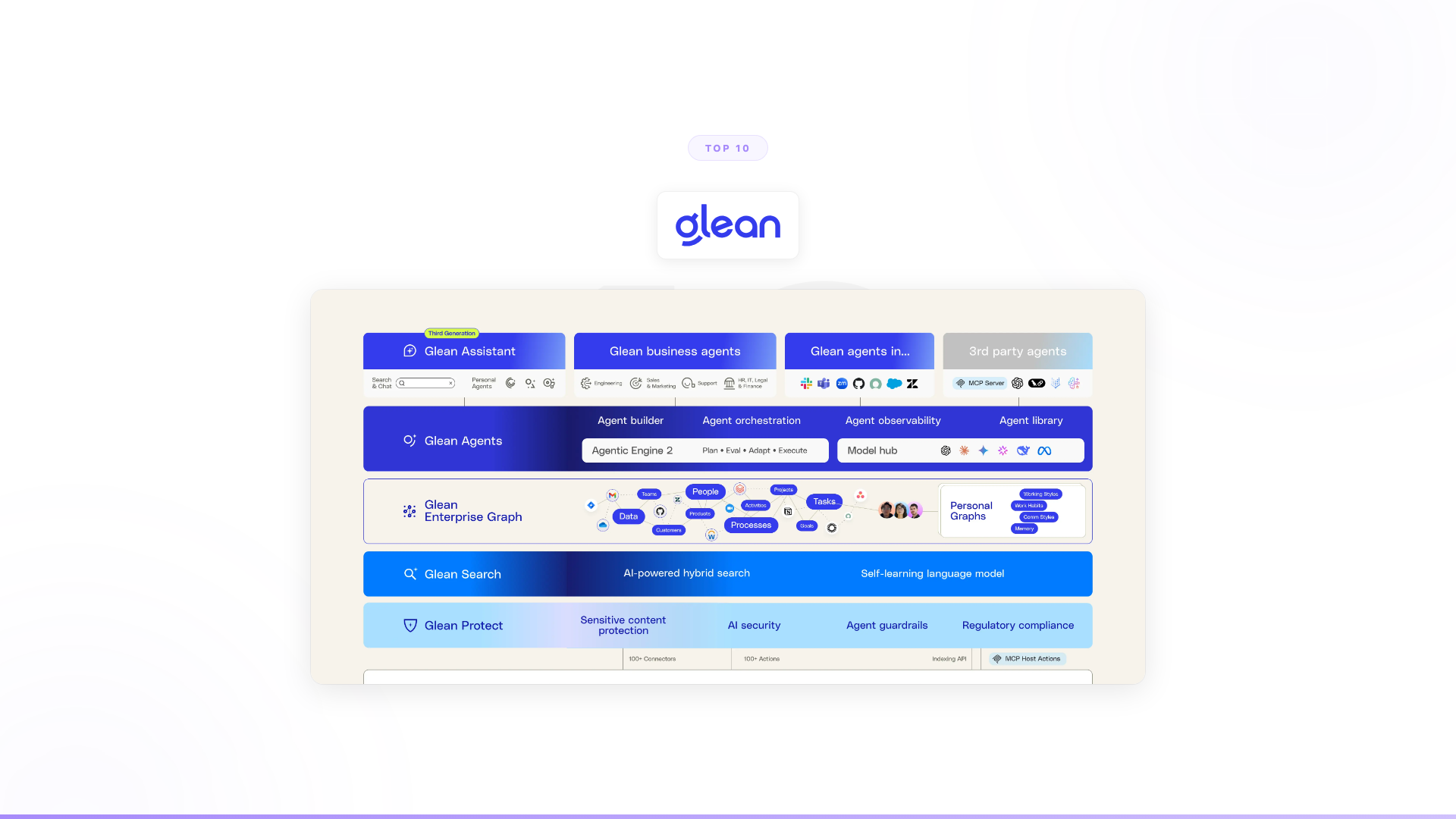
What it is: Enterprise AI search and knowledge assistant. Connects to 100+ enterprise data sources and lets employees search across all of them with natural language. Also generates answers by synthesizing information from multiple sources.
What it does well: Glean is arguably the most capable enterprise knowledge search tool available. It indexes everything — Confluence, Slack, Drive, SharePoint, Salesforce, Jira, email — and makes it searchable through one interface. For large enterprises where information is scattered across dozens of tools, Glean solves a real, painful problem. Knowledge workers stop spending a fifth of their working week hunting for things.
Glean has raised over $200M from Sequoia and Kleiner Perkins and has deployed at enterprise scale across financial services, technology, and healthcare. Its unified search index is deep: it understands document relationships, recency, and access permissions, surfacing results that are both relevant and actually accessible to the person asking.
Where it falls short: Search is the beginning of work, not the end. Glean finds the answer. It doesn't validate it against your customer's situation, check it against compliance rules, execute an action, or route an exception. The gap between "I found the information" and "the work is done" stays manual.
Pricing: Per-user enterprise pricing, reportedly $15–25/user/month.
Best for: Large enterprises where information discovery across many systems is the primary bottleneck.
Full Nexus vs Glean comparison →
4. Notion AI
What it is: AI features built into Notion's workspace platform. Summarizes pages, answers questions from your Notion knowledge base, drafts content, auto-fills database properties, and helps organize information within the Notion ecosystem.
What it does well: For Notion-centric teams, the native AI experience is seamless. You don't leave Notion. You don't configure a separate tool. The AI understands your workspace structure, page relationships, and content. For teams that have invested heavily in building their knowledge base in Notion, the zero-friction experience matters.
Where it falls short: Notion AI operates within Notion. If your knowledge lives across Confluence, SharePoint, Slack, and five other tools, Notion AI only sees the Notion piece. And like all workspace assistants, it helps individuals work faster within a single tool — it doesn't reach into Salesforce, trigger an action in your ticketing system, or complete a cross-system workflow. It's better described as a workspace writing assistant than an enterprise knowledge management platform.
Pricing: $10/user/month as a Notion add-on.
Best for: Notion-centric teams where most knowledge lives in Notion and the job is finding and using that knowledge within the same tool.
5. Guru
What it is: AI-powered knowledge management platform focused on getting verified, accurate information to the right people at the right time. Strong at knowledge verification workflows, keeping content up-to-date, and delivering answers in the context where employees work (browser extension, Slack, Teams).
What it does well: Guru solves a problem most knowledge tools ignore: knowledge decay. Documents go stale. Policies change. The wiki nobody maintains becomes the wiki nobody trusts. Guru adds verification workflows so subject matter experts regularly confirm or update content. For support teams, sales teams, and customer-facing roles, getting the right answer — not a stale answer — matters more than finding any answer. Guru's browser extension and Slack integration deliver verified knowledge directly in the context where employees are working, without requiring a context switch.
Where it falls short: Guru delivers knowledge. It doesn't execute it. The support agent still needs to apply the answer, take the action, and handle the exceptions. Guru ensures they have accurate information. The gap between having accurate information and completing the work remains manual.
Pricing: Starts at $15/user/month. Enterprise pricing custom.
Best for: Organizations where knowledge accuracy and freshness are the primary challenge, particularly customer-facing teams that need verified, up-to-date answers in their existing workflow context.
6. Confluence AI
What it is: Atlassian's AI features built into Confluence. Summarizes pages, generates content, answers questions from your Confluence knowledge base, and helps teams create and organize documentation.
What it does well: If your organization runs on Atlassian (Confluence, Jira, Trello), the native AI is frictionless. It understands your Confluence space structure, page hierarchy, and content relationships. For teams with years of documentation in Confluence, the AI makes that existing investment more accessible without requiring migration or a new tool. Atlassian serves over 300,000 organizations globally — for Atlassian-native enterprises, Confluence AI is often the path of least resistance.
Where it falls short: Same limitation as Notion AI, but for the Atlassian ecosystem. Confluence AI sees Confluence content. If knowledge lives across multiple tools, you only get AI assistance for one piece. It's still an assistant: it helps individuals find and use information within Confluence, not complete workflows across systems.
Pricing: Included in Confluence Premium ($6.05/user/month) and Enterprise plans.
Best for: Atlassian-native organizations with significant knowledge in Confluence.
7. Slite
What it is: A team knowledge base with built-in AI. Designed for small to mid-size teams that need a simple, clean place to store and find internal knowledge. AI answers questions, summarizes docs, and helps keep the knowledge base organized.
What it does well: Simplicity. Slite doesn't try to be everything. It's a clean, fast knowledge base that teams can actually adopt without months of configuration. The AI layer makes existing content more useful without requiring a separate implementation. For teams under 500 people who need a straightforward internal wiki with AI search, Slite delivers without the complexity of enterprise platforms.
Where it falls short: Scale and scope. Slite is built for team-level knowledge, not enterprise-wide knowledge management across thousands of employees and dozens of systems. It doesn't integrate deeply with enterprise data sources, and the AI capabilities are limited to the Slite ecosystem.
Pricing: Starts at $10/user/month. Enterprise pricing available.
Best for: Small to mid-size teams that want a simple, AI-powered internal knowledge base without enterprise complexity.
8. Tettra
What it is: Internal knowledge base designed for fast, lightweight knowledge management. Teams create pages, organize them in categories, and the AI helps surface answers from the knowledge base. Integrates with Slack for Q&A workflows.
What it does well: Tettra focuses on a specific workflow: someone asks a question in Slack, and the AI either answers from the knowledge base or routes it to the right expert. This is practical for teams where most knowledge sharing happens in Slack. The knowledge base stays lean, and the AI bridges the gap between "someone knows the answer" and "the answer is documented."
Where it falls short: Similar to Slite, Tettra is team-scale, not enterprise-scale. Limited integrations, limited AI capabilities, and no path to workflow execution. It's a good lightweight knowledge base. It's not an enterprise knowledge management solution.
Pricing: Starts at $8.33/user/month.
Best for: Small teams that want AI-powered Q&A connected to a simple internal knowledge base, particularly Slack-centric teams.
9. Document360
What it is: AI-powered knowledge base platform for both customer-facing documentation and internal knowledge. Supports multiple knowledge bases, has strong content management features, and includes an AI assistant that answers questions from your documentation.
What it does well: Document360 straddles internal and external knowledge management. You can run a customer-facing help center and an internal knowledge base from the same platform. The content management features — versioning, workflows, analytics, category management — are stronger than most competitors. For organizations that need both public documentation and internal knowledge, it's a practical choice without duplicating tools.
Where it falls short: Content management is Document360's strength, not enterprise-wide knowledge synthesis. It doesn't index Salesforce, Slack, or your CRM. It manages the documentation you create in its platform. The AI is limited to that content, and it doesn't act on anything it finds.
Pricing: Tiered plans starting at $199/month (not per-user for base plans). Enterprise pricing custom.
Best for: Organizations that need structured knowledge base management for both customer-facing and internal documentation.
10. Custom build
What it is: Build your own knowledge management AI using frameworks like LangChain, LlamaIndex, or vector database providers (Pinecone, Weaviate, Qdrant). Your engineering team designs the retrieval architecture, manages embeddings, builds the interface, and handles governance.
How it compares: Maximum flexibility. You can build a system that indexes exactly the sources you need, retrieves exactly the way you want, and potentially goes beyond what any off-the-shelf tool offers. For organizations with unique knowledge architectures or strict data requirements, custom is sometimes the only option.
Why it might not solve the problem: Building enterprise-grade knowledge AI isn't a weekend project. You need retrieval quality tuning, security, access control, embedding management, prompt engineering, monitoring, and ongoing maintenance. Retrieval-augmented generation (RAG) done well is surprisingly difficult — answers that are 90% accurate aren't useful when employees need to trust the output. The opportunity cost of diverting engineering capacity from your core product is real, and it compounds over the multi-year investment a production-grade system typically requires.
Pricing: Engineering salaries + infrastructure. Typically 3–6 months for basic retrieval, 6–12 months for production-grade.
Best for: Organizations with dedicated AI engineering teams and unique knowledge architecture requirements.
What is the difference between enterprise search and AI knowledge management?
Enterprise search (Glean, Microsoft Search) indexes content across enterprise systems and makes it discoverable via natural language queries. AI knowledge management is broader — it includes not just finding information but also maintaining knowledge quality, automating knowledge capture, and enabling knowledge to power automated workflows.
The distinction matters in practice. A pure search tool (Glean) optimizes for the quality and breadth of what it can retrieve. A knowledge management platform (Guru) optimizes for the trustworthiness and freshness of what's stored. A workflow platform (Nexus) optimizes for what the AI does after retrieval — the decisions, actions, and completions that follow.
Most enterprises need elements of all three. The evaluation question is: where is your biggest gap? Finding, trusting, or acting?
AI tools for knowledge management in European enterprises
European enterprises face constraints that US-focused tools don't fully address. GDPR compliance, data residency requirements, and national data sovereignty rules mean that sending employee queries and internal documents to US-based API infrastructure isn't always viable.
Langdock was built for this. EU-hosted, ISO 27001 certified, SOC 2 compliant, and built around the principle that European enterprises should be able to choose their LLM without giving up data control. Merck's deployment — 33,000 monthly active users — is the most visible signal of what Langdock enables for large European enterprises.
Glean also offers EU data residency options and has enterprise deployments in Europe. For teams where Atlassian is the knowledge backbone, Confluence AI inherits Atlassian's enterprise compliance posture.
For European enterprises that need AI to act on knowledge — not just surface it — Nexus operates with the same deployment model globally, with Forward Deployed Engineers who work within your team and your data governance requirements.
The real question: find knowledge or act on it?
Every tool on this list makes enterprise knowledge more accessible. That's valuable. The question is whether your bottleneck is access or action.
If the bottleneck is finding information — employees spending too much time searching across tools — Glean, Langdock, Notion AI, or Guru will genuinely help. Each has a different strength: Glean for breadth of search across 100+ systems, Langdock for European governance and model flexibility, Notion AI for Notion-native teams, Guru for knowledge accuracy and freshness.
If the bottleneck is what happens after someone finds the information — the validate, decide, act, handle exceptions, and complete the work steps — the tools above won't close the gap. They make the "find" step faster. The rest stays manual. That's the structural ceiling of knowledge assistants.
If you need AI that turns enterprise knowledge into completed work, that's a different category. That's what Nexus was built for.
Orange's agents don't just find product information. They use it to complete customer onboarding autonomously across CRM, ERP, and WhatsApp. ~$6M+ yearly revenue impact. 4-week deployment. 100% team adoption.
A major European telecom's agents don't just look up support policies. They apply those policies to resolve customer issues across millions of interactions, handling 40% of support volume autonomously.
Knowledge management that stops at "here's the answer" is valuable. Knowledge management that ends with "the work is done" is transformational.
Frequently asked questions
Q: What is the best AI tool for enterprise knowledge management?
It depends on where your bottleneck sits. For enterprise-wide search and knowledge discovery across 100+ systems, Glean is the leading purpose-built platform. For frontline team knowledge delivery with quality verification, Guru is the most focused tool. For Atlassian-native teams, Confluence AI is the natural choice. For European enterprises with data residency requirements, Langdock provides governed LLM access with ISO 27001 and SOC 2 certification. For completing full business workflows based on enterprise knowledge — not just finding information — Nexus agents act end-to-end.
Q: What is the difference between enterprise search and AI knowledge management?
Enterprise search (Glean, Microsoft Search) indexes content across enterprise systems and makes it discoverable via natural language queries. AI knowledge management is broader: it includes finding information, maintaining knowledge quality, automating knowledge capture, and enabling knowledge to power automated workflows. Guru focuses on verified knowledge delivery with freshness workflows. Nexus focuses on using knowledge to complete business processes autonomously. Most enterprises need elements of both — the question is which gap is costing you the most.
Q: Does Notion AI count as enterprise knowledge management?
Notion AI is a workspace AI — it generates and summarizes content within Notion. For teams that use Notion as their primary knowledge repository, it's a useful addition. But it doesn't index or search across other enterprise systems (Confluence, SharePoint, Slack), doesn't apply knowledge to automated workflows, and doesn't support the governance and access control requirements of large enterprises. It's more accurately described as a workspace writing assistant than an enterprise knowledge management platform.
Q: What is Langdock and who uses it?
Langdock is a European AI assistant platform that gives organizations a governed way to connect multiple LLMs to enterprise knowledge sources — with EU data residency and GDPR compliance built in. It's used by European enterprises that need AI access to internal documents without routing data through US-based API infrastructure. Merck is the most publicly known customer, with 33,000 monthly active users. Personio also uses Langdock internally.
Q: How do knowledge management AI tools handle access control and data governance?
Access control is a critical evaluation criterion that most tool demos skip over. Glean inherits permissions from the source systems it indexes — if an employee can't see a document in SharePoint, they can't see it in Glean search results either. Guru uses its own role-based access controls and verification routing. Langdock applies organization-level access policies and keeps all data within EU infrastructure. Confluence AI inherits Confluence's existing space permissions. For enterprises with strict data classification requirements, this is often the deciding factor — not feature coverage.
Worth exploring?
Every Nexus engagement starts with a 3-month proof of concept tied to measurable outcomes. Forward Deployed Engineers embed with your team from day one. You see results before committing to anything long-term.
See how Nexus compares to Langdock →