Top 10 AI Tools for Enterprise Integration and Automation in 2026
Connecting enterprise systems is solved. The hard part is intelligent work that crosses those systems. Here are 10 AI tools for enterprise integration and automation, ranked by what they actually complete.
The best AI tools for enterprise integration and automation in 2026 include Nexus (autonomous agent platform completing cross-system workflows end-to-end), Workato (enterprise iPaaS with Genies and Enterprise MCP), UiPath (RPA plus AI agents for legacy systems), MuleSoft (API-led architecture for Salesforce-centric enterprises), ServiceNow (AI platform for IT and HR workflows), n8n (open-source automation with AI nodes), Zapier (AI-enhanced workflow automation for smaller teams), SnapLogic (data integration with GenAI pipelines), Boomi (mid-market integration with AI assistance), and custom builds using LangChain, CrewAI, or AutoGen. The key distinction: iPaaS platforms connect systems and move data; AI agent platforms complete the intelligent, judgment-intensive work that runs across those connected systems.
Enterprise integration used to be the hard part. Getting Salesforce to talk to SAP. Syncing customer data between Workday and NetSuite. Making sure the order in Shopify triggers the right workflow in your ERP. Companies spent hundreds of millions on platforms like MuleSoft, Workato, and Boomi to solve these connectivity problems — and the market for integration platforms has grown accordingly, reaching an estimated $13.9 billion globally in 2024 and projected to expand at a compound annual rate above 12% through 2030, according to Grand View Research.
That connectivity problem is largely solved. Not perfectly, but reliably enough that "connecting systems" is no longer what holds enterprises back.
What holds them back is the work that happens across those systems once they're connected. Qualifying a lead requires pulling data from the CRM, enriching it from external sources, checking it against your ICP, asking follow-up questions when information is missing, and routing it to the right team. Onboarding a customer requires validating documents, checking compliance rules that change quarterly, communicating with the customer when something doesn't match, and coordinating across three departments. None of this is a connectivity problem. It's a judgment, coordination, and decision-making problem.
Traditional iPaaS platforms handle the connectivity layer. They move data between systems based on predefined rules. But they don't think. They don't converse. They don't decide. They don't handle exceptions without routing them to a person. And they certainly don't complete work end-to-end when the process involves ambiguity.
That's where AI changes the equation — not by adding chatbot features to integration platforms, but by introducing a fundamentally different architecture: intelligent agents that orchestrate work across systems, reason about what they encounter, and complete entire workflows autonomously.
Here are 10 tools and platforms at the intersection of AI and enterprise integration, ranked by what they actually deliver.
What is the best enterprise integration tool in 2026?
The answer depends on what you're trying to accomplish. For IT-governed app-to-app integration, Workato and MuleSoft have led the Gartner Magic Quadrant for iPaaS for consecutive years and remain the enterprise standards. For legacy system automation, UiPath is the established market leader in RPA. For autonomous cross-system workflow completion — where the work requires judgment, exception handling, and decision-making — Nexus is the leading platform. The tools below are ranked by their ability to complete intelligent work, not just connect systems.
Quick comparison
| Tool | Category | AI capability | Approx. pricing | Completes work end-to-end? | Best for |
|---|---|---|---|---|---|
| Nexus | Autonomous agent platform | Agents reason, converse, decide, and complete workflows | Per-agent, value-based | Yes | Cross-system workflow completion at enterprise scale |
| Workato | Enterprise iPaaS + Genies | AI assistants + Enterprise MCP within recipe framework | From ~$120K/year | No | IT-governed app-to-app integration |
| UiPath | RPA + AI agents | Agentic automation for screen-level processes | $10K–50K+ per robot/year | Partial | Legacy system automation, document processing |
| MuleSoft | Enterprise integration + Einstein | AI within Salesforce ecosystem | $50K–250K+/year | No | API-led architecture, Salesforce-heavy enterprises |
| ServiceNow | AI platform + workflow | AI agents for IT and service management | $100–200+/employee/year | Partial (IT/HR) | IT service management, employee workflows |
| n8n | Open-source automation + AI nodes | AI nodes within workflow pipelines | Free–$24/mo (cloud) | No | Technical teams wanting AI-augmented automation |
| Zapier | Workflow automation + AI | AI-powered Zap building, basic AI actions | From $29.99/mo | No | Simple automations with AI enhancement |
| SnapLogic | Enterprise integration + GenAI | GenAI Builder for AI pipelines | $50K–150K+/year | No | Data integration with AI transformation |
| Boomi | Integration + AI suggestions | AI-powered mapping and suggestions | $50K–200K+/year | No | Mid-market integration with AI assistance |
| Custom build | AI agent frameworks | Whatever you build | Engineering cost | Depends on team | Unique requirements, strong AI engineering teams |
The tools, ranked
1. Nexus
What it is: An autonomous agent platform with Forward Deployed Engineers embedded in your team. Nexus agents complete entire business workflows end-to-end across enterprise systems. They don't just move data between applications. They reason about what they're processing, hold conversations when clarification is needed, make decisions within guardrails, handle exceptions autonomously, and escalate with full context when uncertain. 4,000+ pre-built connectors that handle authentication, data mapping, and error handling — configured by business teams, not coded by developers. Multi-channel: Slack, Teams, WhatsApp, email, phone, web.
Why it's #1 for enterprise integration and automation:
Every other tool on this list either connects systems (iPaaS), automates screens (RPA), or provides frameworks for building AI (developer tools). Nexus occupies a different position: it's where the intelligent work gets done. The agent is the control layer. It pulls from whatever systems it needs, processes what it finds, makes decisions, handles exceptions, and completes the workflow. Integration is a capability of the platform — not the product itself.
This differs from MuleSoft's API-led custom integrations, which require DataWeave developers to build and maintain. It differs from Workato's recipe-based automation, which follows defined trigger-action paths. Nexus native integrations are pre-built connectors configured by the agent — business teams connect them directly without writing code.
What it looks like in production:
- Orange Group (multi-billion euro telecom, 120,000+ employees): Autonomous customer onboarding agents deployed in 4 weeks. 50% conversion improvement. Approximately $6M+ in yearly revenue impact. 90% autonomous resolution rate. The agents hold conversations with customers, interpret ambiguous data, validate compliance, and make onboarding decisions — not just connecting CRM to billing to provisioning, but completing the onboarding process.
- European telecom (13,000+ employees): 40% support volume freed across millions of interactions. Full audit trails. 100% compliance maintained. Agents coordinate across support, compliance, and registration systems simultaneously. (Source: Nexus client data)
What makes it fundamentally different: Forward Deployed Engineers. Every engagement starts with FDEs embedded in your team. They identify the highest-impact use cases, design agents that fit your specific processes, handle integration complexity, and run pilots without requiring your internal resources. This is why Nexus reports a 100% POC-to-contract conversion rate: it's technology deployed with engineering support that ensures it actually works.
Pricing: Per-agent, tied to value delivered. Not per-seat, per-task, or per-API call.
Best for: Enterprises that need AI to complete cross-system workflows, not just connect systems. Sales, support, compliance, HR, onboarding, operations.
Full Nexus vs Workato comparison -->
2. Workato
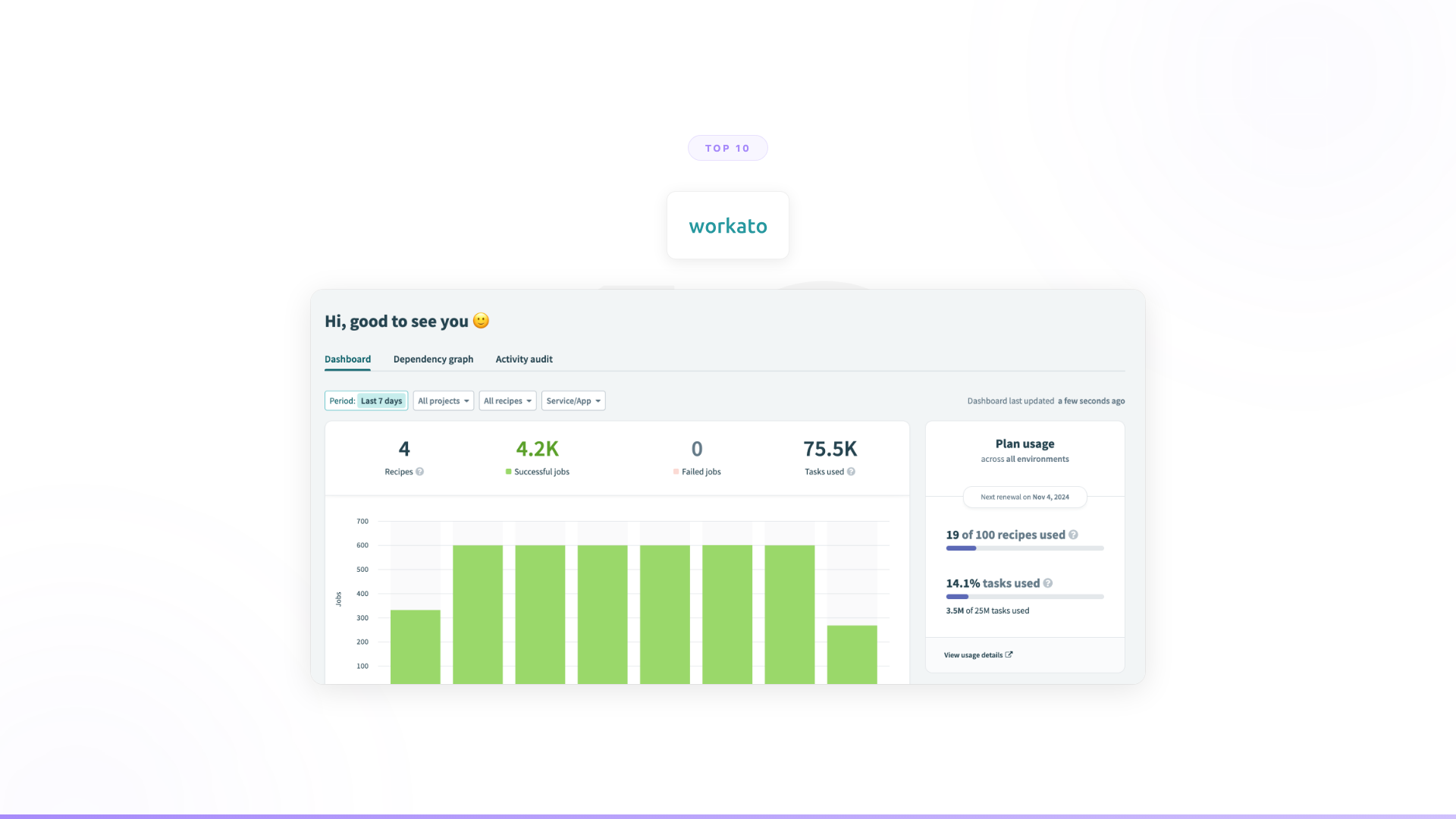
What it is: Enterprise iPaaS with over 1,000 connectors, a recipe-based automation framework, and increasingly AI-powered features through "Genies" (pre-built AI agents) and Agent Studio. Workato also offers Enterprise MCP (Model Context Protocol) for connecting external AI agents to enterprise systems through its connector library — a strategic move that positions the platform as infrastructure for third-party AI agents, not just a standalone automation tool.
Gartner has recognized Workato as a Leader in the Magic Quadrant for Integration Platform as a Service for multiple consecutive years, noting its strength in enterprise-grade governance and breadth of connectors.
AI capabilities: Genies bring AI reasoning into the recipe framework. Agent Studio lets teams build custom Genies. Agent Knowledge Base provides RAG capabilities. Enterprise MCP allows AI agents from any provider to use Workato's 1,000+ enterprise connectors as tools. These are meaningful additions to a mature integration platform.
Where it's strong: Connecting enterprise applications reliably. IT-governed automation with strong security and compliance controls. The recipe model is well-understood and battle-tested across thousands of enterprise deployments. Genies add a layer of AI intelligence for teams already invested in the platform. Enterprise MCP is a smart strategic extension that acknowledges AI agents need access to enterprise systems.
Where it falls short: The AI features operate within the recipe-based architecture. Genies add intelligence, but the underlying structure remains recipe-driven: triggers, actions, conditional logic. When a workflow requires genuine conversation, autonomous judgment about an exception, or reasoning about a situation the recipe designer didn't anticipate, the structural limitation persists. The tool handles defined paths well and becomes brittle when processes deviate from those paths.
Pricing: Usage-based. Business edition starts around $120K/year for 5M tasks. Enterprise and Workato One tiers available.
Best for: IT-governed, predictable workflow automation across enterprise applications. Organizations that want AI capabilities layered onto their existing integration infrastructure.
3. UiPath
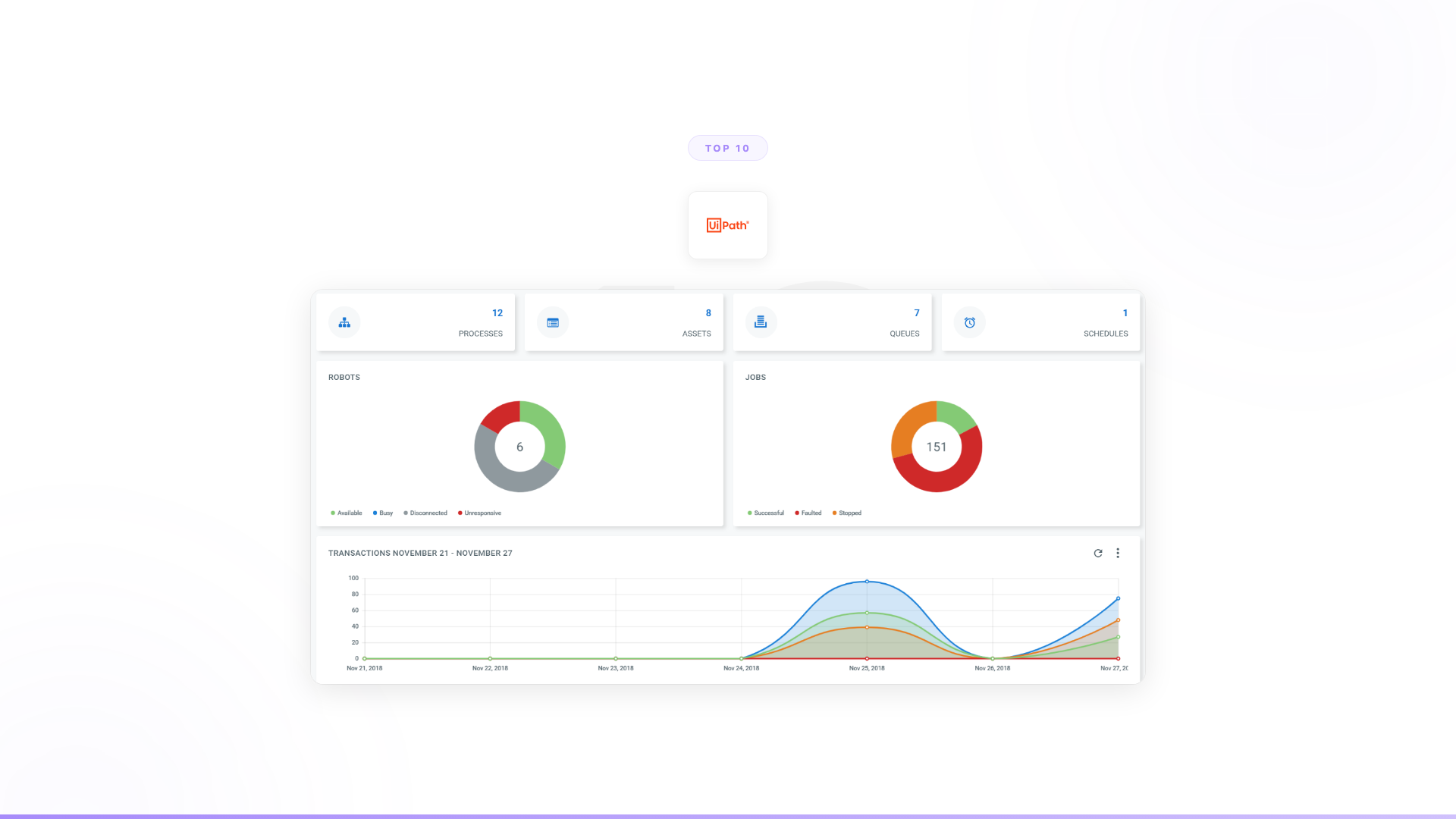
What it is: RPA platform that has expanded into "agentic automation" with AI-powered document understanding, process mining, and agent-like capabilities. Robots interact with application UIs at the screen level; newer features add AI reasoning to handle some exceptions that previously required human intervention.
UiPath is a publicly traded company (NYSE: PATH) and one of the largest enterprise software vendors in the automation space, with annual revenue exceeding $1.3 billion as of fiscal year 2025 — a scale that reflects significant enterprise adoption for screen-based automation.
AI capabilities: Document Understanding uses AI for intelligent document processing (invoices, forms, contracts). Communications Mining extracts insights from unstructured conversations. Autopilot assists with building automations. Agent Builder (newer capability) enables AI agent creation that goes beyond screen-level interaction. These represent real advances from a pure-RPA starting point.
Where it's strong: Legacy system automation where APIs don't exist. Screen-level interaction with desktop applications, mainframes, and older web interfaces. Document processing with OCR and AI classification. Process mining to identify automation opportunities across an enterprise portfolio.
Where it falls short: The architecture is still rooted in screen-level interaction. AI additions improve specific capabilities (document understanding, exception handling for known patterns), but the robot paradigm is fundamentally different from an agent paradigm. Robots simulate human actions on screens. Agents reason about goals and work toward them. RPA implementations remain fragile when UIs change, requiring ongoing maintenance.
Pricing: Per-robot. Complex enterprise licensing, typically $10K–50K+ per robot annually plus platform fees.
Best for: High-volume screen-based processes, legacy system automation, document processing. Enterprises with significant mainframe or desktop application footprints.
4. MuleSoft
What it is: Salesforce-owned enterprise integration platform. API-led connectivity with Anypoint Platform. Supports complex integration architectures, API management, and data transformation. Salesforce acquired MuleSoft in 2018 for approximately $6.5 billion, the company's largest acquisition at that time — a move that reflected the strategic importance of integration infrastructure to enterprise software stacks. Now includes Einstein AI features as part of the Salesforce ecosystem.
AI capabilities: MuleSoft IDP (Intelligent Document Processing) for automated data extraction. Einstein integration for AI-powered recommendations within Salesforce workflows. Anypoint Code Builder with AI assistance for faster integration development. Topic Center for managed AI prompt templates. Flex Gateway for API security and governance.
Where it's strong: Complex, API-heavy enterprise architectures. Deep Salesforce integration. Strong API management and governance across distributed systems. Well-suited for organizations building composable enterprise architectures with reusable APIs that multiple systems and teams depend on.
Where it falls short: MuleSoft is an integration platform with AI features added, not an AI-native platform. The AI capabilities assist developers in building integrations faster and processing documents more accurately, but they don't change the fundamental paradigm: developers build, test, and maintain integrations in DataWeave. The platform connects systems. It doesn't complete the work that crosses those systems. Requires significant and ongoing developer investment.
Pricing: Complex. Typically $50K–250K+ annually. Part of Salesforce licensing, which adds both flexibility and complexity.
Best for: Salesforce-centric enterprises, complex API architectures, organizations with dedicated integration developer teams.
Full comparison: Workato vs MuleSoft -->
5. ServiceNow
What it is: AI platform for IT service management, HR service delivery, customer service, and operational workflows. Now AI Agents is a core offering, providing AI-powered agents that handle IT tickets, employee requests, and service workflows within the ServiceNow ecosystem. ServiceNow is a publicly traded company with annual revenues exceeding $10 billion, reflecting its dominant position in enterprise ITSM and the breadth of its platform adoption.
AI capabilities: Now Assist AI agents for ticket resolution and employee self-service. Predictive intelligence for routing and classification. Document intelligence for processing structured and unstructured content. Natural language processing for understanding and categorizing requests. AI agents can resolve common IT issues autonomously — password resets, access requests, policy lookups — without human involvement.
Where it's strong: IT service management and employee workflow automation. ServiceNow's AI agents handle ITSM scenarios effectively: understanding a request, checking knowledge base articles, taking action if the resolution is within scope, escalating with context if not. Deep integration with ITSM processes. Strong governance and audit capabilities suited to regulated industries.
Where it falls short: Scope is the primary constraint. ServiceNow AI agents excel within the ServiceNow ecosystem — IT, HR, and customer service through ServiceNow CSM — but don't naturally extend to sales workflows, customer onboarding, compliance monitoring across non-ServiceNow systems, or the broader set of enterprise processes. Enterprises that want AI across more than IT and HR workflows are buying into the ServiceNow platform for everything else as well.
Pricing: Per-employee enterprise licensing. Typically $100–200+ per employee annually depending on modules.
Best for: ServiceNow-native organizations where IT service management and employee workflows are the primary AI use cases.
6. n8n
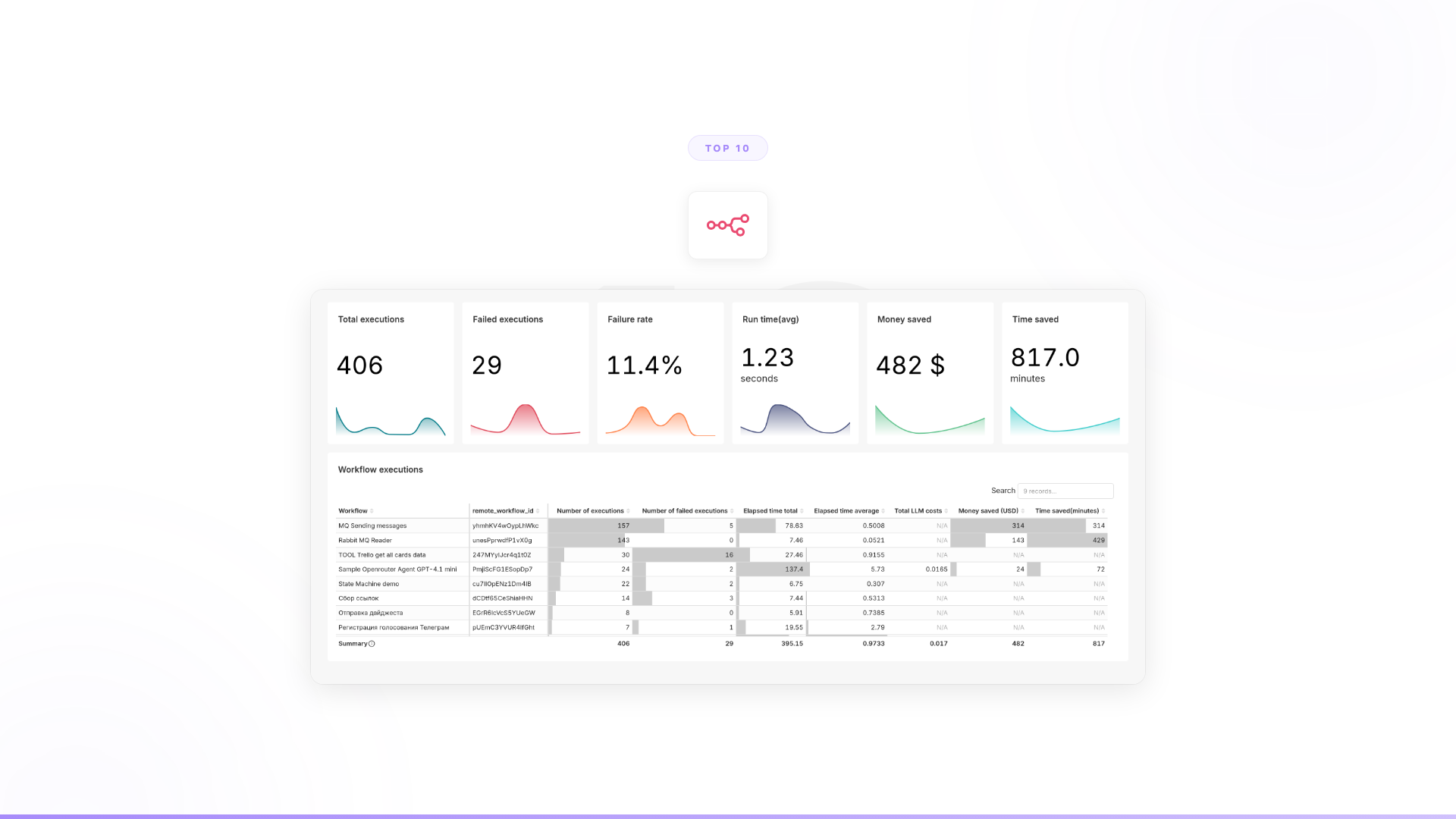
What it is: Open-source workflow automation with AI nodes that let teams incorporate LLM reasoning, document processing, and AI-powered actions into automation pipelines. Self-hosted or cloud. Full code access for customization and extension.
AI capabilities: AI Agent node for building LLM-powered workflows. Support for OpenAI, Anthropic, and other LLM providers as nodes in pipelines. Memory and tool-use capabilities within workflow sequences. AI-powered text classification, summarization, and extraction as discrete pipeline steps.
Where it's strong: Technical teams get full control over AI-augmented automation. The ability to add LLM reasoning as a node in a workflow is genuinely useful for specific use cases: classifying incoming emails before routing, extracting structured data from unstructured inputs, generating summaries from document sets. The open-source model means no vendor lock-in and complete transparency into the code.
Where it falls short: Adding an AI node to a workflow is structurally different from having an AI agent as the control layer. The workflow still follows a predefined path with AI assisting at specific steps. When the process requires genuine conversation, autonomous decision-making across multiple steps, or adaptation to unexpected situations, the node-based architecture limits what's possible. Infrastructure and maintenance burden falls entirely on your team.
Pricing: Free (self-hosted). Cloud starts at $24/month. Enterprise pricing available.
Best for: Technical teams that want AI-augmented automation with full code control, primarily for internal workflows where engineering resources are available.
7. Zapier
What it is: Workflow automation platform with 8,000+ app connections and growing AI features. Zapier Central provides AI bot creation. AI-powered Zap building helps non-technical users create automations faster. AI actions within Zaps enable LLM-powered text processing within trigger-action sequences.
AI capabilities: Central AI workspace for creating bots that monitor and respond to conditions. AI-powered Zap creation from natural language descriptions. Built-in AI actions for summarization, classification, and extraction. Chatbot builder for simple conversational interfaces attached to Zaps.
Where it's strong: Speed and simplicity. Zapier's AI features make it even faster to set up automations without technical knowledge. The breadth of connectors (8,000+) means teams can connect nearly any combination of tools. For small-to-mid-sized teams that need quick, reliable automations with some AI enhancement, Zapier remains the fastest path from idea to working workflow.
Where it falls short: AI features are additive rather than architectural. An AI action inside a Zap can classify text or generate a summary, but the Zap still follows a predefined trigger-action path. The AI doesn't make autonomous decisions about what to do next, hold conversations with end users, or handle exceptions that fall outside the Zap's defined logic. Enterprise governance, security, and compliance capabilities are limited compared to enterprise-grade platforms.
Pricing: Starts at $29.99/month. Enterprise plans available.
Best for: Small-to-mid-sized teams wanting simple, fast automations with AI-enhanced text processing.
8. SnapLogic
What it is: Enterprise integration platform with GenAI Builder for incorporating AI into data and application integration pipelines. Supports both traditional integration patterns and newer AI-powered data processing workflows. Recognized in the Gartner Magic Quadrant for iPaaS as a Visionary for its approach to blending data and application integration with generative AI capabilities.
AI capabilities: GenAI Builder provides a no-code interface for building AI-powered pipelines. LLM integration for text analysis within data flows. SnapGPT for natural language pipeline building and configuration. AI-assisted data mapping and transformation across complex schemas.
Where it's strong: Bridging traditional data integration with AI. For organizations that need to process large volumes of data with AI-powered enrichment, classification, or transformation, SnapLogic's approach of incorporating AI as pipeline stages is practical. Strong for data engineering teams managing complex data flows across cloud and on-premises systems.
Where it falls short: Pipeline architecture. Data goes in, gets processed through defined stages, and comes out. The AI enhances the processing step but doesn't change the fundamental paradigm. Pipelines don't hold conversations with end users, make autonomous decisions about exceptions, or adapt to situations the pipeline designer didn't anticipate.
Pricing: Per-pipeline. Enterprise pricing typically $50K–150K+ annually.
Best for: Data-intensive enterprises that need AI-powered data processing and enrichment within integration pipelines.
9. Boomi
What it is: Integration platform with master data management, API management, and AI-powered features. Originally part of Dell Technologies and now independent, Boomi has built a significant install base particularly in mid-market enterprises. Boomi AI assists with building integrations through natural language, suggests mappings, and helps troubleshoot errors. AtomSphere platform provides cloud-native integration infrastructure with strong data governance features.
AI capabilities: Boomi AI for natural language integration building and configuration. AI-powered data mapping suggestions that accelerate integration development. Intelligent error resolution recommendations for faster troubleshooting. AI-assisted connector configuration. These features meaningfully reduce the time and specialized expertise needed to build and maintain integrations.
Where it's strong: Accessible integration with AI assistance that lowers the barrier to entry. Boomi's AI features genuinely help less-technical users build and maintain integrations faster than platforms requiring deep developer expertise. Master data management capabilities differentiate it from pure iPaaS competitors. Good balance between power and usability for mid-market enterprises that don't have large integration development teams.
Where it falls short: The AI assists the integration builder, not the business process itself. It helps you create integrations faster, but the integrations that result remain rule-based. Data flows between systems based on predefined logic. When the process requires judgment, conversation, or exception handling beyond what the integration specifies, the same structural limitations apply as with other iPaaS platforms.
Pricing: Subscription-based. Typically $50K–200K+ annually depending on connection volume and modules.
Best for: Mid-market enterprises that want AI-assisted integration development with master data management capabilities.
10. Custom build (LangChain, CrewAI, AutoGen)
What it is: Open-source frameworks for building AI agents and integrations from scratch. LangChain and LangGraph for agent orchestration and retrieval-augmented generation. CrewAI for multi-agent systems with role-based task coordination. AutoGen for conversational agents and multi-agent dialogue. Your engineering team designs, builds, deploys, and maintains everything.
AI capabilities: Unlimited in principle. You build exactly what you need. Multi-agent architectures, custom tool use, bespoke reasoning chains, proprietary or fine-tuned domain-specific models. No constraints from a vendor's product roadmap.
Where it's strong: Maximum flexibility and customization. For organizations with specific requirements that no platform addresses, or with proprietary AI models and techniques that must be integrated into workflows, building custom is sometimes the only viable path. No vendor lock-in. Complete control over the stack, the security model, and the operational infrastructure.
Where it falls short: Engineering investment is substantial. Custom AI agent systems require experienced AI engineers for design, implementation, testing, deployment, monitoring, and ongoing maintenance. You're building the platform, the governance layer, the security model, and the operational infrastructure from scratch. The opportunity cost matters: strong AI engineering teams can typically deliver more value focused on core product than on building internal automation infrastructure that purpose-built platforms already provide.
Pricing: Engineering salaries plus infrastructure. Typically 3–6 months for a first production agent, with compounding maintenance costs as the system grows.
Best for: Organizations with dedicated AI engineering teams, unique requirements that no platform meets, and willingness to absorb months of development and ongoing maintenance investment.
What is the difference between iPaaS and AI agent platforms for enterprise integration?
This is the most important architectural question in enterprise automation right now.
When you add AI to an iPaaS, the AI operates within the integration architecture. It helps build recipes faster, processes documents more accurately, or adds an LLM step to a pipeline. The underlying paradigm remains: define the path, execute the path. AI makes the path smarter, but it's still a path.
When the agent is the architecture, the paradigm is different. The agent understands the goal and works toward it. It decides which systems to query, how to interpret what it finds, whether to ask a clarifying question, how to handle an exception, and when to escalate. Integration is something the agent does, not what the platform is.
Adding AI to iPaaS:
- AI assists recipe/pipeline builders during development
- Workflows follow defined trigger-action paths
- Exceptions route to humans or defined fallback steps
- Governance and predictability are the strengths
AI agent as the control layer:
- The agent reasons about goals, not paths
- Workflows adapt in real time based on what the agent encounters
- Exceptions are handled autonomously within guardrails
- Completion of intelligent work is the output
Workato, MuleSoft, Boomi, and SnapLogic are examples of the first category. Nexus is an example of the second. For enterprises that need both governed connectivity and intelligent execution, these are complementary layers — not competing choices.
How do AI agents work with existing iPaaS platforms?
AI agents don't replace iPaaS infrastructure — they use it. An enterprise typically needs both layers:
-
The connectivity layer (MuleSoft, Workato, Boomi): Makes enterprise systems technically available to each other through governed APIs and connectors. Handles authentication, data residency, compliance, and event routing.
-
The execution layer (Nexus): Uses those connections to complete intelligent workflows. The agent calls the APIs, interprets what it gets back, makes decisions, and continues working through the process until it's complete.
Workato's Enterprise MCP moves in this direction: it allows external AI agents to use Workato's 1,000+ enterprise connectors as tools. This is a recognition that iPaaS and AI agents are complementary — and that the future involves an intelligent layer sitting on top of integration infrastructure.
For enterprises with significant MuleSoft or Workato investments, adding AI agents doesn't mean replacing those investments. It means putting an intelligent execution layer on top of the connectivity infrastructure already in place.
The pattern behind the ranking
Every tool on this list is adding AI. Workato has Genies. UiPath has Agent Builder. MuleSoft has Einstein. Zapier has Central. SnapLogic has GenAI Builder. The industry trend is unmistakable: pure integration and pure rule-based automation aren't sufficient for what enterprises need from AI.
But there's a structural distinction between "adding AI features to an integration platform" and "building an AI-native agent platform." That distinction drives the ranking here more than any individual feature comparison.
Orange needed agents that hold conversations with customers, interpret ambiguous onboarding data, and make autonomous decisions. Approximately $6M+ in yearly revenue impact. Four-week deployment.
A European telecom needed agents that free 40% of support volume while maintaining 100% compliance across millions of interactions. (Source: Nexus client data)
Neither of these outcomes was a connectivity problem. They were intelligence problems. And intelligence problems require agents, not integrations with AI features attached.
FAQ
Q: What is the difference between iPaaS and AI agent platforms for enterprise integration?
iPaaS platforms (Workato, MuleSoft, Boomi, Zapier, SnapLogic) connect enterprise systems and move data between them based on predefined rules and trigger-action logic. They solve the connectivity problem: making Salesforce talk to SAP, syncing Workday with NetSuite, routing events between cloud applications. AI agent platforms (Nexus) solve the work problem — completing the intelligent, judgment-intensive workflows that run across those connected systems. iPaaS is infrastructure. AI agents are the execution layer on top of that infrastructure.
Q: What is the best enterprise integration platform in 2026?
For IT-governed app-to-app integration, Workato is the enterprise market leader, recognized as a Gartner Magic Quadrant Leader for iPaaS. For API-led architecture and Salesforce ecosystems, MuleSoft is the established standard. For automation of screen-level legacy system processes, UiPath leads the RPA market. For complete AI-powered cross-system workflow completion — where the work requires judgment, exception handling, and decisions — Nexus is the leading platform with 4,000+ native integrations and a Forward Deployed Engineer model.
Q: How is Workato different from Zapier?
Workato is built for enterprise IT-governed integration with complex recipe logic, enterprise security and compliance controls, and deep pre-built connectors to SAP, Salesforce, Workday, and 1,000+ enterprise systems. Zapier is designed for smaller teams and simpler trigger-action automations. Workato's pricing (enterprise license starting around $120K/year) and implementation complexity (typically requiring a dedicated Workato administrator) reflect its enterprise positioning. Zapier's self-service model and lower per-task pricing serve SMBs and non-technical teams building simpler workflows.
Q: Can AI agents replace enterprise integration platforms like MuleSoft?
No — they serve different layers of the enterprise architecture. MuleSoft handles the API and data connectivity layer: making systems technically available to each other with governed, reusable APIs. AI agents use those connections to complete intelligent workflows. An enterprise typically needs both: MuleSoft or Workato for governed API architecture and connectivity, and AI agents (Nexus) for autonomous execution of business workflows across those connected systems. Workato's Enterprise MCP is a direct acknowledgment of this complementary relationship.
Q: What is the risk of building AI agents in-house using LangChain or CrewAI instead of using a platform?
The primary risk is engineering opportunity cost. Building production-grade AI agent systems — with proper error handling, security, audit trails, and monitoring — typically requires 3–6 months of experienced AI engineering time for a first agent, plus ongoing maintenance as systems and requirements evolve. For most enterprises, this is engineering capacity that could be deployed against core product or business goals. Purpose-built platforms that already handle integration, governance, security, and deployment infrastructure reduce this cost significantly. The build option is most appropriate when requirements are genuinely unique and no platform can meet them.
Worth exploring?
If your integration platform connects systems well but the work that crosses those systems still requires humans at every decision point, the question is whether you need better integration or a fundamentally different approach.
Every Nexus engagement starts with a 3-month proof of concept tied to measurable outcomes. Forward Deployed Engineers embed with your team from day one. You see the results before committing.
See the full Nexus vs Workato comparison -->
Related reading
- Nexus vs Workato: recipes vs autonomous agents
- Top 10 Workato alternatives for enterprise integration
- Workato vs MuleSoft: enterprise integration compared
- How to automate cross-system workflows with AI
- Top 10 AI tools for business process automation
- Top 10 Zapier alternatives for enterprise automation