The best AI customer service agents in 2026 include Nexus (autonomous end-to-end workflow completion across any department), Wonderful.ai (genuine CX agent that completes customer-facing work), Ada (conversation automation with partial action capability), Intercom Fin (AI support assistant), Kore.ai (enterprise conversational AI, recognized in the Gartner Magic Quadrant), Genesys AI (contact center platform), Zendesk AI (ticketing platform AI layer), Yellow.ai (multilingual conversational AI across 135+ languages), Forethought (triage and intelligent routing), and custom builds. Most tools labeled "AI agents" are conversation assistants — only Wonderful and Nexus complete work autonomously end to end.
There's a word doing a lot of heavy lifting in customer service AI right now: "agent."
Every vendor calls their product an agent. Ada has "AI agents." Zendesk has "AI agents." Intercom has "AI agents." Even platforms that were called "chatbots" six months ago suddenly rebranded. The label changed. The technology, in most cases, didn't.
Here's the distinction that actually matters. A chatbot answers questions. An agent completes work.
When a customer contacts your company about a billing issue, the chatbot says "I see your account shows a balance of $247.50. Would you like me to connect you with billing?" That's answering a question. The agent pulls up the account, identifies the discrepancy, checks the billing rules, applies the appropriate credit, updates the CRM, sends a confirmation email, and flags the pattern for the finance team. That's completing work.
One automates the conversation. The other automates the process.
Most "AI agents" on the market today are chatbots with better NLU. They understand what the customer is asking more accurately, they generate more natural responses, and they route to humans less often. Those are improvements. They're not agents.
A real AI agent can access systems, make decisions within guardrails, handle exceptions, execute actions, and complete the end-to-end process without handing off to a human. The conversation is one step in that process, not the whole thing.
This list ranks 10 tools by how close they actually come to that standard. Not by marketing language. By what they do in production.
Quick comparison
| Tool | Scope | Answers questions? | Completes work? | Starting price |
|---|---|---|---|---|
| Nexus | Any department | Yes | Yes, full workflow | Per-agent |
| Wonderful.ai | Customer service only | Yes | Yes, within CX | Consumption-based |
| Ada | Customer service only | Yes | Partial | $0.99/resolution |
| Intercom Fin | Customer service only | Yes | No | $0.99/resolution |
| Kore.ai | CX, IT, HR conversations | Yes | Partial | $300K+/yr (enterprise) |
| Genesys AI | Contact center | Yes | Partial (within contact center) | $100K+/yr |
| Zendesk AI | Customer service only | Yes | Partial (within Zendesk) | Per-resolution add-on |
| Yellow.ai | CX across languages | Yes | Partial | Enterprise license |
| Forethought | Customer service only | Partial | Partial (triage + simple actions) | Per-ticket |
| Custom build | Unlimited | Depends on team | Depends on team | Engineering cost |
What is the difference between an AI chatbot and an AI customer service agent?
The difference is between answering and doing.
A chatbot is built around the conversation. It receives a question, retrieves the best answer, and delivers it. More sophisticated chatbots understand intent more accurately, generate more natural language, and route to humans less often. These are real improvements. They're not agents.
An AI customer service agent is built around the work. It receives a request, accesses the relevant systems, makes decisions within defined guardrails, handles exceptions, executes the required actions, and closes the loop — all without a human in the chain. The conversation is one step in a process, not the end goal.
Why does this distinction matter in practice? Gartner research identifies autonomous task completion — not conversation deflection — as the highest-value AI use case in customer service and support. Deflecting a ticket saves a few minutes. Completing the work behind the ticket removes the manual process entirely.
The AI for customer service market is projected to reach $47.82 billion by 2030, up from $12.06 billion in 2024, according to MarketsandMarkets. Most of that value is in workflow completion, not conversation deflection.
A chatbot that deflects 40% of tickets still leaves 100% of the operational work — validation, system updates, decisions, exception handling — to humans. An agent that completes 90% of workflows autonomously handles the conversation and the process behind it. The gap between those two outcomes isn't a feature gap. It's a category gap.
The tools, ranked
1. Nexus
What it is: An autonomous agent platform paired with Forward Deployed Engineers who embed with your team. Nexus agents don't just handle the customer conversation. They complete the entire business process behind it: collecting data from multiple systems, validating it, making decisions within guardrails, handling exceptions, and executing actions across systems. Any department. Any workflow.
Why it's the top-ranked AI customer service agent:
Every other tool on this list is built around customer service. Nexus is built around completing work, and customer service is one of many departments where that applies. That distinction matters because real customer service work rarely stays inside one department. A billing dispute touches finance. A technical issue touches operations. An onboarding request touches compliance, CRM, and provisioning. Agents that can only operate within customer service hit a wall every time the work crosses a department boundary.
Nexus agents cross those boundaries because that's what they were built for.
What it looks like in production:
- Orange Group (multi-billion euro telecom, 120,000+ employees): Replaced their CX chatbot — which had a 27% drop-out rate — with Nexus agents that complete the full customer onboarding workflow. Not just the conversation. The validation, compliance checks, system updates, exception handling, and confirmation. Deployed in 4 weeks. 90% autonomous resolution. 50% conversion improvement. ~$6M+ yearly revenue impact. 100% team adoption. Built by the business team, not engineering. (Nexus client data)
- European telecom (13,000+ employees): Deployed agents across support, compliance, registration, data harmonization, and escalation. Five agent types under one governance framework. 40% of support capacity freed across millions of interactions. Full regulatory compliance maintained. When regulations changed, agents adapted without a rebuild. (Nexus client data)
The agent test: Does it complete the full process? Yes. Nexus agents handle everything from first customer contact through validation, decision, execution, and follow-up. Across departments and systems.
Pricing: Per-agent, tied to value delivered. Not per-conversation or per-resolution.
Full Nexus vs Wonderful comparison →
2. Wonderful.ai
What it is: AI agent platform purpose-built for customer-facing interactions. Wonderful's agents update accounts, schedule technicians, process billing changes, and resolve 80%+ of interactions without human escalation. "Local by design" with embedded country teams across 30+ countries. $134M in funding from Index Ventures, Bessemer, and Insight Partners.
What makes it genuinely agentic:
Credit where it's due. Wonderful isn't using "agent" as a marketing term. Their AI actually completes customer service work: processing changes, updating records, scheduling actions. That's more than most platforms on this list deliver. The local country team model — local CTOs, engineers, and GMs embedded with clients — means cultural fluency that goes beyond translation. Their voice AI detects speaker characteristics and adapts tone accordingly.
Where it falls short of a full agent:
Scope. Wonderful's agents complete work within customer service. When the workflow crosses into compliance, sales, HR, or operations, Wonderful can't follow. The governance is early-stage (founded early 2025). And the financial outcomes reported are primarily activity metrics — 80%+ resolution rate, 60+ deployments — rather than documented revenue or cost impact per client.
The agent test: Does it complete the full process? Partially. Wonderful's agents complete customer-facing work well. But when the process spans departments, they stop at the CX boundary.
Pricing: Consumption-based. No setup fees. Available on Azure Marketplace.
Full comparison: Nexus vs Wonderful →
3. Ada
What it is: AI-powered customer service platform. Ada automates conversations, deflects tickets, and resolves common inquiries. Recently introduced a "reasoning engine" and "AI agents" within the CX scope.
What makes it agentic (and what doesn't):
Ada's newer capabilities go beyond basic chatbot responses. The reasoning engine handles multi-step conversation flows and makes simple decisions about how to resolve an inquiry. But Ada is fundamentally designed around the conversation, not the work behind it. It answers questions and routes complexity to humans. The multi-system validation, compliance checks, and cross-department coordination that make up the real work still require human agents.
The agent test: Mostly no. Ada resolves conversations. The operational work behind those conversations stays manual.
Pricing: $0.99 per resolution. Costs rise as AI performance improves — the more tickets it resolves, the higher the bill.
Best for: High-volume ticket deflection where the conversation is the bottleneck, not the work behind it.
4. Intercom Fin
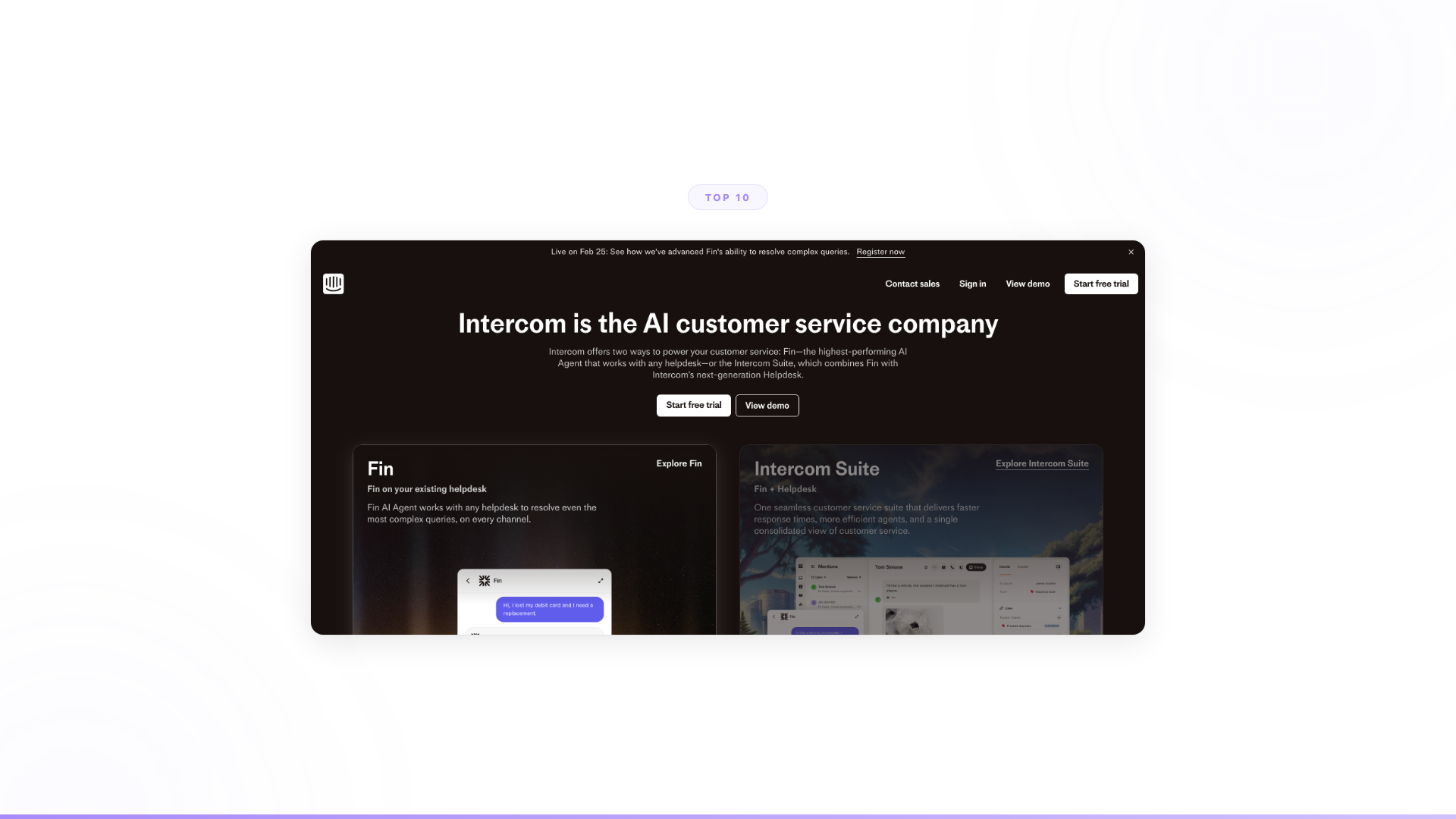
What it is: AI support assistant built into Intercom's messaging platform. Fin answers customer questions using your help center content, past conversations, and custom data sources.
What makes it agentic (and what doesn't):
Fin is an assistant, not an agent. It's good at finding the right answer to a customer question. It doesn't complete the work that question is about. If a customer asks about a return, Fin explains the return policy. An agent would check the order, verify eligibility, initiate the return, update the inventory system, and send the shipping label.
The agent test: No. Fin answers questions. It doesn't complete work.
Pricing: $0.99 per resolution. Requires Intercom subscription.
Best for: Intercom customers who want AI-enhanced support within their existing messaging stack.
5. Kore.ai
What it is: Enterprise conversational AI platform. Named a Leader in the Gartner Magic Quadrant for Conversational AI Platforms. Builds virtual assistants for customer support, IT helpdesk, and HR across voice and digital channels. Strong NLU, dialogue management, and enterprise governance.
What makes it agentic (and what doesn't):
Kore.ai builds more sophisticated conversations than most competitors. Multi-turn dialogues, complex intent hierarchies, conditional logic within conversations. Some integrations allow basic actions — creating tickets, looking up information. But the core architecture is conversation-centric. Kore.ai agents talk. They don't autonomously complete multi-step processes across systems with decision logic and exception handling.
The agent test: Partially. Kore.ai can trigger simple actions from conversations. It doesn't autonomously complete complex workflows.
Pricing: Enterprise licensing, typically $300K+ annually (estimate based on publicly reported enterprise contract ranges).
Best for: Large enterprises that need sophisticated conversation automation with strong NLU across multiple channels and strong governance requirements.
6. Genesys AI
What it is: AI capabilities within the Genesys Cloud CX contact center platform. Includes conversational AI (voicebots and chatbots), predictive routing, agent assist, and journey analytics. Part of a full contact center infrastructure stack.
What makes it agentic (and what doesn't):
Genesys's AI handles conversations and routes them intelligently. Predictive routing matches customers with the best human agent. Bot flows handle self-service for common requests. Some integrations enable basic actions within the Genesys ecosystem. But Genesys is contact center infrastructure. Its AI makes the contact center run better. It doesn't replace the contact center with autonomous agents.
The agent test: Partially. Genesys AI enhances human agents and handles simple self-service. Complex work still routes to humans.
Pricing: Per-seat and usage-based. Enterprise deployments from $100K to several million annually.
Best for: Large enterprises that need full contact center infrastructure with AI-enhanced routing and self-service layered in.
7. Zendesk AI
What it is: AI layer built into Zendesk's support platform. Includes AI agents (bots that resolve tickets), intelligent triage (auto-classify and route), agent assist (suggestions for human agents), and generative AI features.
What makes it agentic (and what doesn't):
Zendesk's "AI agents" are bots that resolve common ticket types within the Zendesk ecosystem. They answer questions, look up order status, and handle straightforward requests. But they operate within Zendesk's ticket paradigm. The cross-system validation, compliance checks, and multi-department workflows that represent the hard part of customer service sit outside what Zendesk AI was built to handle. According to the Zendesk CX Trends Report 2025, AI currently resolves around 30% of all support tickets automatically — the remaining 70% still require human involvement.
The agent test: Partially within Zendesk. For anything that requires work across systems or departments, no.
Pricing: AI features bundled with plans. Advanced AI as add-on. Per-resolution pricing for automated resolutions.
Best for: Zendesk customers who want AI enhancement without adding another vendor to their stack.
8. Yellow.ai
What it is: Conversational AI platform with 135+ languages and 35+ channels. Strong in APAC and Middle East markets. Includes voice AI, enterprise integrations, and multi-language support at scale.
What makes it agentic (and what doesn't):
Yellow.ai's breadth is impressive: more languages and channels than most competitors. Some integrations allow basic actions — checking order status, updating preferences. But the architecture is conversation-first. Yellow.ai excels at understanding customer intent in many languages and generating natural responses. The work behind those conversations stays manual.
The agent test: Mostly no. Yellow.ai automates conversations across more languages than anyone else. It doesn't complete the work behind those conversations.
Pricing: Enterprise licensing with usage-based components.
Best for: Global enterprises with multi-language, multi-channel customer service requirements where conversation coverage (not workflow completion) is the primary need.
9. Forethought
What it is: AI for customer support focused on ticket triage and auto-resolution. Classifies incoming tickets, predicts priority, routes to the right team, and resolves simple cases automatically. Works with Zendesk, Salesforce, and other helpdesk platforms.
What makes it agentic (and what doesn't):
Forethought is smart about triage. It classifies and routes tickets faster and more accurately than manual processes. For simple, pattern-matching cases, it auto-resolves. But it doesn't handle complex cases — the ones that actually cost the most in human time and error rate. And it doesn't complete multi-step operational workflows. Better triage gets work to the right person faster. It doesn't eliminate the work.
Forethought is worth including here precisely because it illustrates where AI adds real value without being agentic. Triage intelligence is a genuine improvement over manual classification. Don't confuse it with workflow completion.
The agent test: No. Forethought routes and triages. The work itself stays with humans.
Pricing: Per-ticket pricing.
Best for: Support teams with high ticket volume that need smarter triage, routing, and simple auto-resolution before the work reaches human agents.
10. Custom build
What it is: Building AI agents from scratch using developer frameworks (LangChain, LangGraph, CrewAI) or LLM APIs directly. Your engineering team designs, builds, deploys, and maintains everything.
What makes it agentic (and what doesn't):
Maximum potential. With enough engineering talent and time, you can build agents that complete any workflow, handle any exception, and integrate with any system. No vendor limitations. The question is whether you have the team and the timeline — and whether the opportunity cost of engineering time is worth it relative to deploying a purpose-built platform.
The agent test: Depends entirely on your engineers. The ceiling is unlimited. The floor is months of development with no production agent.
Pricing: Engineering salaries plus infrastructure. 3-6 months for initial deployment is a realistic baseline for a production-grade agent.
Best for: Organizations with dedicated AI engineering teams, unique technical requirements, and timelines that can absorb 6+ months of development before seeing production results.
Why cross-department scope matters for customer service specifically
The scope comparison — "any department" vs. "customer service only" — is the central differentiator in this list. But it's easy to dismiss as irrelevant if you're a customer service buyer. Worth addressing directly.
Customer service work doesn't stay inside customer service.
A billing dispute requires finance to confirm the credit. A technical issue requires operations to check provisioning status. A new customer onboarding request touches compliance (ID verification), CRM (account creation), and provisioning (access setup) — all in the same workflow. Agents limited to the customer service perimeter hit a wall every time the process requires something from another department.
When that wall is hit, the work goes back to humans. The agent answered the question. A person still does the work.
Orange saw this directly. Their previous chatbot had a 27% drop-out rate. Customers started conversations and abandoned them because the bot couldn't complete the process — it would explain what needed to happen, then require the customer to wait for a human to actually do it. Nexus agents complete the full onboarding workflow: validation, compliance, system updates, and confirmation. 90% autonomous resolution. (Nexus client data)
The scope limit isn't a minor feature gap. It determines whether AI completes work or just describes what needs to be done.
Frequently asked questions
Q: What is the difference between an AI chatbot and an AI customer service agent?
A chatbot answers questions. An AI agent completes work. When a customer contacts you about a billing issue, a chatbot says "your balance is $247.50, would you like to speak with billing?" An agent pulls up the account, identifies the discrepancy, checks billing rules, applies the credit, updates the CRM, sends the confirmation email, and flags the pattern for finance — without a human involved. The conversation is one step in that process, not the whole thing.
Q: What is the best AI agent for customer service?
For complete autonomous workflow execution across customer service and other departments, Nexus ranks first — agents complete the full process from customer contact through validation, decision, execution, and follow-up. For customer-facing work specifically, Wonderful.ai is the most genuinely agentic CX-focused platform. For conversation deflection within existing platforms, Ada, Intercom Fin, and Zendesk AI are widely deployed options.
Q: Can AI agents fully replace human customer service representatives?
For defined, repeatable workflows — billing adjustments, onboarding steps, status checks, standard escalations — genuinely agentic AI resolves 90%+ autonomously. What remains for humans is the 10% that requires judgment: ambiguous situations, relationship management, novel exceptions not covered by existing rules. The role shifts from routine execution to exception handling and oversight. That's what happened at Orange: human agents moved from processing standard cases to managing edge cases and continuous improvement.
Q: How much does AI customer service automation cost?
Pricing varies significantly by model. Ada and Intercom Fin charge $0.99 per resolved conversation. Zendesk AI is an add-on to existing Zendesk plans with per-resolution pricing. Kore.ai typically costs $300K+ annually for enterprise deployments. Nexus is priced per-agent tied to deployed workflows. Wonderful.ai is consumption-based with no setup fees. Yellow.ai and Genesys use enterprise licensing. The pricing model matters as much as the headline number — per-resolution pricing means costs rise proportionally with AI performance, which affects the economics of scaling.
Q: What AI customer service agent works best for multilingual or global enterprises?
Yellow.ai leads on language coverage (135+ languages, 35+ channels) and is the strongest option for enterprises where conversation reach across languages is the primary requirement. Wonderful.ai's "local by design" model — with embedded country teams across 30+ countries — addresses cultural and regulatory nuance beyond translation. Nexus deploys across languages as part of full workflow automation; Orange's deployment spans a multilingual European market.
The real question: chatbot or agent?
Most tools on this list are chatbots calling themselves agents. Some are genuinely agentic within customer service (Wonderful). One is genuinely agentic across the entire enterprise (Nexus).
The distinction isn't semantic. It shows up in outcomes.
A chatbot that deflects 40% of tickets saves your team from answering common questions. The complex cases — the ones that cost the most — still go to humans. The operational work behind every ticket stays manual. You've optimized the conversation. The work is untouched.
An agent that completes 90% of workflows autonomously handles the conversation and the work behind it: validation, decisions, system updates, exception handling, confirmation. The human agents who used to spend 80% of their time on routine processes now handle the 10% that genuinely requires human judgment.
Gartner notes that the future of customer service is shifting from conversation automation to autonomous task completion — where AI doesn't just answer queries but executes the processes behind them. That transition is already happening. Orange's results are one example. The gap between a chatbot answering a question and an agent completing the work behind that question isn't a feature gap. It's a category gap. No amount of NLU improvement or conversation design closes it.
If you need a better chatbot: Pick the one that fits your stack. Ada, Intercom Fin, Zendesk AI, Yellow.ai. They're all capable at conversations.
If you need genuine AI agents that complete customer service work: Wonderful does this within CX. Nexus does this across the enterprise.
If you need AI agents that complete work across every department: That's what Nexus was built for. Customer service is one workflow. Sales, compliance, onboarding, HR, and operations each have hundreds more.
Worth exploring?
Every Nexus engagement starts with a 3-month proof of concept tied to measurable outcomes. Forward Deployed Engineers embed with your team from day one. You see the results before committing. You can exit anytime.
100% of clients who started a POC converted to an annual contract.
See all Wonderful alternatives →