Top 10 Dust Alternatives for Enterprise AI Assistants in 2026
Dust connects knowledge to chat. But if you need AI that completes workflows, not just answers questions, here are 10 alternatives ranked by what they actually deliver in production.
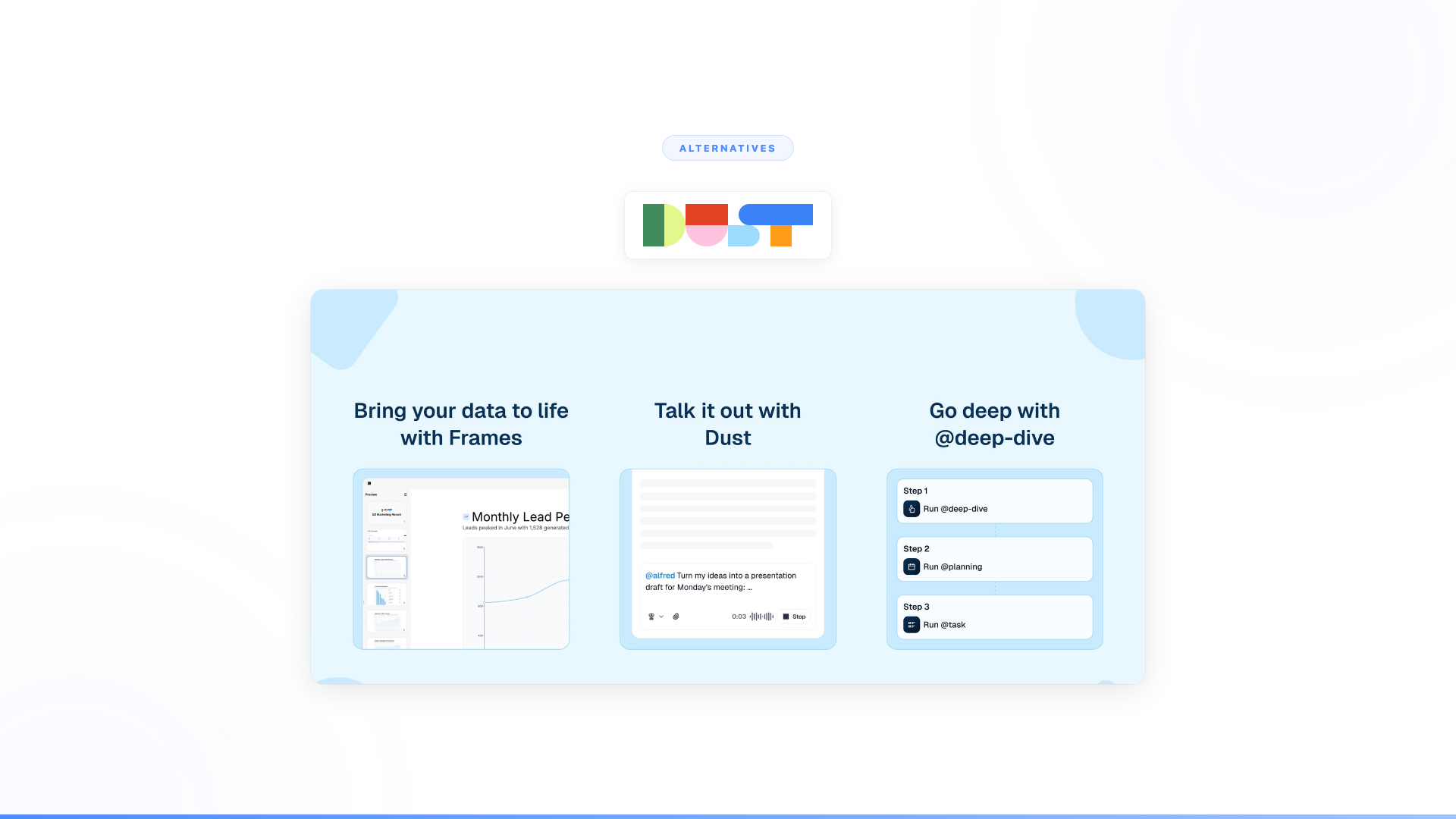
The best Dust alternatives in 2026 are Nexus, Glean, Microsoft Copilot, Langdock, ChatGPT Enterprise, Claude for Enterprise, Notion AI, Guru, Moveworks (ServiceNow), and custom build. Dust is an enterprise AI assistant platform — co-founded by ex-OpenAI and ex-Stripe engineers and backed by Sequoia Capital — that connects internal knowledge sources to large language models. Alternatives range from deeper enterprise search tools to autonomous agent platforms that complete workflows rather than just answering questions.
If you're looking for a better assistant, several alternatives on this list will fit. If you're looking for AI that actually completes work, you need a different category entirely. Both are valid. The distinction matters because it determines whether the alternative you pick will hit the same ceiling Dust does.
Here are 10 alternatives, organized by what they actually deliver.
Dust Alternatives: Quick Comparison Table (2026)
| Tool | Category | Best for | Completes workflows? | Pricing model |
|---|---|---|---|---|
| Nexus | Autonomous agent platform | Full enterprise workflow automation across any department | Yes, end-to-end | Per-agent |
| Microsoft Copilot | AI assistant | Individual productivity inside Microsoft 365 | No | Per-user ($30/mo) |
| Glean | Enterprise search + assistant | Finding information across enterprise systems | No | Per-user |
| Langdock | AI assistant platform | European teams wanting LLM flexibility | No | Per-user |
| ChatGPT Enterprise | AI assistant | General-purpose AI assistance with data privacy | No | Per-user |
| Claude for Enterprise | AI assistant | Teams wanting strong reasoning and analysis | No | Per-user |
| Notion AI | Workspace AI | Teams already using Notion for knowledge management | No | Per-user add-on |
| Guru | Knowledge management + AI | Internal knowledge verification and delivery | No | Per-user |
| Moveworks (ServiceNow) | IT self-service assistant | IT helpdesk ticket deflection | Partial (IT only) | Per-employee |
| Custom build | Developer framework | Engineering teams building from scratch | Depends on team | Engineering cost |
What Dust Does Better Than Its Alternatives
Before evaluating alternatives, it's worth understanding what Dust is genuinely good at.
Dust was co-founded by Stanislas Polu — who spent three years on OpenAI's research team working on mathematical reasoning in language models — and Gabriel Hubert, who led product at Alan after a stint at Stripe. The company raised a $16M Series A led by Sequoia Capital in 2024, bringing total funding to $21.5M. [Source: TechCrunch]
Dust's core strength is letting teams build and customize AI assistants that are connected to internal knowledge sources — Notion, Slack, GitHub, Confluence, Google Drive — through a clean, model-agnostic interface. Non-technical teams can configure these assistants without engineering help. The product ships quickly and is thoughtfully built.
Where Dust fits well:
- Teams that want custom AI assistants built on top of internal knowledge
- Organizations where individual productivity (drafting, summarizing, searching) is the primary use case
- Smaller enterprise or scale-up teams wanting a fast, flexible assistant layer
Where alternatives may fit better:
- Enterprise-wide search across 100+ systems (Glean)
- IT helpdesk automation (Moveworks)
- AI that completes multi-step workflows end-to-end, not just answers questions (Nexus)
Top 10 Dust Alternatives for Enterprise AI Assistants
1. Nexus: Best Dust Alternative for Autonomous Workflow Completion
What it is: An autonomous agent platform paired with Forward Deployed Engineers who embed with your team. Nexus agents complete entire business workflows end-to-end: collecting data from multiple systems, validating against business rules, making decisions within guardrails, handling exceptions, and executing actions. Any department. Any workflow. Business teams build and own the agents.
Why enterprises move from Dust to Nexus:
The distinction isn't about which tool has better features. It's about categories. Dust helps individuals find information and draft content. Nexus agents complete the full workflows that information supports. An assistant helps someone look up the customer onboarding procedure. An agent performs the onboarding: collecting data, validating compatibility, routing exceptions, notifying stakeholders, and logging the outcome. One answers questions about work. The other does the work.
What it looks like in production:
- Orange Group (multi-billion euro telecom, 120,000+ employees): Business team built autonomous customer onboarding agents. Deployed across multiple European markets in 4 weeks. 50% conversion improvement. 90% autonomous resolution. 100% team adoption. They previously used a CX chatbot with a 27% drop-out rate.
- Lambda (enterprise AI infrastructure company): Their CTO considered building internally but chose Nexus. Agents now monitor 12,000+ accounts, synthesize buying signals, and surface pipeline opportunities autonomously. 24,000+ hours of research capacity added annually. Built by a non-engineer.
- European telecom (13,000+ employees): Spent 6 months with Copilot Studio, couldn't deliver a single production use case. Deployed a dozen Nexus agents in the same timeframe. 40% support volume freed across millions of interactions.
How it differs from Dust specifically:
Dust is per-seat ($29/user/month). Nexus is per-agent, tied to value delivered. An agent serving millions of customers costs the same whether you have 500 or 50,000 employees. Dust connects to knowledge sources (Notion, Slack, Drive) for read access. Nexus connects to 4,000+ enterprise systems with full read and write access. Dust requires employees to open a chat and ask questions. Nexus agents deploy into the channels teams already use (Slack, Teams, WhatsApp, email, phone, web) and complete work as it arrives.
Best for: Enterprises that need AI to complete high-volume business processes, not just help individuals find answers. Sales, support, compliance, HR, onboarding, operations, reporting.
Full Nexus vs Dust comparison -->
2. Microsoft Copilot
What it is: Microsoft's AI assistant embedded across Microsoft 365. Drafts emails in Outlook, summarizes meetings in Teams, generates slides in PowerPoint, analyzes data in Excel.
How it compares to Dust: Same category, different ecosystem. Copilot is locked to Microsoft 365. Dust is ecosystem-agnostic and connects to a broader range of knowledge sources. For teams not fully embedded in Microsoft, Dust is more flexible. For Microsoft-heavy organizations, Copilot is the native option.
Why it might not solve the problem: If you're leaving Dust because assistants haven't delivered business transformation, Copilot is the same category with tighter ecosystem constraints. According to Gartner research on enterprise AI adoption, only a fraction of organizations that piloted Copilot moved to larger-scale deployment. [Source: Gartner, 2024] The structural ceiling is the same.
Pricing: $30/user/month (Microsoft 365 Copilot).
Best for: Microsoft 365 organizations that want embedded AI assistance and don't need cross-system workflow completion.
See our full Copilot alternatives breakdown -->
3. Glean: Best Dust Alternative for Enterprise Search
What it is: Enterprise AI search and knowledge assistant. Connects to 100+ enterprise data sources and lets employees search across all of them with natural language. Also generates answers from your company's knowledge.
How it compares to Dust: Glean is stronger at enterprise-wide search. It indexes more systems and is purpose-built for finding information across a large organization. Dust is more focused on building custom assistants that employees interact with conversationally. If the core problem is "our people can't find anything," Glean is the more targeted tool.
Glean raised $150M at a $7.2B valuation in June 2025 and reported over $100M in ARR — a strong signal that enterprise AI search has become a distinct, high-demand category. The platform now powers more than 100 million agent actions annually. [Source: TechCrunch]
Why it might not solve the problem: Finding information is one step in a larger process. Glean tells you the answer. It doesn't act on it. If the bottleneck is what happens after someone finds the information — validation, decisions, cross-system actions, exception handling — Glean doesn't reach there.
Pricing: Per-user, custom enterprise pricing. Reportedly $15–25/user/month depending on scale.
Best for: Enterprises where information discovery across many systems is the primary bottleneck.
Full Nexus vs Glean comparison -->
4. Langdock
What it is: A European AI assistant platform that lets teams use multiple LLMs (GPT-4, Claude, Mistral) through a single interface with enterprise security controls. Based in Berlin. SOC 2, GDPR-compliant.
How it compares to Dust: Similar category and similar positioning. Both are European-influenced, both connect to company knowledge, both focus on AI-assisted productivity for teams. Langdock differentiates on LLM flexibility (multiple model providers from one interface) and its German/EU data residency focus. Dust differentiates on its assistant builder and broader integration ecosystem.
Why it might not solve the problem: Same structural ceiling as Dust. Langdock is an assistant that helps individuals interact with LLMs using company context. It doesn't complete workflows, orchestrate across systems, or make autonomous decisions. A better assistant is still an assistant.
Pricing: Per-user, custom enterprise pricing.
Best for: European organizations that want LLM flexibility, strong data residency controls, and a team-level AI assistant.
5. ChatGPT Enterprise
What it is: OpenAI's enterprise version of ChatGPT. Adds admin controls, SSO, data privacy guarantees (no training on your data), higher usage limits, and a shared workspace for teams.
How it compares to Dust: ChatGPT Enterprise is a more powerful general-purpose assistant but less customizable for specific team workflows. Dust lets you build role-specific assistants connected to your company's knowledge. ChatGPT Enterprise gives everyone the same powerful assistant without deep knowledge integration. Different tradeoffs.
Why it might not solve the problem: Still an assistant. Powerful for individual tasks (writing, analysis, coding, research) but doesn't complete multi-step business processes, orchestrate across enterprise systems, or operate autonomously. The employee drives every interaction.
Pricing: Custom enterprise pricing (reportedly $60/user/month).
Best for: Organizations that want a powerful general-purpose AI assistant with enterprise security and don't need deep knowledge integration or workflow completion.
6. Claude for Enterprise
What it is: Anthropic's enterprise offering. Known for strong reasoning, long-context analysis, and careful outputs. Includes admin controls, SSO, and data privacy guarantees.
How it compares to Dust: Claude excels at deep analysis and reasoning tasks. For work that requires understanding long documents, complex analysis, or nuanced writing, Claude is arguably stronger than the models Dust uses by default. But like ChatGPT Enterprise, it's a general-purpose assistant without Dust's custom assistant builder or knowledge integration layer.
Why it might not solve the problem: Same category ceiling. Excellent for individual knowledge work but doesn't complete business processes across systems autonomously.
Pricing: Custom enterprise pricing.
Best for: Teams doing complex analysis, research, and reasoning where output quality matters more than workflow integration.
7. Notion AI
What it is: AI features built into Notion's workspace platform. Summarizes pages, answers questions from your Notion knowledge base, generates content, and helps manage information within the Notion ecosystem.
How it compares to Dust: If your team already lives in Notion, Notion AI is the native option. It understands your Notion workspace deeply and helps you work within it. Dust is broader — it connects to Notion plus Slack, Drive, Confluence, and others — but requires a separate interface. For Notion-centric teams, the native experience may feel more natural.
Why it might not solve the problem: Even more constrained than Dust. Notion AI operates within Notion. It doesn't reach into Salesforce, SAP, or your CRM. And it's an assistant: it helps individuals work faster within a single tool, not complete cross-system workflows.
Pricing: $10/user/month as a Notion add-on.
Best for: Notion-centric teams that want AI-assisted productivity within their existing workspace.
8. Guru
What it is: AI-powered knowledge management platform. Captures, verifies, and delivers company knowledge to employees in context. Strong at ensuring knowledge stays accurate and up-to-date.
How it compares to Dust: Guru focuses specifically on knowledge management: making sure the right information gets to the right person at the right time, with verification workflows to keep content accurate. Dust is broader (conversational AI that can draft, summarize, and search) but doesn't have Guru's verification and content management layer.
Why it might not solve the problem: Guru solves knowledge access and accuracy. It doesn't complete business processes. If the problem is "our support team doesn't have the right answers," Guru helps. If the problem is "our support process requires too many manual steps across too many systems," Guru doesn't reach there.
Pricing: Starts at $15/user/month. Enterprise pricing custom.
Best for: Teams where knowledge accuracy, verification, and delivery are the primary challenge.
9. Moveworks (ServiceNow): Best Dust Alternative for IT Self-Service AI
What it is: AI-powered IT self-service assistant, now part of ServiceNow following the acquisition announced in March 2025. Resolves or routes employee IT requests automatically. Purpose-built for IT helpdesk ticket deflection.
How it compares to Dust: Completely different focus. Dust is a general-purpose assistant for knowledge access. Moveworks is specialized for IT support. For IT helpdesk automation, Moveworks is significantly more capable. For everything else, it doesn't apply.
Why it might not solve the problem: Scope. Moveworks handles IT and employee service requests. It doesn't touch sales, customer onboarding, compliance monitoring, or any process outside the IT/HR helpdesk. Since the ServiceNow acquisition, Moveworks is now positioned as part of a broader ITSM suite rather than a standalone AI product. [Source: ServiceNow press release]
Pricing: Per-employee licensing ($100–200/employee/year).
Best for: ServiceNow-native organizations where IT ticket deflection is the primary AI use case.
Full Nexus vs Moveworks comparison -->
10. Custom Build (LangChain, CrewAI)
What it is: Open-source frameworks for building AI applications from scratch. Your engineering team designs the architecture, writes the code, handles deployment, monitoring, security, and maintenance.
How it compares to Dust: Maximum flexibility but maximum effort. You can build exactly what you need, including things that go beyond the assistant category. For organizations with strong AI engineering teams, building custom can produce something Dust can't: autonomous agents that complete workflows.
Why it might not solve the problem: Most enterprises don't have surplus AI engineering capacity. Even engineering-led organizations often find the opportunity cost of diverting core technical talent to internal tooling too high — particularly when purpose-built platforms can achieve production results in weeks rather than months. Custom builds also require you to solve governance, security, compliance, monitoring, and maintenance yourself.
Pricing: Engineering salaries + infrastructure. Typically 3–6 months for a first production agent, with ongoing maintenance costs.
Best for: Organizations with dedicated AI engineering teams, unique technical requirements, and timelines that can absorb 6+ months of development.
So Which Dust Alternative Should You Actually Choose?
It depends on what problem you're solving. Being precise about that saves months of evaluation.
If you're evaluating Dust alternatives purely for internal knowledge Q&A and document search, Glean (enterprise search) and Guru (knowledge verification) are your closest alternatives. They share the same structural ceiling as Dust — they help individuals, they don't complete workflows — but they may fit your specific needs better.
If the problem is knowledge access and you want LLM flexibility or better reasoning, look at Langdock (multi-LLM, EU focus), Claude for Enterprise (reasoning quality), or ChatGPT Enterprise (general-purpose power). These are solid assistants for individual productivity.
If the problem is IT support automation, Moveworks is purpose-built for that. Specialized and effective within its scope, though now embedded within the ServiceNow platform.
If the problem is that AI assistants haven't delivered the business process transformation leadership expected — and you need AI that completes high-volume, multi-step workflows across systems while making decisions, handling exceptions, and maintaining full compliance — that's a different category of problem entirely. That's what Nexus was built for.
Orange didn't need a better assistant. They needed agents that complete customer onboarding autonomously across multiple European markets — 50% conversion improvement, 4-week deployment, 100% team adoption.
An enterprise AI infrastructure company didn't need help drafting research summaries. They needed agents that monitor 12,000+ accounts and surface pipeline opportunities autonomously. Agents now handle research capacity that previously required thousands of analyst hours annually.
A major European telecom didn't need another pilot. They spent 6 months with Copilot Studio and couldn't deliver a single production use case. Then they deployed a dozen Nexus agents in the same timeframe. 40% of support volume freed.
The gap between an assistant and an agent isn't a feature gap. It's a category gap. No amount of improving the assistant closes it.
Frequently Asked Questions
What is Dust and how does it work for enterprise AI?
Dust is an enterprise AI assistant platform that connects internal knowledge sources — Notion, Slack, GitHub, Confluence, Google Drive — to large language models, and lets teams build and deploy customized AI assistants through a chat interface. It was co-founded by Stanislas Polu (ex-OpenAI research) and Gabriel Hubert (ex-Stripe), and raised a $16M Series A led by Sequoia Capital in 2024. Dust is best suited for teams that want AI-assisted individual productivity: searching internal knowledge, drafting content, summarizing documents.
What is the difference between Dust and Glean for enterprise knowledge?
Both Dust and Glean connect enterprise knowledge to AI, but they take different approaches. Glean is an enterprise search platform purpose-built to index and search across 100+ enterprise systems — it's optimized for finding the right information across a large, fragmented organization. Dust is a conversational AI platform focused on building custom assistants that interact with a curated set of knowledge sources. Glean is better for broad search across many systems; Dust is better for building team-specific assistants with custom behavior.
Is Dust a better alternative to Microsoft Copilot for internal knowledge AI?
For teams outside the Microsoft ecosystem, Dust is generally more flexible. Copilot is tightly embedded in Microsoft 365 and doesn't extend well beyond it. Dust is model-agnostic, connects to a wider range of knowledge sources, and can be customized per team or role. However, both are AI assistants with the same structural ceiling: they help individuals find information and complete tasks, but don't complete multi-step business processes autonomously.
What happened to Moveworks after the ServiceNow acquisition?
ServiceNow announced its acquisition of Moveworks in March 2025, integrating the AI self-service platform into the ServiceNow product suite. Moveworks remains focused on IT and employee service request automation, but is now positioned as part of ServiceNow's ITSM platform rather than a standalone product. For organizations already using ServiceNow, this strengthens the native AI capabilities. For those evaluating Moveworks as an independent tool, the acquisition means a tighter platform dependency.
Can Dust integrate with Slack, Notion, and Google Workspace?
Yes. Dust natively integrates with Slack, Notion, Google Drive, GitHub, Confluence, and several other knowledge sources. These integrations are read-only — Dust pulls content to answer questions and assist with tasks, but doesn't write back to connected systems or trigger actions across them. This is a meaningful constraint for teams that need AI to both read and act on enterprise data.
Worth Exploring?
Every Nexus engagement starts with a 3-month proof of concept tied to measurable outcomes. Forward Deployed Engineers embed with your team from day one. You see the results before committing. You can exit anytime.
See the full Nexus vs Dust comparison -->