Top 10 Deloitte AI Alternatives for Enterprise AI in 2026
Deloitte AI charges $2,500+/day per consultant and takes 6-12 months to deliver. Here are 10 alternatives that get enterprise AI into production faster, from autonomous agent platforms to in-house builds.
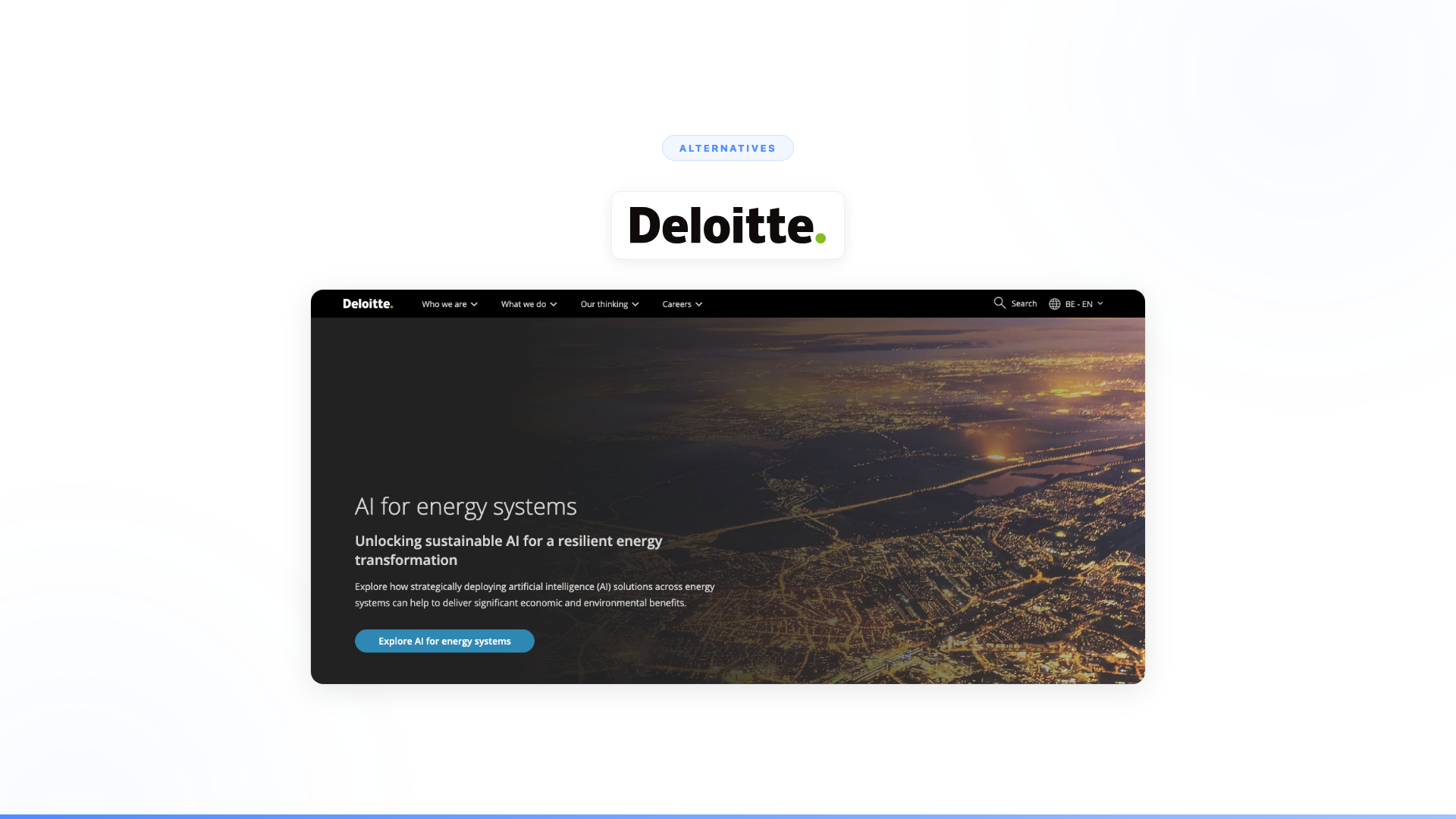
The best Deloitte AI alternatives in 2026 include Nexus, Accenture AI, McKinsey QuantumBlack, BCG X, PwC AI, Capgemini AI, Cognizant AI, Infosys Topaz, Thoughtworks, and in-house build. Deloitte is one of the largest AI consulting practices globally — $67.2B in revenue, 450,000+ employees — with day rates typically $2,500+ per consultant per day. Alternatives range from competing Big 4 and strategy firms to autonomous agent platforms that deploy AI in weeks without ongoing consulting dependency.
Most enterprises searching for Deloitte AI alternatives aren't doing it because Deloitte lacks talent. They're doing it because the model doesn't match the urgency.
The pattern repeats across industries. Leadership approves a Deloitte AI engagement. A team of 5–8 consultants starts discovery. Weeks turn into months. The first deliverables are strategy documents and architecture diagrams. By month six, the solution is still in development. By month nine, it is in UAT. By month twelve, it is in production for the original requirements. When the business needs changes, a change request goes in and the team waits for consultant availability.
Total cost: $1M–$2M+. Time to first production agent: 6–12 months. Ongoing dependency: built in by design.
The issue isn't competence. Deloitte employs genuinely talented people and its AI Institute publishes some of the most widely cited enterprise AI research globally. The issue is structural. Consulting firms earn revenue from consultant hours billed. Every phase — discovery, design, build, testing, change management, handover — is billable. There is no structural incentive to compress a 9-month engagement into 9 weeks.
According to research across enterprise AI programs, 88% of AI pilots never make it to production. The consulting billing model — which rewards time spent rather than results delivered — is one contributing factor. The global AI consulting services market is projected to grow from $22.3 billion in 2025 to over $257 billion by 2033 (MarketDataForecast). Whether that spend delivers proportional results is what enterprises are increasingly questioning.
If you have hit that wall, here are 10 alternatives worth evaluating.
Deloitte AI Alternatives: Quick Comparison Table (2026)
| Alternative | Category | Time to production | Who owns the result | Cost model |
|---|---|---|---|---|
| Nexus | Agent platform + FDEs | 2–6 weeks | Your business team | Per-agent |
| Accenture AI | Consulting + technology | 4–12 months | Accenture-managed | Day rates ($250–450/hr) |
| McKinsey QuantumBlack | Strategy + analytics | 6–18 months | McKinsey-guided | Day rates ($500–700/hr) |
| PwC AI | Consulting + audit | 4–12 months | Shared | Day rates ($250–450/hr) |
| BCG X | Strategy + digital build | 4–10 months | BCG-managed | Day rates ($400–600/hr) |
| Capgemini AI | IT services + AI | 3–9 months | Capgemini-operated | Project-based |
| Cognizant AI | IT services + AI | 3–9 months | Shared | Blended rates |
| Infosys Topaz | IT services + AI | 3–9 months | Infosys-managed | Blended rates |
| Thoughtworks | Engineering consultancy | 3–6 months | Client-owned | Day rates ($200–350/hr) |
| In-house build | Internal engineering | 3–12+ months | Your team | Engineering salaries |
Day rates vary by seniority, engagement type, and geography. Figures represent typical senior consultant rates based on industry benchmarks.
Top 10 Deloitte AI Alternatives for Enterprise AI Strategy
1. Nexus: Best Deloitte AI Alternative for Autonomous Agent Deployment
What it is: An enterprise AI agent platform paired with Forward Deployed Engineers who embed with your team. Nexus agents complete entire business workflows end-to-end: collecting data, validating against systems, making decisions within guardrails, handling exceptions, and executing actions. Any department. Any workflow. Business teams build and own the agents.
Why enterprises switch from Deloitte to Nexus:
The structural difference matters more than any feature comparison. Deloitte's model charges $2,500+/day per consultant across 6–12 month engagements where the firm earns more when projects take longer. Nexus replaces that with a platform where Forward Deployed Engineers are included (not billed separately), your business teams own the result from day one, and production happens in weeks.
FDEs aren't advisors who coordinate between your business team and a development group somewhere else. They're builders who implement directly on Nexus's own full-stack platform. The person sitting with your team is the same person configuring the agent, wiring integrations, and pushing to production. No translation layer. No advisory overhead.
What it looks like in production:
- Orange Group (multi-billion euro telecom, 120,000+ employees): Business team built autonomous customer onboarding agents. Deployed across multiple European markets in 4 weeks. 50% conversion improvement and roughly $6M+ in yearly revenue impact. In a typical Deloitte engagement, week 4 is when discovery is wrapping up.
- European telecom (13,000+ employees): Spent 6 months with Copilot Studio without delivery. Deployed a dozen Nexus agents in 12 weeks. 40% support volume freed across millions of interactions.
Pricing: Per-agent, tied to value delivered. FDEs included. Not per-seat, not per-hour. 100% POC-to-contract conversion rate.
Best for: Enterprises that need AI agents completing business workflows in production within weeks, with their team owning the outcome and without creating a consulting dependency.
Full Nexus vs Deloitte comparison -->
2. Accenture AI
What it is: One of the world's largest technology and consulting firms with a massive AI practice. Accenture reported $69.7B in revenue and employs over 77,000 people trained in AI and data. They launched AI Refinery — a platform designed to help enterprises build, deploy, and scale AI agents across industry-specific solutions — and tripled their generative AI revenue to $2.7B in fiscal 2025.
How it compares to Deloitte: Accenture is closer to implementation than Deloitte. Where Deloitte's power structure is advisory-led, Accenture has a larger technology delivery workforce. They write more code and manage more production systems. But the economic model is the same: day rates, multi-month timelines, teams of consultants billed per engagement.
Why it might not solve the problem: Replacing one consulting firm with another doesn't change the structural dynamics. Accenture's AI engagements still follow the consulting cadence: discovery, design, build, test, deploy, handover. Each phase is billable. Requirements changes trigger re-scoping. And the firm's scale means your project competes for attention with thousands of others.
Pricing: Day rates ($250–450/hr). Enterprise AI projects: $300K–$2M+.
Best for: Organizations that want a consulting partner with stronger technology delivery than Deloitte, and are comfortable with consulting economics and timelines.
Full Nexus vs Accenture comparison -->
3. McKinsey / QuantumBlack
What it is: McKinsey's AI and advanced analytics arm. QuantumBlack brings data science and engineering capability to McKinsey's strategy consulting. Known for CEO-level influence, rigorous analytical frameworks, and premium positioning.
How it compares to Deloitte: Higher price point, stronger strategic influence, weaker implementation capacity. McKinsey shapes decisions at the board level better than almost anyone. But their core competency is strategy, not production systems. QuantumBlack has genuine data science talent, but the firm's DNA is advisory. Consultants define what should be built, then hand specifications to internal teams or systems integrators who often lack the business context to build it well.
Why it might not solve the problem: If you are leaving Deloitte because implementation took too long, McKinsey will take longer. Their value is in framing the problem and defining the strategy. The execution gap between a McKinsey AI strategy deck and production AI agents is often 12–18 months and another vendor.
Pricing: Day rates ($500–700/hr). Engagement minimums often $500K+.
Best for: Organizations that need the AI strategy defined and want McKinsey's brand credibility for board-level alignment. Not for organizations that need production agents soon.
Full Nexus vs McKinsey comparison -->
4. PwC AI
What it is: PwC's AI practice, part of their broader technology consulting and advisory business. $55.4B in revenue globally. Deep in audit, tax, and risk advisory, with growing AI capabilities. PwC has embedded AI across their assurance practice and built industry-specific AI solutions for financial services, healthcare, and government.
How it compares to Deloitte: Similar Big 4 model, similar pricing, similar timelines. PwC has slightly stronger positioning in audit-integrated AI and risk advisory. Deloitte has broader technology partnerships and more AI-specific research infrastructure through the Deloitte AI Institute. Both share the fundamental consulting economics: day rates, phased delivery, scope-driven billing.
Why it might not solve the problem: Switching from Deloitte to PwC is switching consultants, not switching models. The day-rate structure, multi-month timelines, and dependency dynamics are the same. If the model itself was the issue, PwC won't fix it.
Pricing: Day rates ($250–450/hr). Similar to Deloitte.
Best for: Organizations where PwC already provides audit or tax services and wants to consolidate AI consulting within an existing relationship. Not a model change.
Deloitte vs PwC AI: detailed comparison -->
5. BCG X
What it is: BCG's technology build and design arm. Combines BCG's strategy consulting with engineering and design teams that build digital products. BCG X has genuine engineers alongside consultants, aiming to close the strategy-to-execution gap.
How it compares to Deloitte: BCG X is arguably closer to execution than either McKinsey or Deloitte. They have product managers, engineers, and designers who build software. But BCG's economics are still consulting-driven: premium day rates, phased engagements, and a revenue model tied to hours billed.
Why it might not solve the problem: BCG X builds products, but within a consulting wrapper. Engagements still follow consulting timelines. The people who sell and govern the engagement are strategy consultants, not product leaders. For enterprise AI agents specifically, you're paying strategy-firm rates for work that could be done in weeks on a purpose-built platform.
Pricing: Day rates ($400–600/hr). Project minimums often $300K+.
Best for: Organizations that want strategy and build from one firm, with budget for premium consulting rates.
Full Nexus vs BCG X comparison -->
6. Capgemini AI
What it is: European IT services and consulting firm with a growing AI practice. $22B+ in revenue. Capgemini brings scale in IT outsourcing, system integration, and managed services, with AI capabilities layered on top. Their Engineering and Technology division handles AI-specific work.
How it compares to Deloitte: Lower day rates, larger delivery teams, more offshore capacity. Capgemini is more implementation-heavy and less strategy-heavy than Deloitte. They will build and operate systems, often with significant offshore engineering. The trade-off is that strategic depth and board-level influence are weaker.
Why it might not solve the problem: Capgemini's AI delivery model is still services-driven. Projects follow waterfall or agile-waterfall timelines. Onshore consultants scope and design, offshore teams build. The coordination overhead between onshore and offshore adds time. And the ownership question persists: when the engagement ends, who maintains it?
Pricing: Project-based, blended rates ($200–350/hr). Lower than Big 4, higher than pure offshore.
Best for: Organizations that want IT-services-style AI delivery at lower rates than Big 4, with tolerance for longer timelines and offshore coordination.
Full Nexus vs Capgemini comparison -->
7. Cognizant AI
What it is: Major IT services firm ($19B+ revenue) with growing AI and digital capabilities. Cognizant combines consulting with large-scale delivery, strong in financial services, healthcare, and manufacturing. Their AI practice includes data engineering, ML ops, and generative AI solutions.
How it compares to Deloitte: Cognizant is cheaper per hour, with larger delivery teams and more offshore engineering capacity. Less strategic influence, more implementation muscle. For organizations where the primary need is building and running AI systems rather than defining strategy, Cognizant offers a more cost-effective services model.
Why it might not solve the problem: Scale does not equal speed. Cognizant's large delivery teams still follow services-company cadences: requirements gathering, design phases, development sprints, QA cycles, deployment windows. A large AI practice doesn't mean your project gets an outsized team — it means a team of 5–15 working through the same phased process as any other services firm.
Pricing: Blended rates ($150–300/hr). Competitive with other IT services firms.
Best for: Cost-conscious enterprises that want large-scale AI implementation support at lower rates than consulting firms.
Full Nexus vs Cognizant comparison -->
8. Infosys Topaz
What it is: India-headquartered IT services giant ($18B+ revenue) with a dedicated AI and automation practice. Infosys Topaz is their AI platform initiative, combining generative AI, analytics, and automation. They bring massive engineering scale and competitive offshore pricing.
How it compares to Deloitte: Significantly lower cost per hour. Much larger engineering workforce. Weaker strategic and board-level influence. Infosys excels at building and running large-scale systems at competitive rates. For pure technology implementation, they can deliver more engineering hours per dollar than any Big 4 firm.
Why it might not solve the problem: Lower cost does not mean faster time to value. Infosys projects still follow multi-phase delivery timelines, often with complex coordination between onshore architects and offshore development teams. Communication overhead, timezone gaps, and organizational complexity can extend timelines. For enterprise AI agents specifically, having more engineers does not help when the bottleneck is business context, not code volume.
Pricing: Blended rates ($100–250/hr). Among the lowest in the enterprise AI services space.
Best for: Large-scale AI implementation where cost efficiency is the primary driver and the organization can manage offshore coordination.
Full Nexus vs Infosys comparison -->
9. Thoughtworks
What it is: Technology consulting firm focused on software engineering excellence. Smaller than the Big 4 or major IT services firms, but with a strong engineering culture. Known for Agile practices, clean code, and engineering rigor. Their AI practice emphasizes responsible AI and production-grade engineering.
How it compares to Deloitte: Thoughtworks is closer to engineering than consulting. Their people write code. They pair-program with your team. They care about test coverage and deployment pipelines. For organizations frustrated by the advisory layer between Deloitte consultants and actual technical work, Thoughtworks is a meaningful step toward builders over advisors.
Why it might not solve the problem: Still a services company. Still billed by the day. Still requires multi-week engagements to deliver production systems. The engineering culture is genuinely better, but the economic model is the same: you pay for time, and the firm's revenue grows when engagements are larger and longer. Thoughtworks also lacks the enterprise platform infrastructure that makes agent deployment fast. They will build something excellent, but they will build it from scratch.
Pricing: Day rates ($200–350/hr). Higher than IT services firms, lower than Big 4.
Best for: Organizations that want genuinely strong engineering talent embedded with their team, with tolerance for services-company timelines.
Full Nexus vs Thoughtworks comparison -->
10. In-house build
What it is: Your own engineering team builds AI agents from scratch using open-source frameworks (LangChain, LangGraph, CrewAI) or cloud provider tools (AWS Bedrock, Google Vertex AI, Azure AI). Maximum control, maximum flexibility, maximum engineering cost.
How it compares to Deloitte: No consulting dependency. Full control over architecture, data, and roadmap. Your team owns everything. The trade-off is that you need the engineering team, the AI expertise, the platform infrastructure, the compliance framework, and the willingness to divert engineers from your core product.
Why it might not solve the problem: Most enterprises don't have surplus AI engineering capacity. The engineers you have are working on your core product, not internal workflow automation. Custom builds also require you to solve governance, security, compliance, monitoring, integrations, and maintenance yourself. Even technology companies with world-class engineering teams have evaluated build-vs-buy and chosen to buy, because the opportunity cost of diverting engineering from core product development is too high.
Pricing: Engineering salaries + infrastructure. 3–6 months for a first production agent. Ongoing maintenance is permanent.
Best for: Organizations with dedicated AI engineering teams, unique technical requirements, and the ability to absorb 6+ months of development without impacting core product work.
Consulting Day Rates Compared: Deloitte vs. McKinsey vs. Accenture vs. Alternatives
One of the most important data points for any enterprise evaluating AI consulting spend is the actual cost per day. Day rates vary significantly by firm tier, seniority level, and geography — but the ranges below reflect typical senior consultant benchmarks based on industry observation:
| Firm | Typical day rate (senior consultant) | Engagement minimum | Time to first production agent |
|---|---|---|---|
| McKinsey / QuantumBlack | $4,000–$5,600/day | $500K+ | 6–18 months |
| BCG X | $3,200–$4,800/day | $300K+ | 4–10 months |
| Deloitte AI | $2,000–$3,600/day | $250K+ | 6–12 months |
| PwC AI | $2,000–$3,600/day | $250K+ | 4–12 months |
| Accenture AI | $2,000–$3,600/day | $300K+ | 4–12 months |
| Capgemini AI | $1,600–$2,800/day | $150K+ | 3–9 months |
| Cognizant AI | $1,200–$2,400/day | $100K+ | 3–9 months |
| Infosys Topaz | $800–$2,000/day | $100K+ | 3–9 months |
| Thoughtworks | $1,600–$2,800/day | $150K+ | 3–6 months |
| Nexus | Per-agent pricing | POC included | 2–6 weeks |
Rates vary by seniority, engagement type, and geography. Figures represent estimated typical senior consultant rates based on industry benchmarks and are not official published figures from any firm.
When Deloitte AI Consulting Is the Right Choice
Deloitte is not the wrong choice for every organization. There are specific situations where their model genuinely fits.
Regulated industries requiring governance frameworks. Deloitte's AI governance and responsible AI practice is one of the most developed in the Big 4. For banking, healthcare, and public sector organizations that need AI governance consulting tightly coupled with audit and compliance infrastructure, Deloitte has invested heavily here. The Deloitte AI Institute publishes substantive research on enterprise AI adoption trends, governance, and responsible deployment.
Large-scale transformation programs. If the AI initiative is part of a broader multi-year digital transformation involving strategy, technology, operations, and change management simultaneously, Deloitte has the workforce size and cross-functional capacity to run that program. Few firms can.
Public sector contracts. Deloitte has significant US federal and UK government AI contracts. For public sector buyers, where procurement processes favor established Big 4 relationships and where compliance requirements are stringent, Deloitte is a natural fit.
When you need board-level credibility. For organizations where internal alignment requires an externally recognized name, Deloitte's brand carries weight with boards and executive teams that a newer platform or boutique firm may not.
If none of those conditions apply — and for most commercial enterprises looking to deploy AI agents in specific workflows — the consulting model may not be the right fit regardless of which firm you choose.
The real question: consulting model or platform model?
Every alternative on this list falls into one of three categories:
Same model, different firm (Accenture, McKinsey, PwC, BCG X). You're switching the brand on the consulting engagement. Day rates change slightly. The strategic flavor changes. But the structural dynamics, incentive alignment, timeline, and ownership model stay the same. If the model was the problem, switching firms won't fix it.
Lower cost, same model (Capgemini, Cognizant, Infosys). You're reducing the per-hour cost through offshore capacity. That's real savings. But the delivery cadence, phased approach, and dependency dynamics persist. Cheaper consulting is still consulting.
Different model entirely (Nexus, in-house build). This is where the structural shift happens. With Nexus, you get a production platform with embedded engineering support. Agents go live in weeks. Business teams own the result. There's no advisory layer between the problem and the solution. With in-house, you get full control but need the engineering team to match.
The question isn't which consultant to hire. It's whether the consulting model fits what you need.
Frequently asked questions
How much does Deloitte charge for AI consulting per day?
Deloitte's AI consulting rates typically range from $2,000 to $3,600 per senior consultant per day, based on industry benchmarks. Rates vary significantly by seniority, engagement type, service line, and geography. A full AI engagement typically involves 4–8 consultants across 6–12 months, making total project costs $500K–$2M+ common. These are estimated figures — Deloitte does not publish official rate cards.
What is the difference between Deloitte AI and Deloitte Consulting for AI projects?
Deloitte operates multiple distinct groups that handle AI work. Deloitte Consulting is the strategy and management consulting arm that typically leads AI transformation programs, defines roadmaps, and governs engagements. Deloitte's technology and implementation teams build and integrate systems. The Deloitte AI Institute is a research and thought leadership body that publishes enterprise AI research and benchmarks. Buyers often encounter different Deloitte teams with different capabilities, pricing, and delivery styles depending on how the engagement is structured and who is leading it.
Is Deloitte better than McKinsey or Accenture for AI transformation?
It depends on what the transformation requires. McKinsey is stronger at board-level AI strategy and C-suite influence but weaker at implementation. Accenture is stronger at technology delivery and managed services at scale. Deloitte sits between them — stronger implementation capacity than McKinsey, stronger audit and governance integration than Accenture, with a large AI consulting practice. For organizations where AI needs to be deeply integrated with regulatory compliance or audit processes, Deloitte is often the strongest Big 4 choice. For pure technology delivery at scale, Accenture has more engineering capacity.
What is Deloitte's AI governance framework?
Deloitte has developed an enterprise AI governance practice that covers responsible AI principles, model risk management, bias and fairness assessments, AI audit processes, and regulatory compliance frameworks. This is particularly relevant for regulated industries including financial services, healthcare, and public sector. The Deloitte AI Institute publishes ongoing research on AI governance. For organizations in regulated industries where governance is a primary concern, this is one of Deloitte's clearest differentiators versus competitors.
Can a mid-market company afford Deloitte AI consulting?
Deloitte's engagement minimums typically start at $250K+ for AI projects, and full transformation programs often exceed $1M. For mid-market companies with revenues under $500M, this can represent a significant portion of the annual IT budget. Most mid-market organizations searching for Deloitte alternatives are looking precisely because the economics don't work at that scale — or because Deloitte's minimum engagement size exceeds what the project actually requires. Platform-based alternatives and fixed-scope AI agent deployments can offer more predictable costs at lower minimums.
Worth exploring?
Every Nexus engagement starts with a proof of concept tied to measurable outcomes. Forward Deployed Engineers embed with your team from day one. Results come before a full commitment. The exit option is always open.
100% of clients who started a POC converted to an annual contract.
See the full Nexus vs Deloitte comparison -->
Related reading
- Nexus vs Deloitte AI: full comparison
- Nexus vs Accenture AI
- Nexus vs McKinsey / QuantumBlack
- Deloitte AI vs PwC AI: enterprise AI consulting compared
- Top 10 enterprise AI deployment solutions
- How to evaluate enterprise AI vendors
- All outsourcing comparisons
Sources and methodology: Deloitte global revenue figure ($67.2B, FY2024) from Deloitte Global press release. AI consulting market size projections from MarketDataForecast. Enterprise AI pilot-to-production failure rate (88%) from S&P Global Market Intelligence 2025 survey. Day rates and engagement minimums are estimates based on industry benchmarks and vary by seniority, engagement type, and geography — they are not official published figures from any firm. Deloitte AI Institute research cited from deloitte.com/us/en/services/consulting/content/advancing-human-ai-collaboration.html.