Top 10 Cognigy Alternatives for Voice AI and Contact Centers in 2026
Cognigy was acquired by NICE and rebranded as NiCE Cognigy in 2025, folding into the CXone Mpower ecosystem. Here are 10 alternatives for enterprise voice AI and contact center automation, ranked by whether they automate conversations or complete the work behind them.
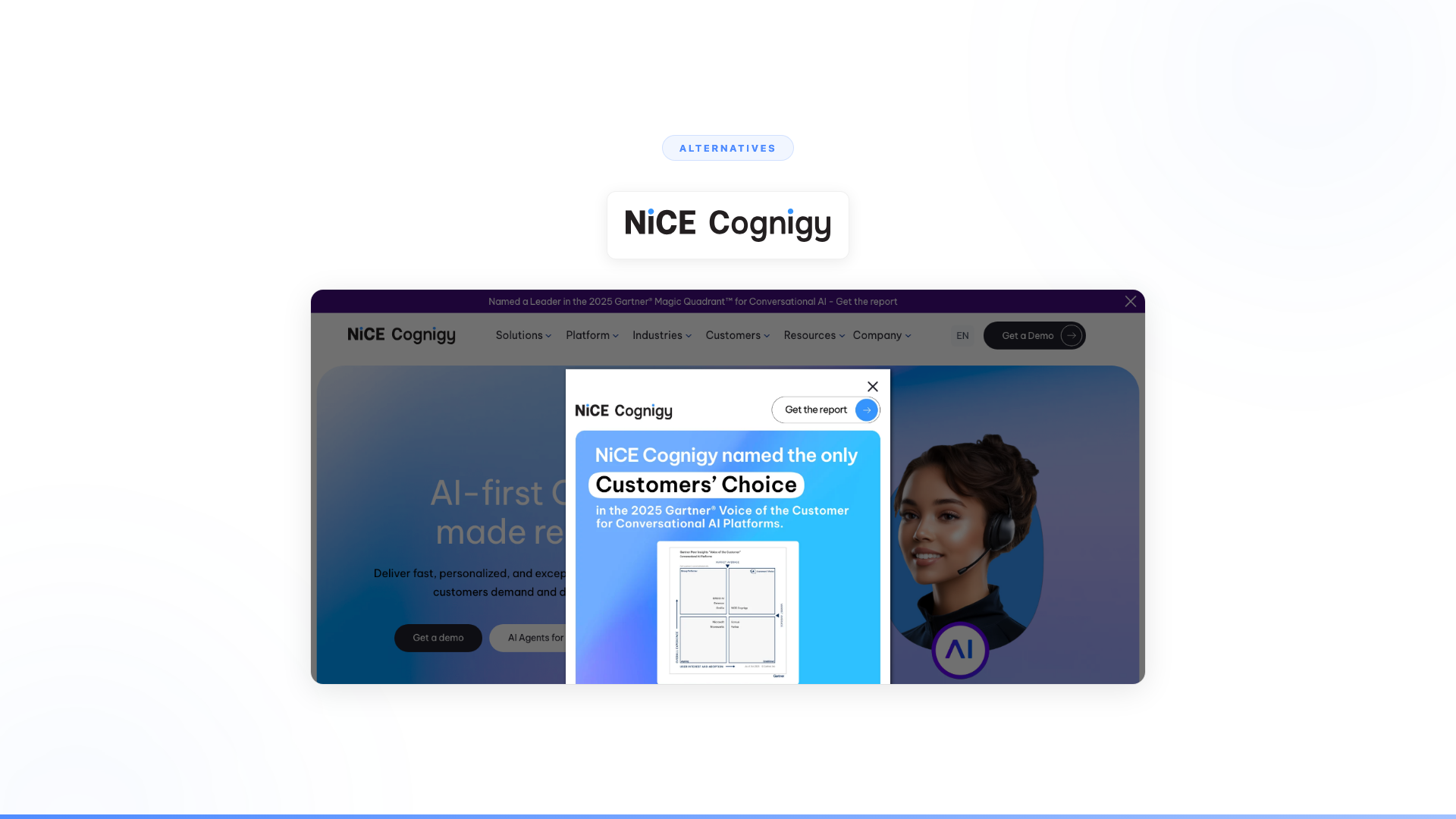
The best Cognigy alternatives in 2026 are Nexus, NICE CXone, Genesys Cloud AI, Kore.ai, Google Contact Center AI, Amazon Connect, Nuance (Microsoft), Parloa, Replicant, and custom build. Cognigy was acquired by NICE in 2025 and rebranded as NiCE Cognigy, making it part of the CXone Mpower platform — a development that has enterprise customers evaluating alternatives before their contracts lock them into the broader NICE ecosystem.
That's not necessarily bad. NICE is a serious company. CXone is a serious platform. But the acquisition changes the calculus. Cognigy's roadmap is now NICE's roadmap. Cognigy's pricing will eventually align with NICE's pricing. Your conversational AI investment just got absorbed into a broader CX ecosystem with its own priorities, cross-sell incentives, and platform dependencies. That's a reasonable time to evaluate alternatives.
But there's a second reason companies look for Cognigy alternatives that has nothing to do with the acquisition. It's the category itself.
Cognigy automates conversations. It does that well. NiCE Cognigy is named a Leader in the 2025 Gartner Magic Quadrant for Conversational AI — continuing a run of consecutive recognitions in that report. Strong NLU, solid voice capabilities, good telephony integration across 1,250+ enterprise deployments. The problem is that conversations are roughly 10% of most business processes. A customer calls to change their plan. The conversation takes 4 minutes. The operational work behind it — eligibility check, proration calculation, compliance validation, system updates, confirmation — takes 15 minutes across multiple systems. Cognigy handles the 4 minutes. The 15 minutes stay manual.
If you're looking for a different conversational AI platform, there are options below. If you're looking for AI that completes the work behind conversations, not just the conversations themselves, that's a different category entirely.
Here are 10 alternatives, ranked by what they actually do.
What the NICE Acquisition Means for Cognigy Customers in 2026
In 2025, NICE acquired Cognigy and rebranded the combined entity as NiCE Cognigy. Cognigy's conversational AI technology is being integrated into the CXone Mpower platform as its AI agent layer. The combined company serves 1,250+ enterprise brands and maintains Cognigy's Düsseldorf, Germany headquarters alongside NiCE's Dallas operations.
For existing Cognigy customers, the practical implications are:
- Roadmap alignment: Cognigy's product direction now serves NiCE's platform strategy, not its own independent roadmap.
- Pricing evolution: Expect eventual migration toward CXone commercial structures as standalone Cognigy contracts renew.
- Integration benefits (if you're already in NICE): For organizations running CXone, the acquisition may reduce vendor count and simplify integration — the concern applies primarily to organizations not already committed to the NICE stack.
- Ecosystem gravity: Once voice AI, WFM, QM, analytics, and routing are all NICE, switching costs compound significantly.
Cognigy Alternatives: Quick Comparison Table (2026)
| Tool | Category | Best for | Completes work behind calls? | Pricing model |
|---|---|---|---|---|
| Nexus | Autonomous agent platform | Full workflow completion across any department | Yes, end-to-end | Per-agent |
| NICE CXone | Contact center platform | Large-scale contact center operations | No, conversation layer only | Per-seat + usage |
| Genesys Cloud AI | Contact center AI | Enterprise contact center orchestration | No, conversation layer only | Per-seat |
| Kore.ai | Conversational AI | High-volume chatbot and voice automation | No, conversation layer only | Enterprise license |
| Google CCAI | Cloud AI for contact center | Google Cloud native organizations | Partial (with custom builds) | Usage-based |
| Amazon Connect | Cloud contact center | AWS-native organizations | Partial (heavy engineering) | Pay-per-use |
| Nuance (Microsoft) | Conversational AI | Healthcare, financial services voice AI | No, conversation layer only | Enterprise license |
| Parloa | AI agent platform for CX | Contact center voice automation | No, conversation layer only | Usage-based |
| Replicant | Autonomous contact center | High-volume call automation | Partial (call resolution only) | Per-resolution |
| Custom build | Internal development | Unique technical requirements | Depends on investment | Engineering cost |
Top 10 Cognigy Alternatives for Enterprise Contact Center AI
1. Nexus: Best Cognigy Alternative for Full Workflow Automation
What it is: An autonomous agent platform paired with Forward Deployed Engineers who embed with your team. Nexus agents don't stop at conversations. They complete entire business workflows end-to-end: collecting data from customers and backend systems, validating against business rules, making decisions within guardrails, handling exceptions, executing actions across every system the workflow touches, and escalating with full context when they reach a boundary. Any department. Any process. Business teams build and own the agents.
Why companies switch from Cognigy to Nexus:
The switch happens when enterprises realize they've automated the conversation and the bottleneck hasn't moved. Cognigy handles the dialogue. The data validation, compliance checks, system updates, exception routing, and decision-making behind that dialogue still require humans. That's the 90%.
Nexus replaces Cognigy because it handles both: the conversation layer across voice, chat, and messaging, plus the operational work behind it. There's no need for a separate conversational AI tool when the agent handles the full workflow.
What it looks like in production:
- Orange Group (multi-billion euro telecom, 120,000+ employees): Had a CX chatbot with a 27% drop-out rate. The conversation worked. The workflow behind it didn't. Deployed Nexus agents across multiple European markets in 4 weeks. 50% conversion improvement. Significant yearly revenue uplift. 90% autonomous resolution. The business team built it, not engineering.
- European telecom (13,000+ employees): Built a dozen production agents in 12 weeks covering support, compliance, registration, data harmonization, and escalation routing. 40% of support capacity freed across millions of interactions. Full regulatory compliance with complete audit trails.
- Lambda (leading AI infrastructure company): Their CTO chose Nexus over building internally. Agents monitor 12,000+ enterprise accounts, synthesize buying signals, surface pipeline opportunities. Substantial cumulative pipeline discovered. 24,000+ hours of research capacity added annually. Built by a non-engineer.
What makes it different:
- 4,000+ integrations across CRMs, ERPs, billing, legacy systems, and custom APIs
- Forward Deployed Engineers embedded with your team from day one
- Business teams build and own agents, not IT or engineering
- Per-agent pricing tied to value, not conversation volume
- 100% of POC clients converted to annual contracts
Pricing: Per-agent, tied to value delivered. Not per-seat or per-interaction.
Best for: Organizations that need AI to complete the full workflow, not just the conversation in front of it. Sales, support, compliance, HR, onboarding, operations.
Full Nexus vs Cognigy comparison -->
2. NICE CXone: Default Path for Existing Cognigy Customers
What it is: The platform that now owns Cognigy. NICE CXone is a comprehensive contact center suite: ACD, IVR, workforce management, quality management, analytics, and Cognigy's conversational AI capabilities through CXone Mpower. NICE reported $1.7B+ in annual revenue. Strong in workforce optimization and analytics.
How it compares to Cognigy: If you're a Cognigy customer, NICE is where your product is heading anyway. The Cognigy technology is being integrated into CXone Mpower as the conversational AI layer under the NiCE Cognigy brand. If you were planning to stay with Cognigy, staying with NICE is the default path.
Why it might not solve the problem: NICE is a contact center platform — a very good one. But it automates the contact center, not the work behind it. Adding Cognigy's conversational AI to NICE's operational suite gives you a better contact center. It doesn't give you AI that completes the multi-system workflows those conversations are about.
The lock-in question: This deserves honest evaluation. Cognigy was an independent conversational AI platform. You could deploy it alongside whatever contact center stack you had. Now it's part of NICE. The integration benefits are real, but so is the ecosystem gravity. Cognigy's roadmap will increasingly serve NICE's platform strategy. If your needs diverge from where NICE is heading, your options narrow.
Note: For organizations already running NICE CXone, the Cognigy acquisition may simplify integration and reduce vendor count. The concern applies primarily to organizations not already committed to the NICE stack.
Pricing: Per-seat plus usage. Enterprise contracts with separate charges for different modules.
Best for: Organizations already in the NICE ecosystem that want conversational AI integrated with their existing CXone deployment.
3. Genesys Cloud AI: Enterprise Contact Center at Scale
What it is: Genesys Cloud's AI capabilities for contact center automation. Predictive routing, speech and text analytics, agent assist, and virtual agent features. Genesys reported $2.2B ARR. Named a G2 2026 Best Agentic AI Software award recipient. Processes hundreds of millions of virtual self-service conversations annually.
How it compares to Cognigy: Genesys is a broader contact center platform with AI built in. Cognigy was a specialized conversational AI layer you could deploy on top of different contact center stacks. If what you valued about Cognigy was specialization and independence, Genesys is a different proposition: comprehensive but opinionated about its ecosystem.
Why it might not solve the problem: Same category limitation as Cognigy, just at a bigger scale. Genesys optimizes conversations, routing, and workforce management inside the contact center. The operational workflows behind those conversations remain manual. Better call handling doesn't reduce the 15 minutes of cross-system work that follows every complex call.
Pricing: Per-seat licensing. Multiple tiers from CX1 through CX3 with increasing AI capabilities.
Best for: Enterprises that need a full contact center platform with built-in AI and are comfortable with the Genesys ecosystem.
Full Nexus vs Genesys comparison -->
4. Kore.ai: Independent Conversational AI Leader
What it is: Conversational AI platform for building chatbots and virtual assistants. Named a Gartner Magic Quadrant Leader for Enterprise Conversational AI Platforms in 2025, 2023, and 2022 — consistent three-year recognition. Handles customer support, IT helpdesk, and HR FAQ automation. Strong NLU with a no-code builder for conversation flows. Multi-channel: web, voice, messaging.
How it compares to Cognigy: Very similar category. Both are dedicated conversational AI platforms. Kore.ai positions more broadly across enterprise departments (IT, HR, sales) while Cognigy went deeper on voice and contact center. Neither was acquired before Cognigy's 2025 NICE deal. Kore.ai remains independent as of 2026.
Why it might not solve the problem: If you're leaving Cognigy because conversations are only 10% of the work, Kore.ai gives you the same category. Good conversations. Same structural ceiling. The validation, decisions, exception handling, and multi-system execution behind those conversations still require humans or separate tooling.
Pricing: Enterprise licensing, typically $300K+ annually for large deployments.
Best for: Organizations whose primary need is automating high-volume conversations, and who want an independent conversational AI platform without NICE ecosystem dependency.
5. Google Contact Center AI: For Google Cloud-Native Organizations
What it is: Google Cloud's AI suite for contact centers. Dialogflow CX for virtual agents, Agent Assist for real-time agent guidance, CCAI Insights for conversation analytics. Integrates with most major contact center platforms (Genesys, NICE, Avaya, Cisco).
How it compares to Cognigy: CCAI is more of a building-block approach. Cognigy gave you a complete conversational AI platform. CCAI gives you powerful AI components that your engineering team assembles into a solution. More flexible. More engineering effort. Google's Gemini models behind it are strong, but you need engineering capacity to deploy and maintain.
Why it might not solve the problem: CCAI improves the conversation layer with Google's AI. But it's still the conversation layer. You can build custom integrations with Google Cloud Functions and Vertex AI to connect to backend systems, but that's custom engineering, not autonomous workflow completion. You're building the 90% yourself.
Pricing: Usage-based. Dialogflow CX: per request. Agent Assist: per conversation. Enterprise pricing via Google Cloud agreements.
Best for: Google Cloud-native organizations with engineering capacity to build custom integrations on top of CCAI components.
6. Amazon Connect: For AWS-Native Organizations
What it is: AWS's cloud contact center service. Pay-per-use pricing. Integrates with the AWS ecosystem: Lex for conversational AI, Lambda for backend logic, Bedrock for generative AI. Contact Lens for real-time conversation analytics. Completely API-driven.
How it compares to Cognigy: Different philosophy. Cognigy is a finished product you configure. Amazon Connect is infrastructure you build on. If your engineering team is strong and you're already deep in AWS, Connect gives you more control and flexibility than Cognigy. If you want something production-ready without significant engineering, it's more work than Cognigy was.
Why it might not solve the problem: Amazon Connect can reach further into backend workflows than most conversational AI platforms, because AWS Lambda lets you write custom logic for anything. But "can" and "does" are different. You're building every integration, every decision tree, every exception handler from scratch. It's an engineering project, not a deployment. Every workflow change requires developer involvement.
Pricing: Pay-per-use. Per-minute for voice, per-message for chat, plus charges for AI services.
Best for: AWS-native organizations with engineering teams that want full control over their contact center architecture.
7. Nuance (Microsoft): For Healthcare and Financial Services Voice AI
What it is: Microsoft's conversational AI and voice biometrics platform, acquired in 2022 for $19.7B. Strong in healthcare (Dragon Medical), financial services, and telecommunications. Voice recognition, IVR modernization, and agent assist. Being integrated into Microsoft's Copilot and Dynamics 365 Contact Center.
How it compares to Cognigy: Nuance has deeper domain expertise in specific verticals — healthcare, financial services — than Cognigy did. The voice biometrics capability is genuinely differentiated. But Nuance is now part of Microsoft, which means its future is Microsoft's Dynamics 365 Contact Center platform. Similar acquisition dynamics as Cognigy/NICE: the standalone product becomes an integrated feature.
Why it might not solve the problem: Same conversation-layer limitation. Nuance handles voice interactions exceptionally well, particularly in healthcare and financial services. The multi-system operational work behind those interactions stays manual. And you're now buying into the Microsoft ecosystem, which may or may not align with your stack.
Pricing: Enterprise licensing through Microsoft. Bundled with Dynamics 365 Contact Center or standalone.
Best for: Healthcare and financial services organizations that need voice AI with strong domain specialization and are comfortable in the Microsoft ecosystem.
8. Parloa: Modern LLM-Native Voice AI for European Contact Centers
What it is: An AI agent management platform for customer service, focused on voice and chat automation. Based in Germany — same European heritage as the original Cognigy. Raised $350M in Series D funding at a $3B valuation, representing significant market validation. Positions as "AI agents" for contact centers with LLM-native architecture rather than traditional NLU. Handles millions of conversations across financial services, utilities, e-commerce, healthcare, and IT support.
How it compares to Cognigy: Similar European heritage and voice focus. Parloa is newer and built on modern AI architecture — LLM-native rather than traditional NLU. For organizations that valued Cognigy's European presence, voice capabilities, and DACH data residency requirements but want a more modern technical approach, Parloa is a strong evaluation candidate.
Why it might not solve the problem: Despite the "AI agent" positioning, Parloa's scope is the contact center conversation. Newer technology, same category ceiling. The conversations may be more natural than Cognigy's traditional NLU approach, but the 90% of operational work behind those conversations still requires separate tooling and human intervention.
Pricing: Usage-based pricing. Enterprise contracts with custom terms.
Best for: European organizations that want a modern, LLM-native voice AI platform for their contact center and require European data residency.
9. Replicant: Best Cognigy Alternative for Voice AI with Outcome Pricing
What it is: An autonomous contact center AI focused on resolving customer calls end-to-end. Specializes in voice: billing inquiries, appointment scheduling, order status, account management, authentication. Claims to fully resolve — not just deflect — high-volume call types without human involvement. Has processed 1B+ minutes of conversation data across enterprise clients. Customers report 82 NPS for AI-resolved calls and CSAT scores of 4.6/5.
How it compares to Cognigy: Replicant goes further than Cognigy on resolution. Where Cognigy automates the conversation and often escalates to a human for the action, Replicant tries to resolve the call completely. For straightforward, high-volume call types within its supported use cases, it gets closer to workflow completion.
Why it might not solve the problem: Replicant's resolution capability is real but bounded. It handles specific, well-defined call types within the contact center. Cross-department workflows, complex compliance scenarios, multi-system exceptions, and processes that span sales, operations, and HR are outside its scope. It resolves calls. It doesn't complete business processes.
Pricing: Per-resolution pricing. You pay for successfully resolved calls.
Best for: Contact centers with high volumes of specific, well-defined call types where full resolution — not just deflection — is the goal.
10. Custom Build: For Unique Technical Requirements
What it is: Building your own voice AI and workflow automation using open-source frameworks, cloud AI services, and internal engineering. LangChain for orchestration, Whisper or Deepgram for speech-to-text, cloud telephony APIs, and custom backend integrations.
How it compares to Cognigy: Maximum flexibility. You design exactly what you need. No ecosystem lock-in from any vendor. For organizations with strong AI engineering teams and unique requirements, custom builds can work.
Why it might not solve the problem: Most enterprises don't have surplus AI engineering capacity dedicated to internal tooling. Building voice AI alone requires speech recognition, NLU, dialogue management, telephony integration, and real-time processing. Adding workflow completion on top means integrating with every backend system, building decision logic, handling exceptions, and maintaining compliance. Lambda — a leading AI infrastructure company with world-class engineers — chose to buy from Nexus instead of building because the opportunity cost was too high.
Pricing: Engineering salaries plus infrastructure. Typically 6-12 months for a production voice AI system, with ongoing maintenance.
Best for: Organizations with dedicated AI engineering teams, unique technical requirements, and timelines that can absorb 6+ months of development.
The Real Question Behind Cognigy Alternatives
If you're looking for a Cognigy alternative because of the NICE acquisition, any of the conversational AI platforms above — Kore.ai, Parloa, Google CCAI — give you the conversation layer without NICE ecosystem dependency. That's a lateral move within the same category.
If you're looking because Cognigy automated your conversations but your operating costs didn't drop the way you expected, the problem isn't Cognigy. It's the category. Conversational AI automates roughly 10% of most business processes. The other 90% — the validation, compliance, multi-system execution, and decision-making behind those conversations — requires something different.
If the problem is NICE lock-in, evaluate Kore.ai, Parloa, or Google CCAI. They're independent conversational AI platforms that handle the dialogue layer without pulling you into someone else's ecosystem.
If the problem is that conversations are 10% of the work, and the 90% behind them is still manual, fragmented, or breaking at the edges, that's the gap that Nexus was built to close.
Orange didn't need a different conversational AI platform. They needed agents that complete the full onboarding workflow. 50% conversion improvement. 4-week deployment. 90% autonomous resolution. 100% team adoption.
A European telecom didn't need another voice bot. They needed agents that handle support, compliance, registration, and escalation across millions of interactions. 40% of support capacity freed. 12 weeks.
The gap between conversation automation and workflow completion isn't a feature gap. It's a category gap. Switching conversational AI vendors doesn't close it.
Frequently Asked Questions About Cognigy Alternatives
What does the NICE acquisition mean for existing Cognigy customers?
NICE acquired Cognigy in 2025 and rebranded the combined entity as NiCE Cognigy. Existing Cognigy customers are now, in effect, NICE customers. The Cognigy conversational AI platform is being integrated into the CXone Mpower product suite. In the near term, most deployments continue as-is. Over time, expect pricing, roadmap, and support to align with NICE's broader CXone commercial structure. Organizations not already committed to the NICE ecosystem face increasing switching costs as the integration deepens.
Is Cognigy still available as a standalone product after the NICE acquisition?
As of 2026, the product continues to operate under the NiCE Cognigy brand, positioned as the conversational AI layer within CXone Mpower. The Gartner 2025 Magic Quadrant for Conversational AI recognized NiCE Cognigy as a Leader — indicating continued market standing. However, the product's independent roadmap no longer exists. Future development will serve NICE's platform strategy rather than Cognigy's original product vision.
What is the difference between Cognigy and Kore.ai for enterprise contact centers?
Both are dedicated conversational AI platforms named Leaders in the 2025 Gartner Magic Quadrant for Enterprise Conversational AI. Cognigy (now NiCE Cognigy) went deeper on voice and contact center automation with tight telephony integration. Kore.ai positions more broadly across enterprise departments — IT helpdesk, HR, sales — with a strong no-code builder. The key practical difference today: Cognigy is now part of NICE; Kore.ai remains independent. For enterprises that want conversational AI without NICE ecosystem dependency, Kore.ai is the closest comparable.
How much does Cognigy cost per year for enterprise deployment?
NICE/Cognigy does not publish pricing. Enterprise contracts are custom-quoted. Industry benchmarks for comparable conversational AI platforms at enterprise scale typically range from $200K to $600K+ annually depending on conversation volume, number of channels, and deployment complexity. Kore.ai enterprise deployments commonly run $300K+ annually for large deployments. Per-seat CXone pricing adds to the total cost of ownership for organizations that bundle Cognigy into a full NICE suite.
Does Cognigy support voice AI and telephony replacement?
Yes. Voice has been Cognigy's primary differentiation. The platform integrates with major telephony infrastructure (Genesys, Avaya, Cisco, cloud telephony providers) and handles real-time voice conversations with strong NLU. The DHL deployment handles more than 30 million service inquiries. Post-acquisition, voice capabilities continue under NiCE Cognigy. For organizations specifically evaluating Cognigy for voice AI, Parloa (LLM-native, European, $3B valuation) and Replicant (outcome-based pricing, 1B+ minutes processed) are the closest direct voice-first alternatives.
Worth Exploring?
Every Nexus engagement starts with a 3-month proof of concept tied to measurable outcomes. Forward Deployed Engineers embed with your team from day one. You see the results before committing. You can exit anytime.
100% of clients who started a POC converted to an annual contract. Every one.
See the full Nexus vs Cognigy comparison -->
Related Reading
- Nexus vs Cognigy: full comparison
- Nexus vs Genesys: contact center AI vs autonomous agents
- Nexus vs Moveworks: IT service desk AI vs enterprise agents
- Top 10 AI Tools for Contact Center Automation
- Top 10 AI Tools for Voice Automation and Conversational IVR
- How to Modernize Your Contact Center with AI
- How Nexus works for telecom operators