Top 10 Amdocs Alternatives for Telecom AI in 2026
Amdocs adds AI to BSS/OSS, but it doesn't complete operational workflows. Here are 10 alternatives for telecom operators who need AI that goes beyond billing intelligence, ranked by what they deliver in production.
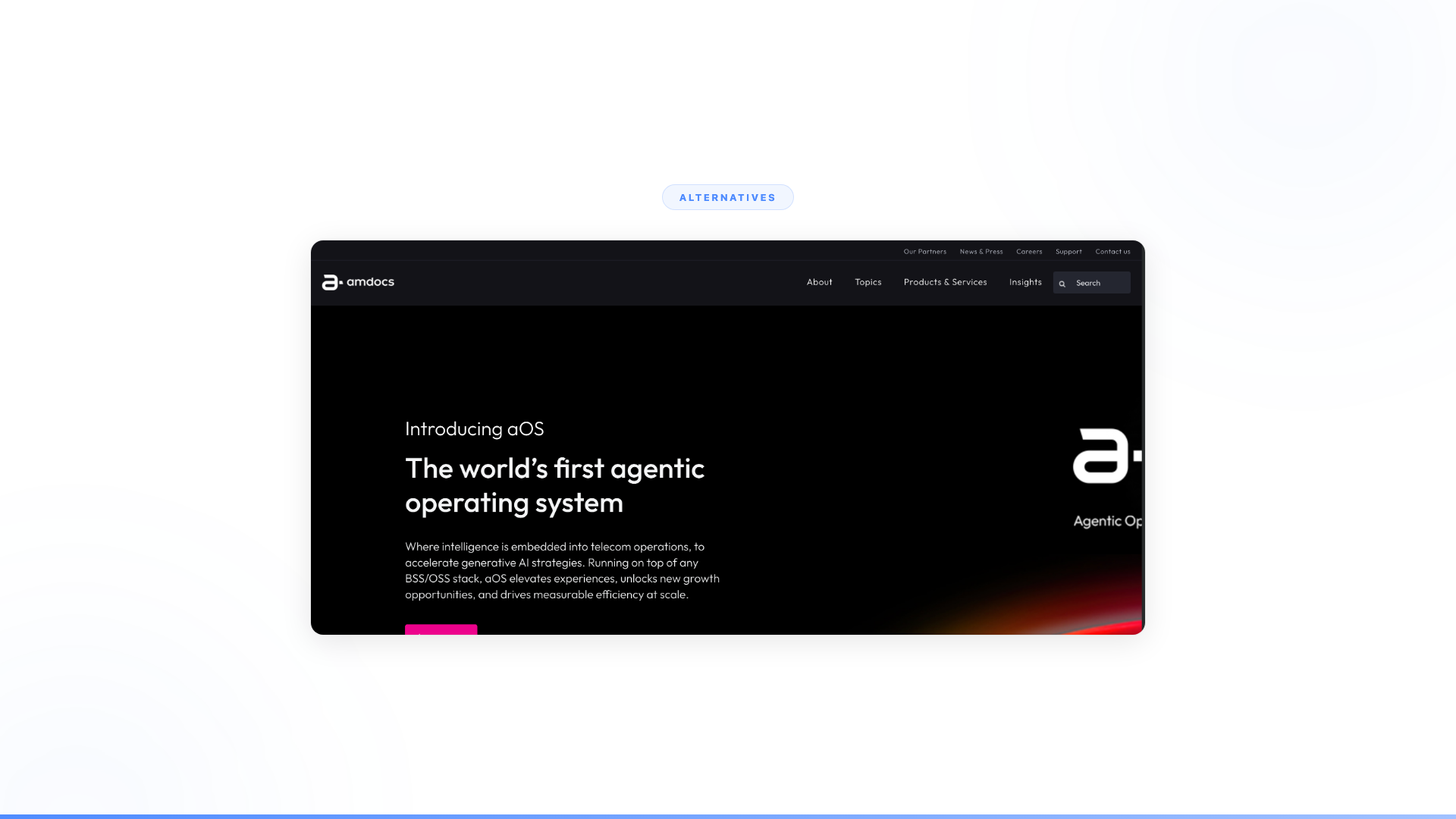
The best Amdocs alternatives in 2026 are Nexus, Ericsson AI, Nokia AI (MantaRay/AVA), Netcracker (NEC), CSG, Comverse (now Amdocs), Huawei AI, ZTE AI, Tecnotree, and custom build. Amdocs dominates telco BSS/OSS with 350+ operator customers globally, but alternatives range from competing BSS vendors to autonomous agent platforms that operate on top of existing BSS infrastructure without requiring replacement. The key distinction: BSS/OSS alternatives like Netcracker replace Amdocs at the system layer. Platforms like Nexus work on top of Amdocs to complete the operational workflows BSS intelligence can't execute autonomously.
What does BSS/OSS mean? BSS (Business Support Systems) covers customer management, billing, ordering, and revenue management. OSS (Operations Support Systems) covers network inventory, provisioning, and network operations. Amdocs is the market leader in BSS/OSS software for telecommunications operators, used across billing, customer lifecycle management, and order management.
Most telecom operators searching for Amdocs alternatives aren't unhappy with their BSS/OSS. They're frustrated that adding AI on top of it didn't transform their operations the way they expected.
The pattern is familiar. Amdocs runs your billing, provisioning, and order management. The amAIz suite adds generative AI to that foundation: customer experience insights, subscriber analytics, agent assist for support. It's real technology backed by decades of telecom domain knowledge. Nobody disputes that.
But here's what happens next. Leadership asks: "Can we use this for customer onboarding? Sales intelligence? Compliance monitoring? HR operations?" And the answer is always some version of "that's not what it was designed for." Because Amdocs AI is an intelligence layer for BSS/OSS systems. It makes your billing smarter. It doesn't complete the operational workflows that span across and beyond those systems.
According to Analysys Mason, telecom operators are expected to spend over $15 billion annually on AI by 2026 — but the majority of that investment is concentrated in network automation and BSS optimization, while the customer-facing and cross-departmental workflow automation opportunity remains largely unaddressed. That gap is what brought many operators to this search.
Amdocs Alternatives: Quick Comparison Table for Telecom Buyers
| Tool | Category | Best for | Completes workflows? | Scope |
|---|---|---|---|---|
| Nexus | Autonomous agent platform | Full telecom workflow automation across any department | Yes, end-to-end | Enterprise-wide |
| Ericsson AI | Network AI/automation | Network optimization and self-healing | Network operations only | Network layer |
| Nokia AI (MantaRay/AVA) | Network automation | Network anomaly detection, predictive maintenance | Network operations only | Network layer |
| Netcracker (NEC) | BSS/OSS + AI | Revenue management, catalog, order management | Within Netcracker stack | BSS/OSS |
| CSG | Revenue management + AI | Billing, charging, revenue assurance | Within CSG systems | Revenue management |
| Comverse (now Amdocs) | Legacy BSS | Value-added services, billing for prepaid | Limited | BSS subset |
| Huawei AI | Full-stack telecom | End-to-end network and BSS for specific markets | Within Huawei ecosystem | Full stack (vendor-locked) |
| ZTE AI | Network AI | Network automation for ZTE infrastructure | ZTE networks only | Network layer |
| Tecnotree | Digital BSS | BSS modernization for smaller operators | Within Tecnotree platform | BSS |
| Custom build | Internal development | Unique requirements, full control | Depends on team | Anything (high cost) |
BSS/OSS Replacement vs. AI Layer: Which Does Your Telco Need?
Before reviewing alternatives, it is worth clarifying what you are actually searching for. There are two distinct problems telecom operators typically bring to this search:
Problem A — BSS/OSS system replacement: You want a different vendor for core billing, order management, and customer lifecycle systems. You're evaluating moving off Amdocs infrastructure entirely. For this, the relevant alternatives are Netcracker, CSG, and Tecnotree. Nexus is not in scope for a BSS/OSS replacement — it's a different layer entirely.
Problem B — Operational workflow automation on top of existing BSS: You're keeping your Amdocs infrastructure but want AI that completes customer-facing and cross-departmental workflows (onboarding, support, compliance, sales intelligence) that Amdocs AI can't execute autonomously. For this, the relevant alternative is Nexus — and Ericsson, Nokia, and other network AI vendors aren't in scope either.
Most operators reading this article fall into Problem B. The rest of this article addresses both, but is clearer about which solutions address which problem.
Top 10 Amdocs Alternatives for Telecom BSS/OSS and AI
Nexus: Best Amdocs Alternative for Operational AI on Top of Existing BSS
What it is: An autonomous agent platform paired with Forward Deployed Engineers who embed with your team. Nexus agents complete entire telecom workflows end-to-end: collecting data, validating against backend systems, making decisions within guardrails, handling exceptions, and executing actions. Any department. Any process. Business teams build and own the agents.
Important scope clarification: Nexus is not a BSS/OSS system. It does not replace Amdocs at the billing, provisioning, or order management layer. Nexus agents work on top of your existing Amdocs infrastructure, connecting to your BSS, CRM, compliance databases, and communication systems to complete the workflows that span and extend beyond those systems. If you need to replace Amdocs core systems, look at Netcracker, CSG, or Tecnotree.
Why telecom operators look at Nexus instead of extending Amdocs AI:
The category difference matters. Amdocs AI makes your BSS/OSS smarter. Nexus agents complete the operational work that happens across and beyond those systems. Customer onboarding isn't a billing query — it's a workflow that touches your CRM, identity verification, compliance database, communication channels, and BSS. Compliance monitoring isn't a subscriber insight — it's a process that spans regulatory systems, internal policies, communication logs, and reporting tools. Amdocs AI can inform these processes. It can't complete them.
What it looks like in production:
- Orange Group (multi-billion euro telecom, 120,000+ employees): Business team built autonomous customer onboarding agents. First agent deployed in 4 hours. Rolled out across multiple European markets in 4 weeks. 50% conversion improvement. ~$6M+ yearly revenue. 90% autonomous resolution. 100% team adoption. Previous chatbot had a 27% drop-out rate.
- Leading European telecom (13,000+ employees): Built a dozen production agents in 12 weeks. Support, compliance, registration, data harmonization, escalation routing. 40% of support capacity freed. Full regulatory compliance maintained across millions of interactions.
- Lambda (a leading AI infrastructure company): Head of Sales Intelligence, who has no engineering background, built an agent monitoring 12,000+ accounts. 24,000+ hours of research capacity added annually.
Pricing: Per-agent, tied to value delivered. Not per-seat. An agent serving millions of customers costs the same whether you have 500 or 50,000 employees.
Best for: Telecom operators that need AI to complete high-volume operational workflows — customer onboarding, support resolution, compliance monitoring, sales intelligence, HR operations — without replacing their existing BSS/OSS infrastructure.
Full Nexus vs Amdocs comparison →
Ericsson AI: Best for Network Optimization and RAN Intelligence
What it is: Ericsson's AI portfolio focuses on network intelligence. Their Ericsson Intelligence Automation Platform (EIAP) and cognitive network capabilities optimize RAN performance, predict network faults, automate configuration, and enable network slicing. Strong in the radio access layer with decades of deployment data.
How it compares to Amdocs: Completely different focus. Amdocs operates in the BSS/OSS layer (billing, subscribers, orders). Ericsson operates in the network layer (radio, transport, core). There's almost no overlap. If your primary challenge is network optimization, Ericsson's domain depth is hard to match. If your challenge is business operations, Ericsson doesn't address it.
Why it might not solve the problem: Network AI doesn't touch business operations. Customer onboarding, sales intelligence, compliance monitoring, HR processes, partner management — none of that lives in the network layer. Operators who need AI across the full business discover that Ericsson and Amdocs together still leave the operational workflows untouched.
Best for: Network-centric operators whose primary AI challenge is RAN optimization, fault prediction, and network automation on Ericsson infrastructure.
Full Nexus vs Ericsson comparison →
Nokia AI (MantaRay/AVA): Best for Network Anomaly Detection and Predictive Maintenance
What it is: Nokia's AI capabilities center on network analytics and automation. Their MantaRay network digital twin and AVA platform provide anomaly detection, predictive maintenance, capacity planning, and automated network remediation. Nokia also offers AI-powered private wireless solutions.
How it compares to Amdocs: Same distinction as Ericsson. Nokia plays in the network layer. Amdocs plays in the BSS/OSS layer. Nokia's AI detects network anomalies and automates remediation. Amdocs' AI provides subscriber and billing intelligence. Neither completes business operations.
Why it might not solve the problem: Nokia's AI is purpose-built for network health and performance. It doesn't handle customer-facing processes, sales workflows, compliance automation, or any of the operational work that telecom operators increasingly need AI to complete. Adding Nokia AI and Amdocs AI together gives you intelligence in two layers. It still doesn't give you autonomous workflow completion in either.
Best for: Operators with complex multi-vendor networks who need predictive maintenance and automated network remediation.
Full Nexus vs Nokia comparison →
Netcracker (NEC): Best BSS/OSS Alternative to Amdocs
What it is: Netcracker is a BSS/OSS vendor owned by NEC, competing directly with Amdocs in revenue management, catalog, order management, and digital services. They've added AI through their Digital Ecosystem Platform, offering revenue assurance, fraud detection, and customer lifecycle management.
How it compares to Amdocs: Nearly identical in scope. Netcracker is the closest direct competitor to Amdocs in the BSS/OSS market. The AI capabilities are similar: intelligence layered on top of BSS/OSS systems. If you are evaluating a different BSS/OSS vendor with comparable AI features, Netcracker is the first name on the list.
Why it might not solve the problem: If the issue with Amdocs is that BSS/OSS AI doesn't complete operational workflows, switching to Netcracker gives you the same category of capability with a different vendor name. The scope limitation is architectural, not vendor-specific. BSS/OSS intelligence doesn't become workflow automation just because you change providers.
TM Forum alignment: Netcracker is an active TM Forum member and their Open Digital Architecture alignment is generally considered strong — a practical consideration for operators standardizing on TM Forum frameworks.
Best for: Operators considering a BSS/OSS vendor switch who want to stay within the same category with competitive pricing or a different integration approach.
CSG: Best for Revenue Management and Billing Optimization
What it is: CSG specializes in revenue management, payments, and customer engagement for communications and media companies. Their AI capabilities focus on billing optimization, revenue assurance, payment orchestration, and customer lifecycle analytics.
How it compares to Amdocs: Narrower scope but deeper in revenue management. CSG doesn't try to be a full BSS/OSS platform. They focus on the revenue and payment side with AI-enhanced analytics, fraud detection, and billing optimization. For operators whose primary concern is revenue management rather than full BSS/OSS, CSG is a more focused option.
Why it might not solve the problem: CSG's AI serves the revenue stack. Same structural limitation as Amdocs but in a narrower domain. If you need AI that handles onboarding, support, compliance, HR, and cross-departmental operations, revenue management AI doesn't reach those processes.
Best for: Operators whose primary challenge is revenue management, billing accuracy, and payment optimization rather than broader operational workflow automation.
Comverse (Now Part of Amdocs): For Legacy System Context
What it is: Comverse was a telecom software company specializing in value-added services (VAS), converged billing, and IP communications. Amdocs acquired Comverse Technology in 2015. The legacy Comverse systems still run at many operators, particularly for prepaid billing and VAS platforms.
How it compares to Amdocs: It is Amdocs now. Including it here because many operators still reference "Comverse" when discussing their legacy billing systems. If you're running legacy Comverse infrastructure and looking for AI capabilities, the path forward is either Amdocs' amAIz (if you stay in the ecosystem) or a platform like Nexus that connects to your existing systems without requiring a migration.
Why it might not solve the problem: Legacy system. The AI question for Comverse operators is usually about modernization, and Amdocs' answer is to migrate to their current platform — a multi-year BSS/OSS transformation. If you need AI-powered workflows now, waiting for a platform migration isn't a strategy. Nexus can connect to legacy Comverse infrastructure without requiring the migration to happen first.
Best for: Operators running legacy Comverse systems who want to understand their upgrade path, or who need AI capability before a full migration can be scheduled.
Huawei AI: Best for Operators in Huawei Infrastructure Markets
What it is: Huawei offers a full-stack telecom AI portfolio: network intelligence (IntelligentRAN, ADN), BSS (SmartCare CEM), and cloud AI services. Their scope is broader than most competitors because Huawei builds everything from chipsets to end-user applications.
How it compares to Amdocs: Broader technology scope but significant market constraints. Huawei's AI is deeply integrated into their own equipment and software. In markets where Huawei is the primary infrastructure vendor (parts of Asia, Middle East, Africa), the vertical integration creates a powerful, tightly coupled ecosystem. In European and North American markets, regulatory restrictions limit Huawei's presence.
Why it might not solve the problem: Vendor lock-in at a level that makes Amdocs look flexible. Huawei's AI requires Huawei infrastructure. It also carries geopolitical risk that affects procurement decisions in Western markets. And like Amdocs, the AI is system intelligence, not autonomous workflow completion for cross-departmental operations.
Best for: Operators in markets where Huawei is the primary infrastructure vendor and where regulatory constraints are not a procurement factor.
ZTE AI: Best for ZTE Infrastructure Operators
What it is: ZTE provides network AI capabilities focused on their own infrastructure: intelligent RAN, autonomous network management, and predictive maintenance for ZTE equipment. Their AI platform primarily serves operators running ZTE network infrastructure.
How it compares to Amdocs: Different layer entirely. ZTE operates in the network equipment and management space. Their AI optimizes ZTE-specific infrastructure. There's no BSS/OSS overlap. ZTE doesn't compete with Amdocs — it competes with Ericsson and Nokia in the network layer.
Why it might not solve the problem: Same network-layer limitation as Ericsson and Nokia, combined with a narrower equipment footprint and similar geopolitical considerations to Huawei. For operators outside ZTE's core markets, it's not a practical alternative.
Best for: Operators running ZTE network infrastructure who want vendor-native network AI for that infrastructure layer.
Tecnotree: Best for Mid-Tier and Emerging Market Operators
What it is: Tecnotree is a digital BSS vendor focused on mid-tier and emerging-market operators. Their AI capabilities (Tecnotree Moments) provide customer experience analytics, digital marketplace management, and revenue growth recommendations within their BSS platform.
How it compares to Amdocs: Smaller scale, more accessible for mid-tier operators. Tecnotree doesn't have Amdocs' enterprise depth, but for operators who find Amdocs too expensive or too complex, Tecnotree offers a more manageable BSS platform with AI features. The AI scope is the same: intelligence within the BSS, not autonomous workflow completion.
Why it might not solve the problem: Same category as Amdocs and Netcracker, at a different scale. BSS AI that stays inside the BSS. If you need AI that handles operational workflows across your organization, changing BSS vendors doesn't address the scope gap.
Best for: Mid-tier operators and emerging-market operators looking for a lighter-weight BSS with AI capabilities at accessible pricing.
Custom Build: Best for Operators With Dedicated AI Engineering Teams
What it is: Building telecom AI capabilities in-house. Your engineering team designs the architecture, selects the models, writes the integrations, handles deployment, monitoring, security, governance, and maintenance. Frameworks like LangChain, LangGraph, and CrewAI provide building blocks.
How it compares to Amdocs: Maximum flexibility. You aren't constrained by any vendor's scope or architecture. For operators with strong AI engineering teams and unique requirements, building custom can theoretically deliver exactly what you need.
Why it might not solve the problem: Most telecom operators don't have surplus AI engineering capacity. The engineers you do have are working on network services and product development, not internal workflow tooling. Custom builds also require you to solve governance, security, compliance, monitoring, and maintenance yourself. The timeline is typically 6-12 months for a first production agent, with ongoing maintenance costs that grow with every agent you add. A leading AI infrastructure company with world-class engineers chose to deploy Nexus instead of building internally because the opportunity cost of diverting engineering from core product was too high.
Best for: Operators with dedicated AI engineering teams, unique technical requirements, and timelines that can absorb 6+ months of development and ongoing engineering maintenance.
So Which Alternative Should You Actually Choose?
The honest answer depends on what problem you're solving.
If the problem is that you want a different BSS/OSS vendor, look at Netcracker, CSG, or Tecnotree. They're direct competitors to Amdocs in the BSS/OSS market. The AI capabilities will be similar in scope. You'll get a different vendor relationship, possibly better pricing, but the same structural limitation: intelligence within the system, not autonomous workflow completion.
If the problem is network intelligence, look at Ericsson or Nokia. They don't compete with Amdocs. They operate in the network layer. Strong for RAN optimization, fault prediction, and network automation. But they won't touch your business operations.
If the problem is that Amdocs AI doesn't complete operational workflows, and you need AI that handles customer onboarding, sales intelligence, compliance monitoring, HR operations, escalation routing, and cross-departmental processes autonomously — that's a different category of problem. BSS/OSS AI from any vendor adds intelligence to telecom systems. It doesn't complete the work that spans across and beyond those systems.
That's the gap Nexus was built for.
Orange didn't need their BSS/OSS to be smarter. They needed agents that complete customer onboarding autonomously. ~$6M+ yearly revenue. 4-week deployment. 90% autonomous resolution.
A leading European telecom didn't need another BSS/OSS intelligence layer. They needed a dozen agents across support, compliance, and registration. 40% of support capacity freed in 12 weeks.
The gap between BSS/OSS intelligence and autonomous workflow completion isn't a feature gap. It's a category gap. No amount of improving the intelligence layer closes it.
FAQ: Amdocs Alternatives
What does Amdocs do for telecom operators?
Amdocs provides Business Support Systems (BSS) and Operations Support Systems (OSS) software for telecommunications companies. Core capabilities include: billing and revenue management (charging customers, handling invoices, managing payment), customer lifecycle management (onboarding, service provisioning, account management), order management (processing service requests across systems), and catalog management (defining and managing the products operators sell). Amdocs serves 350+ operators globally, including most Tier-1 carriers. Their amAIz platform adds generative AI capabilities layered on top of these systems — primarily for customer experience analytics and agent assist tools.
What is the difference between Amdocs BSS and an AI agent platform for telecom?
Amdocs BSS manages the systems of record for billing, customers, and orders — it's where the data lives and where the core business rules are enforced. Amdocs' AI adds analytics and recommendations on top of that data. An AI agent platform like Nexus sits on top of the BSS and other systems to complete the workflows that span them: a customer onboarding workflow might touch Amdocs BSS, a CRM, an identity verification service, a compliance database, and a communication platform — sequentially, with decision logic and exception handling. Amdocs AI surfaces insights. Nexus agents complete actions.
Can Nexus or another AI platform work on top of existing Amdocs infrastructure?
Yes. Nexus connects to existing systems through APIs and integrations without requiring BSS/OSS replacement. Orange Group's deployment is an example: Nexus agents handle customer onboarding on top of existing telecom infrastructure. The agents call into BSS systems for data and validation, connect to compliance databases, and trigger actions across communication channels — without migrating the underlying BSS. This is important for operators facing the choice between a multi-year BSS migration and getting AI capability now: the two don't need to be sequenced.
How long does an Amdocs BSS implementation take?
BSS implementations are among the largest and longest IT programs in the telecom industry. Based on TM Forum research and industry reports, Amdocs BSS implementations typically run 18-36 months for Tier-1 operators, often exceeding $100M in total program cost. Upgrades to major new Amdocs versions at existing customers typically run 12-24 months. The complexity comes from the depth of integration between BSS and every downstream system. This timeline is a primary driver of why operators look for AI capabilities that work on top of existing BSS rather than waiting for BSS modernization to complete.
What are the best AI tools for telecom customer service that work with Amdocs?
Several AI platforms integrate with Amdocs for customer service use cases. Nexus agents connect to Amdocs via APIs and can complete end-to-end customer interactions (onboarding, account changes, support resolution) without requiring agents to manually access BSS. Ada, Kore.ai, and Yellow.ai provide conversational AI for the customer-facing dialogue layer but don't complete the backend workflow. Forethought and Zendesk AI improve triage and routing within helpdesk platforms. The distinction that matters: tools that handle the conversation (Ada, Kore.ai) vs. tools that complete the workflow behind the conversation (Nexus). Most telecom customer service use cases require both layers — and most operators find that the conversation layer is already adequate while the workflow completion layer is what's missing.
Worth Exploring?
Every Nexus engagement starts with a 3-month proof of concept tied to measurable outcomes. Forward Deployed Engineers embed with your team from day one. You see the results before committing. You can exit anytime.
100% of clients who started a POC converted to an annual contract. Every one.
See the full Nexus vs Amdocs comparison →
Related Reading
- Nexus vs Amdocs: full comparison
- Nexus vs Ericsson: network AI vs operational workflow agents
- Nexus vs Nokia: network automation vs autonomous business operations
- How Nexus works for telecom operators
- Amdocs vs Ericsson AI: telecom AI compared
- Top 10 AI tools for telecom operations
- How to modernize telecom BSS with AI agents