Top 10 Accenture AI Alternatives for Enterprise AI Deployment in 2026
Accenture charges $300-500/hour and takes 6-18 months to deploy AI agents. Here are 10 alternatives that get enterprise AI into production faster, with lower cost and less dependency on consultants.
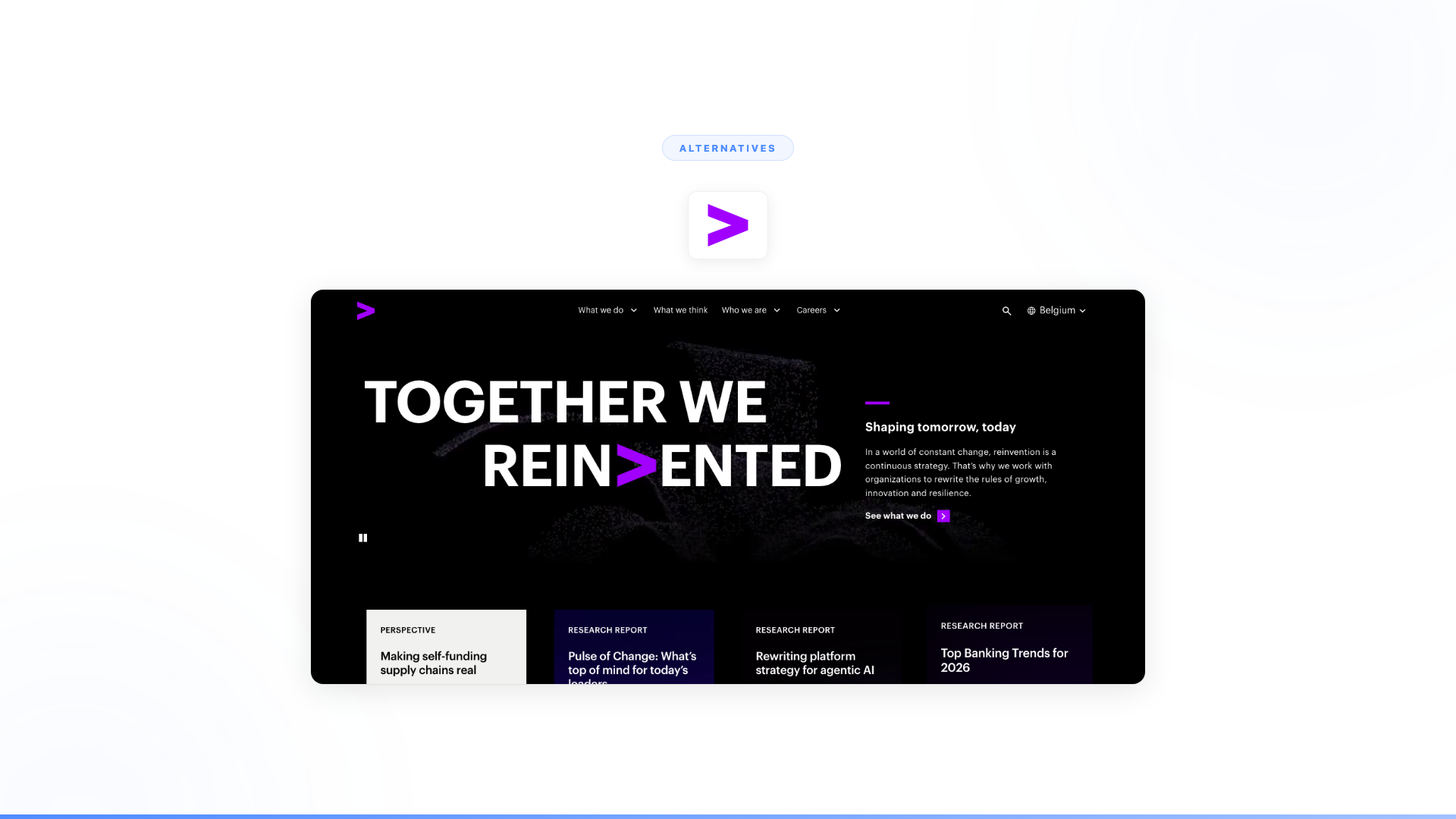
The best Accenture AI alternatives in 2026 include Nexus, BCG X, McKinsey QuantumBlack, Deloitte AI, PwC AI, Capgemini AI, Cognizant AI, TCS AI, Infosys AI, and custom build. Accenture leads enterprise AI consulting with $69.7B in revenue (FY2024) and $2.7B in generative AI revenue in fiscal 2025, but alternatives range from boutique AI specialists to autonomous agent platforms that deliver production results without multi-year transformation timelines. For global rollouts requiring regulatory compliance across 50+ countries simultaneously, Accenture's local presence remains difficult to replicate — but for specific workflow automation on defined business processes, faster and less expensive paths exist.
Enterprises searching for Accenture AI alternatives aren't doing it because Accenture lacks capability. They're doing it because the model doesn't fit what they need.
Accenture is one of the largest professional services firms on the planet. 779,000 employees. 77,000 AI and data professionals. They tripled their generative AI revenue to $2.7B in fiscal 2025 and launched AI Refinery with plans for 100+ industry agent solutions. If you need a multi-year, cross-functional transformation involving strategy, technology, operations, and change management all at once, Accenture is one of the few firms that can run that program.
But most enterprises looking for AI alternatives aren't buying a multi-year transformation. They're trying to get AI agents into production on specific business workflows. Sales operations. Customer support. Compliance. HR onboarding. Marketing. And for that job, the consulting model has a structural problem: it bills by the hour. $300-500/hour, with teams of 4-8 consultants across 6-18 month engagements. Gartner has found that the majority of enterprise AI projects fail to move from pilot to production — a problem compounded when the provider's incentive is time spent rather than outcomes delivered. The longer it takes, the more the firm earns. That's not a criticism of the people. It's a description of the business model.
If you're looking for a faster, less expensive, less dependency-creating path to AI agents in production, here are 10 alternatives worth evaluating.
Accenture AI Alternatives: Quick Comparison Table (2026)
| Alternative | Category | Best for | Time to production | Pricing model |
|---|---|---|---|---|
| Nexus | AI agent platform + FDEs | Full workflow automation, any department | 2-6 weeks | Per-agent |
| McKinsey QuantumBlack | Strategy + AI consulting | AI strategy and data science at board level | 3-12 months | Day rates ($500-700/hr) |
| BCG X | Strategy + AI consulting | AI strategy with rapid prototyping | 3-9 months | Day rates ($400-600/hr) |
| Deloitte AI | Consulting + systems integration | Regulated industries, audit-adjacent | 4-18 months | Day rates ($250-450/hr) |
| PwC AI | Consulting + AI advisory | Risk, compliance, financial services | 4-12 months | Day rates ($250-450/hr) |
| Capgemini AI | Consulting + technology services | European enterprises, SAP/cloud integration | 4-18 months | Day rates ($200-400/hr) |
| Cognizant AI | IT services + AI | Cost-optimized offshore delivery | 3-12 months | Blended rates ($150-300/hr) |
| TCS AI | IT services + AI | Large-scale IT transformation, offshoring | 4-18 months | Blended rates ($100-250/hr) |
| Infosys AI | IT services + AI | Process automation at scale | 3-12 months | Blended rates ($100-250/hr) |
| In-house build | Custom engineering | Unique requirements, strong AI team | 6-18 months | Engineering salaries + infra |
Top 10 Accenture AI Alternatives Ranked
Nexus: Best Accenture AI Alternative for Autonomous Agents
What it is: An enterprise AI agent platform paired with Forward Deployed Engineers who embed with your team. Nexus agents complete entire business workflows end-to-end: collecting data, validating against systems, making decisions within guardrails, handling exceptions, and executing actions. Any department. Any workflow. Business teams build and own the agents.
Why enterprises switch from Accenture to Nexus:
The structural incentive difference is the point. Accenture bills $300-500/hour and earns more when engagements run longer. Nexus charges per-agent and earns more when agents ship to production faster. Forward Deployed Engineers are included in the platform, not billed separately. Your business teams own the agents from day one. No consulting dependency. No managed services upsell.
What it looks like in production:
- Orange Group (multi-billion euro telecom, 120,000+ employees): Business team built autonomous customer onboarding agents. Deployed across multiple European markets in 4 weeks. 50% conversion improvement. ~$6M+ yearly revenue. 100% team adoption. They have the budget for any consulting firm in the world. They chose a platform.
- Lambda (a leading AI infrastructure company): Their CTO evaluated building internally and hiring consultants. Concluded the opportunity cost was too high. A non-engineer built the agent in days. 24,000+ hours of research capacity added annually.
- European telecom (13,000+ employees): Spent 6 months with Copilot Studio. Zero production use cases. Deployed a dozen Nexus agents in the same timeframe. 40% support volume freed across millions of interactions.
Pricing: Per-agent, tied to value delivered. FDEs included. 3-month POC with measurable outcomes before annual commitment. 100% POC-to-contract conversion rate.
Best for: Enterprises that need AI agents in production on specific business workflows in weeks, not months. Sales, support, compliance, HR, onboarding, operations, marketing, reporting.
Full Nexus vs Accenture comparison →
McKinsey QuantumBlack: Best for AI Strategy at Board Level
What it is: McKinsey's AI and data science arm. Combines McKinsey's strategy consulting with dedicated AI/ML teams. Works at the C-suite and board level on AI strategy, operating model design, and high-impact AI use cases. Strong on analytics, data science, and helping leadership teams think through where AI fits in their business.
How it compares to Accenture: More strategy-focused, less implementation-heavy. McKinsey operates at the "what should we do" layer. Accenture operates more at the "how do we build it" layer (though both are expanding into each other's territory). QuantumBlack has genuine data science talent, but the firm is fundamentally advisory-led. Engagements focus on insights and recommendations, with implementation often handed off to other firms or internal teams.
Why it might not solve the problem: If you already know which workflows to automate and need agents in production, a strategy-first engagement adds months and cost before any building begins. QuantumBlack's day rates ($500-700/hour) are higher than Accenture's, and the same structural incentive applies: revenue is a function of time and headcount.
Pricing: Day rates typically $500-700/hour. Engagement minimums often $1M+.
Best for: Enterprises that need AI strategy defined at the board level before committing to implementation.
Full Nexus vs McKinsey comparison →
BCG X: Best for AI Strategy with Rapid Prototyping
What it is: BCG's technology and digital arm. Combines strategy consulting with product development, data science, and engineering. BCG X can build prototypes alongside strategy recommendations. Known for a "ventures" approach that produces MVPs faster than traditional consulting timelines.
How it compares to Accenture: More technically hands-on than McKinsey, less scale in implementation than Accenture. BCG X sits in the middle: they can build prototypes and MVPs, but large-scale production deployments often require additional partners. Their engineering teams are smaller than Accenture's, and the firm's core DNA is still strategy consulting.
Why it might not solve the problem: BCG X prototypes can be impressive in the boardroom but may not survive contact with production reality — scale, edge cases, integrations, compliance. The gap between a demo and a production agent is where consulting models struggle. And the billing model is the same: hours multiplied by headcount.
Pricing: Day rates typically $400-600/hour. Project-based pricing for ventures and sprints.
Best for: Enterprises that want strategy and rapid prototyping combined, with the expectation that production implementation will be handled separately.
Deloitte AI: Best for Regulated Industries
What it is: Deloitte's AI practice spans consulting, technology advisory, and managed services. Strong in regulated industries (financial services, government, healthcare) where audit credibility and compliance matter. Their technology alliances with Google Cloud, AWS, and ServiceNow give them integration depth.
How it compares to Accenture: Similar scale and scope. Deloitte tends to be stronger in regulated industries and audit-adjacent work. Accenture tends to be stronger in pure technology implementation and operations. Both share the same fundamental model: billable hours, multi-month engagements, and incentive structures that reward duration over speed.
Why it might not solve the problem: Same structural issue as Accenture. Custom builds over months. Knowledge concentrates in the consulting team. Scaling means more consultants and more budget. If you're leaving Accenture because the model is too slow, too expensive, or creates too much dependency, Deloitte's model is structurally identical.
Pricing: Day rates typically $250-450/hour. Blended rates vary by geography and engagement type.
Best for: Regulated industries where Deloitte's audit credibility and compliance depth are specifically needed.
Full Nexus vs Deloitte comparison →
PwC AI: Best for Governance and Responsible AI
What it is: PwC's AI practice focuses on risk, compliance, responsible AI governance, and financial services transformation. Strong connections to audit and assurance practices. Their approach tends to be more governance-heavy than Accenture or BCG X.
How it compares to Accenture: Narrower focus. PwC's AI strength is in governance frameworks, responsible AI, and compliance-heavy implementations. They're less likely to build production AI systems and more likely to advise on how AI should be governed, measured, and controlled. If your primary concern is AI risk management and regulatory compliance, PwC has deep expertise.
Why it might not solve the problem: If you need agents in production completing business workflows, PwC's governance-first approach can add layers of process before any building begins. Governance matters, but when it's sold as a separate multi-month workstream before implementation starts, it becomes a bottleneck. Nexus ships SOC 2 Type II, ISO 27001, ISO 42001, and GDPR compliance from day one, built into the platform rather than designed custom per engagement.
Pricing: Day rates typically $250-450/hour. Governance assessments and risk frameworks often $500K-2M+ as standalone workstreams.
Best for: Enterprises where AI governance, risk management, and responsible AI frameworks are the primary requirement, ahead of production deployment.
Capgemini AI: Best for European SAP and Cloud Programs
What it is: Capgemini's AI practice combines consulting, technology services, and managed operations. Strong European presence. Deep SAP and cloud migration expertise. Their AI offerings include consulting, custom development, and managed AI services. Acquired several data and AI companies to build out their capability.
How it compares to Accenture: Similar services model at moderately lower rates. Capgemini is often positioned as a cost-effective alternative to Accenture for European enterprises. They're strong on SAP integration and cloud migrations. Their AI practice is growing but not as mature or well-funded as Accenture's.
Why it might not solve the problem: Same consulting model, slightly different geography and pricing. If the issue with Accenture is the fundamental model (billable hours, multi-month timelines, consulting dependency), switching to Capgemini changes the vendor name but not the structural dynamics.
Pricing: Day rates typically $200-400/hour. Competitive on blended offshore rates.
Best for: European enterprises that need AI integrated into SAP/cloud transformation programs at lower rates than Accenture.
Cognizant AI: Best for Cost-Optimized Offshore Delivery
What it is: Cognizant's AI practice combines consulting with technology delivery, heavily leveraging their offshore engineering centers in India. They offer AI strategy, platform implementation, and managed services. Known for cost-optimized delivery through offshore blended teams.
How it compares to Accenture: Lower cost, less strategic depth. Cognizant's strength is in cost-efficient delivery. Their blended rates (mixing onshore consultants with offshore engineers) are typically 40-60% lower than Accenture's. But the consulting model is the same: billable hours, multi-month timelines, knowledge concentrating in the delivery team.
Why it might not solve the problem: Lower hourly rates don't fix the structural incentive problem. A 12-month engagement at $200/hour still takes 12 months and still creates consulting dependency. The timeline and ownership issues remain. And cost-optimized delivery sometimes means junior offshore resources managed by a thin onshore layer, which can affect quality on complex AI implementations.
Pricing: Blended rates typically $150-300/hour. Competitive on managed services contracts.
Best for: Enterprises that need cost-optimized AI implementation and are comfortable with offshore-heavy delivery models.
TCS AI: Best for Large-Scale IT Transformation
What it is: Tata Consultancy Services' AI practice is part of one of the world's largest IT services firms (600,000+ employees). They offer AI consulting, platform development, and large-scale managed services. Strong in enterprise IT transformation, legacy modernization, and operations.
How it compares to Accenture: Significantly larger workforce, lower rates, and a different operating model. TCS excels at large-scale, long-term IT engagements where cost efficiency matters more than speed-to-innovation. Their AI practice is growing but remains embedded within a broader IT services model rather than leading as a standalone capability.
Why it might not solve the problem: TCS's model is optimized for large-scale, long-term engagements. That's the opposite of what most enterprises need for AI agent deployment: fast, focused, with business teams owning the result. Switching from Accenture to TCS changes the cost profile but keeps (and sometimes extends) the timeline.
Pricing: Blended rates typically $100-250/hour. Large managed services contracts often multi-year.
Best for: Enterprises that need AI as part of a large-scale IT transformation program and prioritize cost over speed.
Full Nexus vs TCS comparison →
Infosys AI: Best for Process Automation at Scale
What it is: Infosys's AI practice (anchored by their Topaz platform) offers AI consulting, development, and operations. Strong on process automation, data analytics, and enterprise AI at scale. Their Topaz platform bundles generative AI capabilities with their existing services.
How it compares to Accenture: Lower rates, strong process automation heritage. Infosys has been doing process transformation and automation for decades. Their AI offerings build on that foundation. Less strategic advisory depth than Accenture, but competitive on implementation and managed services at lower price points.
Why it might not solve the problem: Infosys Topaz bundles AI capabilities into their existing services model. The underlying delivery mechanism is still billable hours, multi-month projects, and knowledge that concentrates in the vendor's team. Their platform is a layer on top of the services model, not a replacement for it.
Pricing: Blended rates typically $100-250/hour. Platform licensing varies.
Best for: Enterprises already in the Infosys ecosystem looking to add AI capabilities to existing managed services relationships.
In-House Build: Best for Teams with Dedicated AI Engineering Capacity
What it is: Your engineering team builds custom AI agents using open-source frameworks (LangChain, LangGraph, CrewAI, AutoGen) or cloud AI services (AWS Bedrock, Azure OpenAI, Google Vertex AI). Full control over architecture, data, and deployment.
How it compares to Accenture: Maximum flexibility, zero consulting dependency. If you have a strong AI engineering team with capacity, building internally gives you complete control. No billable hours, no consultant dependency, no vendor lock-in (beyond cloud providers and foundation models).
Why it might not solve the problem: Most enterprises don't have surplus AI engineering capacity. Your engineers are working on your core product, not internal tooling. Custom builds require solving governance, security, compliance, monitoring, integrations, and maintenance yourself. And the opportunity cost is real: a leading AI infrastructure company with world-class engineers chose to buy from Nexus rather than build because diverting engineering from their core product wasn't worth it.
Pricing: Engineering salaries + infrastructure. Typically 6-18 months for first production agent, with ongoing maintenance.
Best for: Organizations with dedicated AI engineering teams, unique technical requirements, and timelines that can absorb 6+ months of development.
Why Most Accenture AI Alternatives Have the Same Problem
Here's what's worth noticing: alternatives 2 through 9 are all variations of the same model. Different brand names, different rates, different geographic strengths. But the underlying structure is identical. Billable hours. Multi-month timelines. Knowledge concentrating in the vendor's team. Scaling means more consultants. The incentive to deliver fast doesn't exist structurally.
Switching from Accenture to Deloitte or from Accenture to TCS changes the line item on the invoice. It doesn't change the model.
According to IDC's AI Services forecast, the global AI services market is expected to exceed $100 billion by 2026, growing at over 30% annually. Most of that growth is consulting and implementation services. Enterprises that transition to platform-based AI delivery early capture compounding advantages: each deployed agent lowers the cost and time to deploy the next one, while consulting-based deployments reset to zero for each new use case.
The real alternative isn't a different consulting firm. It's a different model entirely: one where the provider earns from agents in production delivering value, not from hours spent getting there.
When Does Hiring an AI Consulting Firm Make Sense?
For all the structural critique above, there are genuinely scenarios where large consulting firms are the right choice:
- Multi-year, cross-functional transformation: If you need strategy, technology, operations, and organizational change managed simultaneously across dozens of countries, Accenture or Deloitte's scale is hard to replicate. No platform can substitute for change management at that scope.
- Highly regulated industries: Financial services firms navigating regulatory requirements, healthcare organizations dealing with HIPAA and AI ethics, or government agencies with specific procurement rules often need the audit credibility and compliance depth that firms like Deloitte and PwC provide.
- AI strategy before implementation: If leadership doesn't yet have clarity on where AI should be deployed, McKinsey QuantumBlack or BCG X can help define the answer. The risk is allowing the strategy engagement to extend into and control the implementation timeline.
- Legacy system integration: When AI agents need to connect deeply with 30-year-old mainframes, custom ERP systems, or proprietary infrastructure, a large systems integrator with relevant platform expertise sometimes has advantages over a newer platform.
The honest framing: Accenture is the right answer for certain problems. It's the wrong answer when the problem is getting AI agents into production on specific workflows in weeks rather than months.
So Which Alternative Should You Actually Choose?
If you need a multi-year, cross-functional transformation that touches strategy, technology, operations, and organizational change simultaneously, a large consulting firm (Accenture, Deloitte, McKinsey) still makes sense. The scale and breadth are hard to replicate.
If you need AI strategy defined before implementation, McKinsey QuantumBlack or BCG X can help at the "what" layer. Just be clear about separating strategy from execution so the strategy firm doesn't also control (and profit from) the execution timeline.
If you need lower cost on the same model, Cognizant, TCS, or Infosys offer the consulting approach at lower blended rates. The timeline and dependency trade-offs remain.
If you need AI agents in production on specific business workflows in weeks, and you want your business teams to own the result without ongoing consulting dependency, that's a fundamentally different model. That's what Nexus was built for.
Orange didn't need a cheaper consulting firm. They needed agents that complete customer onboarding autonomously. ~$6M+ yearly revenue. 4-week deployment. Business teams own everything.
A major European telecom didn't need another pilot. They tried Copilot Studio for 6 months and got zero production results. Then deployed a dozen Nexus agents. 40% of support volume freed.
The gap between consulting and platform isn't a price gap. It's a structural gap. No amount of discounting the hourly rate closes it.
FAQ: Accenture AI Alternatives
How much does Accenture charge for AI consulting?
Accenture's AI consulting rates typically run $300-500/hour for senior practitioners, with engagement teams of 4-8 consultants. A typical AI pilot engagement runs $500K-$2M over 4-6 months. Large-scale transformation programs run $5M-$50M+ over 12-36 months. These figures reflect published benchmarks and industry analyst estimates; Accenture doesn't publish standard rate cards. Rates vary significantly by geography, practice area, and seniority mix.
What is the difference between Accenture AI consulting and an AI agent platform?
Accenture AI consulting delivers strategy, custom implementation, and managed services through teams of human consultants who bill by the hour. An AI agent platform like Nexus delivers deployed agents that run business workflows autonomously, with a per-agent pricing model tied to outcomes. The key structural difference: a consulting firm earns more the longer a project takes. A platform earns more when agents deploy fast and deliver value. That incentive difference produces materially different results on time-to-production.
Can a startup or mid-market company afford Accenture AI services?
Engagement minimums at Accenture typically start around $1M for meaningful AI work. Most mid-market companies ($50M-$500M revenue) and virtually all startups are priced out of a substantive Accenture engagement. Accenture's core market is Global 2000 enterprises with multi-million-dollar transformation budgets. Mid-market buyers typically find better fit with boutique consultancies (Artefact, ML6), regional firms (Capgemini, Cognizant), or platform-based approaches.
How long does an Accenture AI implementation typically take?
Based on published case studies and industry benchmarks, Accenture AI implementations typically run 4-6 months for pilots and 12-24 months for production deployments at scale. Complex multi-department transformations run 24-36+ months. By contrast, platform-based approaches like Nexus typically deploy first production agents in 2-6 weeks, with a 3-month POC before annual commitment.
What are the alternatives to Accenture for telecom AI transformation?
For telecom-specific AI, alternatives include Ericsson (network AI), Nokia (network automation), Amdocs (BSS/OSS AI), and Nexus (operational workflow automation). Accenture has a telecom practice but competes with these specialists. For operators who need AI to complete customer-facing workflows (onboarding, support, compliance) rather than just network optimization or billing intelligence, platform approaches like Nexus are increasingly common. Orange Group's deployment — 50% conversion improvement, ~$6M+ yearly revenue, 4-week deployment — is a reference case for this approach.
Worth Exploring?
Every Nexus engagement starts with a 3-month proof of concept tied to measurable outcomes. Forward Deployed Engineers embed with your team from day one. You see the results before committing. You can exit anytime.
100% of clients who started a POC converted to an annual contract. Every one.
See the full Nexus vs Accenture comparison →
Related Reading
- Nexus vs Accenture AI: full comparison
- Nexus vs McKinsey QuantumBlack: strategy consulting vs platform
- Nexus vs Deloitte AI: Big 4 consulting vs platform
- Nexus vs TCS AI: IT services vs platform
- Top 10 AI consulting alternatives: platforms vs firms
- How to deploy enterprise AI without consultants
- Accenture AI vs McKinsey QuantumBlack compared