The best AI tools for business process automation in 2026 include Nexus (autonomous agent platform for complex, judgment-intensive workflows), Zapier (rule-based app-to-app automation), Workato (enterprise iPaaS), UiPath (RPA with AI), n8n (open-source self-hosted automation), Make (visual workflow builder), Microsoft Power Automate (Microsoft ecosystem), ServiceNow (IT and employee workflows), Camunda (developer process orchestration), and custom builds. The defining distinction: rule-based tools automate the predictable fraction of processes; AI agent platforms handle the exceptions, judgment calls, and adaptation that make up the majority of remaining automatable work.
Here is a number that should concern every operations leader: according to McKinsey Global Institute research on the future of work, fewer than a third of business process activities are fully automatable with existing rule-based tools. Not because automation tools don't exist. Zapier has been around since 2011. UiPath since 2005. The tools exist. The work stays manual.
The reason is structural. Rule-based automation handles the predictable fraction of work: clean data, standard requests, processes where every scenario can be anticipated and coded in advance. The majority of automatable work involves exceptions, judgment calls, ambiguous inputs, conversations, compliance decisions, and adaptation. Rule-based tools structurally cannot reach it.
That gap is why AI tools for business process automation have become the most consequential category in enterprise software. Gartner has forecast the global hyperautomation market — the convergence of AI, RPA, and process intelligence — to reach $26 billion by 2025, driven precisely by enterprise demand to close this gap. Not AI that helps you write emails or summarize meetings. AI that actually completes business processes: collects data from five systems, validates it against business rules, decides what to do when something unexpected occurs, handles the exception, and executes the action. End to end. Without a human in the loop for every edge case.
But the category is broad and confusing. Some tools called "AI automation" are just rule-based platforms with a chatbot bolted on. Others represent genuine architectural change. Here are 10 tools, ranked by what they actually deliver for business process automation — not what their marketing claims.
Quick comparison
| Tool | Category | Automates complex processes? | Handles exceptions autonomously? | Starting price |
|---|---|---|---|---|
| Nexus | Autonomous agent platform | Yes, end-to-end | Yes, with guardrails | Per-agent, POC-first |
| Zapier | Workflow automation | Simple, rule-based only | No, routes to humans | Free; paid from $29.99/mo |
| Workato | Enterprise iPaaS | Complex rules, not judgment | No, routes to humans | ~$50K–200K+/yr |
| UiPath | RPA + AI | Screen-level repetitive tasks | No, robot stops | ~$10K–50K+/robot/yr |
| n8n | Open-source automation | Same as Zapier, self-hosted | No | Free (self-hosted); $24/mo cloud |
| Make | Visual workflow automation | Same as Zapier, more visual | No | Free; paid from $10.59/mo |
| Power Automate | Microsoft automation | Within Microsoft ecosystem | No, rule-based | $15/user/mo or $500/flow/mo |
| ServiceNow | IT and enterprise workflow platform | IT, HR, and employee workflows | Limited (structured scope) | ~$100–200/user/yr |
| Camunda | Process orchestration | Developer-built process logic | No, code-level handling | Free (open source); enterprise custom |
| Custom build | Internal engineering | Whatever you build | Depends on engineering | Engineering cost + 3–6 months |
What is the difference between RPA and AI process automation?
Before ranking the tools, this distinction is worth making precisely — because confusing the two is the most common mistake enterprises make when budgeting for automation.
RPA (Robotic Process Automation) automates screen interactions. Software robots mimic mouse clicks and keyboard inputs on predictable, structured data in existing application UIs. RPA works well for well-defined, repetitive, rules-based processes but breaks on exceptions, unstructured data, and judgment calls. UiPath and Automation Anywhere are the market leaders (both named Leaders in Gartner's Magic Quadrant for Robotic Process Automation). RPA's core constraint: every path must be predefined. Anything outside the script causes the robot to stop.
AI process automation handles unstructured inputs, makes decisions within business rules, adapts to exceptions, and completes multi-step workflows that require interpretation. Rather than following a fixed script, AI agents reason about the current situation, determine the appropriate next action, and execute it — including holding conversations, routing exceptions, and adapting when context changes.
The practical difference: RPA can automate processing a structured invoice. AI process automation can handle an invoice that arrived as an unstructured email attachment, is missing a PO number, requires a compliance check, and needs an exception approval — without a human in the loop for each step.
The tools, ranked
1. Nexus
What it is: An autonomous agent platform paired with Forward Deployed Engineers. Nexus agents complete entire business processes end-to-end. They collect data from multiple systems, validate it against business rules, make decisions within guardrails, handle exceptions autonomously, hold conversations when something is ambiguous, and execute actions. Business teams build and own the agents. No engineering required.
Why it ranks first for business process automation:
Most tools on this list automate tasks. Nexus automates processes. That distinction matters.
A task is: "when a form is submitted, create a CRM record." A process is: "when a customer wants to onboard, validate their identity, check eligibility, collect missing documents through conversation, route to the right product, handle exceptions when data doesn't match, escalate when confidence is low, and complete the setup across six systems." Tasks are rule-based. Processes require intelligence.
Nexus agents handle both, but they are built for the processes. They combine process execution with conversational intelligence and autonomous decision-making. When the situation matches expectations, they proceed. When it doesn't, they reason through it. When they're uncertain, they escalate with full context. Every decision is logged with the data and logic that informed it.
Nexus is also not just a platform. Forward Deployed Engineers embed with your team from day one. They identify the highest-impact use cases, design agents that fit your specific workflows, handle integration complexity, and ensure adoption sticks. Most AI vendors sell software and disappear. Nexus stays until you see measurable results.
In production:
- Orange Group (multi-billion euro telecom): Autonomous customer onboarding agents. 4-week deployment. 50% conversion improvement. 90% autonomous resolution. 100% team adoption. Built by the business team, not engineering.
- European telecom (13,000+ employees): A dozen agents deployed in 12 weeks. 40% of support volume freed across millions of interactions. Full compliance maintained as regulations changed.
Pricing: Per-agent, tied to outcomes. 3-month proof of concept before annual commitment. 100% POC-to-contract conversion rate.
Best for: The majority of automatable work that rule-based tools cannot reach. Any process that involves exceptions, judgment, conversation, or cross-system coordination.
Full Nexus vs Zapier comparison -->
2. Zapier
What it is: The most widely used workflow automation platform. Connects 8,000+ apps with trigger-action logic. When Event A happens in App X, do Action B in App Y. No code required. Recently added AI features including Zapier Agents and an AI Copilot for building automations.
What it actually automates: Simple, predictable, linear workflows. Data syncing between apps. Notifications. Basic routing. Lead capture to CRM. Form submission to spreadsheet. For these tasks, Zapier is fast to set up and reliable.
Where it falls short for business process automation: Zapier follows rules. It cannot hold a conversation, interpret intent, or make a judgment call. When data arrives in an unexpected format, it fails. When a workflow hits an exception that was not anticipated, it stops or routes to a human. The AI features are layered on top of the same trigger-action engine — they help you build automations faster, but the automations themselves remain rule-based. The work requiring judgment stays out of reach.
Pricing: Free to $29.99+/month. Enterprise pricing custom. Per-task pricing can reach $5,999/month at high volume.
Best for: Simple, predictable automations between cloud apps where exceptions are rare and the structured path covers every scenario.
3. Workato
What it is: Enterprise-grade integration and automation platform. More sophisticated than Zapier, with better governance, error handling, and support for complex multi-step workflows. Connects 1,000+ enterprise apps with conditional branching, loops, and data transformation.
What it actually automates: Complex rule-based integrations and data flows. Multi-step workflows with conditional logic. Better suited than Zapier for enterprise IT requirements like SOC 2 compliance, audit trails, and role-based access control.
Where it falls short for business process automation: Workato is a more powerful rule engine. More branches, better error logs, stronger governance. But every path still has to be predefined. Workato does not reason. It does not hold conversations. It does not make autonomous decisions. When something falls outside the predefined logic, a human takes over — the same outcome as Zapier, just with more sophisticated rules reaching the same ceiling.
Pricing: Enterprise pricing, typically $50,000–$200,000+ annually.
Best for: Enterprise IT teams needing complex, governed, rule-based automation with strong compliance controls.
Full Nexus vs Workato comparison -->
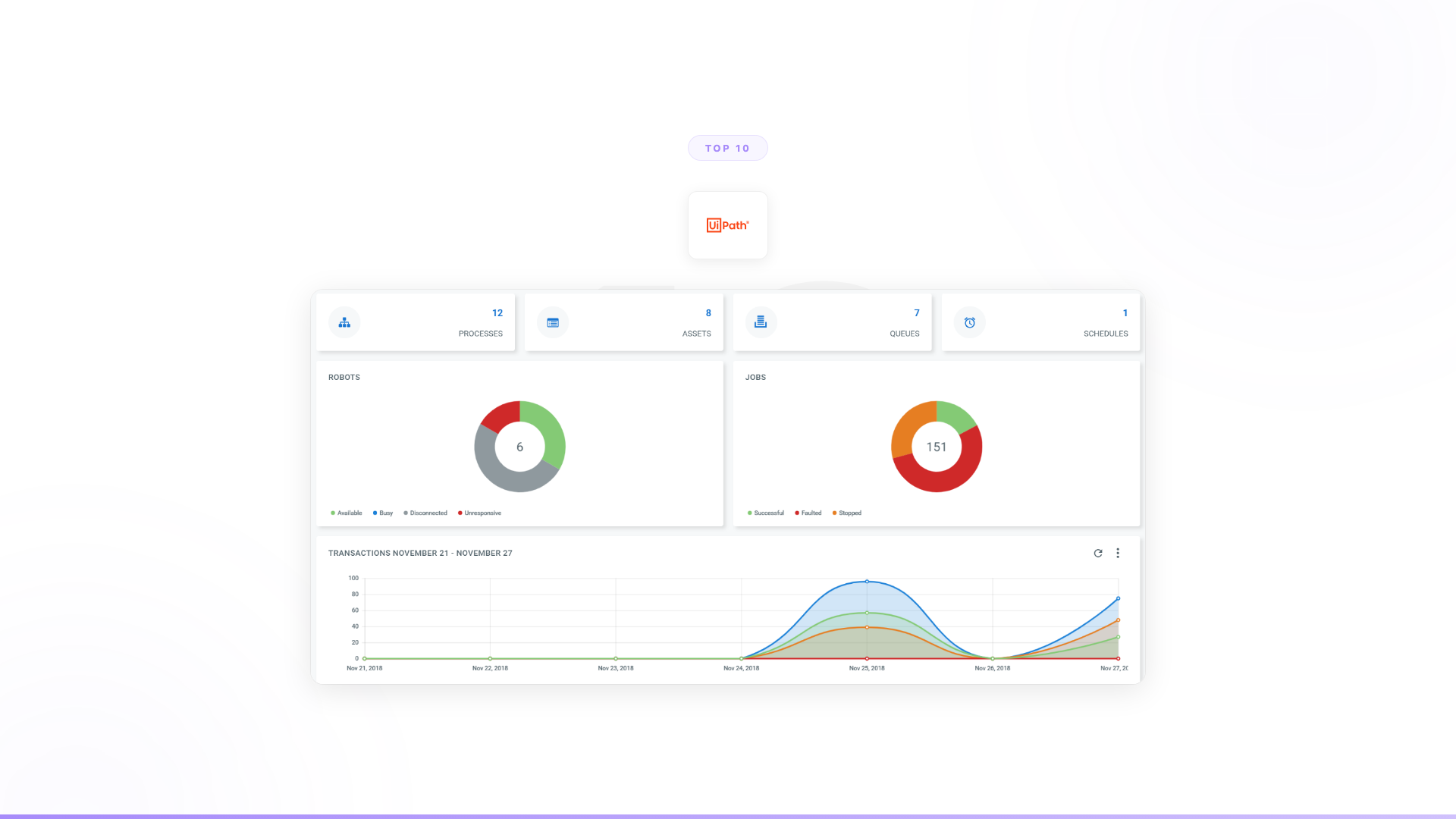
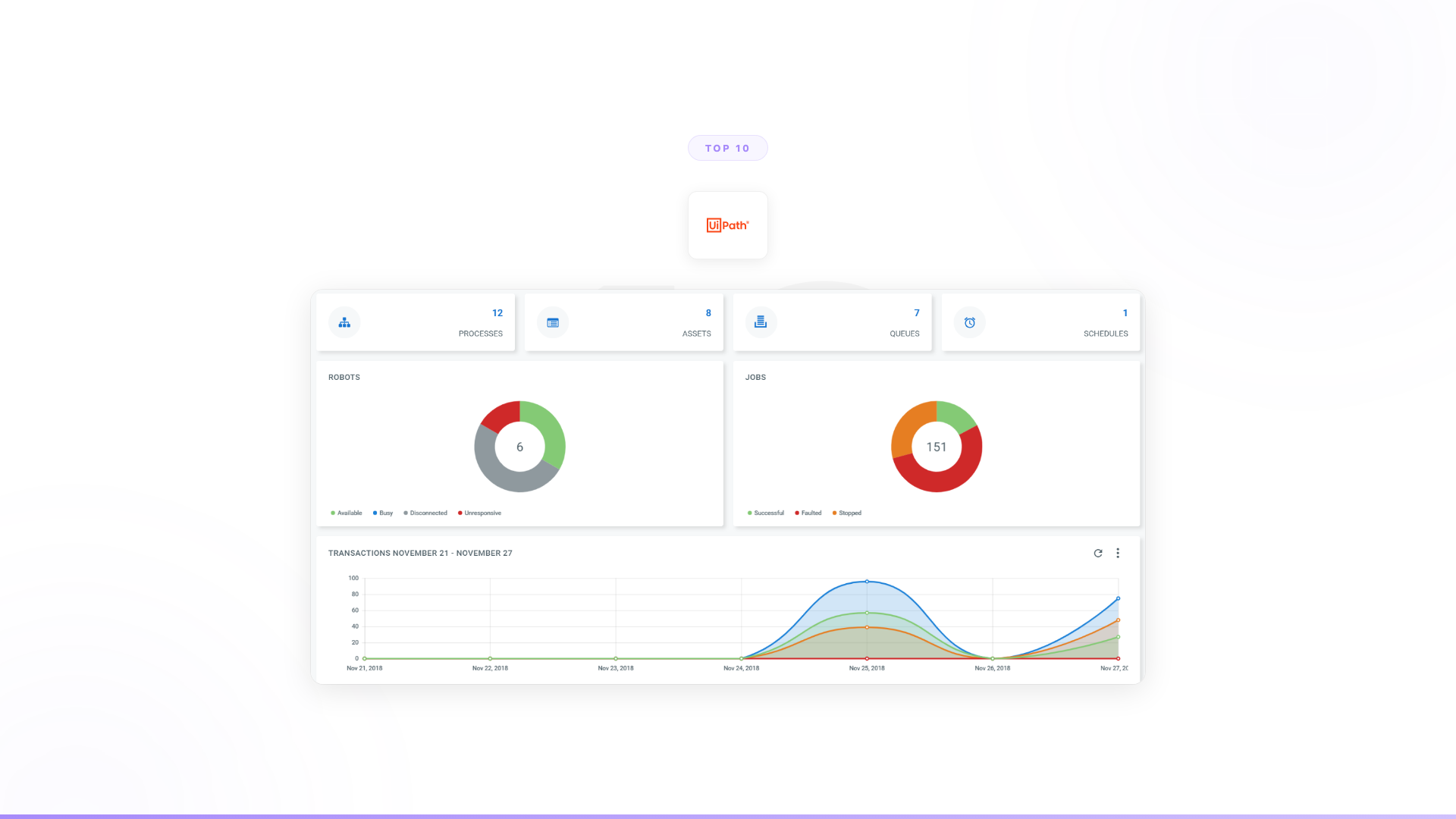
4. UiPath
What it is: The leading RPA platform, named a Leader in Gartner's Magic Quadrant for Robotic Process Automation for consecutive years. Software robots interact with application UIs: clicking, typing, copying data between screens. UiPath has added AI capabilities including document understanding and "agentic automation," but the foundation remains screen-level automation.
What it actually automates: High-volume, repetitive, screen-based tasks. Invoice processing. Data entry across legacy systems. Report generation from applications without APIs. For structured, repetitive work on legacy systems that lack modern APIs, RPA delivers genuine efficiency.
Where it falls short for business process automation: RPA robots follow scripts. When the script encounters something unexpected — a field moved, a format changed, an exception that was not programmed — the robot stops. RPA implementations are notoriously brittle and maintenance-heavy. UI changes break robots. Data format changes break robots. New edge cases require new scripts. The AI additions are improving this, but the architecture is built around mimicking human screen interactions, not reasoning about business processes. According to Forrester research on RPA total cost of ownership, maintenance costs often exceed initial implementation costs within two years.
Pricing: Per-robot licensing. $10,000–$50,000+ per robot annually.
Best for: High-volume, repetitive, screen-based work on legacy systems without APIs.
Full Nexus vs UiPath comparison -->
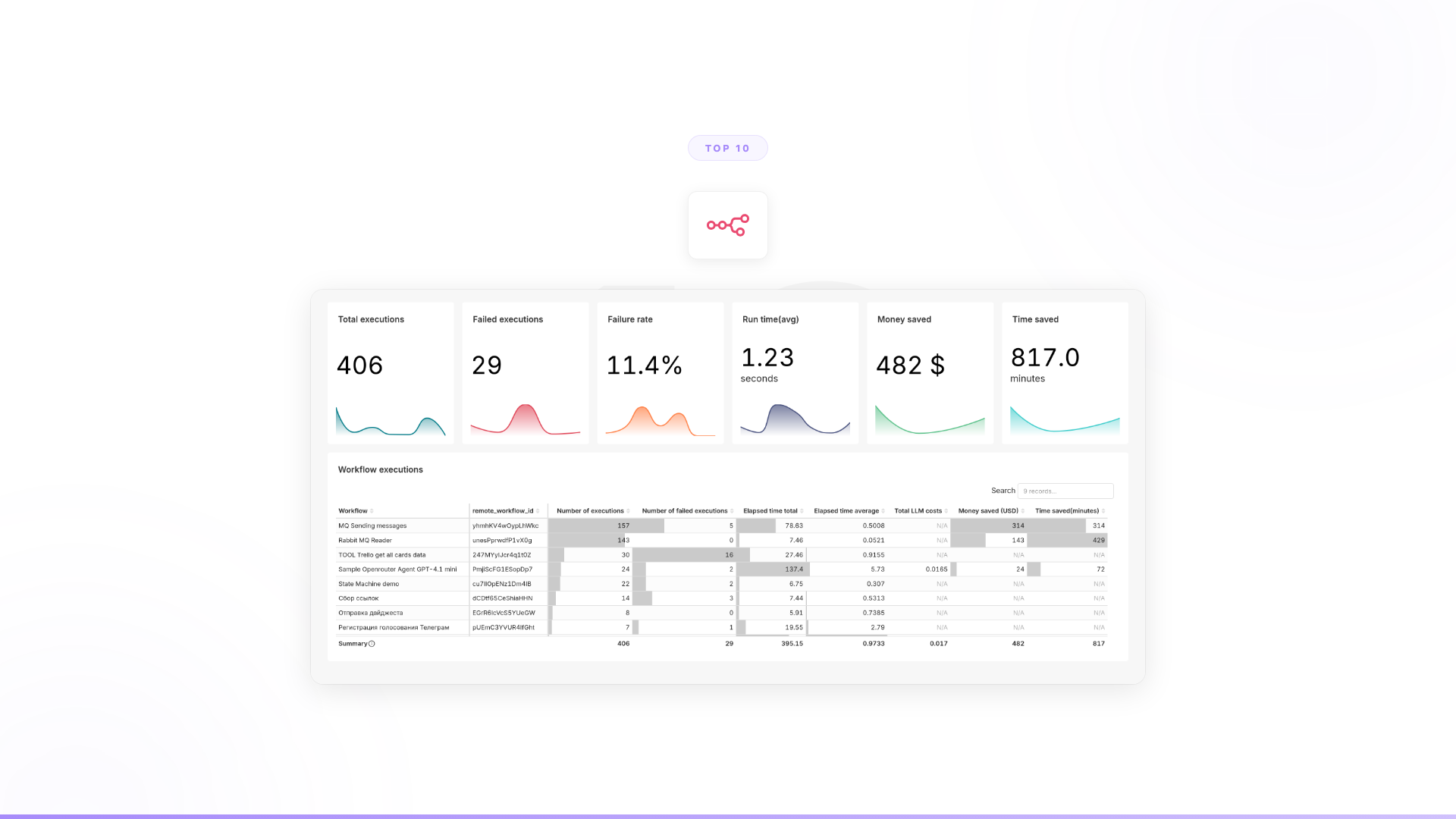
5. n8n
What it is: Open-source workflow automation. Functionally similar to Zapier but fully self-hostable, with support for custom code nodes and greater developer flexibility. Built for technical teams who want control over their automation infrastructure, data residency, and pricing at scale.
What it actually automates: The same scope as Zapier, with more developer flexibility. Custom JavaScript nodes allow more complex data transformation. Self-hosting means no per-task pricing and full data sovereignty — a significant advantage for regulated industries or teams with strict data governance requirements. For technical teams building on-premise, n8n is often the default open-source choice.
Where it falls short for business process automation: n8n is a better Zapier for developers. The architecture is the same: triggers, actions, conditional branches. Self-hosting adds control but also operational burden — your team maintains the infrastructure. For complex processes requiring judgment, conversation, and exception handling, n8n hits the same rule-based ceiling as every other tool in this category.
Pricing: Free (self-hosted). Cloud from $24/month.
Best for: Technical teams wanting open-source, self-hosted workflow automation with full data control.
6. Make
What it is: Visual workflow automation platform (formerly Integromat). Uses a drag-and-drop canvas to build multi-step automations with visual routing, error handling, and parallel execution. More visual and flexible than Zapier's linear model.
What it actually automates: The same category as Zapier with a more visual approach. Complex branching is easier to understand and debug on a canvas. Per-operation pricing can be more cost-effective at scale. Good for teams that find Zapier's linear interface limiting.
Where it falls short for business process automation: A better canvas for drawing rules does not change the fact that they are still rules. No conversation. No judgment. No autonomous decision-making. The visual interface makes rule-based automation more accessible. It does not make it intelligent.
Pricing: Free plan available. Paid from $10.59/month.
Best for: Teams wanting more visual, flexible rule-based automation than Zapier.
7. Microsoft Power Automate
What it is: Microsoft's automation platform combining cloud-based workflow automation with desktop RPA. Deeply integrated with Microsoft 365, Dynamics 365, and Azure. Includes Copilot Studio for building AI-powered flows and automated workflows across Microsoft services.
What it actually automates: Workflows within the Microsoft ecosystem. Approval flows in SharePoint. Notifications in Teams. Data processing in Excel and Dataverse. Desktop automation for Windows applications. Strong for Microsoft-native organizations where the majority of processes run inside the Microsoft stack.
Where it falls short for business process automation: Power Automate is optimized for the Microsoft ecosystem. Cross-platform automation is possible but less natural. Copilot Studio adds AI assistance for building flows, but the flows themselves remain rule-based. Enterprises that have tried deploying Copilot Studio for complex, judgment-intensive workflows typically find they can build simple processes quickly but hit a structural ceiling when workflows require exception handling, multi-system coordination, or autonomous decision-making across business logic that lives outside Microsoft's ecosystem.
Pricing: $15/user/month or $500/flow/month.
Best for: Microsoft-native organizations wanting automation within their existing stack.
8. ServiceNow
What it is: Enterprise workflow and service management platform covering IT operations, HR service delivery, customer workflows, and employee experience. ServiceNow has expanded significantly beyond IT service management (ITSM) — particularly through the 2023 Moveworks acquisition, which added conversational AI capabilities for employee support workflows. The Now Assist suite brings generative AI to workflow creation, incident summarization, and knowledge management.
What it actually automates: IT service management workflows. Employee onboarding. Incident routing and resolution. Change management. HR service requests. Customer-facing workflows within ServiceNow's data model. ServiceNow is genuinely strong for enterprise organizations that have standardized on the platform.
Where it falls short for business process automation: Two constraints. First, scope: ServiceNow excels where processes live within its platform. Extending to sales operations, customer onboarding, compliance monitoring, or workflows that cross many external systems outside ServiceNow's native connectors becomes expensive and complex. Second, the underlying workflow engine remains rule-based — Now Assist and conversational AI improve the interaction layer but do not change the fact that every process path must still be predefined. For enterprise-wide process automation across all departments, ServiceNow covers one domain well while the others stay manual.
Pricing: Per-user licensing. Enterprise pricing varies widely, typically $100–$200/user/year for core modules.
Best for: IT-centric enterprises where ITSM, HR service delivery, and employee experience automation are the primary needs and the team is already standardized on ServiceNow.
9. Camunda
What it is: Process orchestration platform for developers. Camunda lets engineering teams model, execute, and monitor complex business processes using BPMN (Business Process Model and Notation). Designed for technical teams that need fine-grained, code-level control over process logic, particularly in microservice architectures.
What it actually automates: Complex, multi-step business processes where engineering teams define the orchestration logic in code. Well-suited for order processing pipelines, microservice coordination, and workflows where developers need explicit control over every decision point and compensating transaction.
Where it falls short for business process automation: Camunda requires engineering to build and maintain every process. Business teams cannot create or modify workflows without developer involvement. Exception handling must be coded explicitly for every scenario. It is a powerful tool for technical teams building developer-owned systems — but it does not bring automation to the majority of business processes that stay manual because no one has the engineering bandwidth to code every path. Most buyers searching for AI tools for business process automation are not Camunda's target audience.
Pricing: Free (open source). Enterprise pricing custom.
Best for: Engineering teams that need fine-grained BPMN-based process orchestration for developer-built systems and microservice architectures.
10. Custom build
What it is: Building your own AI automation using frameworks like LangChain, LangGraph, CrewAI, or direct API integrations. Full flexibility, full control, full responsibility.
What it actually automates: Anything you can build and maintain. No platform constraints. No vendor dependencies. Maximum customization.
Where it falls short for business process automation: Time, cost, and opportunity cost. Most enterprises do not have surplus AI engineering capacity. A first production agent typically takes three to six months to build — and that is before governance, security, compliance, and monitoring are addressed. Ongoing maintenance compounds. The technical talent required to build, test, and maintain autonomous agents is the same talent needed to build the company's core product. For most enterprises, the opportunity cost of diverting that engineering capacity outweighs the benefits of platform independence.
Pricing: Engineering salaries plus infrastructure. Three to six months minimum before production deployment.
Best for: Organizations with dedicated AI engineering teams, clear platform independence requirements, and timelines that can absorb six or more months of development before seeing production results.
Which AI tools automate complex business processes?
Of the ten tools in this list, only one is architecturally designed for the full scope of complex business process automation: Nexus.
The distinction is not marketing positioning. It is architectural. Tools two through nine are all variations of the same fundamental approach — define rules, execute rules, fail when reality does not match the rules. Some are more visual (Make). Some are more powerful (Workato). Some are specialized for specific domains (ServiceNow for IT, Camunda for developers). But they share the same structural constraint: every scenario must be anticipated in advance.
That constraint works for a portion of automatable business processes — the clean, predictable, linear work that follows the same path every time.
The majority of automatable work requires something fundamentally different. Systems that can reason about what to do when data is ambiguous. Systems that can hold a conversation to collect missing information. Systems that can make a judgment call within guardrails when the situation matches no predefined path. Systems that adapt when business rules change without being rebuilt from scratch.
That is not a feature that rule-based tools can add. It is an architectural difference.
Can AI automation handle exceptions and edge cases?
Yes — but only if the platform is built to reason rather than to match patterns against predefined rules.
Rule-based automation (Zapier, Power Automate, Workato, RPA) handles exceptions through exhaustive rule definition. Every possible exception case must be mapped in advance. If a new exception appears that was not anticipated, the workflow fails or routes to a human. As processes become more complex, the number of possible exception states grows faster than the team can code them.
AI agent platforms handle exceptions differently. Rather than matching the current state against a predefined rule set, agents reason about the current state in context: what information is available, what the business objective is, what constraints apply, and what the appropriate next action is. Novel exceptions that were not anticipated during build can be handled through reasoning — not because every case was coded, but because the agent understands the goal well enough to navigate toward it.
The practical test: take any exception your rule-based automation currently routes to a human. If the human resolves it by following a clear logical chain — reading available data, applying business judgment, taking an action — an AI agent can be built to handle it.
The automation maturity gap
Here is what the ranking reveals. Tools two through nine are all variations of the same fundamental approach: define rules, execute rules, fail when reality does not match the rules.
The enterprises seeing real results from AI business process automation are not layering AI onto rule-based engines. They are deploying agents that combine process execution with conversational intelligence and autonomous decision-making.
Orange Group did not add AI to their existing automation stack. They deployed agents that complete customer onboarding conversations autonomously — 50% conversion improvement, 90% autonomous resolution, 4-week deployment.
A European telecom with 13,000+ employees did not add chatbots to their rule-based support flows. They deployed agents handling millions of interactions while maintaining full regulatory compliance. 40% of support volume freed.
The gap between rule-based automation and intelligent agents is not a feature gap. It is an architectural one. Every additional rule written for a rule-based system gets the automation coverage slightly closer to the ceiling. Deploying an AI agent platform moves the ceiling entirely.
How to choose the right AI automation tool
A practical decision framework:
If your processes are simple and linear — trigger-action between cloud apps, clean data, no exceptions — start with Zapier or Make. Fast setup, predictable cost, wide app support.
If you need enterprise-grade iPaaS with strong governance — complex data transformations, enterprise compliance controls, large-scale integrations — evaluate Workato or MuleSoft.
If your primary bottleneck is screen-based legacy work — data entry, invoice processing, screen scraping on systems without APIs — RPA through UiPath addresses that specific scope.
If you are Microsoft-native — most workflows run inside Microsoft 365, Dynamics 365, or Azure — Power Automate is the lowest-friction starting point.
If IT service management is the primary need — incident management, employee service requests, change management — ServiceNow's depth in ITSM is unmatched.
If you need developer-controlled process orchestration — microservice coordination, BPMN-modeled workflows, engineering team-owned processes — Camunda is purpose-built for that use case.
If the work requires judgment, conversation, and exception handling — the processes that your current automation cannot reach, the manual workflows that involve ambiguous inputs or multi-step decisions — AI agent platforms are the right architectural category. Nexus is the evaluation to run.
Worth exploring?
If rule-based automation has handled the straightforward portion of your processes and the rest stays manual because it requires judgment, conversation, exceptions, and adaptation — it may be worth seeing how that gap closes.
Every Nexus engagement starts with a 3-month proof of concept tied to measurable outcomes. Forward Deployed Engineers embed with your team from day one. You see results before committing.
See Nexus vs Zapier: rules vs intelligence -->
Frequently asked questions
Q: What is the best AI tool for business process automation?
For complex enterprise workflows requiring judgment and exception handling, Nexus ranks first — agents complete end-to-end processes including compliance decisions, exception routing, and multi-system actions without human intervention for each edge case. For simpler rule-based automation, Zapier (SMB and mid-market) and Workato (enterprise iPaaS) are the leading platforms. For RPA-based screen automation on legacy systems, UiPath is the market leader. For IT-specific workflows, ServiceNow is the dominant enterprise platform.
Q: What is the difference between RPA and AI process automation?
RPA automates screen interactions — mimicking mouse clicks and keyboard inputs on predictable, structured processes. It works for well-defined, rule-based tasks but fails on exceptions, unstructured data, and judgment calls. AI process automation handles unstructured inputs, makes decisions within business rules, adapts to exceptions, and completes multi-step workflows that require interpretation rather than script execution. UiPath and Automation Anywhere are RPA platforms adding AI layers; Nexus is an AI-first platform designed for judgment-intensive processes from the architecture up.
Q: Why do so many automatable processes remain manual?
Rule-based automation tools — Zapier, Power Automate, RPA platforms — can only handle processes where every scenario can be anticipated and coded in advance. Exceptions, judgment calls, ambiguous inputs, and compliance decisions that require contextual reasoning fall outside what rule-based tools can handle. According to McKinsey Global Institute research on task automation potential, a significant portion of business process activities involve non-routine cognitive work that rule-based systems cannot address. AI agents close this gap by reasoning about context, interpreting ambiguity, and making decisions within guardrails.
Q: Can Zapier handle complex enterprise workflows?
Zapier is designed for trigger-action rules between apps. It excels at straightforward, sequential integrations with clean, predictable data. Complex enterprise workflows — involving exception handling, conditional logic across multiple systems, compliance decisions, and process branching based on context — exceed Zapier's design scope. Workato handles more enterprise complexity at the rule-based level; Nexus handles judgment-intensive workflows that neither platform can reach.
Q: How long does it take to deploy an AI process automation agent?
Deployment timelines vary significantly by approach. Custom builds using LangChain or similar frameworks typically require three to six months before production deployment — before governance, security, and monitoring are addressed. Platform-based deployments are faster: Nexus's Forward Deployed Engineering model has delivered production agents in four weeks (Orange Group's customer onboarding deployment). The key variable is whether engineering resources are required: platforms that allow business teams to build and own agents without engineering involvement compress deployment timelines substantially.
Related reading
- Top 10 Zapier alternatives for enterprise automation
- Zapier vs Workato: which automation platform for enterprise?
- How to automate business workflows with AI agents
- How to move from RPA to AI agents
- Nexus vs Zapier: full comparison
- Nexus vs UiPath: RPA vs agents that reason
- Nexus vs Workato: enterprise automation comparison