The best AI sales automation tools for enterprise in 2026 include Nexus (autonomous agent platform covering the full revenue cycle), Outreach (sales execution platform, pipeline and forecasting), Salesloft (sales engagement and conversation intelligence), 11x (AI SDR, outbound email and phone, ~$5,000+/month), Artisan (AI SDR with built-in B2B data, $999+/month), Apollo.io (sales intelligence and outreach, freemium to $119/user/month), Gong (revenue intelligence, rated 4.8/5 on G2), Clari (pipeline forecasting), and Amplemarket (multichannel outbound with intent signals). The distinction that matters for enterprise buyers is not which tool does outbound best — it is whether a tool covers one step or the full pipeline.
What is the best AI sales automation tool for enterprise?
Enterprise sales leaders aren't short on AI tools. They're short on AI that covers the full pipeline.
The typical AI sales stack looks like this: an AI SDR for outbound email, a separate tool for data enrichment, another for intent signals, a sales execution platform for pipeline management, a call recorder for conversation intelligence, and a CRM add-on for forecasting. Six vendors. Six contracts. Six integrations. None of them share context. The outbound AI doesn't know what the pipeline AI is seeing. The conversation intelligence doesn't inform the qualification logic. Each tool does one thing well, and together they create a fragmented system that nobody can manage.
The question for enterprises isn't "which AI SDR should we buy?" It's "how do we automate the full revenue cycle without building a disconnected stack of narrow tools?"
That's a different question. And it leads to a different set of tools.
Here are 10 AI sales automation tools ranked by how much of the pipeline they actually cover, from full autonomous platforms to single-step point solutions.
Quick comparison
| Tool | Category | Pipeline coverage | Autonomous? | CRM compatibility | Pricing model |
|---|---|---|---|---|---|
| Nexus | Autonomous agent platform | Full revenue cycle + every other department | Yes, end-to-end | Salesforce, HubSpot, Dynamics, 4,000+ systems | Per-agent |
| Outreach | Sales execution platform | Sequences, pipeline, deal intelligence, forecasting | No (augments reps) | Salesforce, Dynamics, HubSpot | Custom enterprise |
| Salesloft | Sales engagement | Cadences, conversation intel, deal mgmt, forecasting | No (augments reps) | Salesforce, Dynamics, HubSpot | Custom enterprise |
| 11x | AI SDR | Outbound prospecting (email + phone) | Yes (outbound only) | Salesforce, HubSpot | ~$5,000+/mo |
| Artisan | AI SDR | Outbound prospecting with built-in data | Yes (outbound only) | Salesforce, HubSpot | $999+/mo |
| Apollo.io | Sales intelligence + outreach | Prospecting, data, sequences | No (AI-assisted) | Salesforce, HubSpot, Pipedrive | Freemium to $119/user/mo |
| Gong | Revenue intelligence | Conversation analysis, deal tracking, forecasting | No (analytics) | Salesforce, Dynamics, HubSpot | Custom enterprise |
| Clari | Revenue platform | Pipeline inspection, forecasting, revenue analytics | No (analytics) | Salesforce, Dynamics | Custom enterprise |
| Amplemarket | AI sales platform | Multichannel outbound with intent signals | Partial | Salesforce, HubSpot | Custom pricing |
| Custom build | Developer framework | Whatever you engineer | Depends on team | Any (custom-built) | Engineering cost |
What is the difference between an AI SDR tool and sales automation software?
Before the rankings: these categories solve different problems and are often confused.
AI SDR tools (11x, Artisan, Amplemarket) automate outbound prospecting — finding contacts, writing personalized sequences, handling follow-ups, and booking meetings. Scope ends at top of funnel.
Sales execution platforms (Outreach, Salesloft) cover the broader sales workflow: sequence management, pipeline tracking, conversation intelligence, deal analytics, and forecasting. AI assists reps rather than replacing them.
Revenue intelligence tools (Gong, Clari) analyze what is happening inside your pipeline — which deals are at risk, what conversation patterns predict wins, how accurate your forecast is. They observe; they do not act.
Full pipeline automation platforms (Nexus) cover the entire revenue cycle from account research to deal close to post-sale operations. Agents complete work autonomously rather than assisting a rep.
Most enterprises buy from more than one category, which is why the fragmented stack problem exists. The rankings below are organized with this distinction in mind.
The tools, ranked
1. Nexus: Best for Full Revenue Cycle Automation
What it is: An autonomous agent platform paired with Forward Deployed Engineers who embed with your team. Nexus isn't a sales tool. It's a platform where your business teams build AI agents that handle any workflow in any department. For sales, that means agents that cover the full revenue cycle: account intelligence, buying signal detection, competitive analysis, lead qualification, pipeline management, onboarding, support, renewal, and expansion. Connected to 4,000+ enterprise systems.
Why it ranks first:
Most tools on this list automate one step in the pipeline. Nexus automates the pipeline. And the departments that feed into it, and the departments that follow it. The agents don't just send emails or track deals. They research accounts across multiple data sources, identify buying signals, synthesize competitive intelligence, qualify leads against your criteria, manage pipeline progression, handle customer onboarding, run support triage, and monitor renewals. All on one platform. All connected.
Many enterprise teams run Nexus alongside their existing CRM rather than replacing their established sales stack — using agents for research, intelligence, and post-sale operations while keeping pipeline tools for human-managed deal execution.
What it looks like in production:
- Leading AI infrastructure company (10,000+ enterprise accounts): Agents now monitor 12,000+ accounts, synthesize buying signals from multiple sources, and surface pipeline opportunities autonomously. 24,000+ hours of research capacity added annually — equivalent to 12 full-time analysts. Built by a non-engineer who had no prior development experience. The company is now expanding to an agent fleet across sales and marketing.
- Orange Group (multi-billion euro telecom, 120,000+ employees): Business team built autonomous customer onboarding agents. Deployed across multiple European markets in 4 weeks. 50% conversion improvement. ~$6M+ yearly revenue impact. 90% autonomous resolution. 100% team adoption. The same platform handles sales, support, and onboarding.
- European telecom (13,000+ employees): Deployed a dozen agents. 40% support volume freed across millions of interactions. What another platform couldn't deliver in 6 months, Nexus deployed in the same timeframe.
Note: case study figures above are Nexus client-reported data.
The enterprise advantage: Every Nexus engagement starts with a 3-month proof of concept tied to measurable outcomes. Forward Deployed Engineers embed with your team to identify the highest-impact use cases, design agents for your specific workflows, handle integration complexity, and ensure the deployment delivers before you commit. SOC 2 Type II, ISO 27001, ISO 42001, GDPR.
Pricing: Per-agent, tied to value delivered. Not per-seat, not per-contact. An agent serving your entire revenue org costs the same whether you have 5 reps or 500.
Best for: Enterprises that need AI beyond outbound email — account intelligence, pipeline management, qualification, onboarding, support, renewal, and every adjacent department.
Full Nexus vs 11x comparison -->
2. Outreach: Best for Sales Execution with Pipeline Management
What it is: Enterprise sales execution platform. Covers sequence management, pipeline visibility, deal intelligence, forecasting, and rep performance analytics. AI features help reps prioritize accounts, optimize send times, and identify deals at risk. Rated 4.3/5 on G2 across thousands of enterprise reviews. Named a Leader in the Gartner Magic Quadrant for Sales Engagement Platforms.
Pipeline coverage: Broader than any AI SDR tool. Outreach touches sequences, follow-ups, deal progression, pipeline forecasting, and rep coaching. For enterprise sales teams with complex, multi-touch cycles, it covers meaningful ground.
Limitations: AI augments reps rather than completing work autonomously. Someone still needs to run the process. Sales-only. No customer onboarding, support, compliance, or cross-department capability. And per-user pricing means costs scale with headcount, not value delivered.
CRM compatibility: Salesforce (native), Microsoft Dynamics, HubSpot.
Pricing: Custom enterprise pricing. Typically $100+/user/month, with enterprise teams commonly reporting total spend in the tens to hundreds of thousands of dollars annually.
Best for: Enterprise sales teams with complex cycles that need pipeline management and sequence automation, with reps still driving the process.
3. Salesloft: Best for Conversation Intelligence and Cadence Management
What it is: Sales engagement platform with conversation intelligence, cadence management, deal management, and forecasting. Strong call recording and analysis. Owned by Vista Equity Partners. Mature platform widely deployed in enterprise. Rated 4.5/5 on G2 — slightly higher than Outreach on overall satisfaction.
Pipeline coverage: Comparable to Outreach. Cadence management, conversation intelligence, deal tracking, pipeline forecasting. AI assists with next-best-action recommendations and deal risk scoring. Slight edge in conversation intelligence for teams where phone is a primary channel.
Limitations: Same structural constraints as Outreach. Sales-only. AI assists, doesn't replace. Cross-department use cases aren't in scope. Per-user pricing scales with team size.
CRM compatibility: Salesforce (native), Microsoft Dynamics, HubSpot.
Pricing: Custom enterprise pricing. Comparable to Outreach.
Best for: Revenue teams that prioritize conversation intelligence, engagement tracking, and cadence management.
4. 11x: Best for Autonomous Outbound Email and Phone
What it is: AI SDR platform with "Alice" for outbound email and "Julian" for phone qualification and calling. Autonomously finds prospects, writes personalized sequences, handles follow-ups, and books meetings.
Pipeline coverage: Narrow. Top-of-funnel outbound only. No account intelligence, pipeline management, deal tracking, or post-sale capability. The phone channel (Julian) adds more of the outbound motion than email-only tools, but the scope stops at meeting booking.
Limitations: Once the meeting is booked, 11x's job is done. Account research, qualification, pipeline management, onboarding, support, and retention all require separate tools or manual effort. Annual commitment required before you've validated performance. Reviews are polarized on personalization quality.
CRM compatibility: Salesforce, HubSpot (via native integrations).
Pricing: Starts around $5,000/month. Annual commitment.
Best for: Sales teams where outbound volume (email + phone) is the primary bottleneck and the only current AI priority.
See also: Top 10 11x Alternatives -->
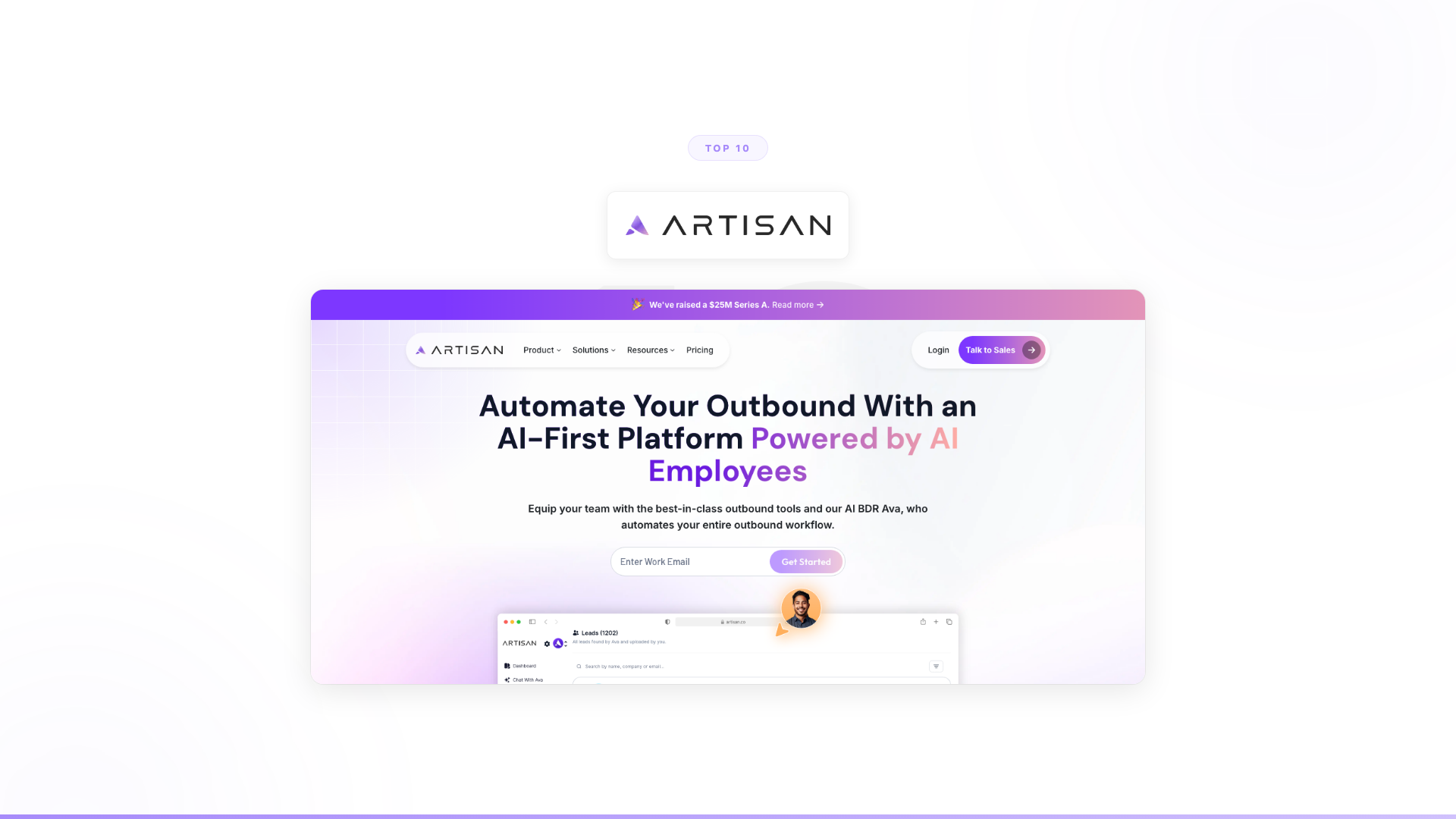
5. Artisan: Best for Outbound Prospecting with Bundled Data
What it is: AI SDR with "Ava," a virtual sales development rep. Automates outbound prospecting with built-in B2B contact database (300M+ contacts). Eliminates the need for separate data providers like ZoomInfo or Lusha.
Pipeline coverage: Same scope as 11x, minus the phone channel. Outbound email prospecting. The built-in data is the differentiator: you don't need a separate enrichment tool, which simplifies the stack for the outbound step specifically.
Limitations: Outbound email only. The "AI Employee" branding sets expectations of autonomy that user reviews on G2 say it doesn't consistently deliver at scale. Emails frequently described as clearly machine-generated. Same narrow scope as other AI SDRs: no account intelligence, no pipeline management, no post-sale workflows.
CRM compatibility: Salesforce, HubSpot (via integrations).
Pricing: Starts around $999/month. Annual commitment.
Best for: Teams that want outbound prospecting with bundled data at a lower price point than 11x.
See also: Artisan Alternatives -->
6. Apollo.io: Best for Sales Intelligence with Integrated Contact Database
What it is: Sales intelligence and engagement platform with a large B2B contact database (275M+ contacts). Combines data, outreach, lead scoring, and analytics. AI features assist with prospecting and email writing, but reps still manage the process.
Pipeline coverage: More than AI SDR tools in some ways. Apollo combines data, outreach, lead scoring, and analytics in one platform. But the AI is assistive, not autonomous. Reps are still running sequences, selecting leads, and managing follow-ups. No pipeline management beyond basic scoring. No post-sale capability.
Limitations: AI assists, doesn't act. For teams that want AI help with outbound but prefer human control, Apollo delivers. For teams that want AI to actually complete sales workflows, it's a productivity tool, not an agent.
CRM compatibility: Salesforce, HubSpot, Pipedrive (native integrations).
Pricing: Free tier available. Paid plans from $49/user/month to $119/user/month.
Best for: Sales teams that want integrated data and outreach with AI assistance, with reps still running the process.
7. Gong: Best for Conversation Intelligence and Deal Risk Analysis
What it is: Revenue intelligence platform. Records and analyzes sales conversations (calls, emails, meetings), surfaces deal insights, tracks pipeline health, and provides forecasting. Rated 4.8/5 on G2 — the highest score among the major sales platforms on this list, reflecting very strong product-market fit for conversation intelligence use cases.
Pipeline coverage: Strong on the intelligence side. Gong tells you what's happening in your deals: which conversations went well, which deals are at risk, what patterns predict success. But it's an analytics tool, not an automation tool. It informs decisions. It doesn't make them or execute actions.
Limitations: Observes, doesn't act. Gong gives your team better visibility into the pipeline but doesn't complete any workflow. No outbound, no qualification, no onboarding, no support. And per-user pricing in the enterprise tier runs higher than most tools on this list.
CRM compatibility: Salesforce (native), Microsoft Dynamics, HubSpot.
Pricing: Custom enterprise pricing. Typically $100–150+/user/month, with a mandatory platform fee layered on top of per-user licensing.
Best for: Sales leadership that needs visibility into deal health, conversation patterns, and pipeline accuracy. Most often deployed alongside an execution platform (Outreach or Salesloft) rather than instead of one.
8. Clari: Best for Pipeline Forecasting and Revenue Operations
What it is: Revenue platform focused on pipeline inspection, forecasting accuracy, and revenue analytics. AI analyzes pipeline data across your CRM, email, and calendar to predict outcomes and identify risk.
Pipeline coverage: Forecasting and pipeline analytics. Clari doesn't generate pipeline. It inspects and predicts what will happen with the pipeline you already have. Strong for revenue operations teams that need accurate forecasting and want to stop relying on rep self-reporting.
Limitations: Analytics, not action. Clari tells you your forecast is off. It doesn't fix the deals that are slipping. No outbound, no qualification, no onboarding, no support. Different problem than what AI SDR tools solve.
CRM compatibility: Salesforce (primary), Microsoft Dynamics.
Pricing: Custom enterprise pricing.
Best for: Revenue operations teams focused on forecast accuracy and pipeline integrity. Deployed alongside execution platforms, not as a replacement for them.
9. Amplemarket: Best for Multichannel Outbound with Intent Signals
What it is: AI-powered sales platform combining prospecting, multichannel outbound (email, LinkedIn, phone), and intent data. Helps prioritize in-market buyers rather than working lists sequentially. The intent signal layer is a meaningful differentiator — teams focus effort on buyers showing active signals rather than sequencing cold contacts.
Pipeline coverage: More channels than most AI SDRs. Automates LinkedIn and phone alongside email, with intent data helping teams focus on buyers showing active signals. Still top-of-funnel only: no pipeline management, deal tracking, or post-sale capability.
Limitations: Multichannel outbound is genuinely better than email-only. But the scope still stops at meeting booking. Everything after the meeting — qualification, deal management, onboarding, support — requires other tools.
CRM compatibility: Salesforce, HubSpot.
Pricing: Custom pricing. Typically positioned mid-market to enterprise.
Best for: Sales teams that want multichannel outbound with intent signals and want more channel coverage than 11x or Artisan provide.
10. Custom Build: For Teams with Dedicated AI Engineering Capacity
What it is: Building your own AI sales automation system using frameworks like LangChain, LangGraph, or CrewAI. Your engineering team designs the architecture, writes the code, handles deployment, security, and maintenance.
Pipeline coverage: Theoretically unlimited. You can build exactly what your organization needs, covering the full pipeline with custom agents. In practice, coverage depends entirely on your engineering capacity and how long you're willing to invest.
Limitations: Most enterprise sales teams don't have surplus AI engineering capacity. One major AI infrastructure company — whose core business is AI infrastructure — chose Nexus over building internally because the opportunity cost of diverting engineering to internal tooling was too high. Custom builds also mean you own security, governance, monitoring, and maintenance. Expect 3 to 6 months for a first production agent, then ongoing maintenance.
CRM compatibility: Any (custom-built).
Pricing: Engineering salaries plus infrastructure. Meaningful opportunity cost beyond direct spend.
Best for: Organizations with dedicated AI engineering teams and unique technical requirements that no commercial tool can serve.
How to automate the full sales pipeline with AI
The fragmented stack problem has a specific cost structure that's worth making concrete.
The tool count grows linearly. Outbound AI (11x or Artisan). Data enrichment (ZoomInfo). Intent signals (Bombora or 6sense). Sales execution (Outreach or Salesloft). Conversation intelligence (Gong). Pipeline forecasting (Clari). Customer onboarding (separate vendor). Support automation (separate vendor). That's eight tools for one revenue process.
The data stays siloed. The outbound AI doesn't know what deals are in pipeline. The conversation intelligence doesn't inform the qualification logic. The onboarding system doesn't flag upsell signals to the sales team. Each tool optimizes its slice. Nobody optimizes the whole.
The cost compounds. Per-user pricing across six tools means the cost scales with headcount, not with results. Add up Outreach ($100+/user), Gong ($100–150+/user), 11x ($5,000+/month), ZoomInfo, and Clari across a 50-person revenue team and you're easily past $500K annually in AI sales tools that don't connect.
Platform economics work differently. The integrations you set up for the first agent serve every subsequent one. The account intelligence that powers outbound also informs qualification, pipeline management, and renewal. Each new agent deploys faster and makes the whole system more capable. The first use case becomes the foundation — not an isolated deployment.
AI sales tool comparison: How to evaluate platforms for enterprise
Before committing to any tool, enterprise buyers should evaluate against four criteria:
1. Pipeline coverage. How many revenue cycle steps does the tool actually cover? Point solutions (outbound only, analytics only) require you to buy and integrate additional tools. Measure this against your full use case, not just the first one.
2. Autonomy level. Does the AI complete work, or does it assist humans completing work? Assistive AI requires reps to execute. Autonomous AI executes independently. Both have a role; they solve different problems and carry different ROI profiles.
3. CRM and systems compatibility. Enterprise sales tools live inside a Salesforce or Dynamics instance. Verify native integration depth, not just API availability. Shallow integrations require manual data transfer and break context continuity.
4. Pricing model alignment. Per-seat pricing scales with headcount. Per-contact pricing scales with volume. Per-agent pricing scales with value delivered. Match the model to your growth trajectory. A 50-person team that expects to double in headcount faces very different economics on per-seat vs. per-agent pricing.
So which tool should you actually choose?
If you need autonomous outbound only — and that's genuinely your only AI priority — 11x (email + phone) or Artisan (email + bundled data) are purpose-built for it. Evaluate personalization quality and CRM integration depth carefully before committing to an annual contract.
If you need sales execution with humans in the loop, Outreach or Salesloft cover pipeline management, conversation intelligence, and deal progression. Strong for complex enterprise sales cycles where reps drive the final decision. Outreach rates slightly higher for multichannel sequencing; Salesloft rates higher for conversation intelligence and coaching.
If you need revenue analytics, Gong (conversation intelligence, 4.8/5 on G2) and Clari (pipeline forecasting) provide visibility into what's happening in your deals. They don't automate. They inform. Most enterprises deploy them alongside execution platforms, not instead of them.
If you need the full pipeline automated — from account intelligence to deal execution to post-sale operations, on one platform that eliminates tool sprawl and connects to 4,000+ enterprise systems with Forward Deployed Engineers ensuring it actually works — that's a different category entirely. That's what Nexus was built for.
The difference between stacking AI sales tools and deploying an AI agent platform isn't efficiency. It's category. One grows linearly with headcount and complexity. The other compounds: each agent makes the platform more capable, each deployment informs the next, and the infrastructure you build for sales becomes the foundation for operations, support, compliance, and every department that follows.
FAQ: AI Sales Automation Tools
Q: What is the best AI sales automation tool for enterprise in 2026?
For full revenue cycle automation — account research through post-sale — Nexus ranks first, with agents covering every stage autonomously. For sales execution with human-led pipeline management, Outreach and Salesloft are the category leaders (rated 4.3/5 and 4.5/5 on G2 respectively). For revenue intelligence specifically, Gong leads on conversation analysis (4.8/5 on G2) and Clari leads on pipeline forecasting. For outbound-only AI SDR automation, 11x and Artisan are the leading purpose-built tools.
Q: What is the difference between an AI SDR tool and sales automation software?
AI SDR tools (11x, Artisan, Amplemarket) automate outbound prospecting — finding prospects, writing emails, booking meetings. Sales automation software (Outreach, Salesloft) covers the broader sales workflow: sequences, pipeline management, conversation intelligence, and forecasting. Full sales automation platforms (Nexus) cover the entire revenue cycle from account research through deal close to customer success, across multiple departments.
Q: How much do AI sales automation tools cost?
Pricing varies significantly: AI SDR tools range from $999/month (Artisan starter) to $5,000+/month (11x); sales engagement platforms (Outreach, Salesloft) are custom enterprise pricing — enterprise teams commonly report total spend in the tens to hundreds of thousands of dollars annually; revenue intelligence tools (Gong at $100–150+/user/month, Clari at custom pricing) add on top of that; Apollo.io is $49–$119/user/month with a freemium tier. Nexus is per-agent pricing tied to deployed workflows, not headcount.
Q: Is Gong worth the cost for enterprise sales teams?
Gong is the market leader in conversation intelligence — capturing sales call data, identifying deal risks, and providing coaching insights at scale. With a 4.8/5 G2 rating across enterprise reviews, it has strong product-market fit for teams with 20+ reps and complex deal cycles where coaching and deal visibility drive meaningful win rate improvement. It works alongside execution platforms (Outreach or Salesloft) rather than replacing them — Gong tells you what's happening in deals; the execution platform is where reps act on that intelligence.
Q: Can you replace Outreach or Salesloft with an AI agent platform?
Not always immediately — and often not the right framing. The better question is: what do you still need them for after agents are handling account research, buying signal detection, qualification, and post-sale operations? Some enterprises run Nexus alongside their existing CRM and execution stack, using agents for the intelligence and automation layers while keeping established tools for human-managed pipeline stages. Others find that as agent coverage expands, the need for multiple point solutions shrinks.
Worth exploring?
Every Nexus engagement starts with a 3-month proof of concept tied to measurable outcomes. Forward Deployed Engineers embed with your team from day one. You see the results before committing.
See the full Nexus vs 11x comparison -->