Top 10 AI Boutique Consultancies in Europe vs AI Platforms (2026)
Europe's AI boutique consultancies bring deep expertise. But the consulting model bills for time, not outcomes. Here are 10 options ranked for enterprises that need AI agents in production, not another 6-month engagement.
The leading AI boutique consultancies in Europe include ML6 (Ghent, Belgium — ML engineering and Google Cloud), Artefact (Paris — data strategy and marketing analytics), and Xebia (Netherlands — AI-first digital transformation). Alongside them, Endava, Thoughtworks, QuantumBlack (McKinsey), and Avanade serve the enterprise market at different price points and specializations. Platforms such as Dataiku and Databricks represent the platform alternative to custom consulting. For enterprises that need production AI agents rather than consulting projects, Nexus (Brussels) is the platform-plus-service alternative ranked first.
Europe has some of the strongest AI talent in the world — and in 2026, that talent is concentrated in a handful of boutique consultancies that most enterprises outside the Benelux, France, and DACH regions have never heard of. These firms aren't generalist IT shops retrofitting an "AI practice." ML6 in Belgium, Artefact in France, and Xebia in the Netherlands hire engineers who have been building production ML systems for years. But as Gartner forecasts GenAI spending in Europe to grow 78.2% in 2026, the question enterprises are asking has shifted: not whether these firms are good, but whether the consulting engagement model — billing by the day for custom builds — still fits what AI deployment actually requires in 2026.
Here are 10 options for enterprises evaluating AI expertise in Europe, ranked by what they deliver for getting AI agents into production.
Quick comparison: AI boutique consultancies and platforms in Europe
| Option | Type | Headquarters | Specialization | Time to production | Pricing model |
|---|---|---|---|---|---|
| Nexus | AI agent platform + FDEs | Brussels | Enterprise workflow automation | 2–6 weeks | Per-agent |
| ML6 | AI boutique | Ghent, Belgium | ML engineering, Google Cloud | 3–12 months | ~€1,200–€1,800/day |
| Artefact | Data & AI consultancy | Paris, France | Data strategy, marketing analytics | 3–12 months | ~€1,000–€2,500/day |
| Xebia | Digital consultancy | Hilversum, Netherlands | AI + cloud + data + agile | 8–16 weeks | ~€900–€1,500/day |
| Dataiku (Platform) | AI/ML platform | Paris, France | Data science workbench | Weeks to months | Platform license |
| Databricks (Platform) | Data + AI platform | Amsterdam (EU HQ) | Data lakehouse, ML pipelines | Weeks to months | Platform + consumption |
| Endava | Nearshore engineering | London, UK | Custom software, AI builds | 3–12 months | ~€600–€1,000/day (nearshore) |
| Thoughtworks | Engineering consultancy | London (EU HQ) | Engineering transformation | 6–18 months | ~€1,500–€3,000/day |
| QuantumBlack (McKinsey) | Strategy + AI consulting | London | AI strategy, data science | 3–12 months | ~€2,500–€4,000/day |
| Avanade | Microsoft-focused consultancy | London (EU HQ) | Microsoft AI + Azure | 4–12 months | Day rates |
Day rate estimates are market estimates based on publicly available benchmarks and should be treated as indicative. Actual rates depend on engagement type, seniority, and geography.
What are the best AI consultancies in Belgium and the Netherlands?
For Benelux-based enterprises, ML6 and Xebia are the two most prominent local specialists. ML6 (Ghent) has the deeper ML engineering pedigree and stronger Google Cloud integration; Xebia (Netherlands) covers more of the full-stack digital transformation scope, including cloud, data platforms, and agile delivery. Both operate in the €900–€1,800/day range for senior consultants. Neither has a product that business teams can own and iterate on post-engagement.
The options, ranked
1. Nexus
What it is: An enterprise AI agent platform paired with Forward Deployed Engineers who embed with your team from day one. Headquartered in Brussels with an office in San Francisco. The founding team has deep European enterprise experience — the CEO is ex-McKinsey and the co-founder built and ran an AI development agency in Europe.
Nexus agents complete entire business workflows end-to-end: collecting data, validating it against systems, making decisions within guardrails, handling exceptions, and executing actions across 4,000+ native integrations. SOC 2 Type II, ISO 27001, ISO 42001, and GDPR certified.
Why enterprises choose Nexus over boutique consultancies:
The structural difference matters more than the talent difference. AI boutiques assign excellent engineers to your project. Those engineers build a custom solution, hand it off, and move to the next client. Every modification, expansion, or update requires re-engagement and more billable days. Your business teams inherit something they didn't build and may not fully understand.
Nexus inverts that model. Business teams build and own the agents, with Forward Deployed Engineers embedded alongside them. You pay per agent, tied to value delivered. The incentive is to get agents into production fast — because that's when value begins for both sides.
What it looks like in production:
- Orange Group (multi-billion euro telecom, 120,000+ employees): Business team built autonomous customer onboarding agents. Deployed across multiple European markets in 4 weeks. 50% conversion improvement. ~$6M+ yearly revenue impact. 90% autonomous resolution. 100% team adoption. (Source: Nexus client data)
- European telecom (13,000+ employees): Deployed a dozen Nexus agents across support operations. 40% of support volume freed across millions of interactions. 12-week deployment. (Source: Nexus client data)
Pricing: Per-agent, tied to value delivered. 3-month POC with measurable outcomes. 100% POC-to-contract conversion rate.
Best for: European enterprises that need AI agents completing business workflows in production in weeks, with business teams owning the result.
Full Nexus vs ML6 comparison →
2. ML6
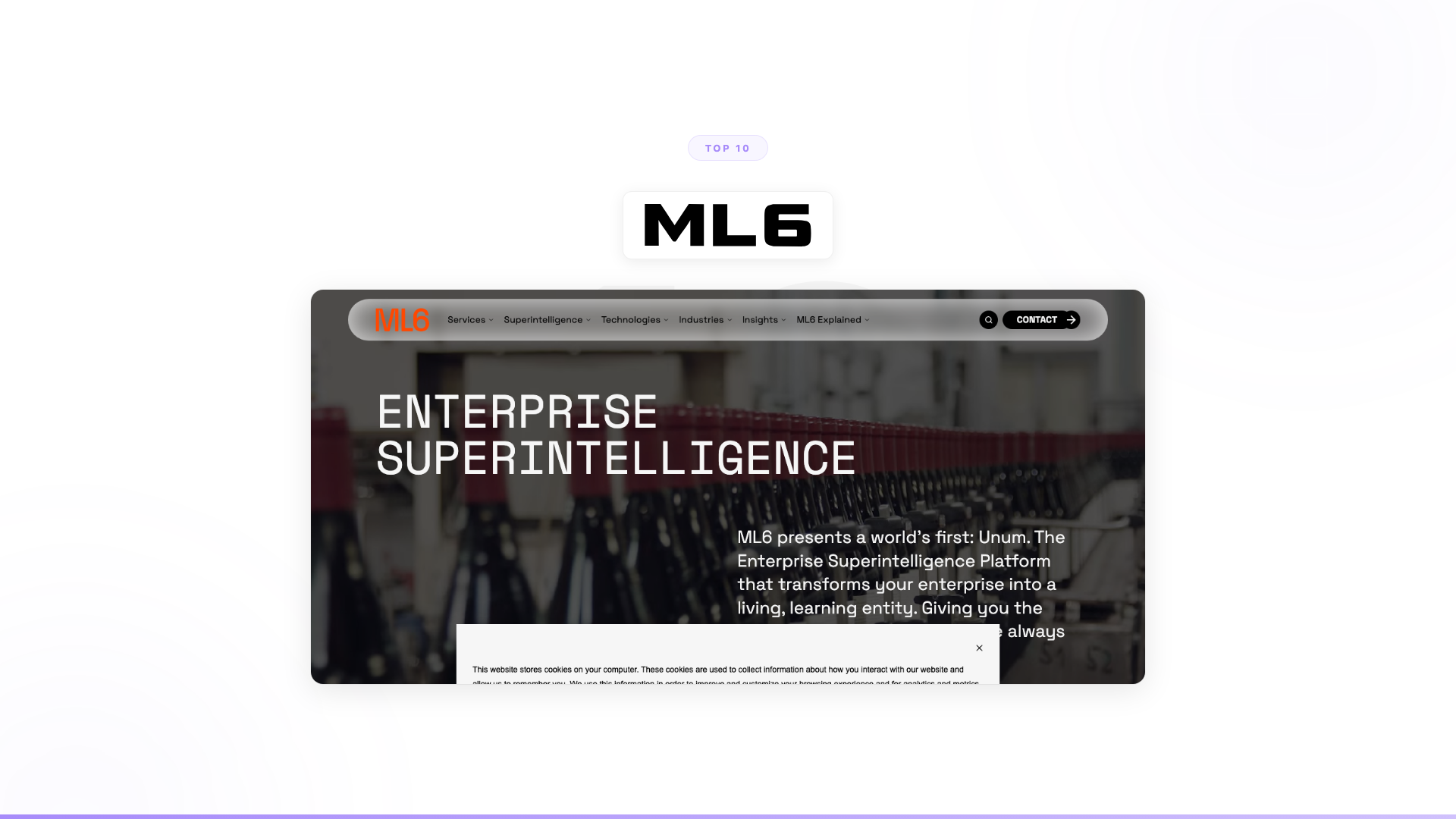
What it is: One of the strongest AI engineering consultancies in Europe. Founded in Ghent in 2013 by Nicolas Deruytter and Michael Lemmer. 140+ AI specialists across Ghent, Amsterdam, Berlin, and Munich. Google Cloud Services Partner of the Year for Benelux (2024). OpenAI Services Partner (2025). 400+ AI projects across 150+ organizations. Four consecutive Deloitte Fast 50 awards. FT1000 list of fastest-growing European companies. Clients include Randstad, ASML, Pfizer, and P&G.
What they're good at: Custom ML model development, MLOps pipelines, and Google Cloud-native AI architectures. They helped ASML analyze calibration data from photolithography machines, shortening release cycles from monthly to biweekly. They helped Randstad build predictive sales tools that raised hit rates from 25% to 70%. ML6 has also announced Unum, their Enterprise Superintelligence platform, signaling a move toward product-led delivery.
The structural tension: Day rates. Project-based fees. The firm earns more when projects take longer. For bounded, well-defined ML challenges, this works fine. For ongoing enterprise AI agent deployment across multiple workflows, the model doesn't scale. Your fifth agent costs roughly as much and takes roughly as long as your first.
Pricing: ~€1,200–€1,800/day for senior AI engineers (market estimate). Project-based pricing for defined scopes.
Best for: Custom ML model development, specialized data science challenges, Google Cloud-native architectures. Especially strong for Benelux enterprises wanting a local partner with genuine ML depth.
Full Nexus vs ML6 comparison →
3. Artefact
What it is: A global data and AI consultancy founded in Paris in 2014. 1,700+ employees across 25 countries. Clients include Samsung, L'Oreal, Sanofi, and Carrefour. Cinven acquired a majority stake in 2025 at a valuation exceeding €1 billion, with stated ambitions to triple the business to 5,000+ staff by 2030. Google Cloud Premier Partner and EMEA AI Partner of the Year.
What they're good at: Data strategy, custom ML models, data engineering, and digital marketing analytics. Their roots include digital marketing (merged with NetBooster in 2017). They bring strong capabilities in marketing attribution, customer data platforms, and media optimization for consumer goods and retail clients.
The structural tension: Day rates (approximately €1,000–€2,500/day per consultant, market estimate), project phases, and retainers. Artefact is excellent at helping enterprises that don't yet have mature data foundations. The risk is that data strategy assessments, governance frameworks, and preparation phases can become self-perpetuating engagements — not always by design, but the billing model doesn't discourage it.
Pricing: Day rates, project-based, and retainer models. Market estimate: ~€1,000–€2,500/day.
Best for: Data strategy transformation, custom ML models, marketing analytics. Strongest when you're early in your data maturity journey and need foundations built before agents can be deployed.
Full Nexus vs Artefact comparison →
4. Xebia
What it is: A global digital consultancy founded in the Netherlands in 2001. 5,500+ professionals across 28 offices. Covers AI/ML, cloud, data engineering, software development, and agile transformation. Google Cloud Premier Partner, Microsoft Solutions Partner. Named a Disruptor in Avasant's Generative AI Services RadarView. Clients include Philips, Ahold Delhaize, Tesco, and ING.
What they're good at: Full-stack digital transformation. If your AI initiative sits inside a broader program that includes cloud migration, data platform modernization, and agile transformation, Xebia can staff the complete program. Their breadth across disciplines is a genuine advantage over pure AI boutiques that can't touch the infrastructure layer.
The structural tension: Day rates and sprint-based billing. Their AI projects typically run 8–16 weeks, with discovery and scoping adding lead time. Each new use case requires a new engagement. The model incentivizes treating every initiative as a fresh project.
Pricing: Day rates. Market estimate: ~€900–€1,500/day. Typical engagements range from €350K to €2M+.
Best for: Enterprises needing full-stack digital transformation alongside AI, particularly in the Netherlands and broader Benelux region.
Full Nexus vs Xebia comparison →
5. Dataiku (Platform alternative to consulting)
What it is: A Paris-founded AI and ML platform — not a consultancy — that provides a collaborative workbench for data scientists, analysts, and engineers. Used by enterprises to build, deploy, and govern ML models. Strong in the European market with customers including Unilever, GE, and BNP Paribas.
What they're good at: Democratizing data science within organizations. Dataiku lets data teams collaborate on model development, feature engineering, and MLOps in a visual environment. For enterprises with existing data science talent that need better tooling and collaboration infrastructure, Dataiku is a strong platform.
The structural tension: Dataiku is a tool for building and managing models. It's not an agent platform. It doesn't complete business workflows end-to-end. Your data team still needs to build, maintain, and integrate whatever they create. For enterprises that need autonomous AI agents on business workflows, Dataiku addresses a different layer of the stack.
Pricing: Platform license, typically enterprise-negotiated.
Best for: Data science teams that need a collaborative environment for model development and MLOps.
6. Databricks (Platform alternative to consulting)
What it is: A data and AI platform with a major European presence — Amsterdam is a key EU hub. Provides the data lakehouse architecture for data engineering, analytics, and ML. Used by enterprises including Shell, ABN AMRO, and Heineken. Their Mosaic AI offering includes tools for building and deploying AI agents.
What they're good at: Unifying data and AI on a single platform. Databricks is strong at the data infrastructure layer: data pipelines, feature stores, model serving, and analytics. Their Mosaic AI agent framework is growing but still primarily aimed at engineering teams rather than business process owners.
The structural tension: Databricks is a data platform with AI capabilities, not an AI agent platform with data capabilities. Building production agents on Databricks requires significant engineering effort. Business teams can't own or iterate on agents directly without engineering support. It's a powerful foundation, but you still need engineers to build whatever sits on top.
Pricing: Consumption-based platform pricing plus enterprise licensing.
Best for: Enterprises that need a unified data and AI infrastructure layer, with engineering teams that can build on top of it.
7. Endava
What it is: A publicly traded, London-headquartered technology services company. Approximately 11,479 employees across 29 countries. Known for high-quality nearshore software engineering from Eastern Europe (Romania, Moldova, Bulgaria, Serbia). Revenue of £772.3M in fiscal 2025. Dava.Flow AI methodology spans Signal, Explore, Govern, and Evolve phases — with over 50% of Endava's workforce now using AI in client projects.
What they're good at: Dedicated engineering teams at competitive nearshore rates with European timezone alignment. For complex, bespoke software applications where you need 5, 10, or 50 engineers as an extension of your own team, Endava's model works well. Their AI practice is genuinely maturing and better integrated into delivery than most nearshore providers.
The structural tension: Nearshore day rates are lower per hour than onshore, but costs still scale linearly with team size and duration. A 6-month engagement with 5–8 engineers can reach €500K–€1.5M+. The structural incentive is the same as any time-based model: longer engagements mean more revenue. Their AI practice is newer than dedicated AI boutiques like ML6.
Pricing: Nearshore day rates. Market estimate: ~€600–€1,000/day. Competitive compared to onshore UK/Netherlands rates.
Best for: Dedicated engineering teams for complex software applications. European enterprises wanting timezone-aligned nearshore delivery at lower rates than onshore boutiques.
Full Nexus vs Endava comparison →
8. Thoughtworks
What it is: A globally respected technology consultancy, founded in 1993. Known for engineering excellence, the Agile Manifesto, and the Technology Radar. 10,000+ consultants across 47 offices. Launched AI/works for legacy modernization. AWS Agentic AI Specialization holder.
What they're good at: Engineering transformation. If the goal is to change how your engineering organization works — TDD, continuous delivery, clean architecture — Thoughtworks delivers knowledge transfer alongside delivery. Their AI/works platform specifically targets legacy modernization. The Technology Radar remains one of the most cited resources in enterprise technology strategy.
The structural tension: Premium rates (approximately €1,500–€3,000/day onshore, market estimate). A 12-month engagement with 8–12 consultants can run €2M–€5M+. The engineering quality is high, but the billing model still rewards duration. For deploying AI agents on business workflows quickly, the timeline and cost structure don't fit most enterprises' needs in 2026.
Pricing: Day rates. Market estimate: €1,500–€3,000/day onshore. Varies significantly by geography and seniority.
Best for: Large-scale engineering transformation, legacy modernization, and building internal engineering capability.
9. QuantumBlack (McKinsey)
What it is: McKinsey's AI and data science arm. Combines McKinsey's strategy consulting with dedicated AI/ML teams. Operates at the C-suite and board level. Strong on analytics, data science, and helping leadership teams think through where AI fits in their business model and operating structure.
What they're good at: AI strategy at the highest level. If your board needs to understand where AI creates value, how to organize around it, and which investments to prioritize, QuantumBlack has the credibility and analytical depth for that conversation. Their sector depth (across financial services, healthcare, and consumer goods) is unmatched among the options on this list.
The structural tension: Strategy-first, implementation-later. If you already know which workflows to automate and are ready to build, a strategy engagement adds months and millions before building begins. Day rates (approximately €2,500–€4,000/day, market estimate) are the highest in this list. Implementation is often handed off to other firms, creating a multi-vendor coordination challenge.
Pricing: Day rates. Market estimate: ~€2,500–€4,000/day. Engagement minimums often €1M+.
Best for: Enterprises that need AI strategy defined at the board level before committing to implementation.
10. Avanade
What it is: A joint venture between Accenture and Microsoft, headquartered in Seattle with significant European operations. 60,000+ professionals. The largest dedicated Microsoft technology provider in the world. Their AI practice is deeply tied to the Azure ecosystem, Copilot, and Microsoft AI services.
What they're good at: Microsoft-native AI implementations. If your enterprise runs on Azure, Microsoft 365, and Dynamics, and you want AI tightly integrated into that stack, Avanade has deeper Microsoft expertise than almost any other firm. Their Azure AI and Copilot customization capabilities are strong — particularly for enterprises already deep in the Microsoft ecosystem.
The structural tension: Locked to the Microsoft ecosystem. If your AI agents need to work across systems — Salesforce, SAP, custom APIs, Slack, WhatsApp — the Microsoft-first approach becomes a constraint. The consulting model (day rates, multi-month projects) carries the same structural incentives as every other firm on this list.
Pricing: Day rates, broadly in line with Accenture's consulting model.
Best for: Enterprises deeply invested in Microsoft's ecosystem that want AI tightly integrated with Azure, Copilot, and Microsoft 365.
Should I use an AI boutique consultancy or an AI platform?
The choice is rarely about quality of talent — it's about business model alignment.
Use a boutique consultancy (ML6, Artefact, Xebia) if:
- You need highly custom ML models or specialized data science work that can't be served by a platform
- You're early in your data maturity and need foundations built before agents can operate
- You have a bounded, well-defined problem and an internal team to absorb the handoff
- Your initiative is genuinely one-off and doesn't need to scale to 10+ use cases
Use a platform (Nexus, Dataiku, Databricks) if:
- You need AI agents completing business workflows in production within weeks
- Business teams need to own, modify, and expand agents without re-engaging a consultancy
- You expect to scale beyond the first 2–3 use cases
- You're measuring success in production outcomes, not project deliverables
The structural difference: boutiques earn from hours billed. Platforms earn from agents in production. Those incentives produce very different behaviors across a multi-year AI program.
What are typical day rates for AI consultancies in Europe?
Day rates vary significantly by firm type and geography. The following estimates are drawn from publicly available market benchmarks and should be treated as indicative:
| Firm type | Example firms | Estimated day rate (senior consultant) |
|---|---|---|
| AI boutique | ML6, Artefact | €1,000–€1,800/day |
| Digital consultancy | Xebia, Endava (nearshore) | €600–€1,500/day |
| Engineering consultancy | Thoughtworks | €1,500–€3,000/day |
| Strategy + AI | QuantumBlack (McKinsey) | €2,500–€4,000/day |
| Microsoft-focused | Avanade | Varies (Accenture-aligned) |
Rates depend on seniority, geography, engagement duration, and scope. Boutiques often charge more for standalone data science work than for larger transformation programs.
The boutique advantage is real. So is its ceiling.
AI boutique consultancies in Europe genuinely offer something the Big 4 and global systems integrators don't: specialized expertise, senior talent on every engagement, and engineers who have been building production AI for years — not months. ML6's 140+ specialists built their reputation on exactly that depth. Artefact's 1,700-person team has delivered AI across 25 countries for clients like Samsung, L'Oreal, and Sanofi.
But the business model has a ceiling. Each project is a new engagement. Knowledge concentrates in the consulting team. Scaling means more consultants and more budget. Your fifth use case takes roughly as long and costs roughly as much as your first. The structural incentive is to bill days, not deliver outcomes fast.
The choice in 2026 isn't between boutique and Big 4. It's between the consulting model and a platform model — where the provider earns from agents in production, not hours in a spreadsheet.
Worth exploring?
Every Nexus engagement starts with a 3-month proof of concept tied to measurable outcomes. Forward Deployed Engineers embed with your team from day one. You see results before committing. You can exit anytime.
Talk to our team — 15 minutes →
See how Nexus compares to ML6 →
Frequently asked questions
What are the best AI boutique consultancies in Europe? The leading AI boutique consultancies in Europe include ML6 (Belgium, specialized in ML engineering and Google Cloud), Artefact (France, strong in data strategy and marketing analytics), and Xebia (Netherlands, AI-first digital transformation). Larger firms like QuantumBlack (McKinsey's AI arm) and Avanade (Microsoft-focused) also operate prominently across Europe. Day rates range from approximately €800–€1,800/day for boutiques to €2,500–€4,000/day for strategy firms like McKinsey.
What is ML6 known for? ML6 is a Belgian AI consultancy founded in Ghent in 2013, known for deep machine learning engineering expertise and a strong Google Cloud partnership. They work primarily with data-intensive enterprise clients across EMEA. Their engineers have genuine ML depth — model development, MLOps, production deployment — rather than the generalist AI advisory approach of larger firms. In 2025, ML6 became an OpenAI Services Partner and announced Unum, their Enterprise Superintelligence platform.
How do AI boutique consultancies compare to AI platforms for European enterprises? AI boutiques (ML6, Artefact, Xebia) provide bespoke engineering expertise at day rates — strong for complex, custom AI development but with timelines of 3–12 months and ongoing engagement dependency. AI platforms (Nexus, Dataiku) provide managed infrastructure where business teams configure rather than code. For enterprises that need production agents within weeks and business-team ownership of the result, platforms offer meaningful advantages in speed and long-term cost, particularly as use cases scale beyond the first two or three workflows.
What day rates do European AI boutiques charge? Day rates vary by firm type: boutiques (ML6, Artefact) typically charge approximately €1,000–€1,800/day for senior consultants; digital consultancies (Xebia, Endava nearshore) €600–€1,500/day; strategy firms (QuantumBlack/McKinsey) €2,500–€4,000/day. These are market estimates — actual rates depend on seniority, engagement type, and geography.
Is Artefact a good AI consultancy for European enterprises? Artefact is among the strongest data and AI consultancies in Europe, with 1,700+ employees across 25 countries and a client roster including Samsung, L'Oreal, and Sanofi. Following Cinven's majority investment at a €1B+ valuation in 2025, Artefact is expanding aggressively. They are particularly strong for enterprises that need data strategy, marketing analytics, or data platform foundations built before AI agents can operate effectively.
Related reading
- Nexus vs ML6: full comparison
- Nexus vs Artefact: data consultancy vs platform
- Nexus vs Xebia: digital consultancy vs platform
- Top 10 ML6 alternatives for AI consulting
- AI boutique consultancy vs AI platform: how to choose
- Top 10 AI consulting alternatives: platforms vs firms
- How to deploy enterprise AI without consultants