Top 10 ML6 Alternatives for AI Consulting in 2026
ML6 is a strong AI boutique, but the day-rate model rewards effort over speed. Here are 10 alternatives for enterprise AI deployment, from platforms to consultancies, ranked by what actually gets agents into production.
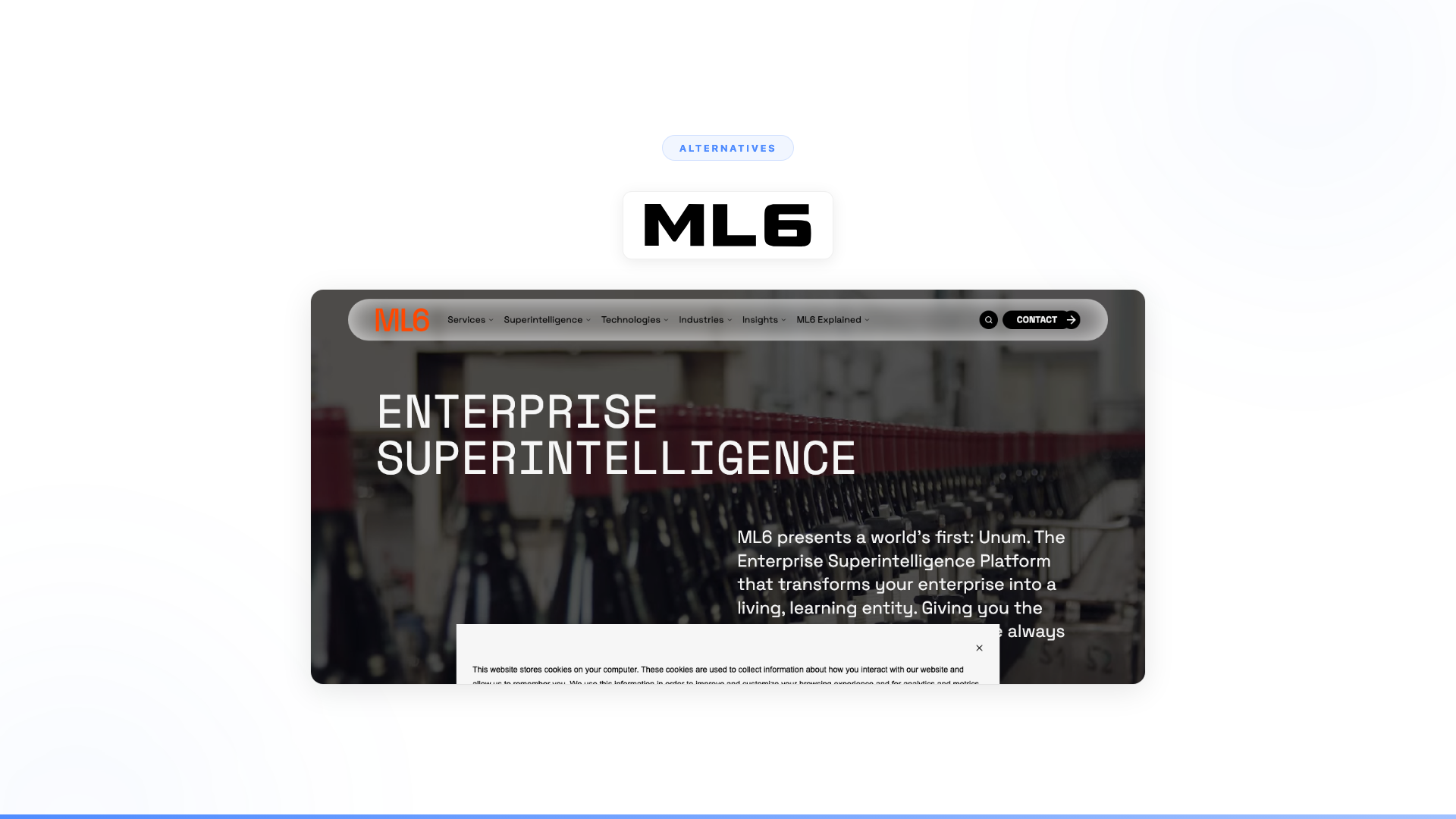
ML6 is a Belgian AI consultancy with 140+ specialists across Ghent, Amsterdam, Berlin, and Zurich, a Google Cloud Services Partner of the Year award for Benelux (most recently 2024), and 400+ delivered AI projects for clients including Randstad, ASML, Pfizer, and P&G. (Source: ml6.eu) They are one of the most technically credible AI boutiques operating in Europe. The reason enterprises start looking elsewhere is structural, not reputational.
ML6 bills by the day. That works cleanly for bounded ML engineering problems: a computer vision model, a predictive algorithm, a GenAI prototype. The project has a natural endpoint, and the day-rate model fits. Where it breaks down is enterprise AI agents for business workflows. These aren't one-time builds. They're living systems that need to evolve with the business, be owned by business teams rather than engineers, and scale from one agent to many across departments. A time-based billing model rewards longer engagements, not faster delivery. The math on scaling is straightforward: your fifth agent costs roughly the same and takes roughly as long as your first.
If that gap sounds familiar, here are 10 alternatives worth evaluating.
What does ML6 do?
ML6 is a Belgian AI engineering consultancy founded in 2016, specializing in machine learning, deep learning, computer vision, NLP, and generative AI. They design and deploy custom AI solutions for enterprises, primarily in the Benelux and DACH regions, using Google Cloud as their primary infrastructure partner. Their client work spans manufacturing, financial services, retail, and life sciences. (Source: ml6.eu)
Quick comparison
| Alternative | Category | Best for | Time to production | Pricing model |
|---|---|---|---|---|
| Nexus | AI agent platform + FDEs | Full workflow automation, any department | 2-6 weeks | Per-agent |
| Artefact | Data & AI consultancy | Data strategy, custom ML models, marketing analytics | 3-12 months | Day rates |
| Xebia | Full-stack digital consultancy | AI + cloud + data + software engineering | 8-16 weeks | Day rates |
| Endava | Nearshore engineering | Custom software, bespoke AI builds | 3-12 months | Day rates (nearshore) |
| Thoughtworks | Premium engineering consultancy | Engineering transformation, legacy modernization | 6-18 months | Day rates ($200-400/hr) |
| Accenture AI | Global systems integrator | Multi-year cross-functional transformation | 6-18 months | Day rates ($300-500/hr) |
| Capgemini AI | Consulting + technology services | European enterprises, SAP/cloud integration | 4-18 months | Day rates ($200-400/hr) |
| Deloitte AI | Big 4 consulting | Regulated industries, audit-adjacent AI | 4-18 months | Day rates ($250-450/hr) |
| BCG X | Strategy + AI consulting | AI strategy with rapid prototyping | 3-9 months | Day rates ($400-600/hr) |
| Custom build | In-house engineering | Unique requirements, strong AI team | 6-18 months | Engineering salaries + infra |
The alternatives, ranked
1. Nexus
What it is: An enterprise AI agent platform paired with Forward Deployed Engineers who embed with your team. Nexus agents complete entire business workflows end-to-end: collecting data, validating it against systems, making decisions within guardrails, handling exceptions, and executing actions. Any department. Any workflow. Business teams build and own the agents.
Why enterprises switch from ML6 to Nexus:
The category difference matters. ML6 builds custom AI solutions for you and hands them off. Nexus gives your business teams a platform where they build, own, and iterate on agents directly, with embedded engineering support that doesn't bill by the hour. The incentive structure is fundamentally different: ML6 earns from days billed, Nexus earns when agents deliver value in production.
What it looks like in production:
- Orange Group (multi-billion euro telecom, 120,000+ employees): Business team built autonomous customer onboarding agents. Deployed across multiple European markets in 4 weeks. 50% conversion improvement. ~$6M+ yearly revenue impact. 90% autonomous resolution. 100% team adoption. (Nexus client data)
- European telecom (13,000+ employees): Spent 6 months with Copilot Studio without a single production use case. Deployed a dozen Nexus agents in the same timeframe. 40% support volume freed across millions of interactions. (Nexus client data)
Pricing: Per-agent, tied to value delivered. FDEs included. 3-month POC with measurable outcomes before annual commitment.
Best for: Enterprises that need AI agents completing business workflows in production in weeks. Sales, support, compliance, HR, onboarding, operations, marketing.
Full Nexus vs ML6 comparison -->
2. Artefact
What it is: A global data and AI consulting firm founded in Paris in 2014, with 1,700+ employees across 25 countries. Artefact specializes in data strategy, custom ML models, data engineering, and digital marketing analytics. They work with Samsung, L'Oreal, Sanofi, and Carrefour. In 2022, Cinven acquired a majority stake at a reported valuation exceeding €1 billion, giving them scale for larger enterprise programs. They hold Google Cloud Premier Partner and EMEA AI Partner of the Year status. (Source: artefact.com)
How it compares to ML6: Similar category (AI boutique consultancy), different specialization. Artefact goes deeper on data strategy and marketing analytics. ML6 leans more toward ML engineering and Google Cloud-native builds. Both bill by the day. Both face the same structural incentive: longer engagements generate more revenue.
Why it might not solve the problem: If the issue with ML6 is the consulting model itself (day rates, multi-month timelines, handoff-then-re-engage), Artefact runs on the same model. The brand name changes. The economics don't.
Pricing: Day rates typically $1,000-$2,500/day per consultant. Project-based and retainer options available.
Best for: Enterprises that need data strategy transformation, custom ML models, or marketing analytics capabilities built from scratch. Not a fit if the goal is production AI agents on business workflows.
Full Nexus vs Artefact comparison -->
3. Xebia
What it is: A global digital consultancy founded in the Netherlands in 2001, with 5,500+ professionals across 28 offices worldwide. Xebia covers AI/ML, cloud, data engineering, software development, and agile transformation. Clients include Philips, Ahold Delhaize, Tesco, and ING. They hold Google Cloud Premier Partner and Microsoft Solutions Partner status. (Source: xebia.com)
How it compares to ML6: Broader scope. ML6 is an AI-focused boutique. Xebia is a full-stack digital consultancy that also does AI. If you need cloud migration, software engineering, and AI together, Xebia can staff a complete program. If you want deep AI-only expertise, ML6 is more focused.
Why it might not solve the problem: Same billing model, different label. Xebia's AI projects typically take 8-16 weeks, with discovery and scoping adding lead time — and billable hours — before work begins.
Pricing: Day rates. Typical engagements range from $360K to $2M+.
Best for: Enterprises that need full-stack digital transformation alongside AI. Not a fit if the bottleneck is deploying agents fast with business team ownership.
Full Nexus vs Xebia comparison -->
4. Endava
What it is: A publicly traded (NYSE: DAVA), London-headquartered technology services company with approximately 11,500 employees across 29 countries. Endava built its reputation on high-quality custom software engineering through nearshore delivery centers in Eastern Europe. Revenue around $980M in fiscal 2025. They're investing in AI through Programme Keystone and Dava.Flow, their AI-native engagement methodology. (Source: endava.com)
How it compares to ML6: Different model entirely. ML6 is a specialized AI boutique. Endava is a nearshore software engineering firm expanding into AI. Endava's strength is dedicated development teams at competitive nearshore rates with European timezone overlap. Their AI practice is newer and less specialized than ML6's.
Why it might not solve the problem: If you're leaving ML6 because the day-rate model is too slow for AI agent deployment, Endava's nearshore model is the same structure at lower per-hour rates. Cheaper hours are still hours. A 6-month engagement with a nearshore team of 5-8 engineers can easily reach $500K-$1.5M+ before production.
Pricing: Day rates for nearshore teams. Lower than onshore, but costs scale linearly with team size and duration.
Best for: Enterprises that need dedicated engineering teams for complex, bespoke software applications. Not a fit if the priority is AI agent deployment speed.
Full Nexus vs Endava comparison -->
5. Thoughtworks
What it is: A globally respected technology consultancy founded in 1993, known for engineering excellence, the Agile Manifesto, and the Technology Radar. 10,000+ consultants across 47 offices in 18 countries. Clients include Mercedes-Benz, Bayer, and Spotify. They launched AI/works for legacy modernization and earned the AWS Agentic AI Specialization in 2025. (Source: thoughtworks.com)
How it compares to ML6: Thoughtworks is a premium engineering consultancy. ML6 is a specialized AI boutique. Thoughtworks brings broader engineering methodology (TDD, continuous delivery, clean architecture) and can run large-scale transformation programs. ML6 is more focused on ML/AI specifically, at a smaller scale.
Why it might not solve the problem: Premium engineering at premium prices. A 12-month Thoughtworks engagement with 8-12 consultants can run $2M-$5M+. Exceptional talent, but the billing model still rewards duration. If the goal is production AI agents in weeks, the timeline and cost don't fit.
Pricing: Day rates typically $200-$400/hour onshore. Blended rates vary by geography.
Best for: Large-scale engineering transformation, legacy modernization, and building internal engineering capability.
6. Accenture AI
What it is: One of the largest professional services firms globally. $69.7B in revenue. 77,000 AI and data professionals. Tripled generative AI revenue to $2.7B in fiscal 2025. AI Refinery platform planned for 100+ industry agent solutions. (Source: accenture.com)
How it compares to ML6: Completely different scale. ML6 is ~140 people. Accenture is 779,000 people. Accenture can run multi-year, cross-functional transformations spanning strategy, technology, operations, and change management. ML6 delivers focused AI engineering on specific projects.
Why it might not solve the problem: If you're leaving a boutique because the consulting model is too slow, a global systems integrator won't be faster. Accenture bills $300-$500/hour with teams of 4-8 consultants across 6-18 month engagements. The structural incentive issue is identical, just at larger scale.
Pricing: Day rates typically $300-$500/hour. Multi-million dollar engagement minimums common.
Best for: Enterprises that genuinely need a multi-year, cross-functional transformation program at global scale.
7. Capgemini AI
What it is: A global consulting and technology services firm with a strong European presence. Their AI practice combines consulting, custom development, and managed AI services. Deep SAP and cloud migration expertise. Acquired several data and AI companies to build out capability. (Source: capgemini.com)
How it compares to ML6: Capgemini is a general-purpose consultancy with an AI practice. ML6 is a specialized AI boutique. Capgemini's rates are often lower than ML6's for comparable work, and they bring breadth across SAP integration and cloud. ML6 brings deeper AI-specific expertise.
Why it might not solve the problem: Same consulting model at different scale and price point. If the issue is structural (billing by the day rewards longer timelines), switching to Capgemini changes the invoice header, not the dynamics.
Pricing: Day rates typically $200-$400/hour. Competitive on blended offshore rates.
Best for: European enterprises that need AI integrated into SAP or cloud transformation programs.
8. Deloitte AI
What it is: Deloitte's AI practice spans consulting, technology advisory, and managed services. Strong in regulated industries where audit credibility and compliance depth matter. Technology alliances with Google Cloud, AWS, and ServiceNow. Particularly relevant in Europe given the full enforcement timeline of the EU AI Act from August 2026. (Source: deloitte.com)
How it compares to ML6: Deloitte is a Big 4 firm with massive scale and regulatory credibility. ML6 is a focused AI boutique with deeper technical specialization per consultant. Deloitte's advantage is in regulated industries where their audit relationship and compliance heritage carry weight.
Why it might not solve the problem: Same model, bigger firm. Custom builds over months, knowledge concentrating in the consulting team, scaling means more consultants. If the consulting model is the issue, a larger consulting firm amplifies the problem.
Pricing: Day rates typically $250-$450/hour.
Best for: Regulated industries (financial services, government, healthcare) where Deloitte's audit credibility and EU AI Act compliance depth matter.
9. BCG X
What it is: BCG's technology and digital arm. Combines strategy consulting with product development, data science, and engineering. Partnerships with Anthropic and OpenAI. Known for rapid prototyping and a "ventures" approach to AI. (Source: bcg.com)
How it compares to ML6: BCG X operates at the strategy + prototype layer. ML6 operates at the engineering + delivery layer. If you need AI strategy defined at the board level before committing to implementation, BCG X fits. If you need engineers building an ML model, ML6 fits.
Why it might not solve the problem: BCG X prototypes can be impressive in the boardroom but may not survive production reality (scale, edge cases, integrations, compliance). The billing model is also the most expensive in this list at $400-$600/hour. If you already know what to build, paying strategy rates for execution doesn't make sense.
Pricing: Day rates typically $400-$600/hour. Project-based pricing for ventures and sprints.
Best for: Enterprises that need AI strategy defined at the C-suite level with rapid prototyping before committing to production.
10. Custom build
What it is: Your engineering team builds AI agents using open-source frameworks (LangChain, LangGraph, CrewAI) or cloud AI services (AWS Bedrock, Azure OpenAI, Google Vertex AI). Full control over architecture, data, and deployment.
How it compares to ML6: Maximum flexibility, zero consulting dependency. If you have a strong AI engineering team with capacity, building internally gives you complete control. No day rates, no handoff gaps, no vendor relationship to manage.
Why it might not solve the problem: Most enterprises don't have surplus AI engineering capacity. Your engineers are working on your core product, not internal tooling. Custom builds require solving governance, security, compliance, monitoring, integrations, and maintenance yourself. Companies with world-class engineering teams have chosen to buy rather than build specifically because diverting engineers from core product wasn't worth it.
Pricing: Engineering salaries + infrastructure. Typically 6-18 months for a first production agent.
Best for: Organizations with dedicated AI engineering teams, unique technical requirements, and timelines that can absorb 6+ months of development.
The pattern across all alternatives
Here's what's worth noticing. Alternatives 2 through 9 are all variations of the same model: time-based billing. Different brand names, different rates, different geographic strengths. But the underlying structure is identical. Days billed. Multi-month timelines. Knowledge concentrating in the vendor's team. Scaling means more consultants or more engineering hours. No structural incentive to deliver fast.
The global AI consulting services market is growing at roughly 26% CAGR and will reach an estimated $11B in 2025. (Source: Future Market Insights) That growth is producing more boutique options, not a different model. Switching from ML6 to Artefact or from ML6 to Capgemini changes the line item on the invoice. It doesn't change the structure.
The real alternative isn't a different consultancy. It's a different model entirely: one where the provider earns from agents in production delivering value, not from hours spent getting there.
Is ML6 better for Benelux than the alternatives?
For pure ML engineering in Benelux, ML6 is among the strongest options. Their Google Cloud-native stack, 10+ year regional track record, and concentrated AI expertise are genuine advantages for bounded ML projects in manufacturing, financial services, and life sciences. Xebia covers a broader technology stack but trades some AI depth for that breadth. For EU AI Act compliance and GDPR-native implementations — both increasingly relevant as high-risk AI system requirements fully apply from August 2026 — ML6's European roots and regulatory familiarity are meaningful.
The question isn't whether ML6 is good. They are. The question is whether the consulting model fits the problem you're trying to solve.
So which alternative should you actually choose?
If you need custom ML models for specialized problems (computer vision, predictive maintenance, recommendation engines), ML6 or Artefact are genuine options. The work requires deep engineering, and a consulting engagement has a natural endpoint.
If you need full-stack digital transformation (cloud, data, software, AI all together), Xebia or Thoughtworks can staff a complete program. Be clear about scope boundaries and milestone-based checkpoints.
If you need lower cost on the same model, Endava or Capgemini offer the consulting approach at competitive rates. The timeline and dependency trade-offs remain.
If you need EU AI Act compliance embedded from the start in a regulated industry, Deloitte or a specialized European boutique with regulatory depth fits better than a platform-first vendor.
If you need AI agents in production on specific business workflows in weeks, and you want your business teams to own the result without ongoing consulting dependency, that's a fundamentally different model. That's what Nexus was built for.
Orange didn't need a different consultancy. They needed agents that complete customer onboarding autonomously. ~$6M+ yearly revenue impact. 4-week deployment. Business teams own everything. (Nexus client data)
A major European telecom didn't need another pilot. They deployed a dozen Nexus agents after 6 months of stalled progress with Copilot Studio. 40% of support volume freed. (Nexus client data)
The gap between consulting and platform isn't a price gap. It's a structural gap. No amount of discounting the day rate closes it.
Frequently asked questions
What does ML6 do? ML6 is a Belgian AI engineering consultancy specializing in machine learning, deep learning, computer vision, NLP, and generative AI. They design and deploy custom AI solutions for enterprises, primarily in Benelux and DACH, using Google Cloud as their primary platform. They've completed 400+ AI projects since founding and hold Google Cloud Services Partner of the Year status for Benelux. (Source: ml6.eu)
How big is ML6? ML6 has 140+ AI specialists across offices in Ghent (Belgium), Amsterdam (Netherlands), Berlin, and Zurich. They have delivered 400+ AI projects since founding and have been a Google Cloud partner for 10+ years. (Source: ml6.eu)
How much does ML6 cost? ML6 does not publish day rates publicly. European AI boutique consultancies typically charge €1,200-€2,500/day per consultant depending on seniority and project scope. Engagement totals vary widely based on team size and duration; a 3-month project with 3-4 consultants would typically run €150K-€350K+.
Is ML6 or Xebia better for AI implementation in Benelux? ML6 focuses exclusively on AI/ML with greater technical depth in custom model development and a stronger Google Cloud specialization. Xebia covers a broader technology stack (cloud, software, data, agile) and has stronger capability in full-stack digital transformation. For pure ML or GenAI engineering projects, ML6's concentrated expertise is an advantage. For programs that combine cloud migration, software, and AI, Xebia's breadth fits better. Both bill by the day.
What are the main limitations of working with ML6? As a boutique, ML6 has capacity constraints that limit concurrent large engagements. Geographic coverage is strongest in Benelux and DACH. Like all consulting firms, project knowledge concentrates in the consulting team rather than transferring directly to internal staff. The day-rate model means the cost of scaling AI agents grows linearly with the number of projects.
Worth exploring?
Every Nexus engagement starts with a 3-month proof of concept tied to measurable outcomes. Forward Deployed Engineers embed with your team from day one. You see the results before committing.
See the full Nexus vs ML6 comparison -->
Related reading
- Nexus vs ML6: full comparison
- Nexus vs Artefact: data consultancy vs platform
- Nexus vs Xebia: digital consultancy vs platform
- Nexus vs Endava: nearshore engineering vs platform
- Top 10 AI boutique consultancies in Europe vs platforms
- AI boutique consultancy vs AI platform: how to choose
- Top 10 AI consulting alternatives: platforms vs firms