How to Automate Sales Outreach with AI Agents (2026 Guide)
From manual prospecting to autonomous AI sales agents. A practical guide to automating outreach, what AI SDR tools actually do, where they stop, and how enterprises are automating the full revenue cycle.
To automate sales outreach with AI agents, choose between three approaches: AI-assisted (reps work faster with AI suggestions), autonomous AI SDR (tools like 11x or Artisan automate prospecting and email sequences end-to-end), or full revenue cycle agents (a platform covering intelligence, outreach, qualification, and post-sale operations). Map your full revenue process before choosing — outbound is typically 15–25% of the total workflow.
How sales outreach automation evolved: 4 stages
Understanding where we are helps clarify where you should invest.
Stage 1: Manual outreach (the baseline)
The starting point that many teams are still working from. Reps manually research prospects, write emails, manage follow-up cadences, track responses, and log activity in a CRM. Productivity is measured in emails sent per day. A strong SDR might send 80 to 100 personalized emails daily.
The cost: Human time. According to Salesforce research, sales reps spend just 28% of their working hours actually selling — the rest goes to research, data entry, and sequence management. An SDR's fully loaded cost runs $90K to $160K annually once salary, benefits, tools, and management overhead are included (SalesHive, 2025).
Stage 2: Sales engagement platforms (2015–2022)
Tools like Outreach and Salesloft automated the mechanics: sequencing, scheduling, follow-up reminders, template management. Reps still wrote the content and managed the strategy. These platforms made reps more efficient. They didn't replace the work.
What improved: Send volume. A rep with Outreach can manage 3x to 5x more active sequences than manually. What didn't: Content quality, personalization, account research. The human effort shifted from logistics to content creation, but didn't decrease.
Stage 3: AI SDR tools (2023–present)
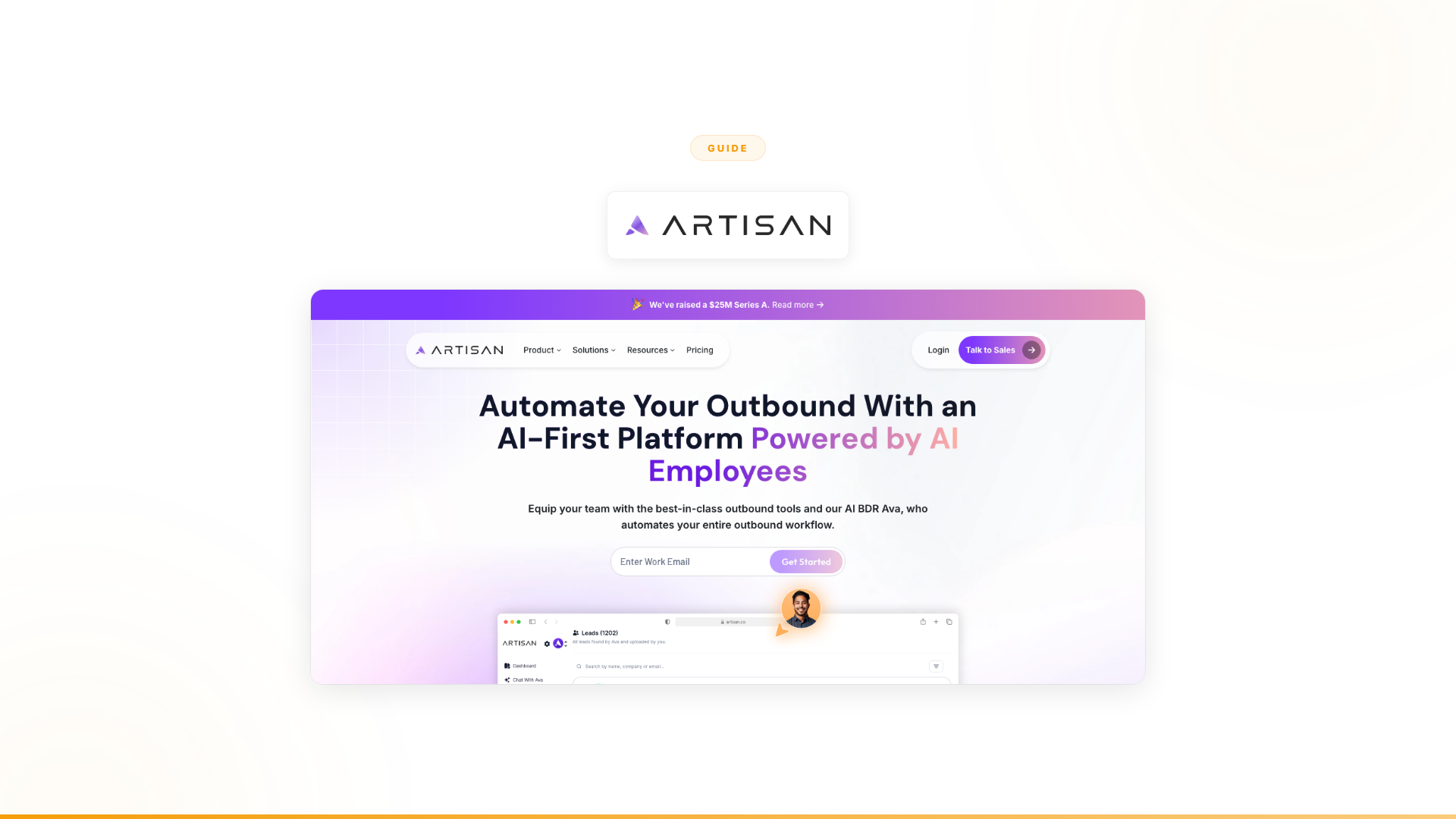
This is where most of the market sits today. Platforms like 11x (Alice), Artisan (Ava), and Amplemarket use AI agents that autonomously find prospects, write personalized sequences, handle follow-ups, and book meetings. The AI does the SDR job, not just the scheduling.
What improved: True automation of outbound. The AI finds the prospects, writes the emails, manages the cadence, and handles responses. For the outbound step specifically, this is a meaningful leap.
What didn't change: Everything else. Account research. Qualification. Pipeline management. Onboarding. Support. Retention. AI SDR tools automate one step and leave the rest of the revenue process untouched.
Stage 4: Full revenue cycle automation (emerging)
This is where the market is heading and where enterprises with the biggest results already are. Instead of AI that automates outbound email, AI agents that handle the full revenue cycle: account intelligence, buying signal detection, competitive analysis, qualification, pipeline management, onboarding, support, renewal, and expansion. All on one platform. All connected.
This isn't theoretical. It's what companies like Lambda and Orange are running in production today.
How AI sales outreach automation works in 2026
If you're evaluating AI outreach tools for the first time, here's what the current generation actually does.
What AI SDR tools automate
-
Prospect identification. The AI matches your Ideal Customer Profile (ICP) against a contact database (300M+ contacts in Artisan's case, third-party integrations for 11x) and generates a target list.
-
Data enrichment. Contact details, company information, recent news, social signals. The AI enriches each prospect with data that informs personalization.
-
Email generation. The AI writes personalized outreach sequences based on the prospect's profile, company context, and your messaging framework. Multiple touches: initial email, follow-ups, re-engagement.
-
Deliverability management. Email warmup, inbox rotation, send scheduling to optimize delivery rates. Infrastructure that prevents your outbound from landing in spam.
-
Response handling. The AI classifies responses (interested, not interested, out of office, wrong person) and routes accordingly. Interested prospects get booked for meetings.
-
Meeting booking. Calendar integration to schedule meetings directly from email conversations.
What AI SDR tools don't automate — the missing 75%
This is the part that marketing materials tend to skip.
-
Account research. Deep intelligence about target accounts: tech stack, buying signals, competitive threats, organizational changes, budget cycles. The research that makes outreach relevant rather than generic. AI SDR tools use surface-level enrichment data. They don't do the strategic research that makes a prospect actually want to respond.
-
Qualification. Once a meeting is booked, who validates that the prospect meets your criteria? Budget, authority, need, timeline. AI SDR tools book the meeting. A human qualifies it.
-
Pipeline management. Tracking deals through stages, identifying risk, forecasting outcomes, recommending next actions. Separate tools (Outreach, Salesloft, Gong, Clari) or manual effort.
-
Post-sale operations. Customer onboarding, support, retention, renewal, expansion. Different tools, different teams, different data silos.
The result: AI automates one step well. The rest of the revenue process stays fragmented across multiple tools, teams, and manual workflows. Gartner projects that 95% of seller research workflows will begin with AI by 2027 — a clear signal that the market is moving toward broader revenue automation, not just outbound email.
3 approaches to AI sales outreach automation compared
When teams evaluate AI for outreach, they're choosing between three fundamentally different approaches. Each has different implications for what you can automate now and what you can automate next.
Approach 1: AI-assisted outreach (human in the loop)
Tools: Apollo.io, Outreach, Salesloft, Lavender
How it works: AI helps your reps work faster. It suggests leads, drafts emails for human review, scores prospects, recommends next actions. But reps still run the process. Every email, every decision, every follow-up has a human making the final call.
Pros: Maximum control over messaging and strategy. Lower risk of brand damage from AI-generated content. Works within your existing sales process.
Cons: Doesn't scale beyond your headcount. The bottleneck is still human time. As your outbound ambitions grow, you need more reps, not better tools.
Best for: Teams that value control over automation and have reps who can leverage AI assistance effectively.
Approach 2: Autonomous AI SDR (single-step automation)
Tools: 11x, Artisan, Amplemarket
How it works: The AI agent does the SDR job autonomously. Finds prospects, writes emails, manages sequences, handles responses, books meetings. You configure the ICP and messaging parameters. The AI runs the outbound process.
Pros: True automation of outbound. Scales without adding headcount. Can run 24/7 across time zones.
Cons: Quality varies. Reviews for both 11x and Artisan describe mixed results on personalization. Scope is fixed at outbound. No account intelligence, qualification, pipeline management, or post-sale capability. Annual commitments before you've validated performance.
Best for: Teams where outbound volume is the primary bottleneck and the only AI priority.
See: Artisan vs 11x comparison -->
Approach 3: Full revenue cycle agents (platform automation)
Tools: Nexus
How it works: Instead of an AI that automates one step, agents that handle the entire revenue cycle on one platform. Account intelligence. Buying signal detection. Competitive analysis. Lead qualification. Pipeline management. Customer onboarding. Support triage. Renewal management. Each agent is built by your business teams for your specific workflows, connected to 4,000+ enterprise systems. Forward Deployed Engineers embed with your team to ensure the deployment delivers.
Pros: Eliminates tool sprawl. Context flows between agents. The account intelligence that powers outreach also informs qualification, pipeline management, and retention. Compounds over time.
Cons: Bigger initial commitment than a point solution. Requires organizational readiness to think about AI as a platform, not a tool.
Best for: Enterprises where outbound is one of many workflows they need to automate. Where tool sprawl is already a problem, or where it will become one within 12 months.
How to build an AI sales outreach strategy: 4-step framework
Step 1: Map the full revenue process, not just outbound
Before you buy any AI outreach tool, map every step in your revenue process from first touch to renewal. Most teams think about outbound in isolation. But outbound effectiveness depends on what happens upstream (account research, targeting) and downstream (qualification, pipeline management, onboarding).
Ask:
- How do we identify which accounts to target? Manual research? Data tools? Gut instinct?
- What happens between meeting booking and qualification? How long does it take? Who does it?
- How do deals move through the pipeline? What causes them to stall?
- What does onboarding look like? How long from close to value realization?
- How do we manage retention, renewal, and expansion?
If outbound is a bottleneck but qualification takes three weeks and onboarding takes three months, automating outbound alone won't move the revenue needle.
Step 2: Decide on approach and scope
Based on your mapping:
If outbound is genuinely the only bottleneck, and every other step is well-handled, a single-step AI SDR tool might be the right starting point. Evaluate 11x, Artisan, or Amplemarket.
If you see multiple bottlenecks across the revenue cycle, a platform approach avoids building the disconnected stack that enterprises regret at month 12. The integrations you set up for the first agent serve every subsequent one. This is the approach Lambda took. They started with sales intelligence and expanded to a full agent fleet.
If you want human control over messaging, look at AI-assisted tools (Apollo.io, Outreach, Salesloft) that augment reps rather than replacing them.
Step 3: Validate before committing
This applies regardless of which approach you choose. The biggest risk in AI sales tools is committing to an annual contract before you've validated performance.
- For AI SDR tools: Test email quality against your actual ICP. Run a sample outbound campaign. Measure reply rates, meeting quality, and brand perception. Don't commit to an annual contract based on a demo. Industry benchmarks show cold email reply rates averaging 5.1% — anything above 8% signals strong targeting and messaging (LevelUp Leads, 2025).
- For platform approaches: Look for vendors that offer proof-of-concept periods tied to specific outcomes. Nexus starts every engagement with a 3-month POC. You see the results before committing. 100% of clients who started a POC converted to an annual contract.
Step 4: Measure what matters
Outbound metrics (emails sent, reply rates, meetings booked) are necessary but not sufficient. The metrics that matter:
- Pipeline generated. Not meetings booked. Pipeline dollars from AI-sourced outreach.
- Qualification rate. What percentage of AI-booked meetings actually qualify? If the AI books meetings with unqualified prospects, it's creating work, not eliminating it.
- Time to value. How long from deployment to measurable pipeline impact?
- Total cost of outcomes. Not tool cost. The full cost including the AI tool, data providers, human oversight, and the time other tools or people spend on the steps the AI doesn't cover.
Enterprise AI sales outreach results: real examples
Here's what happens when organizations move beyond single-step outreach automation.
Lambda: from manual research to autonomous sales intelligence
Lambda is a leading AI infrastructure company. Their sales team needed to monitor thousands of enterprise accounts for buying signals, competitive movements, and market opportunities. Manual research couldn't scale.
They didn't buy an AI SDR. They built autonomous sales intelligence agents on Nexus. The result:
- 12,000+ enterprise accounts monitored continuously
- $4B+ in cumulative pipeline identified (Nexus client data)
- 24,000+ hours of research capacity added annually — equivalent to 12 full-time analysts
- Built by Joaquin Paz, Head of Sales Intelligence, with no engineering background
On choosing Nexus over alternatives, Joaquin Paz noted that open-ended AI agents were smart but inconsistent — the same question produced different answers every time — while traditional automation was reliable but required heavy hard-coding. The combination of intelligent reasoning and consistent output was the deciding factor.
Lambda started with sales intelligence and is now expanding to an agent fleet across sales and marketing.
The difference: Lambda didn't automate the act of sending emails. They automated the intelligence that makes every sales interaction informed, prioritized, and effective.
Orange Group: agents that transform the entire customer lifecycle
Orange Group, one of Europe's largest telecom operators (120,000+ employees), needed to transform customer onboarding across multiple markets. Not just outreach. The full lifecycle.
On Nexus, Orange deployed customer onboarding agents that handle everything: guiding new customers through setup, troubleshooting issues, answering questions, escalating complex cases with full context. Multiple European markets. Multiple languages. Integrated with existing CRM, billing, and support infrastructure.
Results (Nexus client data):
- 50% conversion improvement
- Approximately $6M in yearly revenue impact
- 90% autonomous resolution
- 100% team adoption
- 4-week deployment with Forward Deployed Engineers
- Previous chatbot had a 27% drop-out rate
European telecom: a dozen agents replacing disconnected tools
A major European telecom (13,000+ employees) spent 6 months with another AI platform and couldn't deliver a single production use case. They deployed a dozen Nexus agents in the same timeframe. Result: 40% of support volume freed across millions of interactions.
The pattern: enterprises that succeed with AI outreach don't just automate email. They automate the system around it.
Common mistakes in AI sales outreach
Mistake 1: Optimizing outbound volume without optimizing outbound quality
Sending more emails faster only works if the emails are relevant. AI SDR tools that prioritize volume over personalization — a common criticism in reviews of both 11x and Artisan — can damage brand perception faster than they generate pipeline. If prospects receive generic AI-generated emails, they don't just ignore them. They form a negative impression of your company.
Fix: Before scaling volume, validate email quality. Run test campaigns. Measure not just reply rates but the quality of replies. Is the AI generating genuine interest or just confused responses?
Mistake 2: Automating outbound without automating what comes next
The most common pattern. AI books meetings. Humans still research accounts, qualify leads, manage pipeline, handle onboarding, and run support. The outbound bottleneck moves, but the overall revenue velocity doesn't change because the next bottleneck is now qualification or pipeline management.
Fix: Map the full revenue process before investing. Identify all bottlenecks, not just the most visible one.
Mistake 3: Buying one tool per step
Outbound AI. Data enrichment tool. Intent signals provider. Call recorder. Pipeline forecaster. Customer onboarding platform. Support automation. Each solves one problem. Together they create a disconnected stack where data doesn't flow and context is lost. HubSpot research finds that 1 in 4 sales leaders say they already have too many sales tools — and the number is growing.
Fix: Evaluate platform approaches that handle multiple steps on one foundation. The integrations you build once serve every agent you deploy.
Mistake 4: Committing before validating
Both 11x and Artisan require annual commitments. Some teams sign based on a demo, then discover the output quality doesn't match their standards or the tool doesn't integrate cleanly with their workflow. Annual contracts with AI tools you haven't validated in your environment are a predictable source of regret.
Fix: Demand proof of concept. Validate with real data, real ICP, real prospects. If a vendor won't let you prove value before a long-term commitment, that's information.
Mistake 5: Ignoring compliance requirements for automated outreach
AI outreach tools send at scale. That creates regulatory exposure that manual outreach rarely triggered. CAN-SPAM (US), GDPR (EU), and CASL (Canada) impose different requirements on commercial email — from opt-out mechanisms to legitimate interest documentation. GDPR fines can reach €20 million or 4% of global annual revenue. CASL penalties reach CAD $10 million per violation for businesses (Outreach Bloom, 2026).
Fix: Before deploying any AI outreach tool at scale, confirm it supports unsubscribe handling, sender identification, and your specific compliance requirements for each market. Apply the strictest applicable standard across your entire contact list.
How to evaluate AI sales outreach tools: 10 criteria
| Criteria | Questions to ask |
|---|---|
| Scope | Does it handle outbound only, or more of the revenue cycle? |
| Autonomy | Does it complete work, or assist humans? How much oversight is needed? |
| Data approach | Built-in database, or connected to your existing systems? |
| Personalization quality | Can you test email quality before committing? |
| Contract flexibility | Annual commitment, or proof-of-concept period? |
| Integration depth | How many systems does it connect to? Your CRM, data tools, communication platforms? |
| Post-outbound capability | Does it handle qualification, pipeline, onboarding, support? |
| Cross-department potential | Can the same platform serve other departments when they need AI? |
| Deployment support | Self-serve configuration, or engineers who embed with your team? |
| Compliance coverage | SOC 2, ISO 27001, GDPR? Unsubscribe handling, audit trails, and decision traceability? |
The bottom line
AI sales outreach automation has moved through clear stages. From manual prospecting, to sales engagement platforms, to autonomous AI SDR tools, to full revenue cycle agents.
Most of the market is stuck between stages 2 and 3: tools that automate outbound email but leave the rest of the pipeline untouched. That's valuable, but it's not transformative. It moves one bottleneck and exposes the next.
Enterprises seeing the biggest results have moved to stage 4. Not just automating outreach, but automating the intelligence, qualification, pipeline management, and post-sale operations that make the entire revenue process work. Lambda's pipeline results. Orange's conversion improvements. A European telecom's 40% support reduction.
The starting question — "how do I automate outreach?" — is the right one. But the better question is: "how do I automate the revenue process that outreach is part of?"
The answer to the first question is an AI SDR tool. The answer to the second is a platform.
Frequently asked questions
What is the best AI tool for sales outreach automation?
The best tool depends on your scope. For outbound email automation only, AI SDR tools (11x, Artisan, Amplemarket) handle prospecting, email writing, and meeting booking. For full revenue cycle automation — intelligence, qualification, pipeline management, onboarding — an agent platform approach is needed. Evaluate based on whether outbound is your only bottleneck or one of several.
Do AI SDR tools really work? What results should I expect?
AI SDR tools consistently increase outbound volume. Results on quality vary: personalization accuracy depends on data source quality and ICP definition. Industry benchmarks show a 5.1% average cold email reply rate, with well-targeted sequences reaching 8–15% (LevelUp Leads, 2025). McKinsey reports that companies using AI for sales see leads and appointments increase by nearly 50%. Test email quality and qualification rates before committing to an annual contract.
What is the difference between 11x, Artisan, and a full AI agent platform?
11x and Artisan automate the outbound email step: prospect identification, email writing, follow-ups, and meeting booking. A full agent platform automates the entire revenue cycle, including the account intelligence, qualification, pipeline management, and post-sale operations that AI SDR tools leave manual. The difference is one step versus the full process.
How do I avoid committing to an AI sales tool before validating it?
Test email quality against your actual ICP with a sample campaign before signing an annual contract. Both 11x and Artisan have historically required annual commitments — validate personalization accuracy, reply rate quality, and brand perception before committing. Look for vendors that offer proof-of-concept periods tied to specific, measurable outcomes.
How much does AI sales outreach automation cost?
AI SDR tools typically cost $1,000–$5,000+ per month for outbound email automation. Add data enrichment, intent signals, and sales execution platforms, and total stack cost can reach $5,000–$15,000+/month. Platform approaches offer per-agent pricing where all revenue cycle workflows — outreach, intelligence, qualification, support — run on one contract, which reduces total cost as automation scope expands.
What compliance requirements apply to AI-powered outreach?
AI outreach operates at scale, which raises the compliance stakes. CAN-SPAM (US) is opt-out: you can send commercial emails without prior consent but must honor unsubscribe requests. GDPR (EU) requires a documented legitimate interest basis for B2B cold outreach. CASL (Canada) requires opt-in consent for most commercial emails. If your contact list spans multiple markets, apply the strictest applicable standard universally.
Worth exploring?
Every Nexus engagement starts with a 3-month proof of concept tied to measurable outcomes. Forward Deployed Engineers embed with your team from day one. You see the results before committing. You can exit anytime.
100% of clients who started a POC converted to an annual contract. Every one.
See the full Nexus vs Artisan comparison -->