Top 10 Haystack Alternatives for AI Search and RAG in 2026
Haystack gives developers clean RAG pipelines. Most enterprises need agents that act on what they find. Here are 10 Haystack alternatives ranked by what they actually deliver in production.
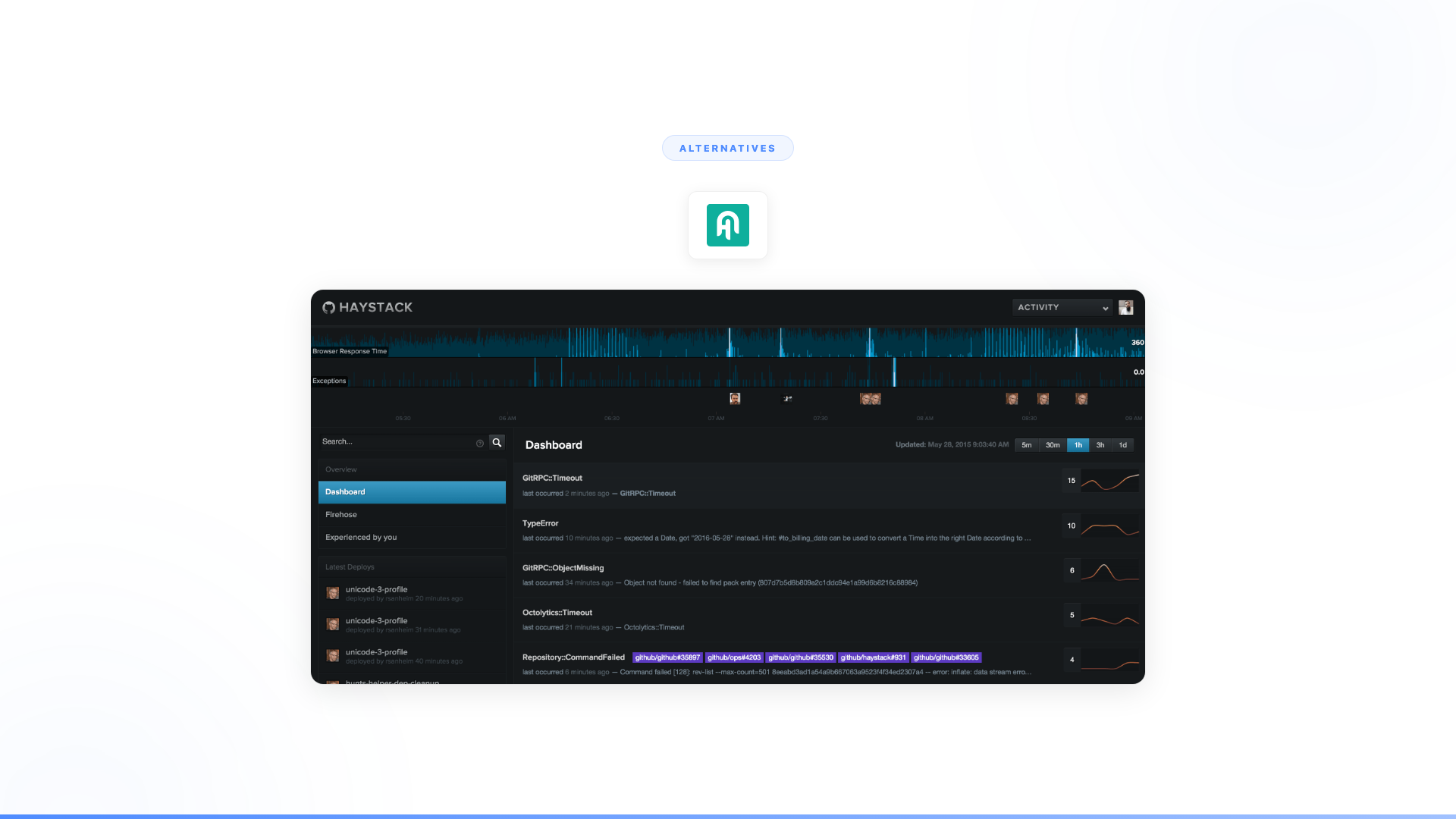
The best Haystack alternatives in 2026 are Nexus, LangChain, LlamaIndex, Glean, Pinecone, Weaviate, Elasticsearch, Vectara, Cohere, and custom build. Haystack is deepset's open-source Python framework for building RAG and LLM pipelines, with 20,000+ GitHub stars and enterprise customers including Airbus and Siemens — alternatives range from competing developer frameworks to fully managed enterprise platforms that eliminate the need to build and maintain retrieval infrastructure.
So why are teams searching for alternatives?
The pattern falls into three buckets. Some teams built a working RAG pipeline with Haystack and realized the retrieval step is only 20% of the business process. The other 80% — validation, routing, decision-making, exception handling, cross-system execution — still requires custom engineering. Some teams don't have the dedicated AI engineering resources Haystack assumes. And some teams are evaluating the full landscape before committing to a framework that creates a long-term engineering dependency for internal business workflows.
This article addresses two distinct needs:
- Developers looking for alternative RAG and LLM application frameworks to replace Haystack in their stack. If that's you, LangChain, LlamaIndex, and Vectara are your primary options — jump to section 2.
- Enterprise teams that built on Haystack and want to explore whether a managed platform can eliminate framework maintenance overhead entirely. If that's you, keep reading from section 1.
All three patterns lead to the same question: do you need a better retrieval framework, or do you need AI that acts on what it retrieves?
Here are 10 alternatives, organized by what they actually deliver.
Haystack Alternatives: Quick Comparison Table (2026)
| Tool | Category | Best for | Requires engineering? | RAG capabilities | Time to production |
|---|---|---|---|---|---|
| Nexus | Enterprise agent platform + service | Full workflow automation across any department | No (business teams build with FDE support) | Built-in (real-time + stored) | Days to weeks |
| LangChain | Developer framework (general-purpose) | Broad LLM applications for engineering teams | Yes | Strong (with configuration) | Weeks to months |
| LlamaIndex | Developer framework (data-focused) | Data-intensive retrieval applications | Yes | Excellent (specialized) | Weeks to months |
| Glean | Enterprise search + assistant | Finding information across enterprise systems | No | Built-in | Days (search), weeks (platform) |
| Pinecone | Vector database + RAG service | Vector search infrastructure | Yes (for RAG layer) | Infrastructure-level | Weeks to months |
| Weaviate | Vector database + search | AI-native search applications | Yes | Infrastructure-level | Weeks to months |
| Elasticsearch | Search platform + vector search | Hybrid keyword + semantic search | Yes | Strong (hybrid) | Weeks to months |
| Vectara | RAG-as-a-service | Managed RAG without infrastructure | Minimal | Built-in (managed) | Days to weeks |
| Cohere | AI model provider + RAG toolkit | Enterprise-grade embeddings and retrieval | Yes (moderate) | Strong (model-level) | Weeks |
| Custom build | Self-built | Unique requirements, unlimited engineering budget | Yes (significant) | Whatever you build | Months to quarters |
Top 10 Haystack Alternatives for RAG and LLM Development
1. Nexus: Best Haystack Alternative for Enterprise Workflow Automation
What it is: An enterprise AI agent platform paired with Forward Deployed Engineers who embed with your team. Nexus agents don't just retrieve information — they complete entire business workflows end-to-end: collecting data from multiple systems, validating against business rules, making decisions within guardrails, handling exceptions, and executing actions. Any department. Any workflow. Business teams build and own the agents.
Why enterprises choose Nexus over Haystack:
The distinction isn't about retrieval quality. Haystack handles retrieval well — that's the point. The distinction is about what happens after retrieval. Enterprise workflows don't end when you find the right document or extract the right answer. They require validation against CRM data, compliance checks, routing decisions, exception handling, human escalation with context, system updates, and notifications across channels.
With Haystack, you'd build every one of those steps as custom components and maintain the entire orchestration. With Nexus, agents handle the whole process.
A useful framing before evaluating: if you need a better RAG pipeline, Haystack is genuinely strong and the framework alternatives below are worth evaluating. If you need AI to complete the work that retrieval enables — decisions, actions, cross-system execution — that's a different problem entirely.
What it looks like in production:
- Orange Group (multi-billion euro telecom, 120,000+ employees): Business team built autonomous customer onboarding agents. Deployed across multiple European markets in 4 weeks. 50% conversion improvement, approximately $6M+ yearly revenue, 90% autonomous resolution, 100% team adoption.
- Lambda (AI infrastructure company): Agents now monitor 12,000+ accounts, synthesize buying signals, and surface pipeline opportunities. 24,000+ research hours added annually. Built by a non-engineer in days.
- European telecom (13,000+ employees): Spent 6 months with Copilot Studio, zero production use cases. Deployed a dozen Nexus agents across millions of interactions in the same timeframe. 40% support volume freed.
Lambda builds supercomputers for AI training with world-class engineers. If any company could justify building custom RAG pipelines and agent infrastructure internally, it was Lambda. They chose to buy because the opportunity cost of diverting engineering from their core product was too high.
Pricing: Per-agent, tied to value delivered. Every engagement starts with a 3-month POC tied to measurable outcomes. 100% POC-to-contract conversion rate.
Best for: Enterprises that need AI to complete business workflows, not just retrieve documents. Sales, support, compliance, HR, onboarding, operations.
Full Nexus vs Haystack comparison →
2. LangChain: Best Haystack Alternative for Python-Based RAG Pipelines
What it is: The most popular open-source framework for building LLM applications. 125,000+ GitHub stars. LangChain provides a broad set of components for chains, agents, RAG, memory, and tool use. The ecosystem now includes LangChain core, LCEL, LangGraph (for graph-based agent orchestration), and LangSmith (for observability).
How it compares to Haystack: LangChain is the generalist; Haystack is the specialist. LangChain covers a broader surface area — agents, chains, RAG, memory, tools — while Haystack focuses on doing retrieval pipelines extremely well. Developers who've used both often note that Haystack's pipeline architecture is more predictable and explicit for retrieval use cases, while LangChain's broader scope offers more flexibility at the cost of more complexity.
If you're leaving Haystack because you need more than retrieval, LangChain gives you agent capabilities. If you're leaving because you want cleaner retrieval specifically, LangChain probably isn't the answer.
Why it might not solve the problem: LangChain is still a developer framework. Your engineering team still builds, deploys, integrates, secures, monitors, and maintains everything. The ecosystem's complexity — four interconnected products, each with its own learning curve and pricing — is a common pain point for teams trying to reach production. The prototype-to-production gap is where most teams stall.
Pricing: Open-source (free). LangSmith starts at $39/seat/month. LangGraph Platform charges per node execution.
Best for: Engineering teams that need agent capabilities beyond what Haystack's pipeline architecture supports and are comfortable managing a larger, broader ecosystem.
Full Nexus vs LangChain comparison →
3. LlamaIndex: Best Haystack Alternative for Data-Intensive RAG
What it is: An open-source framework focused specifically on connecting LLMs to data. LlamaIndex provides data connectors, indexing strategies, and query engines for building applications where LLMs reason over private data. Includes LlamaHub (community data connectors) and LlamaCloud (managed RAG service).
How it compares to Haystack: Both are strong at retrieval, but their approaches differ. Haystack is pipeline-first: you compose components into explicit, reproducible pipelines. LlamaIndex is data-first: it provides sophisticated indexing and retrieval abstractions that handle complex data structures — hierarchical documents, knowledge graphs, multi-modal content — with more built-in intelligence. For teams whose primary challenge is getting high-quality answers from complex data structures, LlamaIndex's indexing abstractions are often more powerful than Haystack's component system.
Why it might not solve the problem: LlamaIndex solves the data retrieval problem well. It doesn't solve the enterprise workflow problem. If you're moving beyond Haystack because retrieval is only one step in a larger business process, LlamaIndex gives you a better retrieval layer — but the same gap remains: everything beyond retrieval is still on your engineering team.
Pricing: Open-source (free). LlamaCloud has usage-based pricing.
Best for: Engineering teams building data-intensive applications where retrieval sophistication over complex data structures is the primary challenge.
4. Glean: Best Haystack Alternative for Enterprise Knowledge Search
What it is: Enterprise AI search and knowledge assistant. Glean connects to 100+ enterprise data sources — Confluence, Slack, Drive, SharePoint, Salesforce, Jira — and lets employees search across all of them with natural language. It also generates answers grounded in your company's knowledge base.
How it compares to Haystack: Different category entirely. Haystack is a framework for building custom search and RAG applications. Glean is a finished product for enterprise knowledge search. You don't build pipelines. You connect your data sources and employees start searching. For teams that chose Haystack to power internal search and found the engineering investment higher than expected, Glean solves the search problem without the engineering.
Why it might not solve the problem: Glean finds information. It doesn't act on it. If you need AI that goes beyond answering questions — executing workflows, making decisions, updating systems, handling exceptions — Glean covers the retrieval layer but nothing beyond it. It's also a per-user SaaS product, not a platform you build on.
Pricing: Per-user, custom enterprise pricing. Reportedly $15–25/user/month depending on scale.
Best for: Enterprises where the primary bottleneck is employees finding information across fragmented tools, and the work after discovery is already handled.
Full Nexus vs Glean comparison →
5. Pinecone
What it is: A managed vector database built for AI applications. Pinecone stores and queries vector embeddings at scale, providing the infrastructure layer that RAG systems need for fast, accurate similarity search. Recently expanded into integrated RAG capabilities with Pinecone Assistant.
How it compares to Haystack: Pinecone operates at a different layer. Haystack is the orchestration framework that coordinates retrieval, re-ranking, and generation. Pinecone is the vector storage and search engine underneath. In fact, Haystack supports Pinecone as one of its document store integrations. If you're reconsidering Haystack, you're not necessarily reconsidering Pinecone — you're reconsidering the orchestration layer above it.
Why it might not solve the problem: Pinecone is infrastructure, not a solution. It gives you fast, scalable vector search — but you still need to build the retrieval pipeline, generation layer, application logic, and enterprise integrations around it. Pinecone Assistant moves closer to a complete RAG product but doesn't address workflow automation, decision-making, or multi-system orchestration.
Pricing: Free tier available. Standard starts at ~$70/month. Enterprise pricing is custom.
Best for: Engineering teams that need a managed, production-grade vector database as part of a larger AI application they're building.
6. Weaviate
What it is: An open-source, AI-native vector database with built-in vectorization, hybrid search, and generative capabilities. Weaviate stores objects with their vectors, runs semantic and keyword search, and generates answers using connected LLMs. It positions itself as more than a vector store: a search engine built for AI applications.
How it compares to Haystack: Like Pinecone, Weaviate operates at the database and search layer rather than the orchestration layer. Weaviate's advantage is that it bundles more functionality into the database itself: built-in vectorization, hybrid search, and native generative modules. Some simple RAG use cases that would require a full Haystack pipeline can be handled directly by Weaviate. For complex retrieval workflows with custom re-ranking, multi-step processing, or agent-like behavior, you still need an orchestration layer on top.
Why it might not solve the problem: Weaviate handles the storage and search layer well. For simple question-answering over documents, its built-in generative modules may be sufficient. For anything beyond that — multi-step workflows, enterprise system integrations, decision-making, exception handling — you need to build the rest.
Pricing: Open-source (self-hosted, free). Weaviate Cloud starts at $25/month. Enterprise pricing is custom.
Best for: Teams building AI-native search applications who want more functionality at the database layer and less orchestration code.
7. Elasticsearch
What it is: The search platform. Elasticsearch has powered enterprise search for over a decade at companies including Netflix, Uber, and Wikipedia. Version 8+ added native vector search (kNN), hybrid search combining BM25 keyword retrieval with dense vector search, and an Elastic Learned Sparse Encoder for retrieval without a separate embedding model.
How it compares to Haystack: Haystack supports Elasticsearch as one of its document stores — the relationship is often complementary rather than competitive. But Elasticsearch alone, with its Relevance Engine and vector search capabilities, can handle many of the retrieval use cases you'd build a Haystack pipeline for. You lose the pipeline abstraction and component composability, but gain battle-tested search infrastructure with a mature ecosystem, strong scaling, and enterprise support from Elastic.
Why it might not solve the problem: Elasticsearch is search infrastructure. Building a complete RAG system on top of it requires embedding pipelines, generation orchestration, and application-level logic that Elasticsearch doesn't provide. Like every other option on this list except Nexus and Glean, it's infrastructure you build on — not a solution that completes work.
Pricing: Self-managed (free, open-source). Elastic Cloud starts at $95/month. Enterprise licensing is custom.
Best for: Organizations already running Elasticsearch that want to add semantic search capabilities without adopting a new database, or teams that need battle-tested search infrastructure at scale.
8. Vectara
What it is: RAG-as-a-service. Vectara provides a managed platform where you upload documents and it handles embedding, indexing, retrieval, re-ranking, and generation. No infrastructure management. No pipeline design. The RAG stack is abstracted away.
How it compares to Haystack: Vectara is the "managed Haystack" idea taken further. Instead of building a pipeline from components, you get a managed service that handles the entire RAG process. Upload documents, ask questions, get answers with citations. For teams that chose Haystack because they needed RAG and found the pipeline engineering more than they bargained for, Vectara removes most of that engineering.
Why it might not solve the problem: You trade control for convenience. Vectara's abstractions mean you can't fine-tune retrieval strategies, custom re-rankers, or generation prompts to the same degree as with Haystack. And like other retrieval-focused tools, it solves the "find information" problem — not the "act on what you find" problem. For enterprise workflows that extend beyond question-answering, you'd still need to build the rest.
Pricing: Free tier (50MB). Growth plans start at $150/month. Enterprise pricing is custom.
Best for: Teams that need RAG capabilities quickly without managing retrieval infrastructure, and whose use case is primarily question-answering over documents.
9. Cohere
What it is: An enterprise AI model provider with strong embeddings, re-ranking, and generation models. Cohere's Embed and Rerank models are widely used in production RAG systems. The platform also includes Command R+ (a model built specifically for enterprise RAG and tool use), along with a full Retrieval-Augmented Generation toolkit.
How it compares to Haystack: Different layer. Cohere provides the models that power retrieval and generation; Haystack provides the framework that orchestrates them. In fact, Haystack supports Cohere as one of its model providers. Where Cohere becomes a Haystack alternative rather than a complement is when teams find that Cohere's own RAG toolkit, combined with its models, handles their use case without a separate orchestration framework. Cohere's Rerank model in particular is one of the best re-rankers available and can dramatically improve retrieval quality regardless of what framework you use.
Why it might not solve the problem: Cohere is primarily a model provider and toolkit, not an agent platform. It gives you excellent building blocks for the retrieval and generation layers. Orchestration, integration, deployment, governance, and workflow logic are still on your engineering team. If you're leaving Haystack because you want less engineering, Cohere reduces some complexity at the model level but doesn't eliminate the pipeline and infrastructure work.
Pricing: Free trial available. Production pricing based on API usage. Enterprise pricing is custom.
Best for: Engineering teams that want high-quality enterprise-grade embedding and re-ranking models, either as part of a framework like Haystack or as standalone components in a custom pipeline.
10. Custom Build
What it is: Building your own retrieval and agent system from scratch using foundational libraries and model APIs directly. No framework dependency. Your engineering team designs the architecture, builds the retrieval pipeline, handles the generation layer, manages vector storage, and owns every layer.
How it compares to Haystack: Maximum control. Zero abstraction overhead. Some teams leave Haystack because they find the framework's opinions about pipeline architecture constraining. Going direct with model APIs (OpenAI, Anthropic, Cohere), a vector database (Pinecone, Weaviate, pgvector), and custom orchestration code gives full flexibility. For teams with strong retrieval engineering expertise, this can be simpler than learning Haystack's component system.
Why it might not solve the problem: You're building everything. Not just retrieval, but the embedding pipeline, re-ranking, generation orchestration, caching, evaluation, monitoring, security, compliance, and maintenance. And if the goal is enterprise business workflows beyond RAG, add integration development, exception handling, agent orchestration, and deployment infrastructure to the list. The engineering cost is permanent — there's no handoff.
Pricing: Engineering salaries + infrastructure costs. Typically 3–6+ months to reach production. Ongoing maintenance is permanent.
Best for: Teams with deep retrieval engineering expertise, unique requirements that genuinely can't be met by existing tools, and enough engineering capacity that the investment doesn't compete with core product work.
The Real Question: Retrieval Framework or Business Solution?
Every Haystack alternative on this list falls into one of two categories.
Better retrieval tools (LangChain, LlamaIndex, Pinecone, Weaviate, Elasticsearch, Vectara, Cohere, custom build): These give you different ways to solve the same problem Haystack solves. Better indexing. Better vector search. Better re-ranking. Managed infrastructure. More flexibility. Less complexity. They're all valid improvements at the retrieval layer.
Platforms that go beyond retrieval (Nexus, Glean): These solve a different problem. Glean handles search and knowledge discovery without engineering. Nexus handles complete business workflows end-to-end.
The question worth asking isn't "which framework handles RAG better?" It's "what percentage of our business process is retrieval?"
If the answer is "most of it" — you're building a search product, a document QA system, a knowledge base — a retrieval framework is the right category. Haystack is strong. LlamaIndex may fit better for complex data. Vectara removes infrastructure headaches.
If the answer is "retrieval is one step in a much larger workflow" — customer onboarding, sales intelligence, compliance monitoring, support operations — the retrieval framework only covers a fraction of what you need. Every step beyond retrieval becomes a custom engineering project. That's where the real cost sits.
Orange needed agents that complete customer onboarding across multiple European markets. Retrieving product information was one step. Validating data against CRM and billing systems, checking compatibility, routing edge cases, escalating with context, updating systems, and sending confirmations across channels was the workflow. They deployed in 4 weeks. 50% conversion improvement.
The gap between retrieving information and completing the work that information enables isn't a framework gap. It's a category gap.
Frequently Asked Questions
What is the difference between Haystack and LangChain for building RAG applications?
Haystack (by deepset) is a specialist: it's built specifically for production RAG and NLP pipelines with a clean component architecture that prioritizes reproducibility and explicit control over retrieval flows. LangChain is a generalist: it covers RAG plus agents, memory, chains, and tool use across a broader surface area. Teams building retrieval-heavy applications often find Haystack's pipeline model more predictable. Teams that need agent capabilities beyond retrieval often find LangChain's broader ecosystem necessary, at the cost of additional complexity.
Is Haystack better than LlamaIndex for enterprise RAG?
It depends on your data complexity. Haystack excels at composable retrieval pipelines with explicit component control — strong for standard document retrieval, hybrid search, and re-ranking workflows. LlamaIndex is data-first and handles complex data structures — hierarchical documents, knowledge graphs, multi-modal content — with more built-in intelligence at the indexing layer. For straightforward enterprise document QA, both are strong. For complex, multi-structured data retrieval, LlamaIndex's abstractions are often more powerful.
What is deepset and how does Haystack relate to deepset Cloud?
deepset is the company that builds and maintains Haystack. Haystack is the open-source Python framework (20,000+ GitHub stars, Apache 2.0 licensed) that developers use to build RAG and LLM pipelines. deepset Cloud is the commercial managed platform built on top of Haystack — it adds an interface, managed infrastructure, collaboration tools, and enterprise support for teams that don't want to self-host. If you're evaluating Haystack as an open-source framework, deepset Cloud is the managed version to compare against services like Vectara.
Can Haystack be used with any LLM provider, including Claude and Mistral?
Yes. Haystack's pipeline architecture is model-agnostic. It supports integrations with OpenAI, Anthropic (Claude), Cohere, Mistral, Hugging Face models, and self-hosted LLMs. This provider flexibility is one of Haystack's distinguishing features compared to frameworks that are more tightly coupled to a specific model provider. The same pipeline can swap model providers without rebuilding the retrieval architecture.
Is Haystack production-ready for enterprise use in 2026?
Haystack v2 (the current major version) significantly improved production-readiness with a redesigned pipeline architecture, better async support, and stronger type safety compared to v1. It is used in production at enterprise companies including Airbus and Siemens. That said, "production-ready" for a framework means your team still owns deployment, monitoring, security, scaling, and integration. Haystack gives you composable components — the production infrastructure around those components is your responsibility. Teams that need a fully managed path should evaluate deepset Cloud or managed alternatives like Vectara.
Worth Exploring?
If your team has been building with Haystack (or evaluating it) and you're realizing the retrieval pipeline is only part of the problem, it may be worth seeing how enterprises approach the full workflow.
Every Nexus engagement starts with a 3-month proof of concept tied to measurable business outcomes. Forward Deployed Engineers embed with your team from day one. You see results before committing. You can exit anytime.
100% of clients who started a POC converted to an annual contract.
Talk to our team, 15 minutes →
See the full Nexus vs Haystack comparison →
Related Reading
- Nexus vs Haystack: full comparison
- Nexus vs LangChain: general-purpose framework vs enterprise agents
- Nexus vs Glean: search assistant vs autonomous agents
- Top 10 RAG Frameworks and Platforms for Enterprise in 2026
- Haystack vs LangChain: AI Frameworks Compared
- How to Build a RAG Pipeline for Enterprise
- Top 10 LangChain Alternatives for Building AI Agents