Top 10 Google Vertex AI Alternatives for Enterprise AI in 2026
Google Vertex AI gives developers powerful cloud AI tools, but most enterprises need production outcomes, not another platform to build on. Here are 10 alternatives ranked by what they actually deliver.
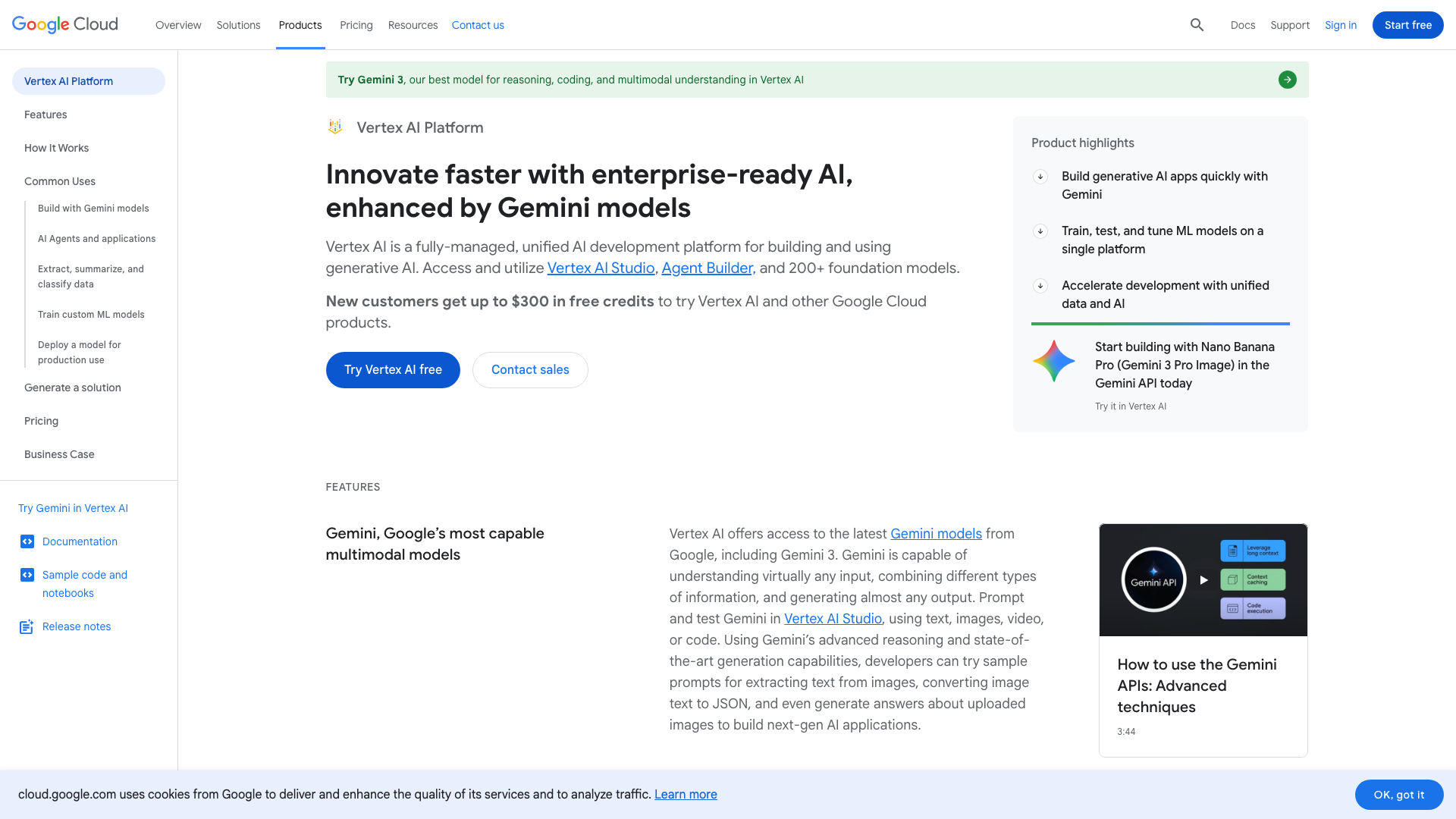
The best Google Vertex AI alternatives in 2026 are Nexus, AWS Bedrock, Azure AI, Databricks, Snowflake Cortex, Hugging Face, Cohere, Anthropic API, OpenAI API, and custom build. Vertex AI is Google's unified cloud AI platform — combining ADK (Agent Development Kit), Agent Engine, Gemini model access, and MLOps tooling — but alternatives range from competing cloud ML platforms (for engineering teams) to autonomous agent platforms that deliver production outcomes without ML engineering overhead.
If you're a developer or ML engineer evaluating Vertex AI alternatives as a model training or deployment platform, AWS Bedrock, Azure AI, and Databricks are your primary options. If you're an enterprise operations or business team trying to deploy AI agents without building on top of raw infrastructure, a different category of solution exists entirely.
The distinction matters because most enterprises that search for Vertex AI alternatives aren't unhappy with Google's technology. They're unhappy with what happened after they adopted it. The tools were solid. ADK is well-designed. Agent Engine handles infrastructure. Gemini models are genuinely capable. But translating that into production agents that complete business processes — across Salesforce, SAP, WhatsApp, Slack, email, and legacy systems — required months of engineering and ongoing maintenance that most organizations can't sustain.
According to an MIT study published in 2025, 95% of enterprise AI initiatives fail to demonstrate profit-and-loss impact. IDC research puts the share of AI proof-of-concepts that never reach production at 88%. The problem is rarely model quality. It's the gap between a cloud AI toolkit and a deployed business outcome.
If that gap sounds familiar, here are 10 alternatives worth evaluating, organized by what they actually deliver.
Google Vertex AI Alternatives: Quick Comparison Table (2026)
| Tool | Category | Best for | Requires engineering? | Completes workflows? | Pricing model |
|---|---|---|---|---|---|
| Nexus | Autonomous agent platform + service | Full enterprise workflow automation, any department | No | Yes, end-to-end | Per-agent |
| AWS Bedrock | Cloud AI platform | AI development on AWS infrastructure | Yes | No (toolkit) | Usage-based |
| Azure AI | Cloud AI platform | AI development on Azure/Microsoft infrastructure | Yes | No (toolkit) | Usage-based |
| Databricks | Data + AI platform | Data engineering teams building ML/AI on lakehouse | Yes | No (toolkit) | Usage-based |
| Snowflake Cortex | Data cloud + AI | AI features on Snowflake data | Yes (SQL-focused) | No | Usage-based |
| Hugging Face | Open-source model hub | Model experimentation and fine-tuning | Yes | No | Free + Pro tiers |
| Cohere | Enterprise LLM API | Enterprise NLP and RAG applications | Yes | No | Usage-based |
| Anthropic API | LLM API | Building with Claude models | Yes | No (API only) | Usage-based |
| OpenAI API | LLM API | Building with GPT models | Yes | No (API only) | Usage-based |
| Custom build | In-house development | Unique requirements, strong engineering teams | Yes (heavy) | Depends on team | Engineering cost |
Top 10 Google Vertex AI Alternatives for Enterprise AI
Nexus: Best Vertex AI Alternative for No-Code Enterprise Agent Deployment
What it is: An autonomous agent platform paired with Forward Deployed Engineers (FDEs) who embed with your team. Nexus agents don't assist. They complete entire business workflows end-to-end: collecting data, validating against systems, making decisions within guardrails, handling exceptions, and executing actions. Business teams build and own the agents. No engineering dependency.
Why enterprises move from Vertex AI to Nexus:
The distinction is structural. Vertex AI gives your engineering team tools to build agents. Nexus gives your business teams production agents that work. One is a starting point. The other is the destination.
Most enterprises evaluating Vertex AI don't have a technology problem. They have a delivery problem. The business processes that drive revenue — customer onboarding, sales intelligence, compliance monitoring, support triage — are owned by operations teams, not developers. Asking engineering to build and maintain agents for these processes means competing with core product work.
Nexus removes that dependency entirely. Forward Deployed Engineers handle the technical complexity. Business teams define the workflows. Agents go live in weeks, not quarters.
What it looks like in production:
- Orange Group (multi-billion euro telecom, 120,000+ employees): Business team built autonomous customer onboarding agents. Deployed across multiple European markets in 4 weeks. 50% conversion improvement. ~$6M+ yearly revenue. 90% autonomous resolution. 100% team adoption.
- European telecom (13,000+ employees): Spent months with platform-based tooling. Couldn't deliver production use cases at scale. Deployed a dozen Nexus agents in 12 weeks. 40% of support capacity freed.
Pricing: Per-agent, tied to value delivered. Not per-user, not usage-based. An agent handling millions of interactions costs the same whether your company has 500 or 50,000 employees. Every engagement starts with a 3-month POC tied to measurable outcomes.
Best for: Enterprises that need AI to complete high-volume business processes across departments — sales, support, compliance, HR, onboarding, operations — without building on raw infrastructure.
Full Nexus vs Google Vertex AI comparison →
AWS Bedrock: Best Vertex AI Alternative for AWS-Ecosystem Teams
What it is: Amazon's managed service for building generative AI applications on AWS. Access to foundation models from Anthropic, Meta, Mistral, Cohere, and Amazon's own Titan models. Includes Agents for Bedrock (multi-step task execution), Knowledge Bases (RAG), Guardrails, and Model Evaluation.
How it compares to Vertex AI: The closest direct competitor. Where Vertex AI is strongest in the Google Cloud ecosystem, Bedrock is strongest on AWS. Both offer managed model access, agent-building tools, and deep integration with their respective cloud platforms. Bedrock has broader model choice out of the box — multi-provider model access versus Vertex AI's Gemini-first approach. Vertex AI has the open-source ADK and tighter Google Cloud data stack integration (BigQuery, Dataflow). Gartner Peer Insights lists both as top options in the Cloud AI Developer Services category, with organizations typically choosing based on their existing cloud infrastructure rather than capability differences.
Why it might not solve the problem: Same fundamental gap as Vertex AI. Bedrock gives developers tools. Your team still builds, deploys, and maintains everything. If the bottleneck on Vertex AI was engineering capacity and organizational change — not Google-specific technology — switching to Bedrock moves the same problem to a different cloud.
Pricing: Usage-based. On-demand or provisioned throughput. Plus infrastructure costs on AWS. Pricing varies by model: Claude Sonnet on Bedrock is priced per input/output token; Titan models carry lower per-token rates.
Best for: AWS-native organizations with AI engineering teams who want to build custom AI applications on their existing infrastructure.
Azure AI: Best Vertex AI Alternative for Microsoft-Ecosystem Teams
What it is: Microsoft's cloud AI platform. Includes Azure OpenAI Service (GPT models), Azure AI Foundry (agent building, formerly Azure AI Studio), Azure AI Search, and deep integration with Microsoft 365, Dynamics, and the broader Azure ecosystem. Also includes Copilot Studio for building custom copilots without heavy engineering.
How it compares to Vertex AI: The Microsoft equivalent. Azure AI's advantage is native access to OpenAI models and tight integration with Microsoft's enterprise stack (M365, Dynamics, Teams). This matters enormously for enterprises already running on Microsoft infrastructure — over 345 million Microsoft 365 seats worldwide give Azure AI a distribution advantage no other cloud platform matches. Vertex AI's advantage is Gemini models and the GCP data stack. Both require engineering to build production agents. For enterprises evaluating lock-in risk, Azure AI ties you to Microsoft infrastructure; Vertex AI ties you to Google Cloud.
Why it might not solve the problem: Same toolkit pattern. Azure AI Foundry and Copilot Studio give developers and citizen developers tools to build. But production agents that complete complex business processes across non-Microsoft systems still require significant engineering and integration work. If you left Vertex AI because the build burden was too high, Azure AI introduces the same burden in a different ecosystem.
Pricing: Usage-based (Azure OpenAI pricing per token). Copilot Studio starts at $200/month per tenant plus per-message overages. Azure infrastructure costs apply separately.
Best for: Microsoft-heavy organizations with engineering teams building AI applications on Azure infrastructure.
Databricks: Best Vertex AI Alternative for Data Engineering Teams
What it is: Unified data and AI platform built on the lakehouse architecture. Combines data engineering, data science, ML, and generative AI (Mosaic AI Agent Framework, Model Serving, MLflow, Unity Catalog for governance). Strong for organizations that want to build AI on top of their own data at scale.
How it compares to Vertex AI: Different emphasis. Vertex AI is agent-first with data capabilities. Databricks is data-first with AI capabilities. If your primary challenge is building AI applications that reason over large, complex datasets — where data engineering and AI are deeply coupled — Databricks is the stronger foundation. According to Gartner Peer Insights, Databricks scores highly among data engineering teams for its lakehouse architecture and model serving capabilities. If the challenge is deploying agents quickly without data engineering overhead, neither platform solves it.
Why it might not solve the problem: Databricks is a data platform that added AI features, not an agent platform. Building production business agents — customer onboarding, sales intelligence, compliance monitoring — on Databricks requires your data engineering team to become an agent engineering team. The tooling is there. The organizational capacity usually isn't.
Pricing: Usage-based (DBU pricing). Enterprise plans start high and scale with compute usage. Databricks' enterprise valuation was last reported at approximately $43 billion, reflecting the platform's significant enterprise adoption in data engineering.
Best for: Data-heavy organizations where AI use cases are tightly coupled to data engineering pipelines and the team already runs on Databricks.
Snowflake Cortex: Best for AI on Warehouse Data
What it is: AI features built into the Snowflake Data Cloud. Includes Cortex AI (LLM functions callable from SQL), Cortex Search (semantic search over Snowflake data), Cortex Analyst (natural language to SQL), and the ability to build and serve AI applications within Snowflake's governed environment. Cortex AI reached general availability in 2024.
How it compares to Vertex AI: Narrower scope but simpler for its target use case. If your data lives in Snowflake and you want AI capabilities on that data without moving it elsewhere, Cortex is the path of least resistance. No separate AI platform needed. SQL + LLM functions in one environment. Vertex AI is broader and more flexible for custom agent architectures outside the data warehouse.
Why it might not solve the problem: Cortex operates within Snowflake's boundaries. Business processes don't live in a data warehouse. They live across CRMs, ERPs, communication channels, email, and legacy systems. Cortex can add intelligence to data workflows, but it doesn't reach into the operational systems where agents need to act.
Pricing: Credit-based (Snowflake credits per query). Costs depend on model and compute tier selected.
Best for: Snowflake-centric organizations that want AI functions on their warehouse data without adopting a separate AI platform.
Hugging Face: Best for Model Research and Fine-Tuning
What it is: The open-source model hub and community platform. Hosts 500,000+ models, datasets, and Spaces for demos. Includes Inference Endpoints (managed model serving), Transformers library, and tools for fine-tuning and evaluating models. The "GitHub of machine learning" for the research and ML engineering community.
How it compares to Vertex AI: Completely different layer. Hugging Face is about model access and experimentation. Vertex AI is about building production applications on top of models. If you're evaluating models, fine-tuning for your domain, or contributing to open-source AI research, Hugging Face is an essential resource. If you need production agent infrastructure, Hugging Face gives you components, not a platform.
Why it might not solve the problem: Hugging Face solves model selection, not enterprise deployment. You still need to build everything around the model: orchestration, integration, governance, monitoring, deployment, and maintenance. For research teams and ML engineers, it's a critical tool. For business teams that need agents completing workflows, it doesn't get you there.
Pricing: Free tier. Pro at $9/month. Enterprise Hub with SSO, audit logs, and advanced security at custom pricing.
Best for: ML engineers and data scientists evaluating, fine-tuning, and experimenting with open-source models.
Cohere: Best for Enterprise NLP with Data Sovereignty Requirements
What it is: Enterprise-focused LLM provider. Offers Command (generation), Embed (embeddings), Rerank (search ranking), and the Compass connector system. Positioned as the enterprise-grade alternative to OpenAI, with focus on data privacy, deployment flexibility (cloud, on-premises, VPC), and multilingual capabilities. A common choice for enterprises with strict data residency requirements in regulated industries.
How it compares to Vertex AI: Narrower but more focused on enterprise deployment constraints. Cohere doesn't offer a full agent-building platform like Vertex AI. It provides the AI models and APIs enterprises can integrate into their own systems. The value proposition is privacy-first, deployable anywhere, and strong for RAG use cases. Vertex AI offers broader infrastructure but ties you to Google Cloud's data perimeter.
Why it might not solve the problem: Cohere gives you models and APIs. Building production agents still requires your engineering team to handle orchestration, integration, deployment, monitoring, and maintenance. If the gap on Vertex AI was "we have tools but can't turn them into production outcomes," Cohere provides different tools with the same gap.
Pricing: Usage-based API pricing. Enterprise agreements with custom terms and deployment options.
Best for: Enterprises with strict data privacy requirements that need LLM capabilities they can deploy on their own infrastructure.
Anthropic API: Best for Engineering Teams Building with Claude
What it is: Direct API access to Claude models (Claude Opus 4, Sonnet, Haiku). Includes tool use, system prompts, vision capabilities, extended context windows (up to 200K tokens), and the Model Context Protocol (MCP) for structured tool integration. Known for strong reasoning, safety focus, and instruction-following across complex multi-step tasks.
How it compares to Vertex AI: Different layer entirely. Anthropic provides the AI model. Vertex AI provides the platform for building with models — including Claude via Vertex AI Model Garden. If you're using Vertex AI primarily for Gemini, the Anthropic API gives you access to a different model family. If you're using Vertex AI for the agent infrastructure (ADK, Agent Engine), the Anthropic API doesn't replace that — it only replaces the model component.
Why it might not solve the problem: An API is the most raw form of AI capability. You get the model. Everything else — agent logic, orchestration, integrations, deployment, monitoring, governance, exception handling — is on your team to build. If the problem with Vertex AI was the engineering burden, going direct-to-API increases that burden.
Pricing: Per-token pricing (input/output tokens billed separately). Volume discounts available for enterprise usage. Claude Sonnet is the most commonly used model for production agent workloads.
Best for: Engineering teams building custom AI applications who want Claude's reasoning capabilities without the GCP infrastructure layer.
OpenAI API: Best for Engineering Teams Building with GPT Models
What it is: Direct API access to GPT models (GPT-4o, o1, o3), plus DALL-E, Whisper, TTS, and the Responses API for building agent-like experiences. The largest model provider by developer adoption. Includes function calling, code interpreter, file search, and persistent threads via the Assistants API.
How it compares to Vertex AI: Same fundamental distinction as Anthropic. OpenAI provides models. Vertex AI provides a platform. The OpenAI Assistants API adds some agent-like features — persistent threads, tool use, file handling — but it's not comparable to Vertex AI's full agent infrastructure (ADK, Agent Engine, connectors, Gemini Enterprise). For model quality alone, OpenAI is competitive. For enterprise agent deployment, it's a component, not a complete solution.
Why it might not solve the problem: Same gap as every raw API. You get the AI model. Everything else is your team's responsibility. OpenAI's enterprise features (ChatGPT Enterprise, custom GPTs) are closer to the AI assistant category than the autonomous agent category — they help individuals accomplish tasks, they don't complete business processes end-to-end.
Pricing: Per-token pricing. ChatGPT Enterprise at custom pricing. Volume discounts for high-usage API customers.
Best for: Engineering teams building AI features into products, or organizations deploying ChatGPT Enterprise for individual-level productivity.
Custom Build: Best for Engineering Teams with Truly Unique Requirements
What it is: Building your own AI agent infrastructure from scratch using open-source frameworks (LangChain, LangGraph, CrewAI, AutoGen, DSPy) and cloud infrastructure. Maximum flexibility. Maximum engineering investment.
How it compares to Vertex AI: More control, more cost. Vertex AI gives you managed infrastructure and pre-built components. Custom building gives you complete architectural freedom but requires you to solve everything: orchestration, state management, model serving, security, compliance, monitoring, deployment, testing, and maintenance. Vertex AI is the middle ground between a raw custom build and a fully managed solution.
The honest calculation: According to MIT's 2025 research on enterprise AI initiatives, 95% fail to produce measurable business impact. For most organizations, the build approach amplifies this risk — every engineering hour spent on internal agent tooling is an hour not spent on core product development, and the maintenance burden compounds with every model update, framework version change, and new integration requirement.
Custom builds also create long-term dependency. Every model update, framework version change, and new integration becomes your team's responsibility indefinitely.
Pricing: Engineering salaries plus infrastructure. Typically 3–6 months for a first production agent. Ongoing maintenance is the hidden and compounding cost.
Best for: Organizations with dedicated AI engineering teams, truly unique requirements that no existing platform can serve, and timelines that absorb 6+ months of initial development before reaching production.
How Nexus compares to building with LangChain →
What is Google Vertex AI, and what makes enterprises look for alternatives?
Google Vertex AI is Google Cloud's unified machine learning platform. It consolidates model training, evaluation, deployment, and agent development under a single managed service. Key components include:
- Gemini model access — Google's flagship model family, available via API within GCP
- ADK (Agent Development Kit) — open-source Python/Java/Go framework for building multi-agent systems, launched in 2024 and expanded with Go support in 2025
- Agent Engine — fully managed runtime for deploying ADK agents to production, with session management, memory, CMEK, and VPC Service Controls now generally available
- Vertex AI Agent Builder — low-code environment for building conversational agents with built-in tool governance
- MLOps tooling — experiment tracking, model registry, pipeline orchestration, and evaluation workflows
Vertex AI is genuinely capable infrastructure. The reason enterprises look for alternatives is almost never about model quality or the platform's technical merit. It's about the organizational reality of translating that infrastructure into running production systems — which requires sustained engineering capacity that most enterprises don't have available.
So which alternative should you actually choose?
The answer depends on why Vertex AI isn't working for you.
If the issue is cloud ecosystem — you need the same category of toolkit but on a different cloud — look at Bedrock (AWS) or Azure AI (Microsoft). Same engineering requirements. Different cloud platform.
If the issue is data platform integration — your data lives in Databricks or Snowflake and you want AI features in that environment — their native AI capabilities keep everything in one ecosystem. Still requires engineering. Still a toolkit.
If the issue is model selection — you want access to Claude, GPT, or open-source models — the API providers and Hugging Face solve that. They don't solve deployment, integration, or organizational delivery.
If the issue is vendor lock-in — you need deployment flexibility across cloud and on-premises environments — Cohere's data-sovereignty approach or open-source frameworks give you architectural freedom. Still requires significant engineering.
If the issue is that you have developer tools but can't turn them into production business outcomes, that's a different kind of problem. It's not a technology gap. It's the gap between raw materials and a finished product. Between a toolkit your engineering team has to build on and a solution your business teams can actually deploy.
That's the gap Nexus fills.
Orange didn't need better cloud AI tools. They needed agents that complete customer onboarding autonomously. ~$6M+ in yearly revenue impact. 4-week deployment. 100% team adoption.
A major European telecom didn't need more engineering time with platform tools. They needed a dozen production agents running at scale. Deployed in 12 weeks. 40% of support capacity freed.
The gap between a cloud AI toolkit and production business outcomes isn't a feature gap. It's a delivery gap. And no amount of switching between cloud providers closes it.
Frequently asked questions
What is the difference between Google Vertex AI, Google AI Studio, and Google ADK?
These are three distinct products serving different audiences. Google AI Studio is a browser-based interface for prototyping with Gemini models — it's aimed at individual developers and experimenters. Google Vertex AI is the enterprise-grade cloud platform for building and deploying AI applications at scale, with full MLOps tooling, model management, and production infrastructure. Google ADK (Agent Development Kit) is an open-source Python/Java/Go framework for building multi-agent systems — it can be used independently or deployed to production via Vertex AI's Agent Engine managed runtime. Most enterprise teams using Vertex AI for production agent deployment combine ADK (for agent logic) with Agent Engine (for managed hosting) within the broader Vertex AI platform.
Is Google Vertex AI better than AWS SageMaker or Azure ML for enterprise AI development?
It depends entirely on your existing cloud infrastructure and team composition. Vertex AI excels for GCP-native organizations, teams building with Gemini models, and those wanting the open-source ADK. SageMaker is generally considered stronger for AWS-native organizations and benefits from AWS's broader enterprise cloud adoption. Azure ML has significant distribution advantages for Microsoft-heavy organizations through its M365 integration. Gartner Peer Insights lists all three as leading options in the Data Science and Machine Learning Platforms market, with competitive ratings. Head-to-head capability gaps are narrowing; the more meaningful differences are ecosystem fit, compliance features, and which cloud your data already lives in.
Do I need Google Vertex AI to use Gemini models?
No. Gemini models are accessible via the Gemini API directly through Google AI Studio or the Google AI API, without requiring a Vertex AI account or GCP infrastructure. Vertex AI provides additional enterprise features on top of Gemini access: model governance, VPC Service Controls, CMEK, SLAs, and integration with other GCP services. For development and prototyping, the direct Gemini API is simpler. For production enterprise deployments with compliance, data residency, and audit requirements, Vertex AI's managed environment adds meaningful value.
How much does Google Vertex AI cost compared to AWS Bedrock and Azure AI?
All three platforms use usage-based pricing tied to model selection and compute consumption, making direct comparison difficult without knowing the specific workload. For inference (calling a model), costs are broadly similar across providers for equivalent model tiers — enterprise pricing typically involves custom agreements. The meaningful cost difference is usually in training and fine-tuning compute, where pricing varies significantly by instance type and duration. All three offer free tiers for development use. The largest cost variable for enterprises is typically not the per-token or per-compute rate, but the engineering hours required to build, deploy, and maintain agents — which is the same challenge across all three platforms.
What is Google ADK (Agent Development Kit) and how does it differ from LangChain?
Google ADK is an opinionated, production-ready framework built specifically for deploying agents on Google Cloud infrastructure. It supports Python, Java, and Go, includes built-in state management, and has a one-line deployment path to Vertex AI Agent Engine. LangChain is a more general-purpose, cloud-agnostic framework with a much larger ecosystem of integrations and community contributors. ADK is typically the better choice if you're building on GCP and want tight integration with Vertex AI Agent Engine's managed runtime. LangChain gives more flexibility across cloud providers and open-source model ecosystems but requires more configuration to reach production. Both still require significant engineering effort to deploy production agents.
Worth exploring?
Every Nexus engagement starts with a 3-month proof of concept tied to measurable outcomes. Forward Deployed Engineers embed with your team from day one. You see the results before committing.
100% of clients who started a POC converted to an annual contract. Every one.
See the full Nexus vs Google Vertex AI comparison →
Related reading
- Nexus vs Google Vertex AI: full comparison
- Nexus vs Microsoft Copilot: AI assistant vs autonomous agents
- Nexus vs LangChain: framework vs platform + service
- Top 10 cloud AI platforms for enterprise
- Google Vertex AI vs AWS Bedrock: cloud AI platforms compared
- How to choose a cloud AI platform for enterprise
- How to build AI agents for enterprise