Top 10 Dify Alternatives for AI App Development in 2026
Dify is great for prototyping AI apps. But most enterprises need production agents, not prototypes. Here are 10 Dify alternatives ranked by what they actually deliver at scale.
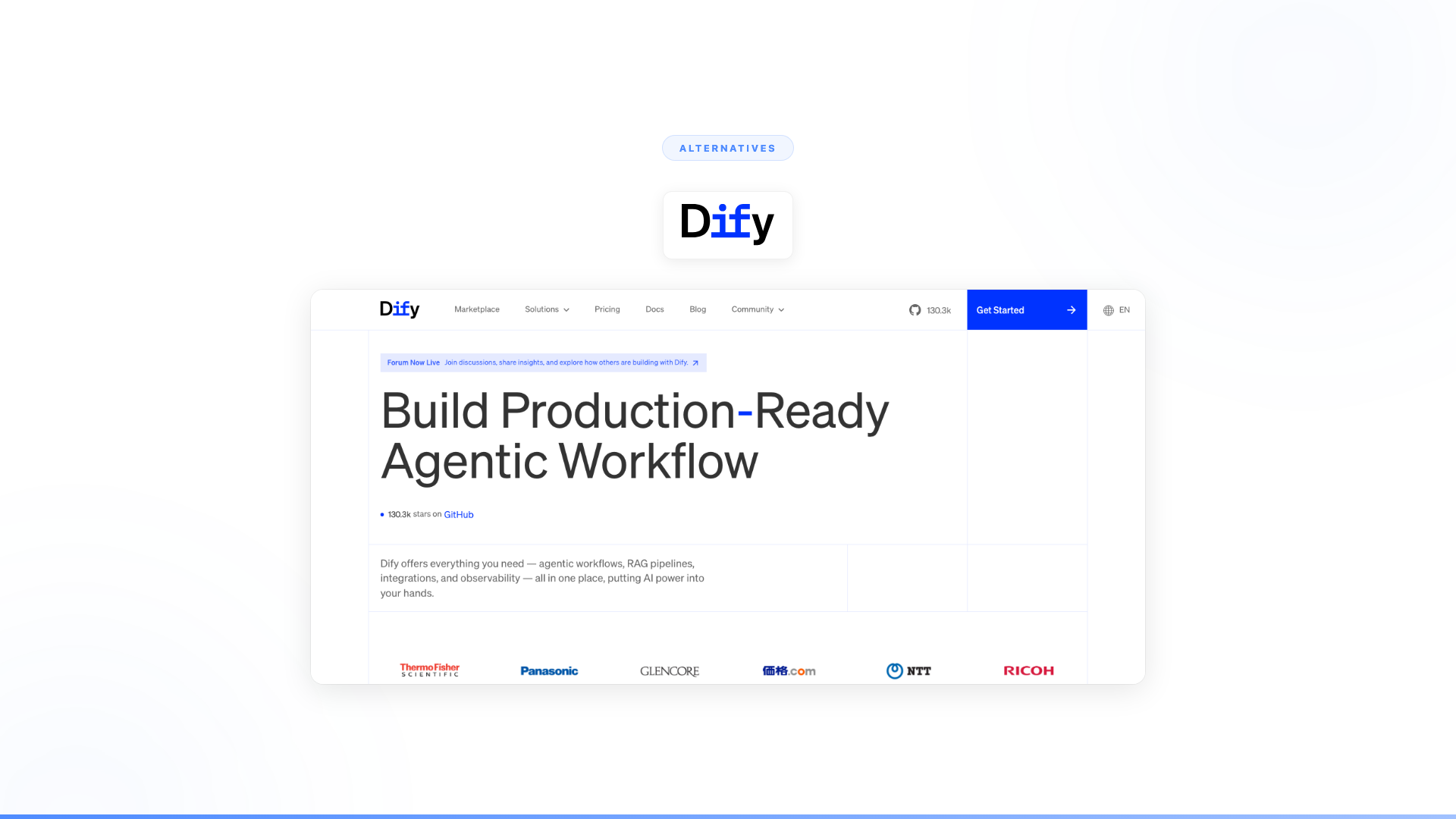
The best Dify alternatives in 2026 are Nexus, LangChain, CrewAI, Flowise, n8n, Relevance AI, Haystack, AutoGen, Dust, and custom build. Dify is an open-source LLM application platform with 130,000+ GitHub stars used for RAG pipelines and visual AI workflows — alternatives range from code-first frameworks to enterprise platforms that deploy production agents without requiring engineering.
There's a pattern among teams searching for Dify alternatives.
Some hit a ceiling with the visual builder. The prototype worked, but extending it to handle real enterprise complexity — exceptions, multi-system orchestration, compliance — required engineering effort the builder couldn't absorb. Some built a working demo and then spent months trying to make it production-ready: security hardening, infrastructure management, governance, monitoring. And some are evaluating Dify for the first time and wondering if there's a path that gets them to production agents without the detour through prototyping.
All three patterns point to the same gap. Dify helps you build AI apps. Getting those apps to run critical business processes at enterprise scale — with governance, adoption, and reliability — is a different problem. And it's the problem that matters most.
Here are 10 alternatives, organized by what they actually give you.
Dify Alternatives: Quick Comparison Table (2026)
| Tool | Category | Best for | Requires engineering? | Time to production |
|---|---|---|---|---|
| Nexus | Enterprise agent platform + service | Full enterprise workflow automation, any department | No (business teams build with FDE support) | Days to weeks |
| LangChain | Developer framework | Flexible LLM application development | Yes (significant) | Weeks to months |
| CrewAI | Developer framework (multi-agent) | Multi-agent collaboration for engineering teams | Yes | Weeks to months |
| Flowise | No-code LLM app builder | Visual chain building for non-developers | Minimal (for prototypes) | Days (prototype), months (production) |
| n8n | Workflow automation + AI | Automating workflows with AI steps | Minimal | Days to weeks (simple), months (complex) |
| Relevance AI | AI agent builder | Building AI agents with a visual interface | Minimal | Days to weeks |
| Haystack | Developer framework (pipelines) | RAG and search-focused applications | Yes | Weeks to months |
| AutoGen | Research framework (multi-agent) | AI research and experimentation | Yes (research-level) | Months |
| Dust | AI assistant platform | Custom AI assistants for teams | Minimal | Days (assistants), months (workflows) |
| Custom build | Self-built | Unique requirements with unlimited engineering budget | Yes (significant) | Months to quarters |
Top 10 Dify Alternatives for LLM App Development
1. Nexus: Best Dify Alternative for Enterprise Production Agents
What it is: An enterprise AI agent platform paired with Forward Deployed Engineers who embed with your team. Nexus agents complete entire business workflows end-to-end: collecting data from multiple systems, validating against business rules, making decisions within guardrails, handling exceptions, and executing actions. Any department. Any workflow. Business teams build and own the agents without writing code.
Why enterprises switch from Dify to Nexus:
The gap isn't about features. Both can build agents. The gap is about what happens after you build the agent.
Dify — available as open-source self-hosted and as a cloud SaaS offering — gives you a visual builder to assemble AI apps and supports 100+ LLM providers. That's genuinely useful for prototyping and experimentation. But deploying those apps into critical business processes at enterprise scale — with governance, compliance, 4,000+ system integrations, organizational change management, and someone accountable for outcomes — is a fundamentally different challenge. Dify gives you software. Nexus gives you a deployment partner.
What it looks like in production:
- Orange Group (multi-billion euro telecom, 120,000+ employees): Business team built autonomous customer onboarding agents. Deployed across multiple European markets in 4 weeks. 50% conversion improvement, approximately €6M+ in yearly revenue impact, 90% autonomous resolution, and 100% team adoption — with no engineering dependency.
- Lambda (AI infrastructure company): A non-engineer built an autonomous research agent monitoring 12,000+ accounts. More than 24,000 hours of annual research capacity added. Deployed in days, not months.
- European telecom (13,000+ employees): Deployed a dozen agents across support operations. 40% of support capacity freed across millions of interactions, delivered in a 12-week deployment with full regulatory compliance.
Pricing: Per-agent, tied to value delivered. Every engagement starts with a 3-month POC tied to measurable outcomes. 100% POC-to-contract conversion rate.
Best for: Enterprises that need AI agents completing business processes in production, not AI apps in a sandbox. Sales, support, compliance, HR, onboarding, operations.
Full Nexus vs Dify comparison -->
2. LangChain: Best Dify Alternative for Python-Based LLM Development
What it is: The most popular open-source framework for building LLM applications. 125,000+ GitHub stars. LangChain provides chains, agents, retrieval components, and tool integrations that developers compose to build AI-powered applications. The ecosystem now includes LangChain core, LCEL, LangGraph (for complex agent orchestration), and LangSmith (for observability).
How it compares to Dify: Dify is a visual builder on top of similar concepts. LangChain is the code-first version. If you found Dify's visual builder too constraining, LangChain gives you maximum flexibility at the cost of writing everything in Python. If you found Dify's builder convenient, LangChain removes the convenience and adds power. The tradeoff is clear: more control, more code, more engineering time.
Why it might not solve the problem: LangChain gives you components. Assembling those components into a production agent that handles governance, security, compliance, monitoring, integrations, and maintenance is still entirely on your team. Many teams switch from Dify to LangChain expecting more capability but discover they've traded one set of limitations (visual builder constraints) for another (ecosystem complexity across four interconnected products). The production gap remains.
Pricing: Open-source (free). LangSmith and LangGraph Platform have usage-based pricing.
Best for: Engineering teams that want full code-level control over AI agent architecture and are comfortable managing the production lifecycle independently.
Full LangChain alternatives breakdown -->
3. CrewAI: Best Dify Alternative for Multi-Agent Systems
What it is: An open-source Python framework for building multi-agent systems. CrewAI lets developers define "crews" of AI agents, each with a specific role, goal, and toolset. Agents collaborate to complete tasks. The abstraction is intuitive: define agents, define tasks, let them work together. 40,000+ GitHub stars and growing.
How it compares to Dify: Different model entirely. Dify is a visual builder for single-agent workflows. CrewAI is a code framework for multi-agent collaboration. If your use case requires multiple AI agents coordinating — research agent, analysis agent, and reporting agent working together — CrewAI's architecture handles that more naturally than Dify's workflow builder. But it's code-first, which means you need developers.
Why it might not solve the problem: CrewAI solves multi-agent orchestration. It doesn't solve enterprise deployment. Governance, compliance, native integrations with enterprise systems, monitoring, audit trails, organizational adoption — all of that is still your team's responsibility. The framework is also relatively young, and the ecosystem around it (enterprise features, deployment tooling, observability) is still maturing.
Pricing: Open-source (free). Enterprise features at additional cost.
Best for: Python developers building multi-agent systems who want a simpler abstraction than LangChain and can handle the full production lifecycle.
Full Nexus vs CrewAI comparison -->
4. Flowise vs Dify: Which Open-Source LLM Builder Is Better?
What it is: An open-source, no-code tool for building LLM applications with a drag-and-drop interface. Flowise is built on top of LangChain and LlamaIndex components, making the same building blocks accessible visually and letting non-developers compose chatbots, RAG pipelines, and simple agent workflows.
How it compares to Dify: Both are visual builders for LLM applications in the same category. Flowise is more focused on the LangChain/LlamaIndex ecosystem and tends to appeal to smaller teams or individual developers. For pure visual LLM pipeline building, Flowise is arguably superior to Dify in simplicity: its node-based editor is more approachable for teams already familiar with LangChain concepts. Dify has a broader feature set — workflow builder, RAG pipeline management, agent strategies, support for 100+ LLM providers, a larger plugin ecosystem, and a cloud SaaS offering alongside self-hosting. For simple prototypes, Flowise is faster to get started. For more complex applications, Dify has more depth. Both are primarily self-hosted open-source tools, though each offers a cloud tier.
Why it might not solve the problem: Flowise inherits the same structural limitation as Dify. It's a prototyping accelerator, not an enterprise deployment platform. The gap between a working Flowise prototype and a production agent with governance, compliance, and enterprise system integrations is just as wide. If you're leaving Dify because of the production gap, Flowise keeps you in the same category.
Also worth considering: Langflow, a visual LangChain builder with significant enterprise adoption, occupies the same space and is worth evaluating alongside Flowise if you want a visual alternative to Dify.
Pricing: Open-source (self-hosted, free). FlowiseAI Cloud has subscription pricing.
Best for: Individual developers or small teams that want quick visual prototyping with LangChain/LlamaIndex components and prefer open-source self-hosted tooling.
5. n8n: Best Dify Alternative for Workflow Automation + AI
What it is: An open-source workflow automation platform with AI capabilities. n8n connects applications and automates workflows using a visual editor. It has added AI nodes that let you integrate LLM calls, vector databases, and agent logic into broader automation workflows. Think of it as Zapier with more technical depth and self-hosting options — a general-purpose automation tool rather than an AI-first builder.
How it compares to Dify: Different focus. Dify is specifically an AI app builder. n8n is a general workflow automation tool that includes AI capabilities. If your primary need is connecting business applications and automating workflows with some AI steps mixed in, n8n is a natural fit. If your primary need is building an AI-native application — chatbot, RAG system, or agent — Dify is more specialized. n8n's strength is breadth: it handles hundreds of integrations and non-AI automation tasks that Dify doesn't cover.
Why it might not solve the problem: n8n automates workflows with rules and conditions. AI nodes add intelligence to specific steps, but the overall architecture is still workflow-based: if-this-then-that with AI sprinkled in. For business processes that require autonomous decision-making, exception handling, and adaptive reasoning across multiple systems, the workflow paradigm hits the same ceiling as other automation tools. Complexity grows faster than the workflow can accommodate.
Pricing: Open-source (self-hosted, free). Cloud starts at €20/month. Enterprise pricing available.
Best for: Technical teams that want to automate multi-step workflows connecting various business tools, with AI intelligence added to specific steps.
6. Relevance AI: Dify Alternative for Agent-Focused Teams
What it is: A platform for building and deploying AI agents with a visual interface. Relevance AI provides a no-code agent builder, tool integrations, and deployment capabilities. It positions itself as a way to build AI agents for specific business functions — sales, marketing, support — without engineering resources.
How it compares to Dify: Relevance AI is more agent-focused where Dify is more app-focused. Dify's builder covers chatbots, RAG pipelines, and general LLM workflows. Relevance AI concentrates on agents that complete specific tasks. For teams specifically building AI agents rather than broader LLM applications, Relevance AI's abstractions can be more direct. The platform's opinionated structure around business function agents (sales agent, support agent) makes it faster to get started for those use cases specifically.
Why it might not solve the problem: Relevance AI is still a builder. Your team builds and manages the agents. Enterprise governance, compliance certifications, Forward Deployed Engineers, change management — none of that is included. For bounded use cases with a single team, it works well. For enterprise-wide deployment across departments with thousands of users, the builder model creates the same scaling challenges.
Pricing: Free tier available. Paid plans start at $19/month. Enterprise pricing custom.
Best for: Small to mid-size teams building focused AI agents for specific business functions who don't need enterprise-grade governance.
7. Haystack: Best Dify Alternative for RAG and Search
What it is: An open-source framework by deepset for building production-ready LLM applications, especially RAG pipelines. Haystack 2.0 uses a clean pipeline architecture where you connect components — retrievers, readers, generators, rankers — to build search and question-answering systems.
How it compares to Dify: Haystack is a code-first framework focused on doing RAG and search exceptionally well. Dify includes RAG as one of many features in its visual builder. If your primary challenge is retrieval quality over enterprise documents — hybrid search, re-ranking, precision at scale — Haystack gives you more sophisticated control than either Dify's built-in RAG tools or visual alternatives like Flowise. If you want a broader AI app builder with some RAG capability, Dify covers more ground but with less depth on retrieval specifically.
Why it might not solve the problem: Haystack excels at retrieval and search. It isn't designed for autonomous multi-step workflow completion. If you need agents that collect data, validate it, make decisions, handle exceptions, and execute actions across enterprise systems, Haystack's pipeline architecture isn't built for that scope. It solves information retrieval well, not the full agent problem.
Pricing: Open-source (free). deepset Cloud (managed service) has usage-based pricing.
Best for: Engineering teams building search, RAG, or document QA applications where retrieval quality is the primary concern.
8. AutoGen (Microsoft): Dify Alternative for Multi-Agent Research
What it is: Microsoft's open-source framework for building multi-agent conversational AI systems. AutoGen lets developers create agents that have conversations with each other, with humans, or both. Agents can write and execute code, use tools, and collaborate through structured dialogue patterns.
How it compares to Dify: Completely different paradigm. Dify is a visual builder for production-oriented apps. AutoGen is a research-oriented framework for multi-agent conversation systems. Where Dify prioritizes getting something working quickly, AutoGen prioritizes flexibility for complex agent interaction patterns. The learning curve is steeper, and the path to production is longer. AutoGen is genuinely excellent for research and experimentation — if that's your use case, it's one of the most capable frameworks available.
Why it might not solve the problem: AutoGen is a research framework becoming a product. The transition is ongoing. Production deployment requires significant engineering around the framework. Enterprise features — governance, compliance, native integrations, deployment infrastructure — are your responsibility. For straightforward business workflows, the conversational multi-agent approach adds overhead without clear benefit.
Pricing: Open-source (free). Infrastructure and engineering costs are your own.
Best for: AI research teams and advanced engineering groups experimenting with multi-agent conversational systems.
9. Dust: Dify Alternative for Internal AI Assistants
What it is: An AI assistant platform that lets teams build custom assistants connected to their data sources. Dust is focused on internal knowledge work: creating assistants that understand your company's context and help teams answer questions, generate content, and complete tasks using your data.
How it compares to Dify: Different scope. Dify builds AI applications — chatbots, RAG pipelines, agent workflows. Dust builds internal AI assistants for teams. If your need is "help our employees find and use internal knowledge more efficiently," Dust is a more direct fit. If your need is "build an AI-powered application or agent workflow," Dify covers more ground. Dust's opinionated focus on internal assistants means faster setup for that specific use case, with less configurability for general agent work.
Why it might not solve the problem: Dust creates assistants. Assistants help people work. They don't complete work autonomously. The same structural limitation applies: Dust helps individuals be more productive, but the business processes those individuals work within stay manual. For teams that need AI to complete multi-step workflows end-to-end rather than just assist, assistants and app builders address different parts of the problem.
Pricing: $29/user/month (Pro). Custom enterprise pricing.
Best for: Teams that want better internal AI assistants with custom context, and whose work doesn't require autonomous process completion.
10. Custom Build: Maximum Control, Maximum Cost
What it is: Building your own AI application infrastructure from scratch using model APIs (OpenAI, Anthropic, open-source models), vector databases, and custom code. Your engineering team designs the architecture, builds the abstractions, handles integrations, and owns every layer.
How it compares to Dify: Maximum control. Zero dependency on a third-party builder's design decisions, limitations, or ecosystem. For engineering teams that found Dify's visual builder too constraining and want to build exactly what they need, this removes all constraints. It also removes all guardrails and all time-to-value acceleration.
Why it might not solve the problem: You're building everything — not just the application logic, but the integration layer, monitoring, security, governance, compliance, deployment infrastructure, and ongoing maintenance. The teams that succeed with custom builds are typically building AI as their core product, not internal tooling. For internal business workflows, the engineering investment is hard to justify when deployment-ready alternatives exist.
Pricing: Engineering salaries plus infrastructure. Typically 3 to 6 months for a first production deployment. Ongoing maintenance is permanent.
Best for: Organizations with unique technical requirements that genuinely can't be met by existing tools, and sufficient engineering capacity that the investment doesn't compete with core product work.
The real question: builder or solution?
Every alternative on this list shares something with Dify. They're all tools that give you building blocks. The difference is which blocks, how many, and how much assembly is required.
That model works when you're building AI capabilities as part of your product. When AI-powered features are what you sell, your team should own the architecture. Pick the builder or framework that fits your team's skills and requirements.
But most enterprises searching for Dify alternatives aren't building AI products. They're trying to automate business processes: customer onboarding, sales intelligence, support operations, compliance monitoring, HR workflows. For those use cases, a builder creates a permanent engineering dependency for something that isn't your core product. You're asking engineers to learn a platform, build apps, manage infrastructure, and maintain everything — indefinitely — instead of working on what your company actually sells.
The question isn't which builder. It's whether you need a builder at all.
Frequently Asked Questions
What is the difference between Dify and LangChain?
Dify is a visual, low-code platform for building LLM applications — it provides a drag-and-drop workflow builder, built-in RAG pipeline tools, and a managed cloud option alongside self-hosting. LangChain is a code-first Python framework that provides modular components (chains, agents, retrievers, tools) for developers to assemble custom LLM applications. Dify trades flexibility for speed of iteration; LangChain trades ease of use for architectural control. Teams that find Dify's builder too constraining typically move to LangChain. Teams that find LangChain too complex sometimes move to Dify. Neither solves enterprise production deployment on its own.
Is Dify production-ready for enterprise use?
Dify has enterprise-relevant features — SSO, audit logs, multi-workspace support, role-based access, and a self-hosted deployment option for data privacy. For development teams building internal AI applications at limited scale, it can work in production. The challenges that push enterprises to look at alternatives typically emerge at scale: governance across hundreds of agents, integration with legacy systems, change management across thousands of users, and ongoing maintenance without a dedicated platform team. Dify builds the app. Enterprise deployment readiness depends heavily on your team's engineering capacity to manage everything around the app.
Can Dify be self-hosted for data privacy compliance?
Yes. Dify's open-source version is fully self-hostable via Docker Compose or Kubernetes. This is one of the primary reasons enterprises choose Dify — data stays on your infrastructure, and you control the deployment environment. The cloud SaaS option (dify.ai) processes data on Dify's infrastructure. For regulated industries (healthcare, finance, government) with strict data sovereignty requirements, self-hosting is the standard deployment path. When evaluating Dify alternatives, it's worth checking whether the alternative offers equivalent self-hosting: Flowise, Haystack, n8n, and LangChain-based deployments all support self-hosting, while some SaaS-only platforms do not.
What is the difference between Dify and Flowise?
Both are open-source visual builders for LLM applications. Flowise uses a node-based drag-and-drop editor built directly on LangChain and LlamaIndex components — it's simpler and faster to get started, and genuinely strong for visual LLM pipeline construction. Dify has a broader feature set: it supports 100+ LLM providers, includes a dedicated workflow builder alongside its chat interface, has more sophisticated RAG pipeline management, a larger plugin ecosystem, and its own agent strategy options. Flowise appeals to developers already in the LangChain ecosystem who want a visual layer. Dify appeals to teams that want a more complete platform. For enterprise use, both face the same production deployment challenge: the gap between a working prototype and a governed, integrated, maintained production system.
Does Dify support multi-agent workflows or just single-agent pipelines?
Dify supports multi-agent workflows through its Agent node in the workflow builder. You can chain multiple agents, define handoffs, and build workflows where different agents handle different steps. That said, Dify's multi-agent capabilities are more limited than dedicated multi-agent frameworks like CrewAI or AutoGen. For straightforward sequential workflows where one agent passes output to the next, Dify handles it well. For complex multi-agent coordination patterns — parallel execution, dynamic agent selection, inter-agent conversation loops — frameworks like CrewAI or LangGraph give you more control over the orchestration logic.
Worth exploring?
If your team has been building AI apps with Dify — or evaluated it and wondered how you'd get from prototype to production — it might be worth seeing how the decision changes when you stop thinking about building and start thinking about outcomes.
Every Nexus engagement starts with a 3-month proof of concept tied to measurable business outcomes. Forward Deployed Engineers embed with your team from day one. You see the results before committing. You can exit anytime.
100% of clients who started a POC converted to an annual contract. Every one.
See the full Nexus vs Dify comparison -->
Related reading
- Nexus vs Dify: full comparison
- Nexus vs LangChain: developer framework vs enterprise agents
- Nexus vs CrewAI: multi-agent framework vs production platform
- Top 10 AI Application Development Platforms for Enterprise
- LangChain Alternatives: 10 options ranked
- Top 10 AI Agent Frameworks and Platforms in 2026
- How to Build AI Applications for Enterprise