Top 10 AutoGen Alternatives for Multi-Agent AI in 2026
AutoGen is in maintenance mode. Microsoft now directs new users to Microsoft Agent Framework. Here are 10 alternatives for teams that need production multi-agent AI, not another framework transition.
Is AutoGen Still Maintained? What the Microsoft Agent Framework Transition Means
The best AutoGen alternatives in 2026 are Nexus, CrewAI, LangGraph, LangChain, Haystack, Dify, AG2, Google Vertex AI Agents, Microsoft Agent Framework, and custom build. AutoGen (55.8k GitHub stars) entered maintenance mode, with Microsoft now directing new users to Microsoft Agent Framework — making evaluation of alternatives urgent for teams building production multi-agent systems.
AutoGen deserves credit. It introduced multi-agent conversations as a paradigm and showed the AI community that agents collaborating through structured dialogue could solve problems no single agent could handle alone. But if you're searching for AutoGen alternatives in 2026, you're dealing with one of two realities.
Reality one: the framework transition. AutoGen is now in maintenance mode. Microsoft's official README states: "if you are new to AutoGen, please checkout Microsoft Agent Framework." AutoGen will continue to receive bug fixes and critical security patches — but new development has shifted. Meanwhile, the original AutoGen creators left Microsoft and forked the project into AG2 (4.3k GitHub stars), which describes itself as "The Open-Source AgentOS" and controls the original PyPI packages under Apache 2.0 licensing. Teams that built on AutoGen now face a choice between a community fork, the transitional 0.4 release, or Microsoft Agent Framework — which is still maturing.
Reality two: the production gap. You built a working multi-agent prototype with AutoGen. Agents that converse, reason, and solve tasks together. The demo was impressive. Then you tried to get it into production with enterprise governance, audit trails, security, integrations across dozens of systems, and monitoring. That's where the project stalled, because AutoGen is a research framework, not a production deployment platform.
Either way, you're looking for what comes next. Here are 10 alternatives worth evaluating, organized by what they actually deliver.
AutoGen Alternatives: Quick Comparison Table (2026)
| Tool | Category | Best for | Production-ready? | Engineering required |
|---|---|---|---|---|
| Nexus | Autonomous agent platform + service | Enterprise workflow automation, any department | Yes, end-to-end | No (business teams build) |
| CrewAI | Multi-agent framework | Role-based agent orchestration for developers | No (DIY) | Heavy |
| LangGraph | Developer framework | Stateful agent workflows as directed graphs | No (DIY) | Heavy |
| LangChain | Developer framework | LLM application development with broad integrations | No (DIY) | Heavy |
| Haystack | Developer framework | NLP/RAG pipelines and agent workflows | No (DIY) | Heavy |
| Dify | LLM app builder | Prototyping AI applications with visual builder | Limited | Moderate |
| AG2 | Open-source agent framework | AutoGen continuity with open governance | No | Heavy |
| Google Vertex AI Agents | Cloud platform | Agent development in Google Cloud | Partial | Moderate to heavy |
| Microsoft Agent Framework | Developer framework | AutoGen's official successor | Not yet (maturing) | Heavy |
| Custom build | DIY | Unique requirements, surplus engineering capacity | Depends on team | Maximum |
Top 10 AutoGen Alternatives for Multi-Agent Systems
1. Nexus: Best AutoGen Alternative for Production Enterprise Agents
What it is: An autonomous agent platform paired with Forward Deployed Engineers who embed with your team. Nexus agents complete entire business workflows end-to-end: collecting data from multiple systems, validating against business rules, making decisions within guardrails, handling exceptions, and executing actions. Business teams build and own the agents. No Python. No engineering backlog.
Why enterprises switch from AutoGen to Nexus:
The category difference is the point. AutoGen gives researchers building blocks for multi-agent conversations. Nexus gives business teams a production-ready platform where agents handle real workflows, with a dedicated engineering partner embedded alongside your team to ensure it actually delivers.
Most teams that evaluate AutoGen run into the same sequence. They build a working prototype. Agents converse, reason, and produce results. The demo looks great. Then they spend months trying to bridge the gap to production: deployment infrastructure, monitoring, security, compliance, enterprise integrations, exception handling. The prototype was 20% of the work. The remaining 80% is what AutoGen doesn't cover — because it's a framework, not a solution.
And now, with AutoGen entering maintenance mode and Microsoft redirecting new users to its successor framework, teams face an additional question: do you invest further in a framework that's no longer the active development target, or find a path that doesn't require you to rebuild when the next version ships?
A useful framing before evaluating:
If you're a developer evaluating AutoGen replacements as a framework, LangGraph and Microsoft Agent Framework are your primary options. If you're an enterprise team that used AutoGen as the foundation for business process automation, Nexus is worth evaluating as a different approach entirely — one where the production gap is already closed.
What it looks like in production:
- Orange Group (multi-billion euro telecom, 120,000+ employees): Business team built autonomous customer onboarding agents. Deployed across multiple European markets in 4 weeks. 50% conversion improvement, approximately $6M+ yearly revenue, 90% autonomous resolution, 100% team adoption. They previously used a CX chatbot with a 27% drop-out rate.
- Lambda (AI infrastructure company): Their CTO considered building internally but chose Nexus. Agents now monitor 12,000+ accounts, synthesize buying signals, and surface pipeline opportunities autonomously. Significant pipeline discovered. 24,000+ hours of research capacity added annually. Built by a non-engineer in days.
- European telecom (13,000+ employees): Deployed a dozen Nexus agents across millions of interactions. 40% support volume freed. Business teams own the agents. No engineering dependency.
Lambda is an AI company with world-class engineers published at NeurIPS and ICCV. They build supercomputers for AI training. If any company had the technical capacity to build multi-agent systems using frameworks like AutoGen, it was Lambda. They chose to buy because the opportunity cost of diverting engineering from their core product was too high.
Pricing: Per-agent, tied to value delivered. Not per-seat. Every engagement starts with a 3-month POC tied to measurable outcomes. 100% POC-to-contract conversion rate.
Best for: Enterprises that need production agents handling high-volume business processes across systems, with governance, compliance, and embedded engineering support from day one. 4,000+ native integrations. SOC 2 Type II, ISO 27001, ISO 42001, GDPR.
Full Nexus vs AutoGen comparison -->
2. CrewAI
What it is: An open-source multi-agent framework that organizes agents by roles, tasks, and tools. 46.3k GitHub stars. Backed by Insight Partners. Over 100,000 certified developers. CrewAI is more opinionated than AutoGen, with a clear structure for defining agent crews that collaborate to complete tasks. The enterprise tier (CrewAI AMP Suite) adds tracing, observability, a unified control plane, and on-premise deployment options.
How it compares to AutoGen: CrewAI is role-based; AutoGen is conversation-based. CrewAI defines agents by what they do (role, goal, backstory). AutoGen defines agents by how they communicate (conversation patterns, group chat dynamics). CrewAI is faster to get started with and more production-oriented. AutoGen gives more granular control over multi-agent communication topologies. CrewAI has a funded company behind it with enterprise ambitions. AutoGen is in maintenance mode.
Why it might not solve the problem: Same fundamental challenge. It's a framework. Your engineering team still builds, deploys, secures, monitors, and maintains everything. Enterprise governance, compliance certifications, 4,000+ integrations, exception handling at scale? Those are still your problems to solve. And the production gap — demo to deployment — remains the same size regardless of which framework you start with.
Best for: Engineering teams that want structured, role-based multi-agent orchestration in Python and are prepared to own the full production stack.
AutoGen vs CrewAI: full comparison -->
3. LangGraph
What it is: A framework from LangChain for building stateful, multi-agent workflows as directed graphs. 26.7k GitHub stars. Agents are nodes. Edges define transitions. State persists across steps. Trusted by companies including Klarna, Replit, and Elastic.
How it compares to AutoGen: LangGraph is lower-level and more explicit. Where AutoGen abstracts multi-agent coordination into conversation patterns, LangGraph requires you to define the exact graph of agent interactions, state management, and transition logic. More control, more engineering effort. AutoGen is easier to prototype with. LangGraph is more customizable for complex, deterministic flows.
Migration from AutoGen: There is no direct migration path. LangGraph's graph-based architecture is fundamentally different from AutoGen's conversation patterns. Teams migrating need to redesign their agent topology in graph terms — nodes, edges, and state schemas — rather than porting AutoGen conversation flows directly. The benefit is more explicit control and better production observability. The cost is a partial rewrite.
Why it might not solve the problem: LangGraph is a developer tool, not an enterprise platform. You get a powerful graph-based orchestration layer. You don't get governance, compliance, monitoring, pre-built integrations, or business-team ownership. Assembling production-grade agent systems from LangChain ecosystem components is substantial engineering work.
Best for: Engineers who want explicit control over agent state machines and are already invested in the LangChain ecosystem.
Full Nexus vs LangGraph comparison -->
4. LangChain
What it is: The foundational framework for building LLM-powered applications. Provides abstractions for chains, agents, memory, retrieval, and tool use. Massive ecosystem with hundreds of integrations. LangGraph (above) is built on top of it, but LangChain itself offers simpler agent patterns.
How it compares to AutoGen: Different scope. AutoGen is specifically a multi-agent conversation framework. LangChain is a broader LLM application framework that includes agent capabilities alongside RAG, chains, and other patterns. LangChain is more versatile but less specialized for multi-agent orchestration. If your use case is a single agent with tools rather than multi-agent collaboration, LangChain may be a simpler starting point.
Why it might not solve the problem: Breadth comes at the cost of depth. LangChain's agent abstractions are simpler than dedicated multi-agent frameworks. And like every framework, it puts the full production stack on your engineering team. The ecosystem is large, but assembling enterprise-grade solutions from components requires significant engineering effort and ongoing maintenance.
LLM compatibility: LangChain supports GPT-4o, Claude Sonnet, Gemini, Llama, Mistral, and virtually all major LLMs through its integrations layer — including both API and locally-hosted models.
Best for: Engineering teams building LLM applications that include agent capabilities, especially when RAG and retrieval are part of the use case.
Full Nexus vs LangChain comparison -->
5. Haystack (deepset)
What it is: An open-source framework by deepset for building NLP pipelines, RAG systems, and agent workflows. Strong focus on retrieval-augmented generation and document processing. Pipelines are composable and flexible, with good support for custom components.
How it compares to AutoGen: Haystack's strength is retrieval and document processing pipelines, not multi-agent conversations. Where AutoGen focuses on agents collaborating through dialogue, Haystack focuses on building pipelines that connect retrieval, processing, and generation steps. Haystack added agent capabilities more recently, but its core strength remains RAG.
Why it might not solve the problem: If your primary need is multi-agent orchestration, Haystack isn't the right tool. It's excellent for building document-centric AI applications. But for enterprise workflow automation that requires agents making decisions, handling exceptions, and executing actions across systems, Haystack's pipeline architecture isn't designed for that scope.
Best for: Teams building document-centric AI applications with strong retrieval requirements, especially those who need custom NLP pipeline components.
6. Dify
What it is: An open-source LLM app development platform with a visual workflow builder. 100,000+ GitHub stars. Supports RAG pipelines, multi-model orchestration, and agent workflows with a user-friendly interface. Lower barrier to entry than code-first frameworks.
How it compares to AutoGen: Dify is broader but shallower. It provides a visual builder for a range of AI applications including chatbots, agents, and content tools. AutoGen goes deeper on multi-agent conversation orchestration. Dify is more accessible for non-engineers. AutoGen is more powerful for complex multi-agent architectures.
Why it might not solve the problem: Dify lowers the bar for building AI applications, which is valuable. But building an app and deploying enterprise agents with governance are different problems. The visual builder is accessible, but the platform doesn't provide certified compliance (SOC 2, ISO 27001), Forward Deployed Engineers, 4,000+ enterprise integrations, or the exception-handling depth that production enterprise workflows demand.
Pricing: Open-source (self-hosted) or cloud plans starting at $59/month.
Best for: Teams that want to prototype AI applications quickly with a visual builder and don't need deep multi-agent orchestration or enterprise governance.
7. AG2: The AutoGen Fork
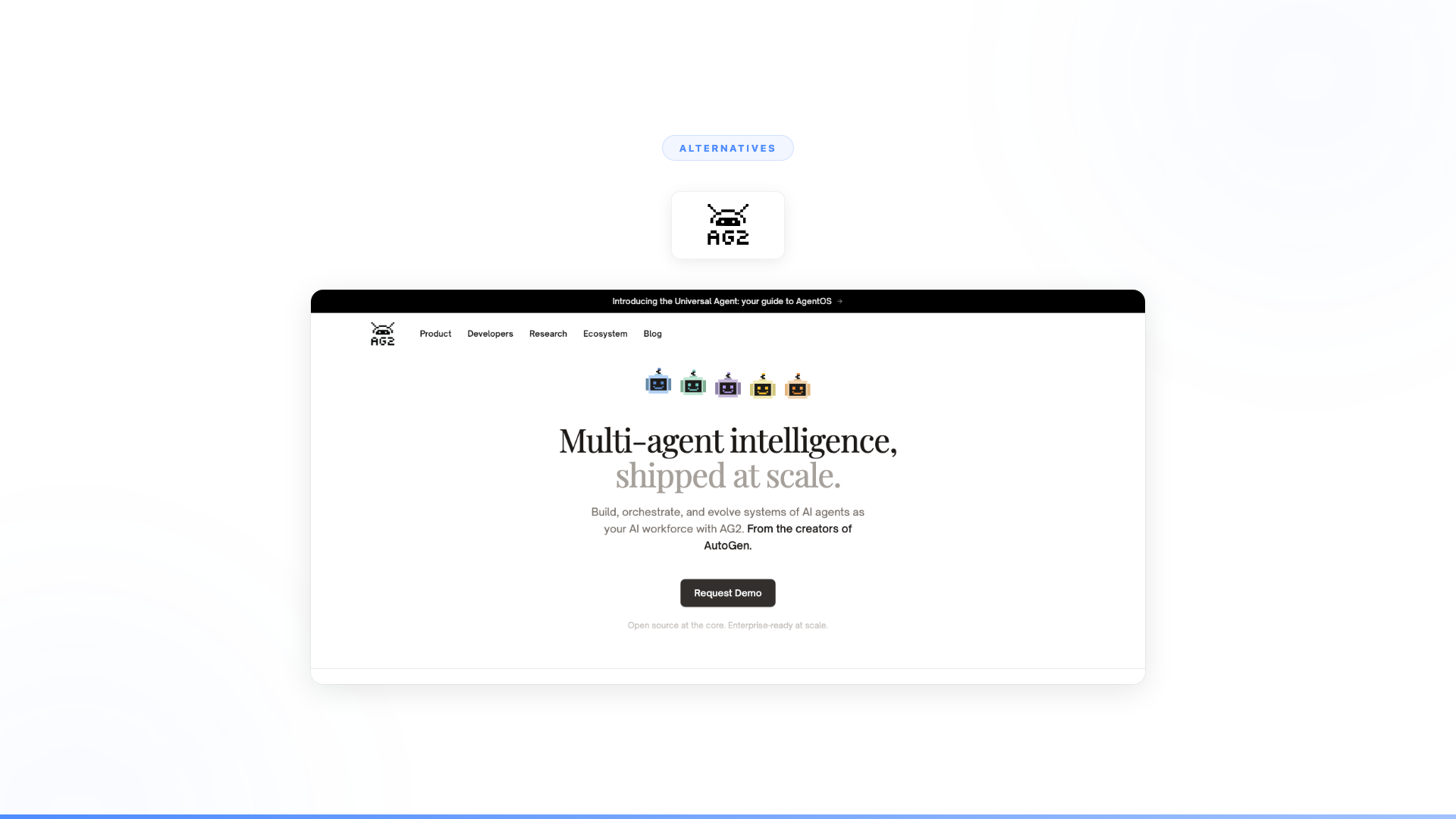
What it is: AG2 is the community fork of AutoGen, created by the original AutoGen authors after they left Microsoft. 4.3k GitHub stars. Positioned as "The Open-Source AgentOS," AG2 operates under open governance through the AG2AI organization and adopted the Apache 2.0 license from version 0.3 onward. It controls the original AutoGen PyPI packages.
How it compares to AutoGen: AG2 is the direct continuation of pre-0.4 AutoGen by its original creators. If you preferred the older AutoGen API before the 0.4 redesign, AG2 is the most direct continuity path. The architectural concepts — conversable agents, group chat, code execution — carry over. The governance model has shifted from Microsoft to an open-source community.
The tradeoff: AG2 has significantly fewer stars than the Microsoft-maintained AutoGen repo (4.3k vs 55.8k), which reflects community uncertainty about which branch to follow. The community is smaller, the ecosystem less established. As an early-stage fork, API stability and long-term maintenance are reasonable questions.
Licensing: Apache 2.0 from v0.3 onward — a permissive license for commercial use without restrictions.
Best for: Teams that want to stay close to the original AutoGen API under open governance, are comfortable with a smaller community, and prefer Apache 2.0 licensing.
8. Google Vertex AI Agents
What it is: Google Cloud's platform for building and deploying AI agents. Part of Vertex AI, which provides the infrastructure, model access (Gemini), and tooling for agent development. Includes Agent Builder for creating conversational agents and custom tool integrations.
How it compares to AutoGen: Vertex AI Agents is a managed cloud platform, not an open-source framework. You get infrastructure, model hosting, and deployment tools out of the box. AutoGen gives you more architectural freedom but zero infrastructure. Vertex is tied to Google Cloud. AutoGen is cloud-agnostic. If you're already building on GCP, Vertex reduces the infrastructure burden significantly.
Why it might not solve the problem: Vertex AI Agents is a developer platform, not a business-team platform. Your engineering team still designs, builds, and maintains the agents. Google's agent capabilities are still maturing. Pre-built enterprise integrations are limited compared to dedicated platforms. Governance features are improving but not at the level of purpose-built enterprise agent platforms with SOC 2, ISO 27001, and ISO 42001.
Best for: Engineering teams already on Google Cloud who want managed infrastructure for agent development and are comfortable building the application layer themselves.
9. Microsoft Agent Framework: AutoGen's Official Successor
What it is: The official successor to AutoGen. Microsoft's README now directs new users to Microsoft Agent Framework rather than AutoGen. The framework builds on AutoGen's multi-agent concepts and Semantic Kernel's enterprise SDK architecture (C#, Python, Java support, Azure integration, structured plugin model). This is where Microsoft is putting its agent development investment going forward.
How it compares to AutoGen: Agent Framework is AutoGen's evolution. It takes the multi-agent conversation patterns that made AutoGen popular and integrates them with Semantic Kernel's enterprise-oriented architecture. If you're on AutoGen 0.4 already, the migration path is more natural than from 0.2 or AG2. Microsoft collaborated with AutoGen and Semantic Kernel teams through 2024-2025 to align the two frameworks before directing users to the unified successor.
Why it might not solve the problem: The framework is still maturing. Building on a framework in active transition means accepting breaking changes, incomplete documentation, and iterating as the product stabilizes. Even when fully mature, Agent Framework is still a developer framework. Your engineering team will still build, deploy, maintain, and iterate on the agents. The production gap, governance requirements, and integration complexity don't disappear because the framework improves.
Best for: Teams already invested in the Microsoft ecosystem, targeting Azure deployment, and willing to work through an evolving framework to get the long-term Microsoft-backed path.
10. Custom Build
What it is: Building your multi-agent system from scratch using base APIs (OpenAI, Anthropic, open-source LLMs) without a framework. Maximum flexibility. Maximum engineering burden.
How it compares to AutoGen: No abstractions, no opinions, no constraints. You design the agent architecture, communication patterns, state management, and orchestration logic from the ground up. AutoGen exists specifically because building this from scratch is time-consuming and error-prone.
Why it might not solve the problem: Unless your use case is truly unprecedented, custom building is the most expensive path. You're solving every problem that frameworks and platforms have already solved: orchestration, memory, tool use, error handling, monitoring, deployment. Plus governance, compliance, and maintenance. The opportunity cost is enormous.
Lambda is an AI company with world-class engineers published at NeurIPS and ICCV. They build supercomputers for AI training. They could build anything. They chose to buy from Nexus because every month an engineer spends on internal agent infrastructure is a month not spent on their core product.
Best for: Organizations with truly unique technical requirements that no framework or platform addresses, dedicated AI engineering teams with capacity to spare, and timelines that can absorb 6+ months of development.
The Real Question Isn't Which Framework
Most enterprises searching for AutoGen alternatives are asking "which multi-agent framework should we migrate to?" The more useful question is "should we be migrating to another framework at all?"
If you've already lived through AutoGen's 0.2 to 0.4 rewrite, the AG2 fork confusion, and now the transition to Microsoft Agent Framework, you know what framework dependency feels like. Rebuilding when the API changes. Rewriting when the architecture shifts. Maintaining infrastructure that isn't your core product.
If you need engineers to build and maintain multi-agent systems, and you have the capacity and timeline, a framework makes sense. CrewAI for role-based orchestration. LangGraph for explicit state machines. Agent Framework if you're all-in on Microsoft. All capable. All put the production stack on your team.
If you need business teams deploying production agents with enterprise governance, and you need it delivering financial outcomes in weeks, not months, that's a different category of solution entirely. Frameworks don't get you there, because the framework is 20% of the work.
Orange built customer onboarding agents that generate approximately $6M+ in yearly revenue. Deployed in 4 weeks. 50% conversion improvement. 100% team adoption.
Lambda added 24,000+ hours of research capacity annually with agents monitoring 12,000+ accounts. Built by a non-engineer in days.
A major European telecom freed 40% of support volume across millions of interactions. After spending 6 months failing to deliver with Copilot Studio.
The gap between a multi-agent prototype and a production system delivering business outcomes isn't a feature gap. It's a category gap. No amount of improving the framework closes it.
FAQ: AutoGen Alternatives in 2026
Is AutoGen still being maintained in 2026?
Yes, but in a limited capacity. AutoGen's official GitHub repository states it will continue to receive bug fixes and critical security patches. However, Microsoft now directs new users to Microsoft Agent Framework rather than AutoGen. Active feature development has shifted to the successor framework. Teams starting new projects today should evaluate whether to build on AutoGen 0.4, the AG2 community fork, or Microsoft Agent Framework directly.
What is the difference between AutoGen, AG2, and Microsoft Agent Framework?
Three separate projects with a shared history. AutoGen (55.8k stars) is the original Microsoft research framework, now in maintenance mode. AG2 (4.3k stars) is a community fork by AutoGen's original authors who left Microsoft, operating under open governance with Apache 2.0 licensing — it controls the original PyPI packages. Microsoft Agent Framework is the official Microsoft successor, merging AutoGen's multi-agent concepts with Semantic Kernel's enterprise architecture. New projects evaluating "AutoGen" in 2026 are choosing between these three distinct paths.
Can I migrate from AutoGen to LangGraph without rewriting everything?
Not directly. AutoGen's architecture is conversation-based (agents communicate through dialogue patterns). LangGraph's architecture is graph-based (agents are nodes, transitions are edges, state is explicit). These are fundamentally different mental models. A migration requires redesigning your agent topology in graph terms rather than porting code. The AutoGen 0.4 release introduced architectural changes significant enough that even upgrading within AutoGen required partial rewrites for 0.2 users — migration to LangGraph is a more involved but feasible project for engineering teams who want LangGraph's explicit state control.
What is the best AutoGen alternative for production enterprise use?
For enterprise teams that have been using AutoGen as the foundation for business process automation, the answer depends on your constraints. If you need your engineering team to own the full stack and have the capacity, Microsoft Agent Framework (for Microsoft ecosystem alignment) or LangGraph (for explicit state control) are the leading framework options. If you need business teams to own and operate agents without an engineering bottleneck — with governance, compliance, and production infrastructure included — Nexus is the category-different option. Every Nexus engagement starts with a 3-month POC tied to measurable outcomes, with Forward Deployed Engineers embedded from day one.
Does AutoGen work with GPT-4o and Claude Sonnet in 2026?
AutoGen 0.4 supports multiple LLM backends including OpenAI (GPT-4o, GPT-4o mini), Anthropic (Claude Sonnet, Claude Opus), Google (Gemini), and open-source models through compatible APIs. LLM compatibility is not a differentiating factor among the major AutoGen alternatives — CrewAI, LangGraph, LangChain, AG2, and Microsoft Agent Framework all support the same major model providers. The more relevant evaluation criteria are architecture, production readiness, governance, and the engineering overhead each option requires.
Worth Exploring?
Every Nexus engagement starts with a 3-month proof of concept tied to measurable outcomes. Forward Deployed Engineers embed with your team from day one. You see the results before committing. You can exit anytime.
100% of clients who started a POC converted to an annual contract. Every one.
See the full Nexus vs AutoGen comparison -->
Related Reading
- Nexus vs AutoGen: full comparison
- AutoGen vs CrewAI: multi-agent frameworks compared
- Top 10 AI agent orchestration platforms for enterprise
- How to orchestrate AI agents for enterprise workflows
- Nexus vs LangGraph: graph-based agents vs enterprise platform
- Nexus vs CrewAI: role-based agents vs enterprise platform
- Nexus vs LangChain: LLM framework vs enterprise agents