
How Enterprises Build Agents That Work
An operating model for turning AI from pilots into production.
The tools already work. The operating model does not.
Enterprise spend on generative AI in 2025 (Menlo Ventures, 2025)
More than triple the year before (Menlo Ventures, 2025)
Of pilots reach real value (MIT Project NANDA, 2025)
Enterprises spent roughly $37 billion on generative AI in 2025, more than triple the year before (Menlo Ventures, 2025). Their employees still pay for the best tools with a personal card. The gap is not capability. The frontier models are strong, and they keep getting stronger on their own. The gap is the way companies run them.
Most enterprises have already tried. They gave everyone a copilot, asked engineering to build, or wired up an automation tool. Adoption spiked, then fell. The platform they paid for sits idle while the real work runs on tools nobody approved. MIT's 2025 study of enterprise AI put the result plainly: about 5% of pilots reach real value, and the rest stall with little to no measurable impact (MIT Project NANDA, 2025).
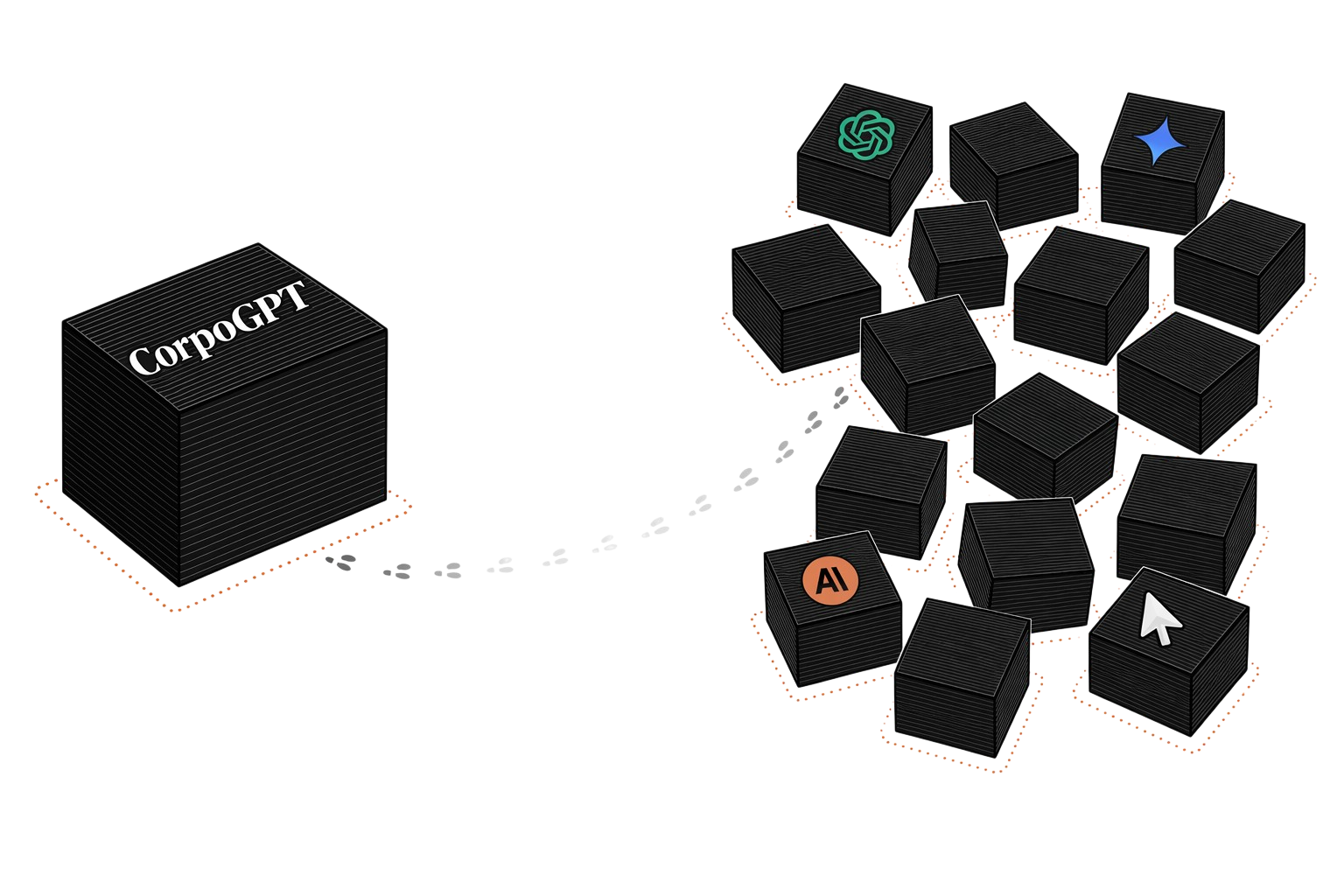
$37bn goes into copilots, in house builds and automation; what comes back is an idle platform, spreading shadow AI and no measurable return.
This is not a technology problem. It is an operating model problem. This document lays out the model: the one habit that separates the winners, the three things you must get right, the architecture that delivers them, and the change and rollout playbook that makes it stick. It is written for the leader who has to get the right people in the room and ask the right questions.
The best AI tools already exist. The work that remains is learning how to run them.
1. The companies that win do not have better models. They have a faster loop.
The enterprises pulling ahead with AI are not the ones with the best models. Everyone buys the same models. They are the ones that turn a working idea into production quickly, then improve it on a short cycle. MIT's 2025 GenAI Divide study made the gap concrete: about 5% of pilots reach real value while the rest stall with little to no measurable impact (MIT Project NANDA, 2025). The split is not explained by model quality or by regulation. It is determined by approach.
Of pilots reach real value (MIT Project NANDA, 2025)
Lifecycle stages on a foundation of governance
The familiar playbook fails for one structural reason: agents are not software. Two properties set them apart.
- The input is unbounded. An agent takes natural language, and increasingly images, audio, and video. The input space has no fixed shape you can enumerate in advance.
- The output is not deterministic. The same prompt can return different results, and small changes in wording move the outcome. Behaviour cannot be read off a specification.
The consequence is decisive. You cannot plan an agent to correctness on paper. You learn how it behaves only when real users meet real work.
That rewrites how you build. The teams that reach production, across every industry we have seen, share three habits.
- Ship narrow and early. Put the smallest useful version in front of real users, rather than waiting for a finished build.
- Iterate on a short cycle. Treat every interaction as a signal, and improve the agent continuously instead of in one release.
- Govern from day one. Keep each agent safe and accountable from the first deployment, so scale never means losing control.
What separates the few from the many is the speed of that loop, not the size of the ambition. The loop has a shape, and naming it lets a leader manage it. The Agent Lifecycle runs four stages on a foundation of governance:
- Build the narrow first version.
- Test it against real cases (not a checklist).
- Deploy it where the work already happens.
- Monitor what it does in the open.
Underneath all four sits govern, the permissions, audit, and visibility that keep the loop safe whether you run one agent or one hundred. Every turn makes the agent better, and the advantage compounds for the companies that master it.
So the question for a leader is not which model to buy. Models are a commodity, and they improve on their own. The real question is sharper: Can the organisation run this loop at all? Can it run the loop faster than its competitors? Can it do both without losing governance as it scales? The rest of this document is about what that takes.
The enterprises winning with AI do not have better models. They have a better way of running them, and they run it faster than everyone else.
2. Fast iteration depends on three things you must get right.
The loop only spins if three conditions hold at once. Each answers a different question, and together they are complete: what the agent knows, who runs it, and how it stays safe.
- Context. Does the agent know our business? Without it, agents are generic and stay in the margins.
- Ownership. Do the people closest to the work build and improve it, without a ticket queue? Without it, iteration is slow and the agent never fits the real work.
- Governance. Can hundreds of people do this safely, with permissions and full visibility? Without it you get lockdown and shadow AI, or you get risk.
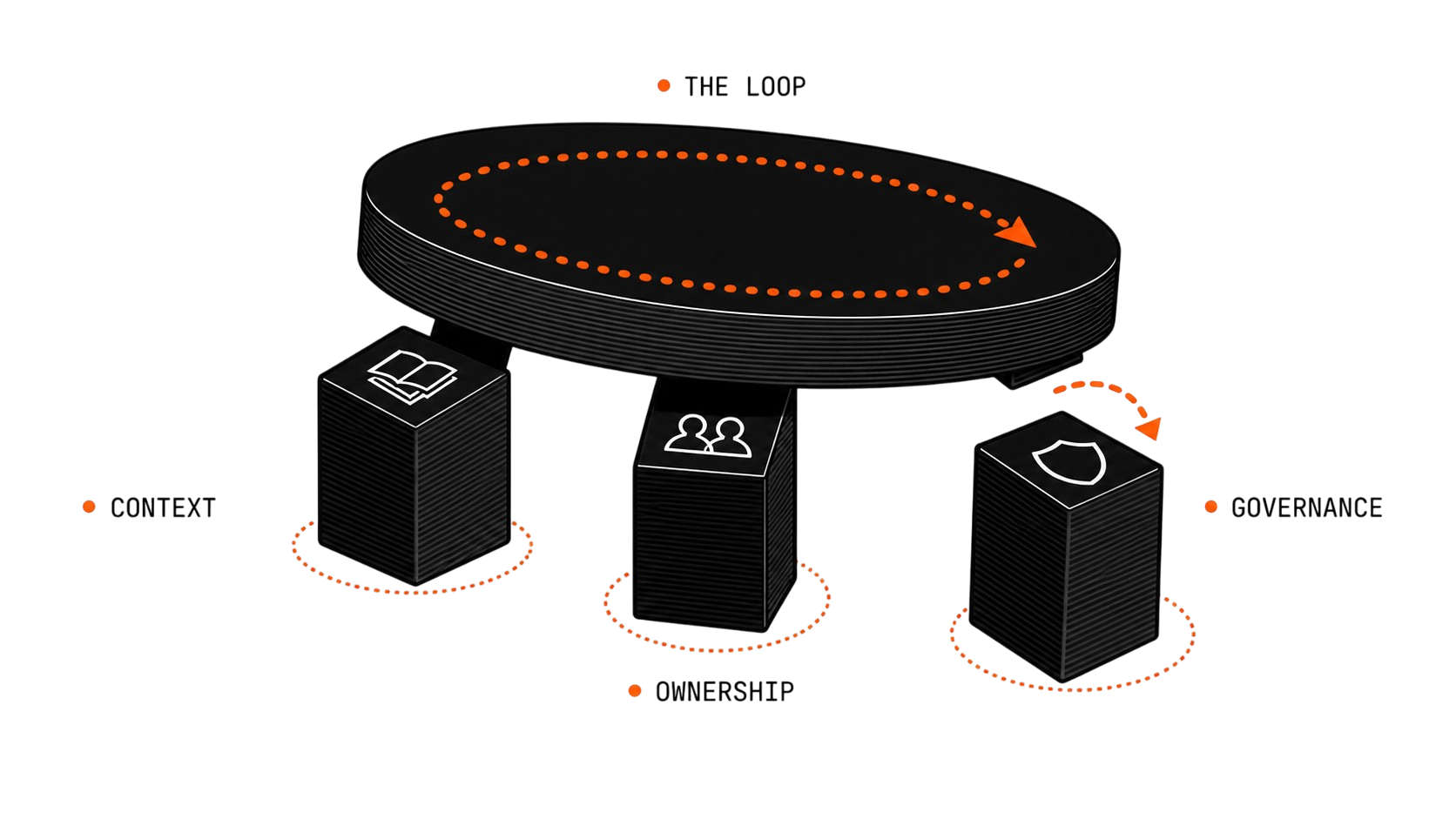
Context, ownership, and governance carry the loop. Miss any one and it stalls.
These are not independent. Context without ownership produces an agent nobody improves. Ownership without governance produces risk that forces a shutdown. Governance without context produces a safe agent that does not know enough to be useful. The three rise or fall together, which is why the rest of this document treats them as one system, and why the architecture in Section 5 is built to deliver all three at the same time.
Knowledge, people, control. Get all three right and the loop runs. Miss one and it stalls.
3. Why most deployments fail.
Most enterprises have tried at least one approach already, and the same three keep stalling. Each fails for its own reason.
- Per seat copilots assist, but they do not complete work. Only about 16% of copilot pilots reach production (Gartner), only about 36% of employees with access actively use the tool, against 83% for the consumer product they prefer (Recon Analytics, 2026), and 74% of companies using AI tools still cannot show tangible business value (Morgan Stanley and RSM, 2025).
- In house and agent builds lose the gap from prototype to production. Over 40% of agentic AI projects will be cancelled by the end of 2027, due to escalating cost, unclear value, or inadequate controls (Gartner, 2025). The build competes with core engineering, and requirements move during the months it takes.
- Rigid automation breaks on the exception. EY finds 30 to 50% of automation projects fail, maintenance consumes 70 to 75% of total cost (HfS Research), and only 3% of organisations scale beyond 50 bots (Deloitte). The logic holds until reality does not match the template.
Three different tools. One outcome. Underneath all of them sit the same three unsolved problems: context, ownership, and governance.
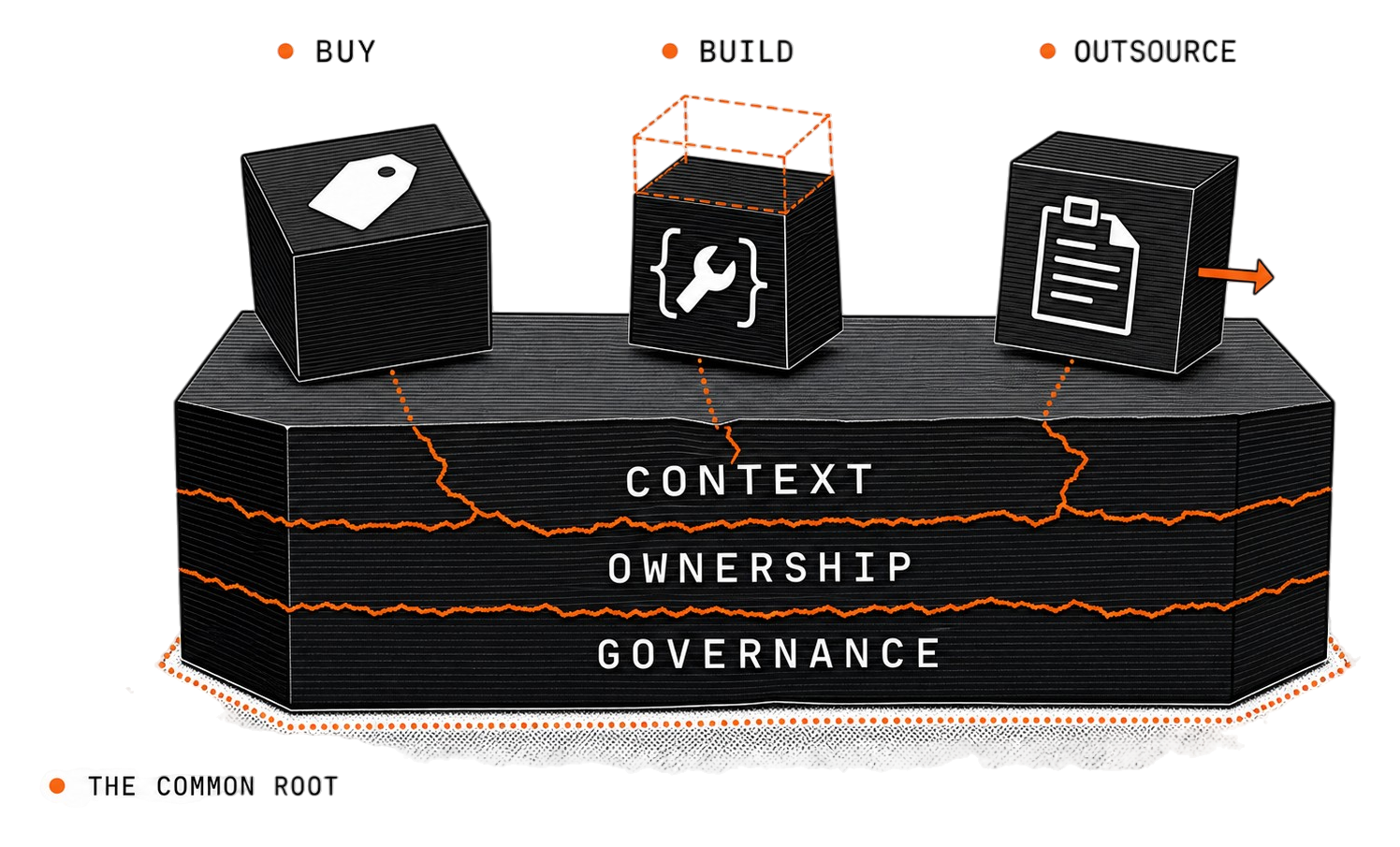
Three different tools, one outcome. Underneath sit the same three unsolved problems.
The clearest symptom is what happens when an enterprise gets none of the three right. Employees do not wait. They reach for better tools on their own.
Today 78% of employees use AI tools their employer has not approved (WalkMe and IDC, 2025), and more than 80% use unapproved tools while fewer than one in five stick to sanctioned ones (UpGuard, 2025). This is not a discipline problem. The tools they found are often better. But the cost is real: a data breach runs about $670,000 higher when it involves shadow AI rather than sanctioned AI (IBM). Shadow AI is the governance failure made visible, and locking people down does not fix it. Solving the three problems does.
Lock people down and they route around you. The tools they found are the right tools. The job is to govern them, not to ban them.
4. The three problems, in depth
Context, ownership, and governance each deserve a closer look, because each has a precise meaning and a precise failure mode.
4a. Context: build a company brain, not a smarter chatbot.
An agent is only as good as what it knows, and most of what a company knows is not written down anywhere an agent can reach. Three problems compound.
- Knowledge is scattered. It lives in heads, in chat, in email, in documents, in a dozen systems that do not talk to each other.
- Knowledge is tacit. The how, the exceptions, the judgment calls, the reasons behind a rule. None of it sits in a manual.
- Knowledge goes stale the moment it is written. A static document is out of date by the next quarter, so the knowledge has to keep itself current.
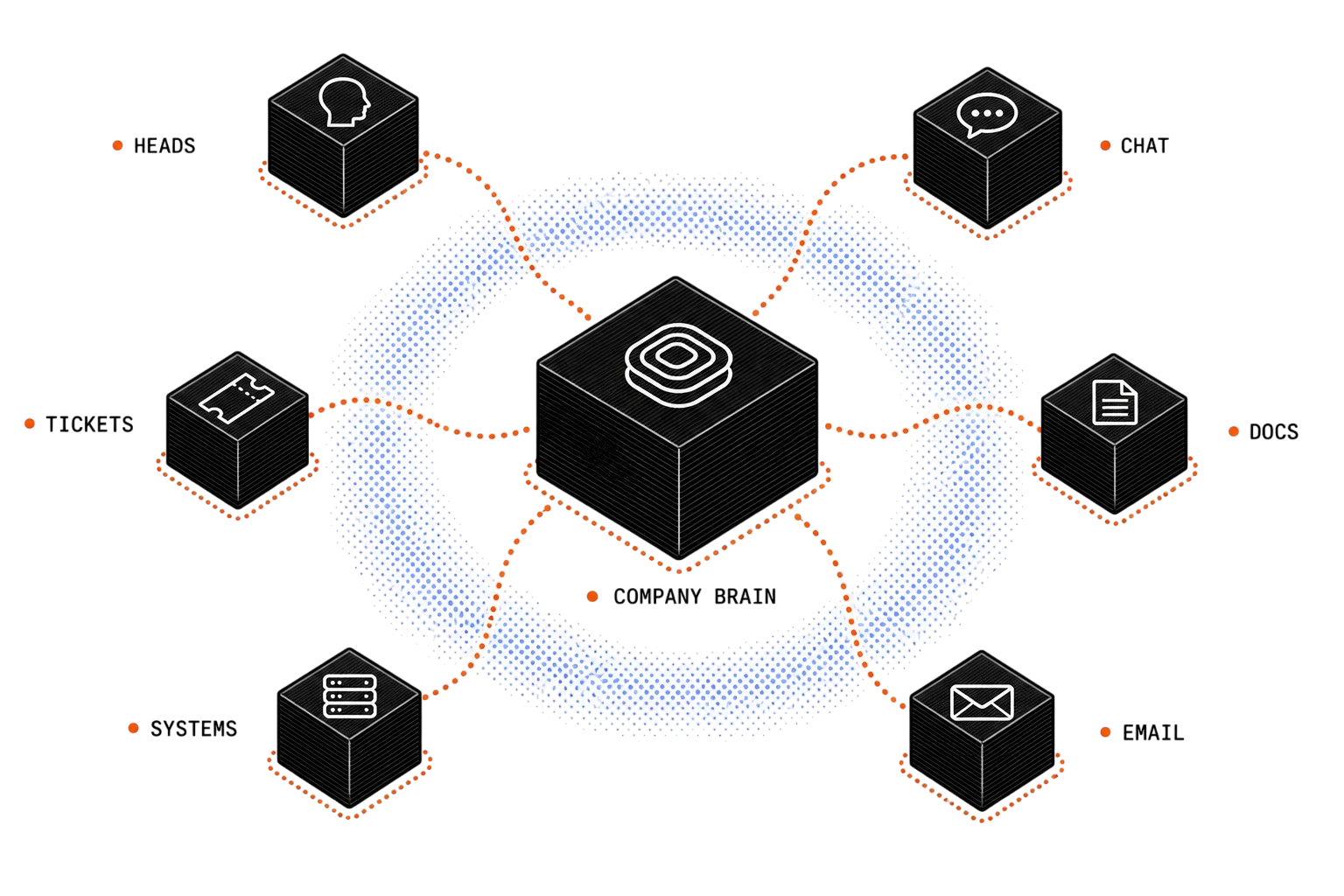
Scattered knowledge drawn into one shared company brain
This is where the real shift sits, and it is not a productivity shift. Productivity means bolting a faster engine onto the old way of working. Capability means changing how the company works: extracting the domain knowledge that defines the business and making it legible to the intelligence. The rule is simple. If something is captured and synthesised, the agent can use it. If it is not, it does not exist to the agent. The durable asset a company builds is this context. The software on top of it is cheap and replaceable.
Once the context is legible, the loop can improve itself between sessions rather than waiting for a person. A self improving loop runs five layers.
- Sensors and data. The signals from the outside world: support tickets, emails, product telemetry, a cancelled subscription.
- Policy. The rules for what the agent may do on its own, what needs a human, and what must be logged.
- Tools. The deterministic actions it can call, from querying a database to sending a message.
- Quality gates. Evaluations, checks, and human review for anything high stakes.
- Learning. What did not work feeds back to the top, and the next run is better.
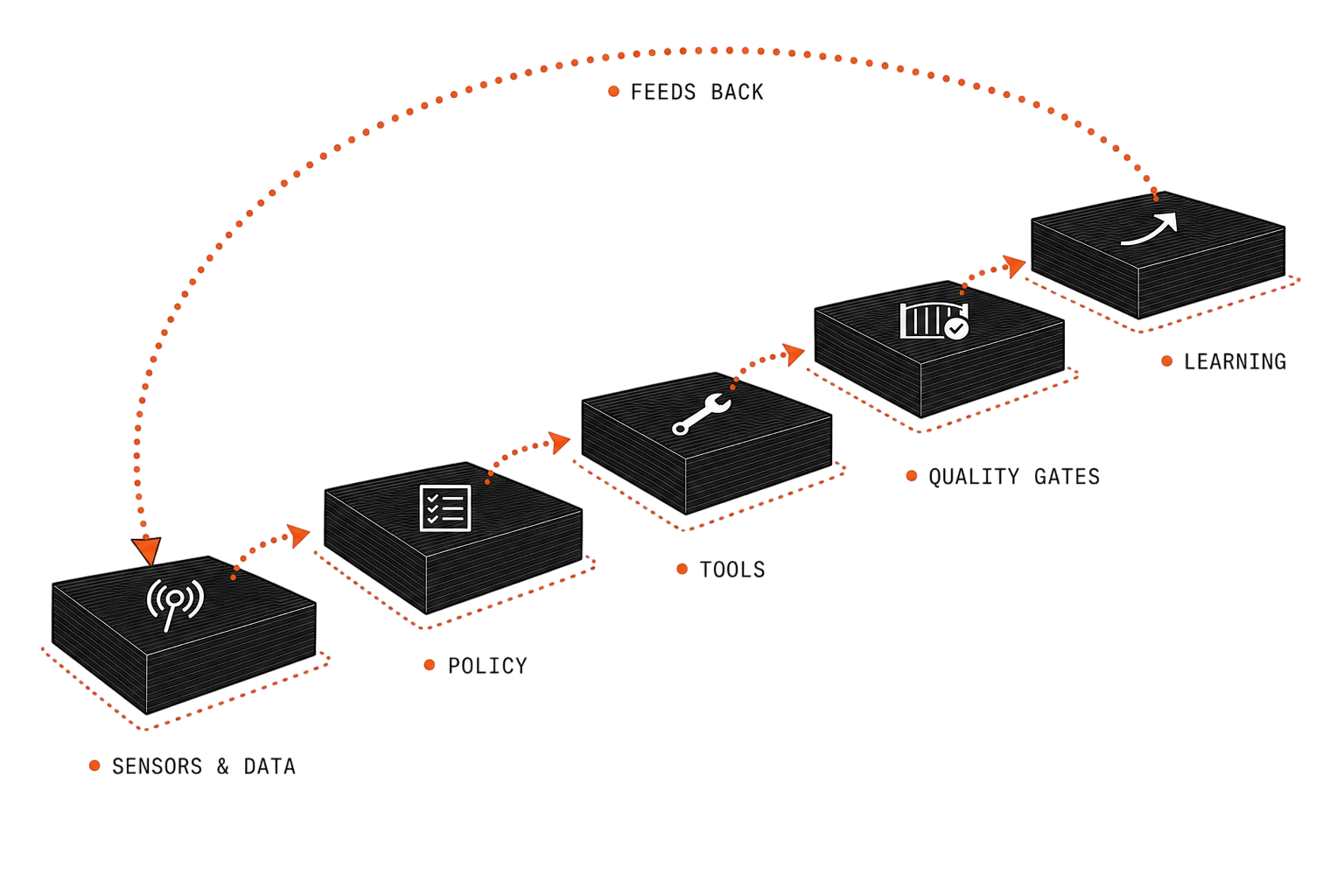
The self improving loop across five layers
For this to work, the context cannot live inside one model, one tool, or one person's head. It has to live in the infrastructure: a shared, governed, versioned layer that every agent draws on and that improves as the company does. A company brain, owned by the company.
Make the company legible to the intelligence. The knowledge is the asset. The software is replaceable.
4b. Ownership: AI is a business problem before a technical one.
The people closest to the work are best placed to improve it. The slowest possible path is to route every change through engineering. Ownership means putting the work in the hands of the people who understand it.
- The business owns the outcome. A named owner for each agent, accountable for whether it works. Not a committee, not a separate AI team.
- IT owns the platform, not the agents. It sets the rails and the rules. The business builds on top of them.
- Iteration happens without a ticket queue. The owner changes the agent the day the work changes, not the quarter after.
This is how the organisations that get value actually operate. The minority capturing real returns from AI put roughly 70% of their effort into people and process rather than the technology itself (McKinsey, 2024).
Of effort on people and process, not technology (McKinsey, 2024)
Assistants built by employees themselves (OpenAI)
Months to reach that scale (OpenAI)
When a bank put AI in the hands of its own experts rather than a central team, employees built more than 2,900 of their own assistants in five months, because the people who run a process are the ones who see how to improve it (OpenAI). The lesson is consistent: the closer ownership sits to the work, the faster the loop turns and the better the agent fits.
IT connects once and governs. The business builds forever. That is the division of labour that scales.
4c. Governance: set the rules once, observe everything.
Governance is not the brake on adoption. It is what makes broad adoption safe. The failure mode is binary. Lock people down and they route around you. Leave it open and you carry the risk. The way out is to govern the work itself.
- Permissions inherited from the directory. An agent sees only what the person using it is allowed to see. No new access model to maintain.
- Observability by default. A live view of what every agent did and why, not a self reported summary that can be gamed.
- Audit and cost control by design. Every action logged for compliance, with spend and data exposure bounded before they become a surprise.
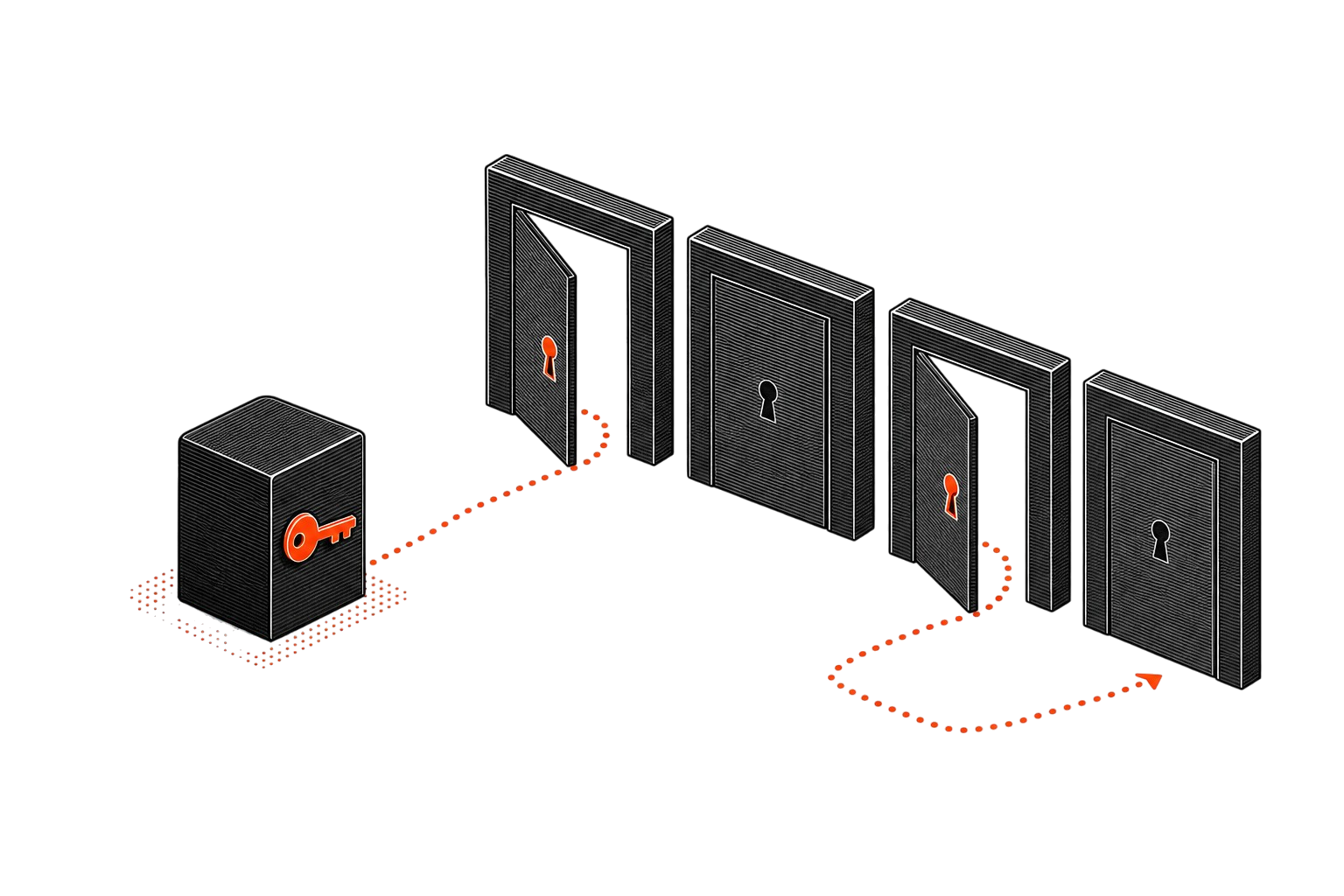
An agent inherits the permissions of the person using it: it opens only the doors they already hold a key to.
Added to the average data breach shadow AI touches (IBM)
The cost of skipping this is measurable. Shadow AI does not just waste the platform a company paid for; it adds about $670,000 to the average data breach it touches (IBM). Governance done well removes the reason to go rogue: when the sanctioned path is both safe and good, people use it. The goal is not control for its own sake. It is to make the safe path the easy path.
Governance is not what slows AI down. It is what lets you say yes to a hundred agents instead of no to all of them.
5. The architecture is the answer to all three.
Solve context, ownership, and governance together and you arrive at a single shape. It is a three layer architecture, and each layer exists to serve one of the three problems.
- Primitives. The raw materials: AI models, internal systems, and external tools. This is where context connects to live data. IT owns it.
- Governed infrastructure. The rails: model routing through a gateway, guardrails and audit, connectors, observability, and reusable building blocks. This is where governance lives, set once for everyone. IT owns it.
- Agents. The work: assistants, specialised agents, automations, and workflows. This is where ownership sits, with the business.
The reason to build it in layers is separation of concerns, and it maps directly onto ownership. IT, once, owns the primitives and the governed infrastructure: it connects the systems, sets the guardrails, manages model access, and turns on observability, one time, for the whole company. The business, always, owns the agents and the outcomes: it builds on the rails IT provided, using reusable components, and iterates as the work changes. And the agents run in the open, observably, so the loop has the signal it needs and governance has the record it needs.
This is what lets one platform investment produce hundreds of agents. When a large marketplace built a single platform layer with security, routing, and guardrails built in, its 17,000 developers could build consistently and fast on top of it rather than each solving the same problems again (OpenAI). The architecture is not the goal. It is the structure that makes context, ownership, and governance hold at the same time, at scale.
One platform investment. Hundreds of agents, built by the people closest to the work, inside the governance IT already shipped.
6. Getting the company to move: the change model.
The architecture is necessary but not sufficient. Most transformations fail on people, not technology.
of transformations fall short of their goals (McKinsey)
succeed among those that fail to engage line managers and frontline employees (McKinsey)
of organisations offered any prompt training in 2025 (Forrester)
Roughly 70% of transformations fall short of their goals, and among those that fail to engage line managers and frontline employees, only 3% succeed (McKinsey). An agent program is a transformation, so it lives or dies on the same four conditions of behaviour change. The McKinsey Influence Model names them, and each has a precise meaning for agents.
- Understanding and conviction. People grasp why this matters, and the why is capability, not headcount. The story is told, not assumed.
- Role modeling. Leaders and respected peers build and use agents visibly. They bring prototypes to meetings, not slideware.
- Talent and skills. People have a path from awareness to building, practised on real work rather than taught in the abstract.
- Reinforcement. Targets, metrics, and incentives align with the new behaviour, and adoption is measured in the open rather than self reported.
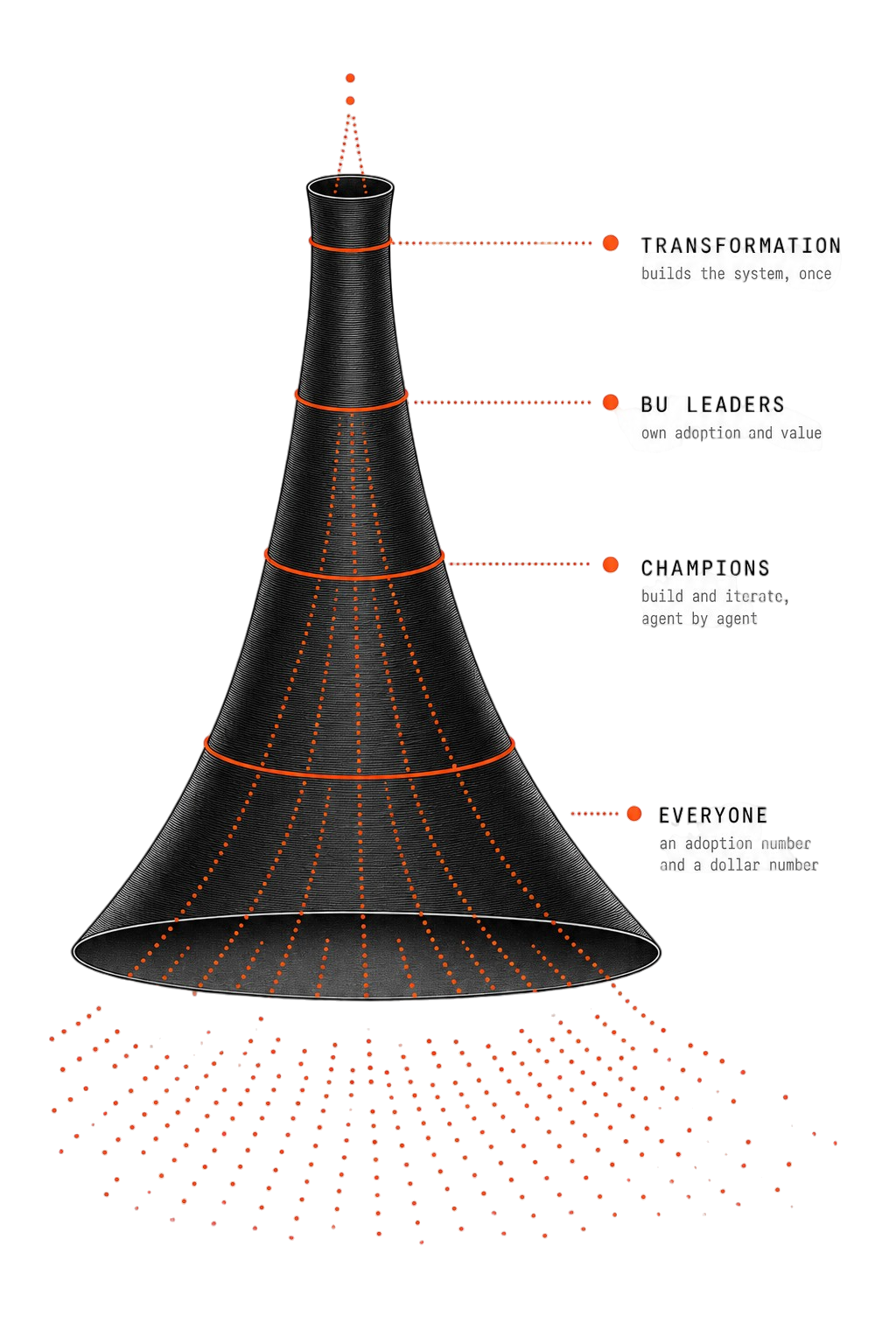
The change cascade, carried by leaders and champions out to everyone
The skills condition is the one most companies skip. Only 23% of organisations offered any prompt training in 2025, which leaves most employees to teach themselves (Forrester). The fix is a tiered program that meets people where they are.
- Everyone. When to hand work to an agent and when not to, the basics of instructing one, and the data and security guardrails that keep it safe.
- Champions. One per team, who finds the high value use cases, builds the first agents, and carries adoption inside the team.
- Builders. A small core that creates the reusable components every team draws on.
Get all four conditions working together and behaviour changes. Pull on one alone and it does not.
An agent program is a transformation. It succeeds on conviction, role models, skills, and reinforcement, or it does not succeed at all.
7. Rolling it out: squads, waves, and a loop that compounds.
You do not boil the ocean. You map the real work, win small, and scale in waves. It begins with a short discovery sprint that values speed over precision, because 80% accuracy is enough to choose where to start.
- Inventory the work. Each team lists its highest volume workflows on a simple template.
- Audit the time. A lightweight look at where the hours actually go.
- Score and prioritise. Rank each workflow by volume, repeatability, and how available the data is, then pick the top candidates.
From there, the rollout itself follows three principles.
- Squads inside teams. A business owner, a champion, and a builder for support. Small, accountable, close to the work.
- Waves, not a big bang. Start with a few willing teams, prove the value, then widen. Each wave makes the next one easier. Wave 1 is 5 to 8 teams to prove value, wave 2 is 20 to 30 teams to widen, wave 3 scales the organisation and standardises.
- A loop that compounds. Every agent improves with use, and the program matures from a sidekick that assists a person, to specialised agents that own whole workflows, to a self improving loop that detects its own gaps and fixes them.
The point of all this is leverage, not subtraction.
Workers using AI well report saving 40 to 60 minutes a day, and heavy users more than 10 hours a week (OpenAI, 2025). That time is not a cut. It is capacity returned to higher value work, which is what capability means in practice. The companies that win do not treat the rollout as a one time project. They treat it as a loop they keep spinning, faster each quarter.
Map the real work, win small, scale in waves. The time you free is capacity, not a cut.
8. A starter catalog of agents that work.
Most teams ask the same question: where do we start? These are proven patterns, organised by function. Each has a clear trigger and a clear output, which is what makes it a good first build.
Sales
| Agent | What it does | Trigger | Delivers |
|---|---|---|---|
| Account intelligence | Scores which accounts are ready to buy and ranks them | Weekly | Ranked accounts with what changed |
| Lead enrichment and routing | Completes missing lead data and sends it to the right owner | New lead arrives | Complete lead, assigned |
| Proposal and RFP | Turns requirements into a first draft from past work | RFP received | Draft ready to edit |
| News and signals | Watches customer news and suggests outreach | When news breaks | Alert with an angle |
| Pipeline hygiene | Finds stalled or incomplete deals and suggests action | Weekly | Issues with recommendations |
Marketing
| Agent | What it does | Trigger | Delivers |
|---|---|---|---|
| Brand performance insights | Answers performance questions by finding the data | You ask | Answer with supporting data |
| Campaign manager | Sets up campaigns across systems so they work together | You describe it | Coordinated assets, ready |
| Customer feedback triage | Listens across channels and routes what matters | Continuous | Routed feedback with context |
| Content creator | Drafts using only approved company material | You request it | First draft to edit |
| Competitive monitoring | Tracks competitors and flags moves that matter | Continuous | Alerts with business context |
Customer support
| Agent | What it does | Trigger | Delivers |
|---|---|---|---|
| Customer onboarding | Qualifies, answers, gathers details, books the meeting | New customer | Qualified customer, booked |
| Tier one resolution | Answers from the knowledge base or hands off cleanly | Question arrives | Answer or seamless handoff |
| Request router | Directs requests and helps complete the paperwork | New request | Routed request with guidance |
| Ticket triage | Classifies tickets by type and severity and routes them | New ticket | Classified, prioritised ticket |
| SLA compliance | Monitors performance and flags breaches and risks | Continuous | Report with breach alerts |
HR
| Agent | What it does | Trigger | Delivers |
|---|---|---|---|
| People analytics | Analyses org health and ranks internal candidates | On request | Insights or a candidate slate |
| HR helpdesk | Answers policy questions and routes complex cases | Question arrives | Answer or routed case |
| Interview coordination | Schedules, collects feedback, builds candidate files | New candidate | Scheduled interviews, compiled feedback |
| Employee onboarding | Runs the checklist across IT, HR, and the manager | New hire date | Completed onboarding, tracked |
| Internal mobility | Matches talent to roles and runs the move | New opening | Slate and completed workflow |
The same patterns extend into finance and operations, from invoice triage to reconciliation to vendor onboarding. The rule for choosing a first agent does not change: high volume, clear trigger, clear output, and a business owner who wants it.
Start where the work is high volume, the trigger is clear, and someone close to it wants the result.
9. How this comes together.
Everything above describes an operating model rather than a product. This is the platform built to deliver it. Nexus is one governed layer between a company's systems and its people, and it gives each of the three problems a home.
- One governed layer. IT connects its systems, sets the guardrails, and turns on observability once. The business builds agents on top, inside that governance, without a ticket queue.
- A living company brain. Workspace holds the shared, versioned context every agent draws on, so agents know the business and improve as it changes.
- Building by conversation. Cue builds agents, pipelines, and automations through conversation. It lives in the terminal for IT and in chat for the business, in Teams, in WhatsApp, wherever people already work. Everything it builds inherits the company's permissions and is fully observable.
The proof is in deployments that had every reason to build their own. Orange, a multibillion euro operator with its own engineering and every option available, built its customer onboarding with the business team, not engineering, in four weeks.
conversion
CSAT
value (5M euro)
to delivery
Adoption was complete and every decision was logged, so a regulated operator got speed without giving up control.
Orange built customer onboarding with its business team, not engineering, in four weeks.
Lambda, an AI native company with world class engineers, chose to buy rather than build, because the opportunity cost of its own engineering time was too high. When an AI company decides the build is not worth it, the buy versus build question answers itself for most enterprises. The roster extends across regulated and complex sectors: a tier one telecom, a European consulting firm, an automotive distributor, a private equity firm, and a fintech.
The whole platform runs inside the controls a regulated enterprise needs: SOC 2 Type II, ISO 27001, ISO 42001, and GDPR.
The best AI tools already exist. Nexus runs them through the prism of your security, observability, and governance, and lets the business build on top.
10. The questions to put to your team.
A Head of Transformation does not need to write the architecture. They need to ask the right questions and recognise a weak answer. These are the ten that matter, organised by the model into five themes: Context (what it knows), Ownership (who owns and iterates), Governance (permissions and visibility), Lifecycle (idea to production), and Scale (one vs one hundred).
The fastest way to answer these is not another deck. It is to run the model on one of your own workflows. Pick a real process, share a recording or a thread, and see it built end to end, on your data, in days. That is the whole test.
You do not need to predict the future of AI. You need to run one loop, on real work, and see how fast it turns.
Sources
- Enterprise generative AI spend, roughly $37 billion in 2025, up 3.2 times year over year: Menlo Ventures, State of Generative AI in the Enterprise, 2025.
- About 5% of pilots reach value, the rest stall: MIT Project NANDA, The GenAI Divide, State of AI in Business 2025, July 2025.
- Copilot pilots reaching production, about 16%: Gartner, cited 2025 and 2026.
- Active use of an assigned copilot, about 36% against 83% for the consumer tool: Recon Analytics, 2026.
- Companies unable to show tangible AI value, 74%: Morgan Stanley and RSM AI Adopter Survey, 2025.
- Over 40% of agentic AI projects cancelled by end of 2027: Gartner press release, June 2025.
- Automation project failure, 30 to 50%: EY. Maintenance at 70 to 75% of total cost: HfS Research. Only 3% scale beyond 50 bots: Deloitte.
- Employees using unapproved AI tools, 78%: WalkMe and IDC, 2025. More than 80% and fewer than one in five using only sanctioned tools: UpGuard, 2025.
- Added breach cost from shadow AI, about $670,000: IBM.
- Roughly 70% of transformations fail; only 3% succeed without frontline and line manager engagement: McKinsey.
- Value capturers put about 70% of effort into people and process: McKinsey, 2024. Only 23% offered prompt training in 2025: Forrester.
- The four conditions of behaviour change: McKinsey Influence Model.
- Time saved of 40 to 60 minutes a day, and more than 10 hours a week for heavy users: OpenAI, The State of Enterprise AI 2025.
- Customer cases, including the bank with 2,900 employee built assistants and the marketplace with 17,000 developers on one platform layer: OpenAI, AI in the Enterprise.
The full report as a designed PDF, ready to share with your team.