The best AI tools for customer service automation in 2026 include Nexus (autonomous platform completing the full service workflow end-to-end), Intercom Fin (AI-first customer messaging), Ada (high-volume ticket deflection), Zendesk AI (mid-market support), Freshdesk Freddy AI (budget-friendly), Kore.ai (enterprise conversational AI named a Gartner Magic Quadrant Leader), Forethought (intelligent ticket triage), Yellow.ai (135+ languages across 35+ channels), Cognigy (voice and digital contact centers), and Moveworks — now part of ServiceNow — for IT self-service. Most tools automate the conversation layer only, which represents roughly 10% of what customer service actually involves. The operational work behind each interaction — validating data across systems, compliance checks, exception handling, and record updates — remains manual for the majority of platforms on this list. According to Gartner, by 2026 conversational AI will reduce contact center agent labor costs by $80 billion globally, yet most enterprises report that AI chatbot deployments plateau in ROI after addressing only high-frequency, low-complexity inquiries.
There's a gap in customer service AI that most buying guides won't tell you about.
Conversation is roughly 10% of what customer service actually involves. The greeting, the question, the answer, the routing — that's the visible part. Every AI tool on the market handles some version of this well.
The other 90% is the operational work behind every conversation: pulling customer records from the CRM, checking order status in the ERP, validating return eligibility against policy, creating tickets across departments, checking compliance against regulatory requirements, coordinating handoffs between teams, sending confirmations, updating records in three systems, scheduling follow-ups.
That work doesn't happen inside a chat window. It happens across systems, departments, and decision points. And most customer service AI doesn't touch it.
This is the 10/90 gap. The conversation is 10%. The operational work is 90%. Most tools optimize the 10% and leave the 90% entirely manual.
The tools below are ranked by how much of the full customer service workflow they actually handle — from the conversation through the operational work behind it. For AI tools focused on broader customer experience platforms (Genesys, Salesforce Einstein, Sprinklr, NICE), see our guide to AI tools for customer experience.
What Is the Best AI Tool for Customer Service in 2026?
The answer depends on whether your bottleneck is the conversation or the work behind it.
If the bottleneck is conversation volume — too many incoming queries, inconsistent responses, agents spending time on repeat questions — most of the tools on this list address that. Intercom Fin, Ada, Zendesk AI, and Freshdesk Freddy AI are all capable conversation-layer tools that reduce ticket volume and improve response speed.
If the bottleneck is the operational work behind conversations — the cross-system validation, compliance checks, exception handling, and multi-department coordination that follows every interaction — only one tool on this list completes it end-to-end: Nexus.
The distinction matters because the two problems have different ROI profiles. Better conversation AI reduces tickets. Autonomous workflow completion reduces the manual work that drives staffing costs.
Quick Comparison Table
| Tool | Category | Handles conversation? | Completes operational work? | Pricing model | Best for |
|---|---|---|---|---|---|
| Nexus | Autonomous agent platform | Yes | Yes, end-to-end | Per-agent | Full service workflow completion |
| Intercom Fin | AI support assistant | Yes | No | Per-resolution ($0.99) | AI-first customer messaging |
| Ada | Customer service AI | Yes | No | Per-resolution ($0.99) | High-volume ticket deflection |
| Zendesk AI | Support AI layer | Yes | Partial (within Zendesk) | Add-on to Zendesk plans | Zendesk-native AI enhancement |
| Freshdesk Freddy AI | Support AI layer | Yes | Partial (within Freshdesk) | Included in Pro/Enterprise | Budget-friendly support AI |
| Kore.ai | Enterprise conversational AI | Yes | No | $300K+ enterprise | Multi-channel enterprise bots |
| Forethought | Support AI triage | Partial (auto-resolve) | No | Per-ticket | Intelligent ticket routing |
| Yellow.ai | Conversational AI | Yes | No | Enterprise license | Multi-language support |
| Cognigy | Contact center AI | Yes | No | Enterprise license | Voice + digital contact centers |
| Moveworks (ServiceNow) | IT self-service AI | Yes (IT scope) | Partial (IT only) | Per-employee ($100–200/year) | Employee IT support |
The Tools, Ranked
1. Nexus
What it is: An autonomous agent platform with embedded Forward Deployed Engineers. Unlike every other tool on this list, Nexus wasn't built around the conversation. It was built around the work. Agents complete entire service workflows end-to-end: collecting information from customers, validating it against backend systems, making decisions within guardrails, handling exceptions, executing actions across multiple systems, and routing edge cases intelligently.
Why it's different from every other tool here:
Every other tool on this list automates some version of the conversation — better chat, smarter triage, faster responses. All valuable. All the 10%.
Nexus automates the 90%. When a customer contacts your business, the agent doesn't just answer the question. It completes the work the question is about. A customer wants to change their plan? The agent validates eligibility, checks system compatibility, processes the change, updates the CRM, sends confirmation, and schedules a follow-up. Not a human in the loop for the routine case. Not a ticket routed to the back office. The work is done.
What it looks like in production:
- Orange Group (multi-billion euro telecom, 120,000+ employees): Previous CX chatbot had a 27% drop-out rate. Customers would start the conversation, hit a wall, and leave. The chatbot could talk, but it couldn't complete the onboarding process. Nexus agents handle the full workflow: data collection, validation against backend systems, compatibility checks, exception routing. Deployed in 4 weeks. 50% conversion improvement. ~$6M+ yearly revenue. 90% autonomous resolution. 100% team adoption.
- European telecom (13,000+ employees): Agents across support, compliance, registration, and escalation handling. 40% of support capacity freed across millions of interactions. Full regulatory compliance maintained. 12-week deployment.
- Leading AI infrastructure company: Agents monitor 12,000+ accounts, synthesize buying signals, and surface pipeline opportunities. Built by a non-engineer.
Pricing: Per-agent, tied to value delivered. Not per-conversation or per-resolution. An agent serving millions of customers costs the same whether volume doubles or triples.
Best for: Enterprises that have realized the conversation is the easy part, and the real cost sits in the operational work behind it.
Full Nexus vs Ada comparison →
2. Intercom Fin
What it is: Intercom's AI agent for customer support. Fin resolves customer questions using your help center content, past conversations, and connected data sources. Deeply integrated with Intercom's messaging platform, inbox, and workflows.
What it handles: The conversation layer. Fin answers questions, resolves common issues, and hands off complex cases to human agents with context. It is one of the more capable conversation-layer tools, particularly for SaaS companies already using Intercom. G2 lists Intercom as a Leader in the Customer Service AI category with over 3,000 reviews.
What it doesn't handle: The work behind the conversation. Fin tells customers about their order status. It doesn't process the return, check eligibility against policy, update the inventory system, and issue the refund across payment and accounting systems. That's still manual.
Pricing: $0.99 per resolution.
Best for: SaaS companies on Intercom who want AI-powered resolution within their existing support stack.
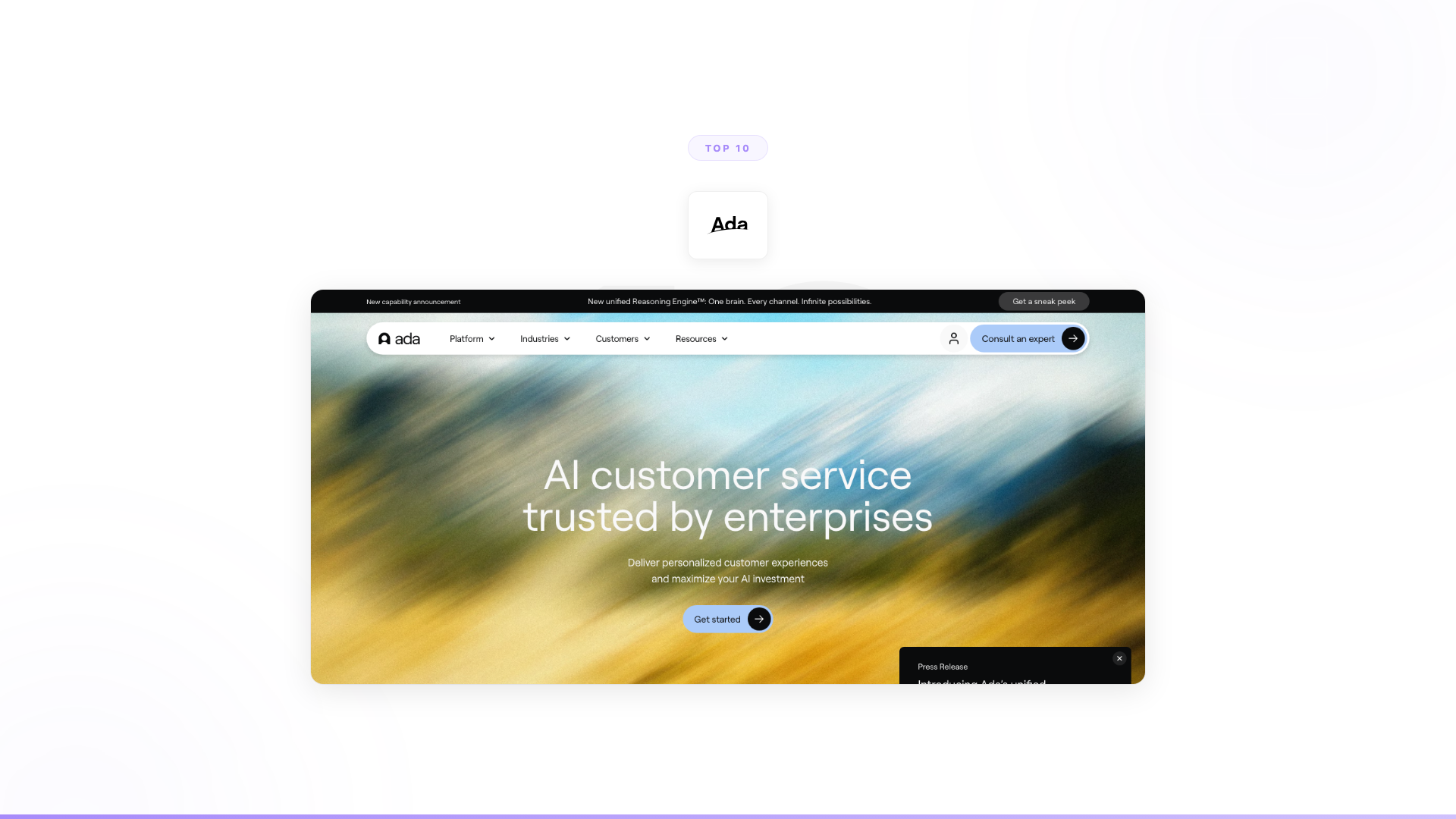
3. Ada
What it is: Customer service automation platform. Ada builds AI-powered chatbots that deflect tickets, resolve common inquiries, and reduce the load on human support agents. Strong NLU, multi-channel deployment, and recently expanded with "AI agent" capabilities and a reasoning engine.
What it handles: Conversation automation for customer support. Ada handles FAQ resolution, guided troubleshooting, ticket deflection, and routing. It is one of the most recognized tools in the customer service AI category, with solid conversation design and support-specific features. Ada is rated 4.6/5 on G2 across hundreds of enterprise reviews.
What it doesn't handle: The 90% behind the conversation. Ada resolves the dialogue — the customer asks, Ada answers. The operational work (multi-system validation, compliance checks, process execution, exception handling) stays with humans. Ada's newer "AI agent" features extend its reach within the CX domain, but the scope remains the conversation layer.
Pricing: Resolution-based pricing at $0.99 per resolution. Can scale into six figures for high-volume operations.
Best for: Support teams focused on ticket deflection and high-volume FAQ automation.
See our Ada alternatives guide →
4. Zendesk AI
What it is: Zendesk's native AI layer across its support platform. Includes AI agents for automated resolution, intelligent triage for ticket classification and routing, agent assist for human agent suggestions, and generative AI features. Built into the Zendesk ecosystem.
What it handles: AI-enhanced support within Zendesk. Auto-resolves simple tickets, routes complex ones to the right team faster, suggests responses to human agents, and summarizes ticket history. For Zendesk shops, it makes existing workflows smarter without adding another vendor. Zendesk reports that its AI features can automate resolution of up to 80% of common support interactions for customers already on its platform.
What it doesn't handle: Work outside the Zendesk ecosystem. Customer service involves CRM updates, inventory checks, compliance validation, cross-department coordination, and actions in systems Zendesk doesn't touch. Zendesk AI makes the Zendesk part better. The rest stays manual.
Pricing: Bundled with Zendesk plans. Advanced AI add-on available. Automated resolutions priced per-resolution.
Best for: Zendesk customers who want native AI without switching platforms or adding vendors.
5. Freshdesk Freddy AI
What it is: Freshworks' AI layer for its Freshdesk support platform. Freddy handles auto-resolution, ticket summarization, response drafting, sentiment analysis, and intelligent routing. The budget-friendly option in customer service AI.
What it handles: AI-enhanced support within Freshdesk at a lower price point than competitors. For teams that want capable AI without the enterprise price tag or implementation complexity, Freddy covers the essentials: auto-resolve simple tickets, suggest responses, classify and route. Freshdesk offers a freemium tier, making it one of the few AI customer service platforms accessible to small and mid-market teams without a procurement process.
What it doesn't handle: Same structural limitation as every other tool in this tier. Freddy makes Freshdesk smarter. It doesn't complete the work behind tickets. Better triage and faster auto-resolution are incremental improvements, not operational transformation.
Pricing: Included in Freshdesk Pro and Enterprise plans. Additional AI credits for higher usage. Freemium tier available for smaller teams.
Best for: Freshdesk customers who want affordable AI capabilities, and small-to-mid-market teams evaluating customer service AI without enterprise budgets.
6. Kore.ai
What it is: Enterprise conversational AI platform. Builds virtual assistants for customer support, IT helpdesk, and HR across multiple channels (web, mobile, voice, messaging apps). Named a Gartner Magic Quadrant Leader in Enterprise Conversational AI Platforms. More sophisticated conversation design than most competitors.
What it handles: Complex, multi-turn conversations across channels. Kore.ai's strength is conversation quality: nuanced intent recognition, contextual dialogue management, and enterprise-grade governance. For organizations that need sophisticated virtual assistants across voice and digital, it is one of the most capable platforms in the market. The Gartner recognition reflects its strong NLU capabilities and enterprise deployment track record.
What it doesn't handle: The conversation is still 10%. Kore.ai builds excellent conversations — more channels, better NLU, more complex dialogue flows. But the 90% of operational work behind those conversations remains untouched. A more sophisticated chatbot is still a chatbot.
Pricing: Enterprise licensing, typically $300K+ annually for large deployments.
Best for: Large enterprises needing multi-channel, multi-turn conversational AI with strong NLU and enterprise governance.
7. Forethought
What it is: AI platform for customer support focused on intelligent triage and automated resolution. Forethought classifies incoming tickets, predicts priority, routes to the right team, and auto-resolves cases matching known patterns. Works with existing helpdesk platforms (Zendesk, Salesforce, ServiceNow).
What it handles: The triage and routing layer. Forethought's strength is what happens between the customer submitting a request and a human working on it: faster classification, smarter routing, and resolution of tickets that match documented solutions. It makes the handoff between conversation and human work faster.
What it doesn't handle: The work itself. Forethought routes tickets to the right person faster. That person still has to pull up records, validate information, make decisions, and execute the resolution manually. Faster triage is valuable, but it optimizes the logistics of getting work to humans — not the work itself.
Pricing: Per-ticket pricing model.
Best for: High-volume support teams where triage bottlenecks and misrouting create measurable waste.
8. Yellow.ai
What it is: Conversational AI platform with broad multi-language (135+ languages) and multi-channel (35+ channels) support. Particularly strong in APAC, Middle East, and emerging markets. Includes voice AI capabilities and enterprise integrations.
What it handles: Multi-language, multi-channel conversation automation. Yellow.ai's differentiation is breadth: more languages, more channels, more geographic coverage than most competitors. For global operations serving customers across regions and languages, that breadth matters — particularly for organizations in markets underserved by English-first platforms.
What it doesn't handle: Language breadth doesn't change the category. Yellow.ai automates conversations in 135 languages. The operational work behind those conversations — the cross-system validation, decision logic, exception handling — stays manual in every one of them.
Pricing: Enterprise licensing with usage-based components.
Best for: Global enterprises with multi-language, multi-channel requirements, particularly in APAC and the Middle East.
9. Cognigy
What it is: Contact center AI platform. Cognigy automates voice and digital interactions for contact centers, with strong voice AI capabilities. Designed for large-scale contact center operations that handle both phone and digital support.
What it handles: The contact center conversation layer, including voice. Cognigy's strength is voice AI: automating phone-based customer interactions that other tools can't handle. For contact centers where phone support is a major channel, Cognigy addresses a gap that chat-only tools miss.
What it doesn't handle: Voice automation is still conversation automation. Whether a customer interacts by chat or phone, the operational work behind their request is the same: systems to check, data to validate, decisions to make, actions to take. Cognigy automates the conversation regardless of channel. The work behind it stays manual.
Pricing: Enterprise licensing based on interaction volume.
Best for: Contact centers with significant voice support volume that need AI across phone and digital channels.
Full Nexus vs Cognigy comparison →
10. Moveworks (ServiceNow)
What it is: AI-powered employee self-service assistant, now fully part of ServiceNow following its acquisition in 2023. Handles IT helpdesk requests: password resets, access provisioning, software requests, troubleshooting common IT issues. Strong at IT ticket deflection within the ServiceNow ecosystem.
What it handles: IT self-service, and it handles it well. For IT helpdesk tickets that follow known resolution patterns — reset my password, give me access to Salesforce, my VPN isn't working — Moveworks can both converse and execute. It resolves, not just deflects. Within the IT scope, it crosses into the operational work layer. Since the ServiceNow acquisition, roadmap investment has accelerated for organizations already in the ServiceNow ecosystem.
What it doesn't handle: Anything outside IT. Moveworks is purpose-built for employee IT requests within ServiceNow. Customer service, sales, compliance, HR operations, onboarding: all outside its scope. And now that it's fully part of ServiceNow, buying Moveworks means buying into that platform's ecosystem and roadmap.
Pricing: Per-employee licensing ($100–200/employee/year).
Best for: ServiceNow-native organizations where IT ticket deflection is the primary AI use case.
Full Nexus vs Moveworks comparison →
Intercom Fin vs Ada: Which AI Customer Service Tool Is Better?
This is one of the most common comparisons in the customer service AI category. Both tools charge $0.99 per resolution and target the same conversation automation use case. The decision usually comes down to your existing platform.
Choose Intercom Fin if:
- You're already using Intercom for customer messaging
- Your primary need is in-product support and SaaS customer success
- You want AI deeply integrated with your inbox, workflows, and conversation history
Choose Ada if:
- You need a platform-agnostic solution not tied to a specific vendor ecosystem
- Your primary need is high-volume FAQ deflection across web, mobile, and messaging
- Your support team requires no-code chatbot configuration without developer involvement
Both tools automate the conversation layer. Neither processes the work behind it — the CRM updates, compliance validation, cross-system actions that follow each interaction. At identical per-resolution pricing, the choice is primarily about ecosystem fit, not capability.
What Is the Cheapest AI Customer Service Tool?
Cost varies significantly by model:
- Freshdesk Freddy AI — Freemium tier available; included in Pro and Enterprise plans. Lowest total cost for teams already on Freshdesk.
- Intercom Fin and Ada — $0.99 per resolution. Cost scales directly with resolved conversation volume.
- Zendesk AI — Add-on to existing Zendesk plans. Total cost depends on your Zendesk tier.
- Forethought — Per-ticket pricing; cost depends on ticket volume.
- Yellow.ai and Cognigy — Enterprise licensing. Minimum commitment typically starts at five figures annually.
- Kore.ai — Enterprise licensing, typically $300K+ for large deployments.
- Moveworks (ServiceNow) — Per-employee pricing ($100–200/employee/year); cost tied to headcount, not usage.
- Nexus — Per-agent pricing tied to deployed workflows. Volume-independent: cost stays fixed as interaction volume scales.
For small and mid-market teams with limited budgets, Freshdesk Freddy AI is the strongest starting point. For enterprises where cost-per-resolution grows quickly with scale, per-agent pricing models become more favorable.
Can AI Replace Customer Service Teams?
The honest answer: it depends on which part of customer service you're asking about.
The conversation layer — answering questions, deflecting FAQ volume, routing inquiries — can be substantially automated today. Tools like Intercom Fin and Ada report resolution rates of 40–70% for straightforward interactions. Zendesk reports up to 80% automation for teams fully on its platform.
The operational work behind conversations is different. Validating data across systems, handling compliance requirements, coordinating cross-department exceptions, updating records across multiple platforms — this work requires integration, decision logic, and exception handling that most conversation tools don't provide.
The practical outcome for most enterprises: deploying conversational AI reduces the volume of simple tickets routed to humans but doesn't reduce headcount proportionally, because the same agents still handle all the operational work behind every remaining ticket. The easy questions leave. The work stays.
What changes that dynamic is AI that completes the workflow — not just the conversation. Organizations that have deployed autonomous workflow agents alongside conversation automation (or replacing it) report materially different results: Orange Group freed 40% of support capacity and improved conversion 50%, not by deflecting more tickets but by completing the work those tickets required.
The 10/90 Gap, Explained
Here's the honest truth about customer service AI in 2026: almost every tool on the market was designed around the conversation. That made sense five years ago, when the first challenge was handling customer interactions at scale without hiring linearly.
But conversation was always the easy part.
Think about what happens when a customer calls about a billing issue. The conversation — understanding the problem, looking up their account, explaining the resolution — takes 3–5 minutes. The operational work behind it (checking the billing system, cross-referencing with the CRM, validating against policy, processing the adjustment, updating records, triggering a confirmation) takes another 10–15 minutes. If there's an exception (partial refund, compliance review, cross-department escalation), it takes hours.
Most customer service AI automates the 3–5 minute conversation and leaves the 10–15 minutes — or hours — of operational work untouched.
That's why the ROI from chatbots plateaus. You deflect 40% of conversations. But the agents who used to handle those conversations still do 90% of the same operational work on the remaining tickets. The easy questions leave. The work stays.
The next phase of customer service AI isn't better conversations. It's completing the work behind those conversations — end-to-end, autonomously, across systems.
How to Choose the Right Tool
If your problem is conversation volume and nothing else: Pick the conversation tool that fits your ecosystem. Intercom Fin if you're on Intercom. Zendesk AI if you're on Zendesk. Freshdesk Freddy if you're on Freshdesk. Ada or Kore.ai if you need a platform-agnostic solution. These tools handle the 10% well. That's real value if the 10% is genuinely your bottleneck.
If your problem is multi-language or multi-channel gaps: Yellow.ai for language breadth, Cognigy for voice. These address specific coverage gaps in the conversation layer.
If your problem is ticket triage and routing: Forethought. Gets tickets to the right person faster. Doesn't do the work, but makes sure the right human does.
If you're evaluating IT self-service specifically: Moveworks (ServiceNow) handles IT helpdesk well and resolves — not just routes — common IT requests within the ServiceNow ecosystem.
If the problem is that customers and agents spend most of their time on the operational work behind conversations: That's the 90%. No conversation tool reaches it. You need agents that complete workflows, not conversations — agents that pull data from the CRM, validate against policy, make decisions, handle exceptions, and execute actions across systems, with embedded engineering support to actually reach production.
That's what Nexus does. Orange replaced a chatbot (27% drop-out rate) with agents that complete onboarding end-to-end. ~$6M+ yearly revenue. A European telecom freed 40% of support capacity — not by deflecting more tickets, but by completing the work those tickets were about.
Frequently Asked Questions
Q: What is the best AI tool for customer service?
The right answer depends on your bottleneck. For complete autonomous workflow execution — from conversation through resolution and system updates — Nexus ranks first. For AI-first in-product support, Intercom Fin is a popular choice for SaaS teams. For high-volume ticket deflection, Ada is purpose-built. For teams already on Zendesk, Zendesk AI adds AI capabilities within the existing platform. For enterprise IT self-service within ServiceNow, Moveworks is the leading option. For multi-language global support, Yellow.ai covers 135+ languages and 35+ channels.
Q: How much do AI customer service tools cost?
Pricing varies significantly by model. Intercom Fin and Ada both charge $0.99 per resolved conversation. Freshdesk Freddy AI has a freemium tier and is included in Freshdesk Pro and Enterprise plans. Zendesk AI is an add-on to existing Zendesk plans, priced per resolution. Kore.ai is typically $300K+ annually for enterprise deployments. Moveworks (ServiceNow) charges $100–200 per employee per year. Yellow.ai and Cognigy use enterprise licensing. Nexus uses per-agent pricing tied to deployed workflows — cost is fixed regardless of interaction volume.
Q: Can Zendesk AI handle customer service automatically?
Zendesk AI resolves common ticket types automatically within the Zendesk platform — answering questions, checking order status, and handling straightforward requests. Zendesk reports up to 80% automation for common interactions on its platform. Complex cases requiring cross-system validation, compliance checks, or multi-department coordination still route to human agents. It is best described as an AI enhancement layer for Zendesk's ticket workflow, not a standalone autonomous agent.
Q: Is Freshdesk Freddy AI worth using for small businesses?
Freshdesk Freddy AI is the strongest budget-friendly option on this list, with a freemium tier and tiered pricing that scales with usage. For small businesses or teams using Freshdesk as their primary support platform, Freddy AI provides ticket classification, suggested responses, and basic automation without enterprise pricing. The trade-off is scope — it operates within Freshdesk's ticket paradigm and doesn't complete cross-system workflows.
Q: What happened to Moveworks — is it still independent?
Moveworks was acquired by ServiceNow in 2023. It continues to operate as a product within the ServiceNow platform, focused on employee IT self-service. If you're evaluating Moveworks today, you're buying into the ServiceNow ecosystem — which means accelerating roadmap investment if you're already a ServiceNow customer, and significant platform commitment if you're not.
Worth Exploring?
Every Nexus engagement starts with a 3-month proof of concept tied to measurable outcomes. Forward Deployed Engineers embed with your team from day one. You see the results before committing. You can exit anytime.
100% of clients who started a POC converted to an annual contract.
Talk to our team, 15 minutes →