How to Build AI Applications for Enterprise (2026 Guide)
Most enterprise AI projects fail in the gap between prototype and production. This guide covers what it actually takes to build AI applications that deliver business outcomes, not just demos.
To build AI applications for enterprise, follow six steps: start with a specific measurable business process, map the full workflow including exceptions and compliance requirements, choose your development approach honestly (developer frameworks, visual builders, or an agent platform with embedded engineers), plan for the production gap before prototyping, measure business outcomes rather than technical metrics, and design for scale from your first deployment.
According to MIT's NANDA initiative, 95% of generative AI pilots at enterprises fail to achieve meaningful business impact. Gartner predicts over 40% of agentic AI projects will be canceled by end of 2027 due to escalating costs, unclear business value, and inadequate risk controls. The problem is rarely the AI technology. It's everything else: governance, compliance, integrations, infrastructure, organizational change, and accountability for outcomes.
This guide covers what it actually takes to build AI applications for enterprise — not just the technology, but the full picture from identifying the right use case through production deployment.
Step 1: Define the business process before choosing technology
The most common mistake is starting with the technology. "We should build a chatbot." "We need a RAG system." "Let's deploy an AI agent." These are solutions looking for problems.
The enterprises that succeed start with a specific business process that has clear, measurable inefficiency. Not "customer support could be better." Something concrete: "Customer onboarding takes 3 days because sales reps manually validate data across 4 systems, check compliance requirements, and create accounts. That manual process costs us X hours per week and has a Y% error rate."
What a good use case looks like:
- The process has high volume (hundreds or thousands of executions per month)
- It involves repetitive judgment calls, not just rule-following
- It touches multiple systems that require manual data transfer
- The business impact is quantifiable (revenue, cost, time, error rate)
- Someone specific owns the process and cares about improving it
What a bad use case looks like:
- It's chosen because it sounds impressive, not because it has clear ROI
- The process is poorly defined even for humans
- Success is hard to measure ("make employees more productive")
- Nobody owns the outcome
- It's chosen because the technology can do it, not because the business needs it
A good use case has clarity before the first line of code or the first platform evaluation. That clarity determines whether the deployment delivers business outcomes or just a demo that gets quietly deprioritized.
Step 2: Map the full workflow including exceptions and compliance requirements
Most prototypes succeed because they only handle the clean, predictable parts of a business process. Real processes have exceptions, edge cases, and human judgment moments that prototypes ignore.
Before building anything, map the entire process:
- Every step from trigger to resolution. Not just the steps AI will handle. The full process, including the human steps before and after the AI application.
- Every system involved. CRM, ERP, ticketing, communication platforms, databases, spreadsheets, email. Real business processes touch more systems than anyone initially estimates.
- Every exception. What happens when data is missing? When a customer request doesn't fit the standard flow? When two systems disagree? When approval is needed? Exception paths often represent 30 to 50% of the real workload.
- Every compliance requirement. Audit trails, data handling rules, regulatory requirements, internal policies. These aren't features you add later. They shape the architecture from day one.
- Every stakeholder. Who currently does this work? Who approves decisions? Who gets escalations? Who measures success? Organizational change is harder than technical change.
The 80/20 trap: Teams often prototype the 80% of cases that are straightforward, declare success, and discover that the remaining 20% of cases (exceptions, edge cases, compliance requirements) represent 80% of the actual deployment effort. If your prototype handles the easy cases and you plan to "handle exceptions later," you're planning to do the hard part of the project after committing resources.
The straightforward cases — clean data, clear signals — are easy to automate. The value in enterprise AI applications comes from handling the messy cases: incomplete data, conflicting signals, new information that changes a previous assessment. That exception-handling capability is what separates a useful prototype from a production application. It's also the part that no prototype covers.
Step 3: Choose your AI development approach: frameworks, visual builders, or agent platform
There are fundamentally three approaches to building AI applications for enterprise. Each has real tradeoffs, and the right choice depends on your actual constraints, not your aspirations.
Approach A: Build with LangChain, LangGraph, or CrewAI
Tools: LangChain, LangGraph, CrewAI, Haystack, custom code.
What you need: A dedicated engineering team with AI/ML experience. 3 to 6 months for a first production deployment. Ongoing engineering capacity for maintenance, monitoring, and iteration. Internal DevOps for infrastructure. Internal expertise for security, compliance, and governance.
When it works: You're building AI as a core product feature. Your engineering team has capacity. The use case is unique enough that no existing platform handles it. You have the organizational patience for a multi-month development cycle.
When it breaks: The engineering team is pulled to other priorities. The prototype works but production deployment stalls. Governance and compliance become a separate project on top of the engineering work. One engineer becomes the "AI person" and knowledge concentrates in their head. The second AI application requires the same engineering effort as the first.
Honest assessment: Building from scratch gives you maximum control and maximum burden. For most internal business process use cases — not product features — the opportunity cost of engineering time exceeds the value of that control. A Gartner survey found 77% of engineering leaders identify AI integration as a major challenge, even when building with capable frameworks.
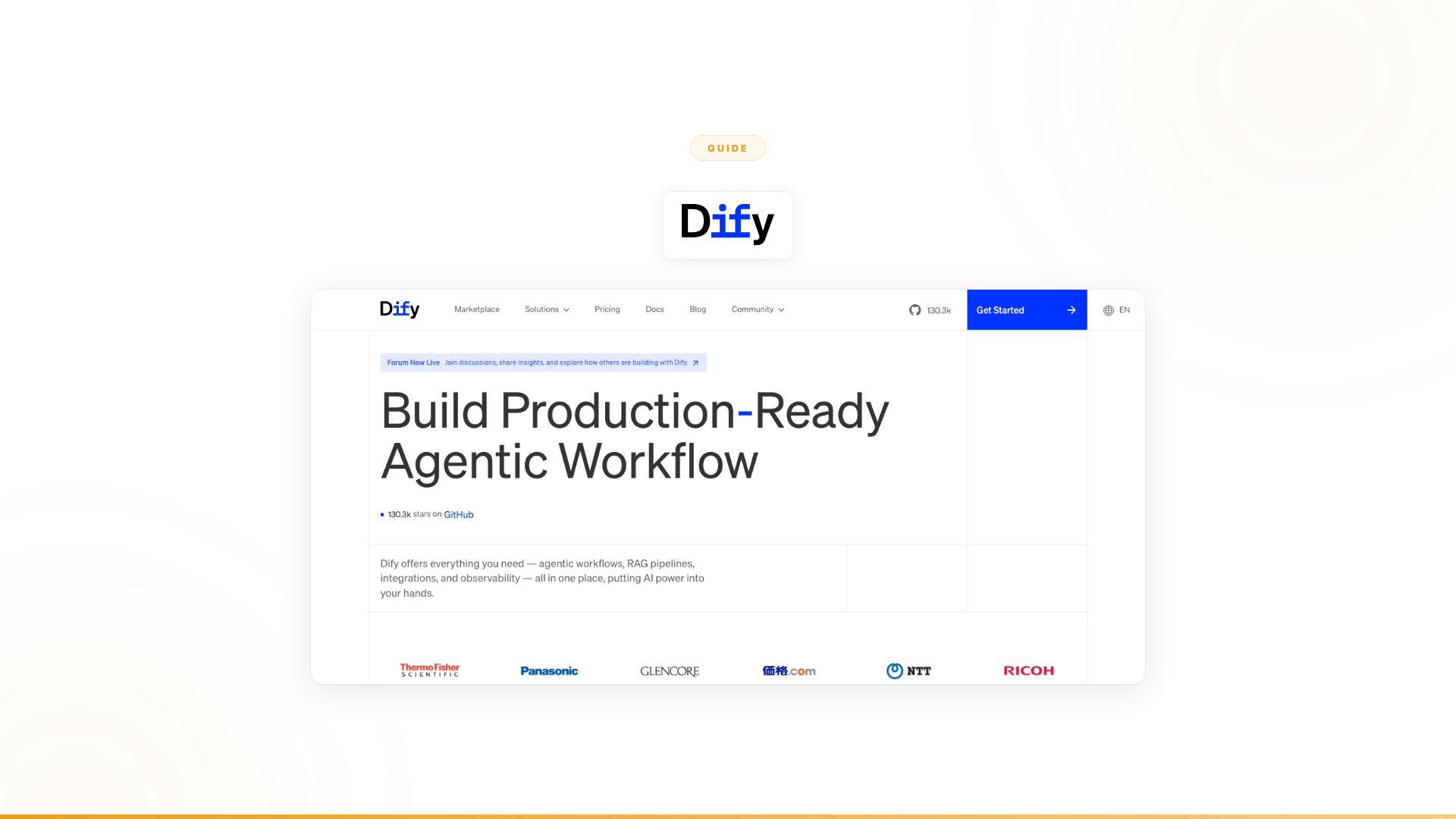
Approach B: Use visual builders like Dify or Copilot Studio
Tools: Dify, Flowise, Microsoft Copilot Studio, n8n with AI nodes, Relevance AI.
What you need: Developers comfortable with the platform (less engineering than Approach A). Infrastructure management for self-hosted tools. Weeks to months for production deployment, depending on complexity.
When it works: The use case is bounded (single chatbot, simple agent, one workflow). Your team wants to validate an idea before committing significant resources. The AI application doesn't need deep multi-system integration or complex exception handling.
When it breaks: The visual builder hits a constraint that requires custom code anyway. Production hardening (security, compliance, monitoring) takes as long as it would have with a framework. The platform's limitations shape the solution more than the business requirements do.
Honest assessment: Visual builders are excellent for prototyping and bounded use cases. They create an illusion of simplicity by solving the easy part fast and deferring the hard part. For enterprise production, the hard part still comes. It just comes later and with less flexibility to address it.
Approach C: Deploy with an enterprise agent platform and embedded engineers
Tools: Nexus (with Forward Deployed Engineers).
What you need: A clear business process to automate. A business team that understands the process. Willingness to start with a 3-month POC tied to measurable outcomes.
When it works: The business process is well-defined and high-volume. Governance and compliance are requirements. Business teams need to own the agents without engineering dependency. You need someone accountable for deployment outcomes, not just software. You want to see ROI before committing.
When it breaks: You want full code-level control over agent architecture. AI is your core product, not internal tooling. You have surplus engineering capacity and want to build for the sake of building.
Honest assessment: This approach trades control for speed, outcomes, and reduced burden. You don't own the platform. You own the outcomes. For most enterprise internal use cases, that's the right tradeoff.
Step 4: Plan for the production gap — what happens between demo and deployment
The production gap is everything between "it works in a demo" and "it runs a business process reliably at scale." Most teams don't plan for it until they're already in it. By then, commitments have been made and timelines have slipped.
Gartner identifies the production gap as the primary reason over 40% of agentic AI projects get canceled: organizations are blinded by early-stage experiments to the real cost and complexity of deploying at scale.
Here's what the production gap actually includes:
Infrastructure and operations
- Hosting and scaling. Your AI application needs to handle production load. For self-hosted tools, that means Kubernetes or equivalent, database management, vector database maintenance, and monitoring.
- Reliability. What happens when the LLM API is slow? When a dependent system is down? When memory usage spikes? Production applications need retry logic, circuit breakers, fallback behavior, and alerting.
- Cost management. LLM API costs at scale are non-trivial. A prototype making 100 calls/day costs little. A production application making 100,000 calls/day costs real money. Token optimization and caching matter.
Security and compliance
- Data handling. Where does customer data flow? Which systems does the AI application access? How is PII handled? These questions require specific answers, not "we'll figure it out."
- Audit trails. In regulated industries, every AI decision needs to be traceable. Who asked what, what data was accessed, what decision was made, why. Building this after the fact is architecturally painful.
- Certifications. SOC 2, ISO 27001, GDPR, industry-specific regulations. Self-managed compliance is a project in itself — one that runs parallel to AI development and never finishes.
- Access controls. Who can use the AI application? Who can modify its behavior? Who can see its outputs? Role-based access that integrates with your organization's identity management.
Integrations and data
- Enterprise system connections. CRMs, ERPs, ticketing systems, communication platforms, databases, file storage. Each integration needs to be built, tested, and maintained. When the CRM updates its API, your integration might break.
- Data quality. Prototypes use clean sample data. Production processes use messy real data. Missing fields, inconsistent formats, duplicate records, stale information. The AI application needs to handle all of it gracefully.
- Real-time vs. batch. Does the application need data in real time (live CRM lookup during a customer interaction) or batch (nightly sync of documents)? The answer affects architecture, cost, and complexity.
Organizational adoption
- Change management. The people currently doing this work manually need to trust and use the AI application. This isn't a training session. It's a cultural change that requires ongoing support.
- Feedback loops. How do users report when the AI gets something wrong? How are corrections fed back into the system? Without feedback loops, the AI application's quality degrades over time.
- Stakeholder alignment. IT, compliance, the business team, leadership. Each has different concerns. Alignment isn't a one-time meeting. It's continuous communication throughout deployment.
This is why enterprises with more resources and more engineering talent than most still choose deployment partners over the build-it-yourself path. The production gap is the hard part, and closing it requires more than software.
Step 5: Measure business outcomes, not technical metrics
The metrics that matter for enterprise AI applications aren't technical. They're business outcomes.
Don't measure:
- Number of API calls
- Response latency (unless it's a customer-facing application)
- Model accuracy on test data
- Number of features shipped
Do measure:
- Revenue impact
- Time saved (hours of manual work displaced per month)
- Process completion rate (what percentage of cases does the AI resolve autonomously?)
- Error reduction (how many exceptions does the AI handle correctly vs. incorrectly?)
- Adoption rate (are the people who should be using it, using it?)
- Cost displacement (what capacity has been freed for higher-value work?)
- Time to value (how long from start to measurable production impact?)
Tie your AI application to specific, measurable outcomes before you start building. Not after. If you can't articulate the expected business impact in concrete terms, the use case isn't ready.
This is why the most disciplined enterprise AI deployments start with a proof of concept tied to defined outcomes rather than a broad "AI transformation" initiative. You see the math. If it doesn't work, you exit. If it works, you have proof to expand.
Step 6: Plan for scale before your first deployment
The first AI application is always the easiest. It's the second, fifth, and tenth that reveal whether your approach scales.
Questions to answer before starting:
- Who maintains the AI applications? If the answer is "our engineering team," every new application competes with product development for engineering time. That bottleneck gets worse, not better, as you scale.
- Does governance scale? Audit trails, compliance, access controls. If these are custom-built for each application, you're multiplying compliance work with every deployment.
- Can non-engineers iterate? When the business process changes (it will), can the business team adjust the AI application, or does every change go through an engineering queue?
- What's the integration maintenance burden? One application connected to 5 systems is manageable. Ten applications connected to 50 systems is a full-time integration engineering role.
Scalable AI deployment looks like this: the fifth agent is as easy to deploy as the first. Non-technical teams own the applications. No engineering queue. No integration maintenance burden accumulating with every new use case. Adding the next agent doesn't multiply the engineering burden.
Gartner predicts 40% of enterprise applications will embed task-specific AI agents by end of 2026, up from less than 5% in 2025. That growth only creates business value for organizations whose deployment model scales — not for those rebuilding governance, integrations, and maintenance from scratch for every new application.
The honest summary
Building AI applications for enterprise is harder than the vendor demos suggest. Not because the AI doesn't work. It does. The hard part is everything around the AI: governance, compliance, integrations, infrastructure, organizational change, maintenance, and scaling.
The teams that succeed tend to share three characteristics:
- They start with a specific, measured business process. Not "let's use AI." Something concrete with quantifiable impact.
- They plan for the production gap before prototyping. Security, compliance, integrations, adoption. These shape architecture from day one, not as afterthoughts.
- They're honest about their constraints. Engineering capacity, timeline, organizational readiness. The approach that matches their real constraints — not their aspirational ones — is the one that delivers.
For teams with strong engineering resources building AI as a product feature, frameworks like LangChain or LangGraph give you the control you need. For teams validating ideas quickly, visual builders like Dify get you a prototype fast. For enterprises that need AI applications completing critical business processes in production — with governance, compliance, and someone accountable for outcomes — that's a different problem that requires a different approach.
The question isn't whether AI can work for your business. It can. The question is which path gets you from "AI can work" to "AI is working" with the least risk and the fastest time to value.
FAQ: Building AI applications for enterprise
What is the "production gap" in enterprise AI application development?
The production gap is everything between a working demo and a deployed production application: hosting and scaling infrastructure, security and compliance certifications (SOC 2, ISO 27001, GDPR), enterprise system integrations, data quality handling, and organizational adoption. Gartner predicts over 40% of agentic AI projects will be canceled by end of 2027 primarily because of this gap — organizations pursue early-stage prototypes without planning for the real cost and complexity of deploying at scale.
Should I use LangChain, Dify, or an agent platform for enterprise AI?
LangChain and LangGraph give maximum control but require 3–6 months and dedicated AI engineering capacity. Dify and Copilot Studio enable faster prototyping but defer the hard production challenges. Enterprise agent platforms with embedded engineers deliver production outcomes faster, with governance and integrations included. The right choice depends on whether AI is a core product feature you're building (use frameworks) or a business workflow you need running in production (use a platform).
Why do so many enterprise AI pilots fail to reach production?
MIT's NANDA initiative found 95% of generative AI pilots fail to achieve meaningful business impact. The primary causes: compliance and governance requirements deferred until post-prototype, integration complexity across 10+ enterprise systems, organizational change management underestimated, and no accountability for deployment outcomes. Prototypes handle the predictable 80% of cases; the messy 20% — exceptions, compliance edge cases, data quality issues — stops most deployments.
How do I identify the right use case for my first enterprise AI application?
A good use case has: high volume (hundreds or more monthly executions), repetitive judgment calls that currently require expert time, multiple systems requiring manual data transfer, quantifiable business impact (revenue, cost, time), and an internal owner accountable for improving it. A bad use case sounds impressive but has unclear ROI, no clear owner, or is poorly defined even for current human execution. If you can't articulate the expected business outcome in concrete terms before building, the use case isn't ready.
What metrics should I use to evaluate an enterprise AI application?
Measure business outcomes, not technical metrics. The right measures are: revenue impact, time saved (hours displaced per month), process completion rate (percentage of cases resolved autonomously), error reduction, user adoption rate, cost displacement, and time to value. Technical metrics like API call counts, latency, or model accuracy on test data don't reflect whether the application is delivering business value.
Worth exploring?
If your team has been working on AI applications and the challenge has shifted from "can we build this?" to "how do we get this into production delivering measurable business outcomes?", it might be worth a conversation.
Every Nexus engagement starts with a 3-month proof of concept. Forward Deployed Engineers embed with your team. Specific outcomes are defined before you start. You see the results before committing. You can exit anytime.
See the full Nexus vs Dify comparison -->
Related reading
- Top 10 AI Application Development Platforms for Enterprise
- Top 10 Dify Alternatives for AI App Development
- Dify vs LangChain: AI Development Platforms Compared
- Top 10 LangChain Alternatives for AI Agents
- Nexus vs Dify: full comparison
- Nexus vs LangChain: full comparison
- How to Build AI Agents for Enterprise: Build vs Buy Guide