How to Automate Sales Development with AI Agents (2026 Guide)
A practical guide to automating the full sales development workflow — from AI SDR email tools to autonomous account intelligence. Covers the 3-stage progression, 6-step implementation guide, and proof points from enterprise deployments.
To automate sales development with AI agents, progress through three stages: manual SDR work, AI SDR tools (email automation), and autonomous sales intelligence (account monitoring, buying signal detection, pipeline management). Start by mapping the full sales workflow — most teams find 75%+ of time goes to research and administration, not outreach. Automating the intelligence layer first delivers the highest return on investment.
The teams producing the best outcomes from AI in sales development are not just automating email. They're automating the entire intelligence layer: account research, buying signal detection, competitive analysis, qualification, and pipeline management. This guide covers the full progression, with practical steps at each stage and proof points from enterprise deployments.
3 stages of AI in sales development: manual, AI SDR, autonomous intelligence
Stage 1: Manual SDR work — where most teams start
This is where most organizations start, and where many still are.
Human SDRs research accounts manually. They scroll through LinkedIn, read company websites, check CRM notes, and scan news articles. Then they write personalized emails — one at a time or in bulk with basic templates — handle responses, qualify leads, book meetings, update the CRM, and repeat.
The math is straightforward: a typical SDR dedicates only 30% of their workday to active selling, with approximately 37% spent on prospect research alone, according to SDR benchmark data from SalesSo and MarketsandMarkets. The rest goes to writing, sending, responding, and administrative tasks. Hiring more SDRs scales linearly: double the headcount, double the output, double the cost.
The problem is not effort. It is ceiling. Manual SDR work hits a hard limit on volume, consistency, and intelligence. No human can monitor 12,000 accounts for buying signals. No SDR team can synthesize competitive movements across an entire market in real time. The work that makes outreach effective — deep account intelligence — is the work that does not scale with headcount.
Stage 2: AI SDR tools — what they automate and where they stop
This is where most teams go first, and it is a meaningful step.
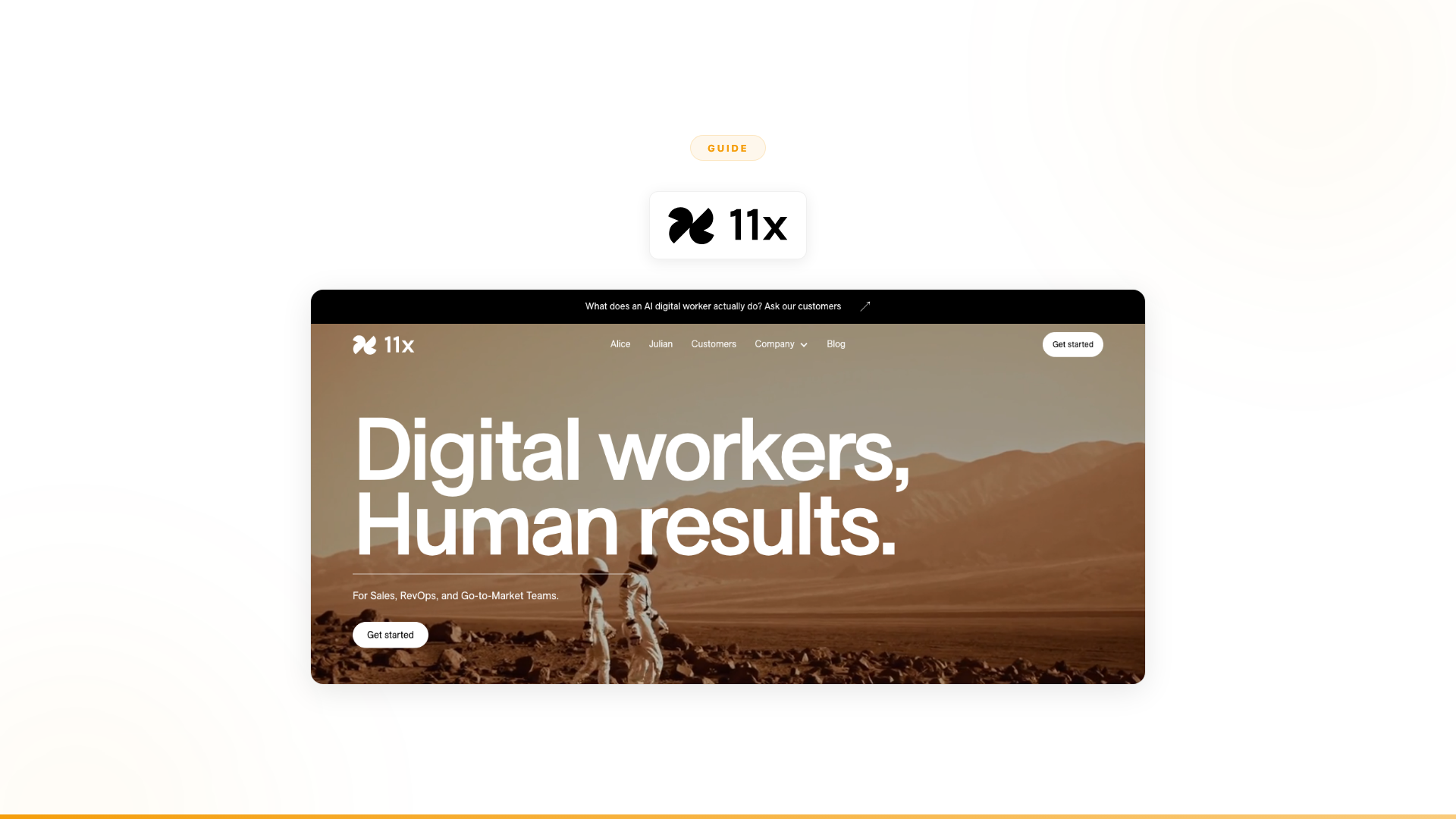
Tools like 11x (Alice), Artisan (Ava), Amplemarket, and others automate the outbound motion. Define your ICP. The AI finds matching prospects, writes personalized sequences, sends emails, handles follow-ups, and books meetings. Volume goes up. SDR time on manual outreach goes down.
Sales teams using AI automation save an average of 12 hours per rep per week, and automated teams are 14.5% more productive overall, according to MarketsandMarkets research. The AI SDR market itself is projected to grow from $4.12 billion in 2025 to $15.01 billion by 2030 at a 29.5% CAGR, according to ResearchAndMarkets.
What you gain: More outbound volume. Faster time-to-first-meeting. Less manual email writing. Basic personalization at scale.
What you do not gain: Account intelligence. Deep research. Competitive analysis. Qualification beyond basic scoring. Pipeline management. Post-meeting deal progression. Customer onboarding. Support integration. Cross-department visibility.
AI SDR tools automate one step: the email. Everything before — research, targeting strategy, signal detection — and everything after — qualification, pipeline, onboarding, retention — stays manual or requires separate tools. This is why teams that deploy AI SDRs often report a burst of meetings followed by a plateau: meetings increase, but the rest of the process has not changed.
Stage 3: Autonomous sales intelligence — from email to full pipeline intelligence
This is where the transformation actually happens.
Instead of automating the email step, you automate the intelligence layer. AI agents monitor thousands of accounts continuously, synthesizing buying signals from multiple sources: news, earnings, job postings, technology changes, competitive movements, leadership transitions, and intent data from platforms like 6sense, Bombora, and G2. They qualify opportunities against your specific criteria and surface the highest-priority targets with context that makes outreach meaningful, not just personalized.
Because the intelligence runs on a platform rather than a single-purpose tool, it connects to everything else. The same foundation powering sales intelligence also handles customer onboarding, support triage, compliance monitoring, and marketing operations. Each agent makes the system smarter. The data compounds. The integrations serve every use case.
According to Gartner, by 2028 AI agents will outnumber sellers by 10x. By 2027, 95% of seller research workflows will begin with AI, up from less than 20% in 2024. Organizations deploying AI in their sales pipelines report a 20% increase in pipeline volume and a 30% improvement in lead conversion rates, according to MarketsandMarkets.
This is the difference between automating email and transforming how a revenue organization works.
Case study: how Lambda built autonomous sales intelligence
Lambda is an AI infrastructure company serving tens of thousands of customers — hyperscalers, enterprises, and research institutions. Their engineering team is world-class. AI is their business. If any organization could build sales automation internally, Lambda could.
Their leadership considered it. But the opportunity cost was too high. Every hour spent on internal sales tooling was an hour not spent on core AI infrastructure product. They chose Nexus instead.
Joaquin Paz, Lambda's Head of Sales Intelligence, built their first agent on Nexus. He has no engineering background. Here is what he built:
AMO Enterprise Evolution: An autonomous agent that monitors 12,000+ enterprise accounts. It synthesizes buying signals from multiple sources — leadership changes, funding rounds, tech stack shifts, competitive movements, expansion signals, hiring patterns — then analyzes each account against Lambda's qualification criteria and surfaces the highest-priority opportunities with deep context.
The results (Nexus client data):
- 12,000+ accounts monitored continuously. Not a static list. Living intelligence that updates as signals emerge.
- $4B+ in cumulative pipeline identified across accounts Lambda was not actively monitoring. Not more emails sent. More pipeline discovered.
- 24,000+ hours of research capacity added annually. That is the equivalent of 12 full-time analysts, delivered by one platform, built by one non-engineer.
- Days to first production agent. Not months. Not quarters.
What happened next: Lambda is now building an agent fleet across sales and marketing — stakeholder mapping, competitive positioning, campaign automation, event management. Anticipated value: more than $7M by 2026 (Nexus client data). All on the same platform, each new agent building on the integrations the first one established.
Lambda's story is not about sending more emails. It is about building a sales intelligence system that monitors an entire market and surfaces opportunities that human effort would miss. That is the difference between Stage 2 and Stage 3.
How to automate sales development with AI: 6-step guide
Step 1: Map your full sales development workflow
Before choosing any tool, map every step in your current process. Not just outbound. The full cycle.
| Step | What happens today | Who does it | Time spent weekly |
|---|---|---|---|
| Account identification | Manual research, list building | SDRs, ops | ___ hours |
| Account research | LinkedIn, websites, news, CRM | SDRs | ___ hours |
| Signal detection | Ad hoc, inconsistent | SDRs, leadership | ___ hours |
| Outbound sequencing | Email writing, follow-ups | SDRs | ___ hours |
| Response handling | Reply management, qualification | SDRs | ___ hours |
| Meeting booking | Scheduling, prep | SDRs | ___ hours |
| Pipeline management | CRM updates, deal tracking | AEs, ops | ___ hours |
| Competitive intelligence | Manual research, shared docs | Various | ___ hours |
| Post-sale handoff | Onboarding, support transition | AEs, CS | ___ hours |
Most teams that complete this exercise discover that outbound email represents 15–25% of the total SDR workflow. Research, qualification, pipeline management, and handoff consume the remainder. Automating only the email step leaves 75% or more of the process untouched.
Step 2: Identify where intelligence matters most
Not all automation is equal. Some steps are simple and repetitive — sending follow-up emails on a schedule. Others require judgment, context, and synthesis — determining whether an account is in-market based on a pattern of signals across multiple data sources.
High-value intelligence work (where AI agents deliver the most impact): monitoring thousands of accounts for buying signals, synthesizing information from multiple sources, qualifying against complex criteria, identifying competitive threats, connecting signals across the revenue cycle, and integrating intent data from providers like 6sense and Bombora.
Low-value repetitive work (where basic automation is sufficient): sending follow-up emails on a schedule, updating CRM fields, routing inbound leads on simple rules, scheduling meetings.
If your plan automates only the low-value work, the highest-impact opportunities remain untouched.
Step 3: Evaluate your options honestly
Based on your workflow map, there are three paths:
Path A: AI SDR tool (Stage 2). You deploy 11x, Artisan, or Amplemarket. It automates outbound email. Fast to deploy, measurable in weeks. Trade-off: you are automating one step. When you need more, you buy more tools. The stack grows linearly. See the full AI SDR tool comparison for a detailed breakdown.
Path B: Sales execution platform. You deploy Outreach or Salesloft. Broader coverage: sequences, pipeline, conversation intelligence, forecasting. Still sales-only and human-driven. Trade-off: AI assists. It does not complete workflows autonomously.
Path C: Autonomous agent platform (Stage 3). You build agents on Nexus that handle the full workflow — account intelligence, outbound, qualification, pipeline, onboarding, support. Business teams own the agents. Forward Deployed Engineers ensure deployment delivers. Trade-off: bigger initial scope. But every agent compounds. Lambda started with one. Now they are building a fleet with $7M+ anticipated value.
Step 4: Start with your highest-impact workflow
Whichever path you choose, start with the workflow that has the most measurable impact.
For most sales organizations, that is not outbound email volume. It is account intelligence — the research, signal detection, and qualification that determine whether outbound actually reaches the right accounts at the right time. This work consumes the most SDR hours, scales the worst with headcount, and has the biggest impact on pipeline quality.
Lambda started here. Not "send more emails" — instead, "monitor 12,000 accounts and identify which ones are ready to buy, and why." The $4B+ in pipeline discovered was not from increased outbound volume. It was from identifying opportunities that manual research could not find.
Step 5: Measure what matters
| Metric | AI SDR tools measure | Autonomous intelligence measures |
|---|---|---|
| Volume | Emails sent per day | Accounts monitored continuously |
| Activity | Meetings booked | Pipeline discovered |
| Efficiency | Cost per meeting | Research hours replaced |
| Quality | Reply rate | Qualification accuracy |
| Compounding | Linear (more emails = more meetings) | Exponential (each agent adds intelligence) |
AI SDR tools optimize activity volume. Autonomous intelligence optimizes decision quality. One compounds. The other does not.
McKinsey research indicates that AI can increase sales leads by 50% and reduce sales costs by 60% when applied to the full intelligence layer — not just outbound email. Organizations that consolidate their sales technology stack see a 15% increase in sales productivity and a 20% reduction in costs (McKinsey, 2025).
Step 6: Plan for expansion
The teams getting the most from AI in sales development plan beyond the first deployment.
Lambda started with one sales intelligence agent monitoring 12,000+ accounts. They added deep research agents for stakeholder mapping and competitive positioning. Now they are expanding to marketing operations agents for campaign automation. Same platform, same integrations, same institutional knowledge. Anticipated value: $7M+ by 2026.
Compare that with point tools: AI SDR (vendor 1), data enrichment (vendor 2), intent data (vendor 3), sales execution (vendor 4), support automation (vendor 5). Five vendors, five contracts, five data silos, zero compounding.
On a platform, each agent makes every other agent more effective. With point tools, each new vendor adds cost without making anything else smarter.
What the full picture looks like in production
Lambda (AI infrastructure, 12,000+ enterprise customers): 12,000+ accounts monitored. $4B+ pipeline identified. 24,000+ hours of research capacity added annually. Non-engineer builder. Agent fleet expanding across sales and marketing. $7M+ anticipated value. (Nexus client data)
Orange Group (multi-billion euro telecom, 120,000+ employees): Customer onboarding agents deployed across multiple European markets. 50% conversion improvement. ~$6M+ yearly revenue impact. 4-week deployment. 100% team adoption. (Nexus client data)
European telecom (13,000+ employees): 40% support volume freed across millions of interactions. A dozen agents deployed in 12 weeks, after 6 months with another platform that could not deliver. (Nexus client data)
European consulting firm (400+ employees): Five agents across the full engagement lifecycle — interviews, CV generation, project matching, proposals, and HR. Proposal turnaround reduced from days to hours. (Nexus client data)
The common pattern: None started with "we need an AI SDR." They started with "we need AI that works." They ended up with a platform that handles everything.
FAQ: Automating sales development with AI agents
What is the difference between an AI SDR tool and autonomous sales intelligence?
AI SDR tools (11x, Artisan, Amplemarket) automate outbound email: finding prospects, writing sequences, booking meetings. Autonomous sales intelligence automates the full intelligence layer — monitoring thousands of accounts for buying signals, synthesizing competitive data, qualifying opportunities, and managing pipeline. AI SDR tools address one step in the workflow. Autonomous intelligence addresses the entire revenue cycle.
Do I need an AI SDR tool before moving to autonomous intelligence?
No. You can start directly at Stage 3. Lambda did not deploy an AI SDR first. They went straight to autonomous sales intelligence on Nexus. The progression from Stage 1 to Stage 2 to Stage 3 is a common path, but it is not required. If your needs go beyond outbound email, starting on a platform avoids migration cost later.
How long does it take to deploy an autonomous sales intelligence agent?
Lambda's first agent was in production within days. Orange deployed customer onboarding agents in 4 weeks. Most enterprise proofs of concept on Nexus go live within 2 to 6 weeks, with Forward Deployed Engineers handling integration and configuration alongside your team. Every engagement starts with a 3-month proof of concept tied to measurable outcomes.
Does my team need engineering skills to build agents?
No. Lambda's Head of Sales Intelligence, who built an agent monitoring 12,000+ accounts and surfacing $4B+ in pipeline (Nexus client data), has no engineering background. Nexus is designed for business teams. Forward Deployed Engineers handle technical complexity.
How does autonomous sales intelligence connect to existing CRM and sales systems?
Nexus provides 4,000+ integrations — CRMs (Salesforce, HubSpot), ERPs, communication platforms (Slack, Teams, WhatsApp, email, phone, web), ticketing systems, and custom APIs. No rip-and-replace required. The intelligence layer sits on top of your existing stack and writes back into your CRM as signals are identified. See Nexus vs 11x for a side-by-side integration comparison.
Automate email or automate intelligence: which delivers more ROI?
Automating sales development with AI is not about sending more emails. It is about building intelligence that compounds.
AI SDR tools deliver more outbound volume. Autonomous sales intelligence delivers something different: a system that monitors your entire market, surfaces opportunities you would otherwise miss, and connects sales to every function that touches revenue.
Gartner projects that by 2028, AI agents will outnumber sellers by 10 to 1. The organizations winning that transition are not the ones who deployed AI SDR email tools in 2024. They are the ones who automated the intelligence layer — and built a foundation that every subsequent deployment compounded on top of.
The question is not whether to automate sales development. It is how far you are willing to go.
Worth exploring?
Every Nexus engagement starts with a 3-month proof of concept tied to measurable outcomes. Forward Deployed Engineers embed with your team from day one. You see results before committing. You can exit at any time.
100% of clients who started a proof of concept converted to an annual contract.
See how Lambda built autonomous sales intelligence →